An AI story generator is a tool that uses artificial intelligence to help writers and creators develop story ideas, characters, plots, dialogue, and complete narratives from simple prompts. It can support brainstorming, overcome writer’s block, speed up early drafts, and help creators explore multiple story directions. The strongest results come when AI supports—not replaces—human imagination, judgment, emotion, and cultural understanding.
How AI Story Generators Are Changing Modern Storytelling
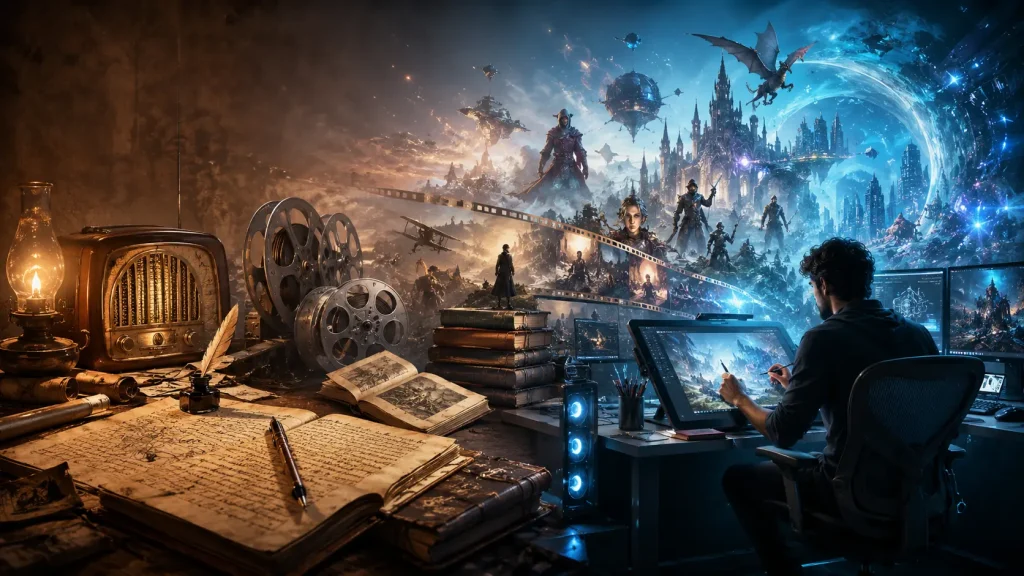
Storytelling has always evolved alongside technology. Books expanded how stories could travel, radio introduced voice-led narratives, cinema added visual expression, and digital platforms made it possible for almost anyone to publish and share stories with a global audience.
Artificial intelligence is now adding another layer to that evolution.
An AI story generator can help writers move from a rough idea to a more developed narrative by assisting with brainstorming, plot development, character creation, dialogue, and drafting. Instead of staring at a blank page, creators can give the AI a starting point and use its suggestions to explore possible directions.
For example, a writer might begin with a simple prompt such as:
“Create a mystery story about a journalist who discovers an abandoned railway station in a small Indian town.”
From that prompt, an AI story creator may suggest a setting, characters, conflicts, plot twists, and even a possible ending. The writer can then keep, reject, rewrite, or expand those ideas.
This can be useful when creators struggle with common challenges such as:
- Finding fresh story ideas
- Developing believable characters
- Structuring a plot
- Writing dialogue
- Maintaining narrative consistency
- Exploring different genres
- Producing stories more efficiently
AI can also help creators experiment. A single concept can be rewritten as a thriller, comedy, romance, fantasy, or children’s story without rebuilding everything from the beginning.
However, faster generation does not automatically mean better storytelling.
A memorable story still depends on human choices: what the story means, why a character matters, which emotions should be emphasized, what cultural details feel authentic, and what the audience should remember after the story ends.
For that reason, AI works best as a creative assistant rather than an autonomous storyteller.
The emerging storytelling workflow is increasingly becoming:
Human imagination → AI-assisted creation → Human refinement → Digital or audio experience
For creators, the opportunity is not simply to generate more words. It is to use AI to explore ideas faster while preserving the originality, emotion, and perspective that make a story worth experiencing.
What Is an AI Story Generator?
An AI story generator is software that uses artificial intelligence to create or assist with fictional and narrative content based on instructions provided by a user.
The instructions may be as short as a single sentence or as detailed as a complete creative brief.
Creators can specify elements such as:
- Genre
- Main characters
- Setting
- Theme
- Tone
- Conflict
- Point of view
- Writing style
- Story length
- Intended audience
The AI analyzes these inputs and generates relevant narrative content.
Depending on the tool and prompt, an AI story generator can assist with:
- Story ideas
- Plot outlines
- Character profiles
- Backstories
- Dialogue
- Scene descriptions
- Story openings
- Alternative endings
- Fiction drafts
- Story variations
For example, instead of asking AI to simply “write a story,” a creator could provide more direction:
“Create a 1,000-word adventure story for young adults about two siblings who discover an ancient map in Kerala. Keep the tone suspenseful but hopeful.”
Adding these details gives the AI clearer creative boundaries and usually produces a more useful starting point.
AI story generators are commonly used by fiction writers, screenwriters, content creators, educators, game developers, marketers, and digital storytellers. Their role can vary from generating a few ideas to supporting an entire early-stage writing workflow.
The important distinction is that an AI story generator produces possibilities. The creator still decides which ideas deserve to become the final story.
How Does an AI Story Generator Work?
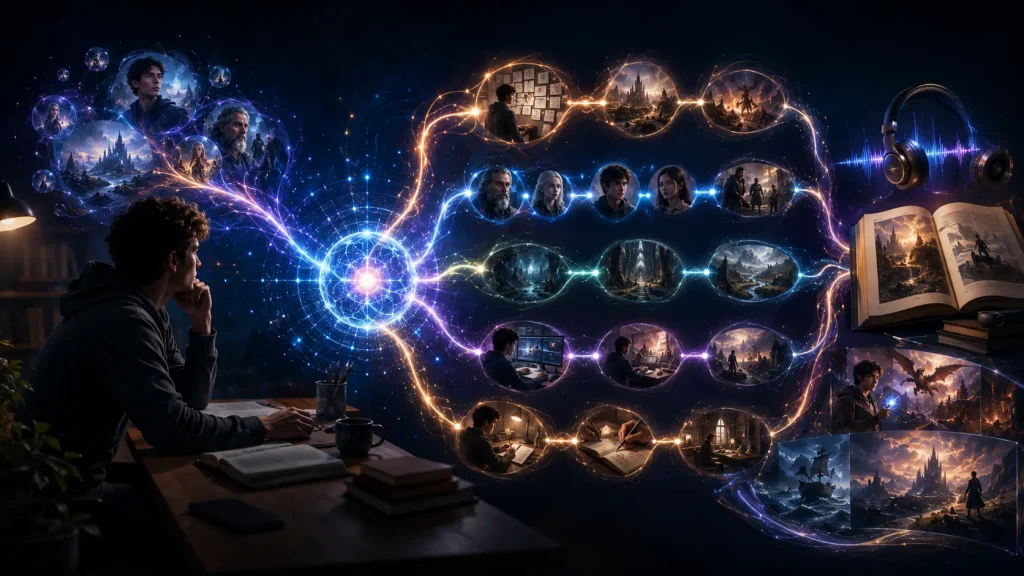
Most AI story generators follow a simple process: the creator provides instructions, the AI interprets those instructions, generates narrative possibilities, and the creator refines the result.
Step 1: Enter a Story Idea or Prompt
The process begins with a prompt describing what the creator wants.
A prompt might be broad:
- A fantasy adventure
- A children’s bedtime story
- A historical narrative
- A mystery set in India
Or it can be more specific:
“Write a short mystery about a photographer who finds the same unknown person appearing in photographs taken decades apart.”
The more useful context the creator provides, the easier it becomes for the AI to generate a relevant story direction.
Step 2: Develop the Story Structure
Once the prompt is understood, the AI can suggest how the story may unfold.
This can include:
- Central conflict
- Beginning, middle, and ending
- Major plot points
- Character roles
- Obstacles
- Turning points
- Possible resolutions
Writers can use this stage to test different directions before committing to a full draft.
Step 3: Generate Characters and Dialogue
AI can also help develop the people inside the story.
Creators may ask for:
- Character personalities
- Motivations
- Strengths and flaws
- Relationships
- Backstories
- Dialogue styles
- Emotional conflicts
Instead of accepting the first suggestion, writers can continue prompting the AI until the characters better fit the intended narrative.
Step 4: Edit and Refine the Story
AI-generated text should be treated as a draft or creative input rather than an automatic final version.
Human refinement is where creators can add:
- Personal experience
- Original observations
- Cultural context
- Emotional nuance
- Natural dialogue
- Distinctive voice
- Accurate details
- Creative judgment
This stage is particularly important because AI-generated stories can sometimes feel predictable, repetitive, or generic when they are not actively shaped by the creator.
Step 5: Transform the Story Into Different Formats
Once the narrative is developed, the same core story can move beyond written text.
Creators can adapt it into:
- Written fiction
- Audio stories
- Podcasts
- Videos
- Narrated social content
- Interactive experiences
- Game narratives
This is where AI-assisted writing can become part of a broader storytelling workflow. A creator might generate and refine a story, turn the final script into AI voice narration, add music or sound design, and publish it as an audio experience for listeners.
In other words, an AI story generator can help create the foundation of a story—but what happens after generation is where creators can turn that idea into a complete experience.
How Writers and Creators Use AI Story Generators
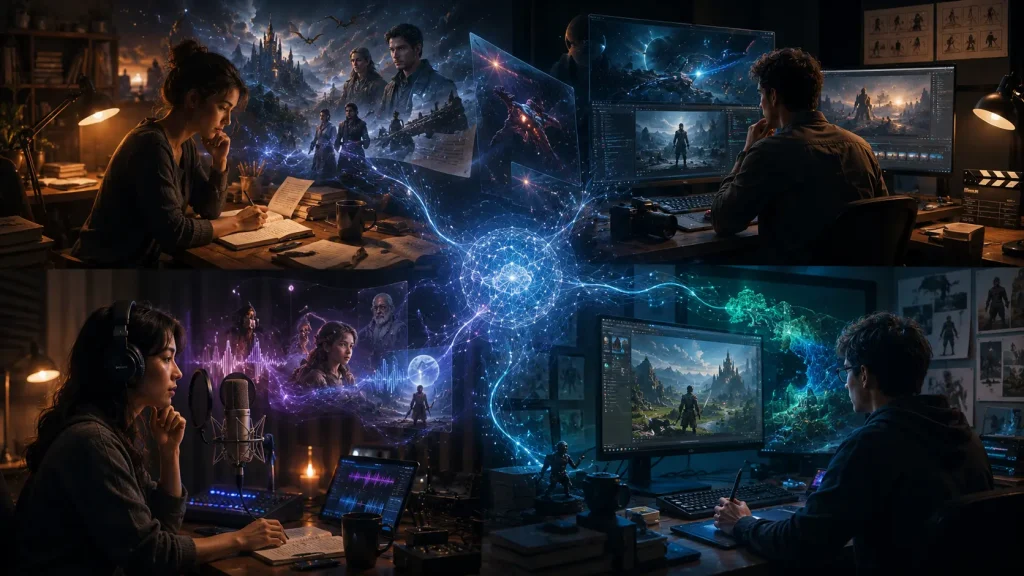
AI story generators can support different types of creators at different stages of the storytelling process. Some use them to brainstorm a first idea, while others use AI to develop characters, restructure scenes, test alternative plots, or prepare a story for another format.
The most effective approach is to use AI where it adds speed and creative possibilities while keeping the creator in control of the final narrative.
Fiction Writers
For fiction writers, an AI story generator can function as a brainstorming and development partner.
Writers can use AI to:
- Generate story premises
- Explore alternative plot directions
- Create character backgrounds
- Develop conflicts and motivations
- Suggest dialogue
- Outline chapters or scenes
- Experiment with different endings
For example, a writer developing a thriller can ask an AI story writer to suggest five possible reasons a character might disappear. Instead of accepting one response as the final answer, the writer can compare the possibilities and develop the one that fits the story best.
AI is particularly useful during early drafting when experimentation matters more than perfection.
Audio Story Creators
Audio creators can use AI earlier in the production workflow to turn an initial idea into a narration-ready script.
AI can assist with:
- Story concepts
- Episode ideas
- Character development
- Narration scripts
- Dialogue
- Scene transitions
- Alternative story endings
However, writing for audio is different from writing only for the page. Sentences often need to sound natural when spoken, dialogue must be easy to follow, and the story needs pacing that keeps listeners engaged.
Once the narrative has been refined, creators can move from AI-assisted story development to voice, narration, sound, and publishing.
For creators exploring that complete process, see how to create audio stories using AI.
YouTube and Video Creators
Story-driven videos require more than an interesting topic. They need a clear narrative that holds attention from the opening to the final scene.
YouTube creators can use AI storytelling tools to develop:
- Video concepts
- Story-based scripts
- Hooks and openings
- Character-led videos
- Narration scripts
- Scene sequences
- Alternative story angles
A creator might begin with one concept and ask AI to develop several different openings before selecting the version most likely to capture the audience’s attention.
AI can therefore speed up scripting, but creators still need to shape the tone, pacing, personality, and visual direction of the finished video.
Game Developers
Games often require stories that extend beyond a single linear plot.
Developers may need character histories, fictional locations, factions, side quests, conversations, and interconnected worlds. AI can help creators explore these elements quickly.
Common uses include:
- Character backstories
- World-building
- Non-player character dialogue
- Quest ideas
- Locations and fictional histories
- Alternative narrative paths
For larger fictional worlds, AI can be especially useful for generating possibilities that developers can later refine into a consistent story universe.
The common pattern across these creator types is simple:
AI generates possibilities. Creators decide what becomes part of the story.
Best AI Story Generator Tools for Creators
There is no single best AI story generator for every creator. The right tool depends on whether the goal is brainstorming, writing fiction, building a long-form narrative, creating visuals, or transforming a finished story into an audio experience.
Here are several tools suited to different stages of the creative workflow.
ChatGPT — Best for Flexible Story Brainstorming
ChatGPT is useful for creators who want a flexible AI assistant that can help develop an idea through conversation.
It can be used to:
- Brainstorm story premises
- Explore characters
- Develop plot directions
- Research and build fictional worlds
- Review drafts
- Suggest alternative approaches
OpenAI specifically positions ChatGPT as useful for brainstorming, writing, editorial feedback, research, and world-building, making it suitable for creators who prefer an iterative process rather than generating an entire story in one step.
Best for: Writers and creators who want to develop a story through repeated prompting and refinement.
Sudowrite — Best for Fiction and Long-Form Story Development
Sudowrite is designed specifically around fiction writing rather than general-purpose content creation.
Its tools support areas such as story planning, character development, prose generation, rewriting, and maintaining information about a longer narrative. Sudowrite also offers fiction-focused models and tools for developing story structures and character arcs.
Best for: Novelists and fiction writers working on longer, character-driven stories.
NovelAI — Best for Interactive Fiction and Story Exploration
NovelAI is another storytelling-focused platform built around AI-assisted fiction.
Creators can write inside its story editor and ask the AI to continue the narrative, retry generations, and explore alternative directions. Its Lorebook feature can also store information about characters, locations, factions, and other elements that may need to remain consistent within a fictional world.
Best for: Fiction creators who enjoy exploring branching stories, fictional worlds, and iterative narrative generation.
Canva — Best for Combining Stories With Visual Content
Canva is useful when storytelling needs to move beyond text and become a visual asset.
Its Magic Write tools can help creators brainstorm, draft, rewrite, and develop scripts, while Canva’s broader design tools allow those ideas to be combined with graphics, presentations, videos, and other visual formats.
Best for: Creators developing visual stories, social content, presentations, video scripts, or illustrated narratives.
Arré Voice — Best for Taking Stories From Text to Voice and Community
AI story generators primarily help with creating and developing the narrative.
But generating a story is only one stage of storytelling.
Once a story has been written and refined, creators may want audiences to hear it, experience it, and engage with it.
That is where Arré Voice fits into the broader workflow.
For an audio creator, the journey can become:
Story idea → AI-assisted story → Script → Voice → Audio experience → Audience
Arré Voice’s ecosystem has been built around voice creators and audio-led participation, including creator challenges and voice-based content experiences.
Rather than competing with an AI fiction generator, Arré Voice can serve the next stage of the creator journey: bringing stories to life through voice and connecting those stories with listeners.
Best for: Audio storytellers and voice creators who want to move beyond generating a story and turn it into a shareable voice-led experience.
Ultimately, the best AI storytelling workflow may involve more than one tool. A creator could use an AI story generator to brainstorm and structure the narrative, refine it with human judgment, develop the visual or audio format, and then publish the finished experience where audiences can discover it.
How to Turn AI-Generated Stories Into Audio Experiences
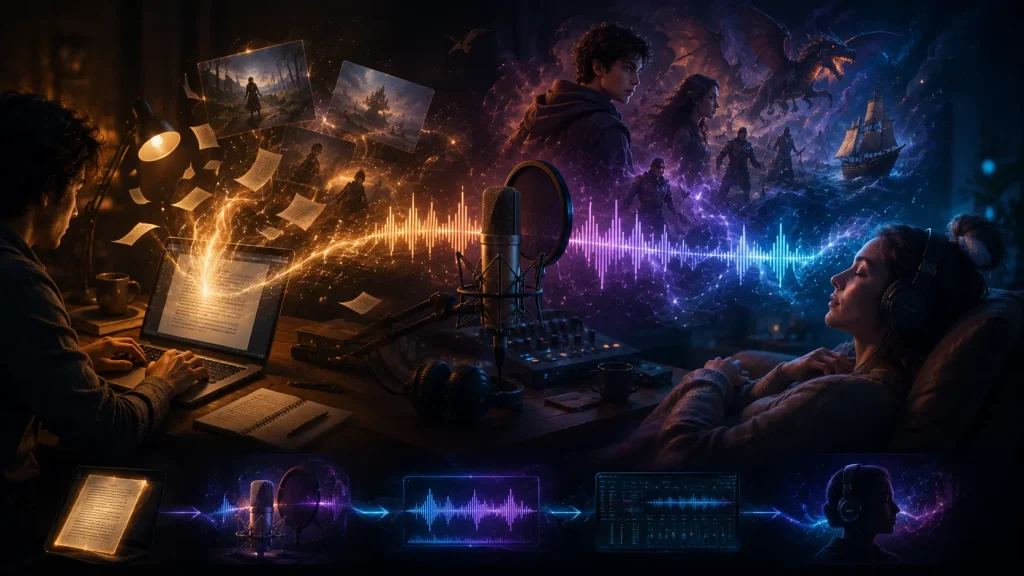
AI story creation is only the beginning. Once a story has been developed and refined, creators can transform it into an audio experience that feels more immersive and personal.
A simple workflow looks like this:
- Create the story concept
Start with the core idea, genre, audience, characters, and central conflict. - Develop the script
Rewrite the story for listening rather than reading. Shorter sentences, natural dialogue, and clear scene transitions often work better in audio. - Select the right voice
Choose a voice that matches the story’s tone, character, language, and audience. - Generate the narration
Use AI voice narration to convert the final script into spoken audio. - Add sound and atmosphere
Music, ambient sound, and effects can help establish mood, location, and emotional intensity. - Publish the audio experience
Once complete, the story can be shared through an audio storytelling platform where listeners can discover and engage with it.
For creators, this creates a broader workflow:
AI story generator → Story script → Voice narration → Sound design → Audio story → Audience
The important point is that AI-generated text does not have to remain text. A well-developed story can become a narrated series, short audio story, character-led performance, or other voice-first format.
Can AI Replace Human Story Writers?
AI can generate stories, but it does not replace the role of the human storyteller.
An AI story generator is good at producing possibilities quickly. It can suggest plots, rewrite scenes, generate characters, and explore different versions of an idea. What it cannot independently provide in the same way is lived experience, personal memory, cultural understanding, emotional intention, and a distinctive creative point of view.
AI is particularly useful for:
- Brainstorming ideas
- Speeding up early drafts
- Structuring stories
- Exploring alternatives
- Testing different genres or tones
Human creators contribute:
- Original perspective
- Emotional depth
- Cultural context
- Creative judgment
- Personal experience
- Meaning and purpose
This distinction becomes especially important when stories deal with identity, relationships, regional culture, history, or deeply personal experiences. A technically complete story may still feel generic if it lacks a clear human perspective.
The most effective approach is therefore not AI versus human creativity, but AI supporting human creativity.
Writers can use AI to expand the number of ideas they explore while remaining responsible for deciding what the story ultimately says and why it matters.
The Future of AI Story Generators
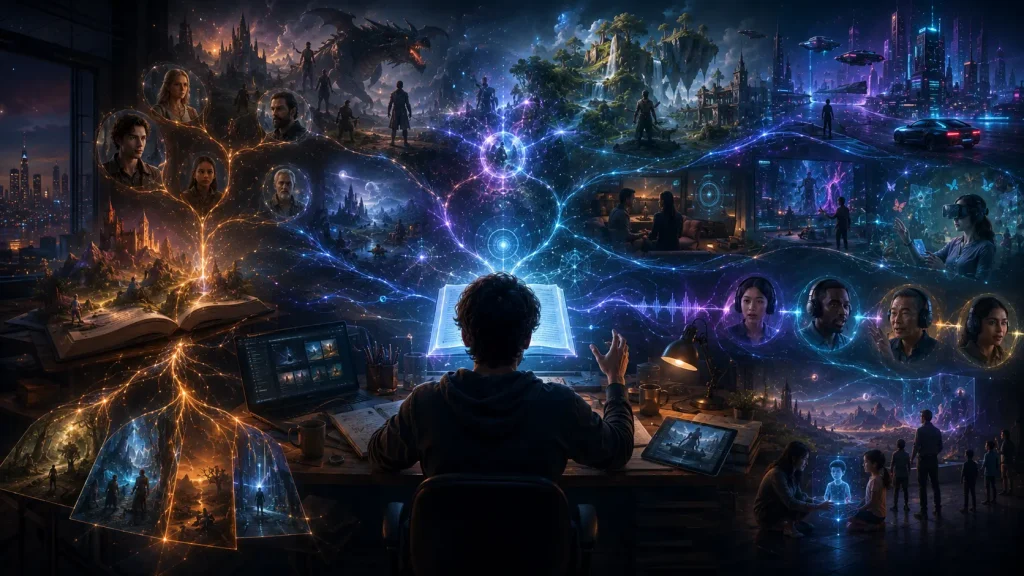
AI story generators are likely to become more integrated with other forms of digital storytelling.
Instead of generating only text, future storytelling workflows may combine writing, voice, visuals, interactive choices, and personalization within the same creative process.
Key developments may include:
- More personalized storytelling: Stories adapted to different audiences, interests, or preferences.
- Interactive narratives: Readers or listeners influencing how a story develops.
- Voice-enabled storytelling: Written narratives moving directly into spoken or character-based audio.
- Multilingual story creation: Creators adapting narratives for audiences across languages.
- More consistent characters and worlds: AI tools becoming better at maintaining details across longer stories.
- Multi-format creation: One story becoming text, audio, video, or an interactive experience.
These developments could make storytelling more accessible to people who have ideas but may not have traditional writing, production, or technical skills.
At the same time, the value of originality will become even more important. As AI makes content easier to generate, audiences will have more choices. Stories with distinctive voices, credible cultural context, memorable characters, and genuine emotional insight are more likely to stand out.
The future of AI storytelling is therefore not simply about generating more content. It is about giving creators more ways to turn ideas into experiences.
How Arré Voice Fits Into AI Story Creation
Most AI story generators focus on the beginning of the creative process: helping users develop ideas, characters, plots, and written narratives.
Arré Voice fits further along the journey, where a story becomes something audiences can hear and engage with.
A creator’s workflow can look like this:
AI story idea → AI-assisted story → Human refinement → Voice → Arré Voice → Audience
This creates a natural connection between AI-assisted writing and audio storytelling.
Creators can use story-generation tools to develop a narrative, refine the final script, turn it into a voice-led experience, and then share that experience with listeners.
Within that broader journey, creators can:
- Develop voice-first stories
- Share personal or fictional narratives
- Experiment with audio formats
- Reach listeners through storytelling
- Participate in voice-led communities
- Build stronger connections around shared interests
This is an important distinction.
An AI story generator helps create the story.
Arré Voice helps give that story a voice and an audience.
For writers and creators, the opportunity is not to stop at AI-generated text. The more powerful creative journey is to turn an idea into a story, transform that story into an audio experience, and make it discoverable to people who want to listen.
Frequently Asked Questions
What is the best prompt for an AI story generator?
A strong AI story generator prompt should define the main character, goal, conflict, setting, genre, tone, target audience, and desired format. Specific instructions usually produce more useful results than broad requests such as “write a story.” You can also specify length, point of view, pacing, or ending style, then refine the output through follow-up prompts.
How do I make AI-generated stories more original?
To make AI-generated stories feel less generic, give the AI specific characters, motivations, conflicts, locations, cultural details, and narrative constraints. Avoid relying on the first draft. Rewrite predictable scenes, replace clichés, deepen emotional stakes, and add observations drawn from your own experience. The more human judgment and distinctive context you add, the more original the finished story can feel.
Can I publish or sell stories created with AI?
You can often publish or sell AI-assisted stories, but the rules depend on the AI tool, publishing platform, and applicable law. Review the tool’s terms for commercial-use rights and check the publication platform’s AI-content policies before releasing the work. Creators should also substantially review, edit, and personalize generated material rather than treating raw AI output as publication-ready.
Who owns the copyright to an AI-generated story?
Copyright protection for AI-generated stories depends on the jurisdiction and how much human authorship is involved. In the United States, the Copyright Office says AI-assisted work can qualify for protection when a human contributes sufficient expressive authorship, while purely AI-generated material is not protected simply because it was prompted. Writers should keep drafts and edits that document their creative contribution.
Is using an AI story generator plagiarism?
Using an AI story generator is not automatically plagiarism, but generated text can still resemble existing expressions, familiar plots, or common genre patterns. Writers should review outputs carefully, avoid asking AI to imitate living authors too closely, verify suspicious passages, and rewrite generic material in their own voice. Original creative choices and human editing reduce the risk of publishing derivative or unoriginal work.
Can an AI story generator write a full novel?
Yes. AI story generators can help plan novels and other long-form fiction by developing outlines, chapters, characters, scenes, and alternative plot directions. The challenge is consistency: longer stories require careful tracking of character traits, timelines, locations, motivations, and unresolved plot points. Writers usually get better results by working chapter by chapter and maintaining a separate story bible for continuity.
How do I keep characters consistent in AI-generated stories?
To keep characters consistent, create a clear character profile before generating scenes. Record each character’s age, appearance, motivations, relationships, background, speech patterns, strengths, flaws, and goals. Reuse those details in prompts and maintain a story bible as the narrative grows. After generation, check every scene for contradictions in behavior, appearance, timeline, relationships, and previously established facts.
Can AI story generators write in different genres and tones?
Yes. AI story generators can create stories in genres such as fantasy, romance, mystery, horror, science fiction, adventure, or children’s fiction, and they can adapt tone as well. Better results come from defining both genre and emotional direction—for example, “a slow-burn mystery with a tense but hopeful tone”—rather than requesting a genre alone. Writers should still refine genre conventions manually.
What is the difference between an AI story generator and an AI writing assistant?
An AI story generator is designed specifically for narrative creation, helping users develop characters, plots, scenes, conflicts, and endings. An AI writing assistant is broader and may also support emails, articles, summaries, editing, or research. Some tools perform both roles. Writers should choose based on whether they need specialized fiction workflows or a flexible assistant that supports multiple writing tasks.
Can I use my own characters and ideas in an AI story generator?
Yes. You can use your own characters, settings, themes, and plot ideas as inputs for an AI story generator, provided you have the rights to use that material. Detailed original inputs can also make generated stories more specific. Before entering unpublished or commercially sensitive material, review the tool’s privacy, data-use, and content-retention policies to understand how your prompts are handled.