
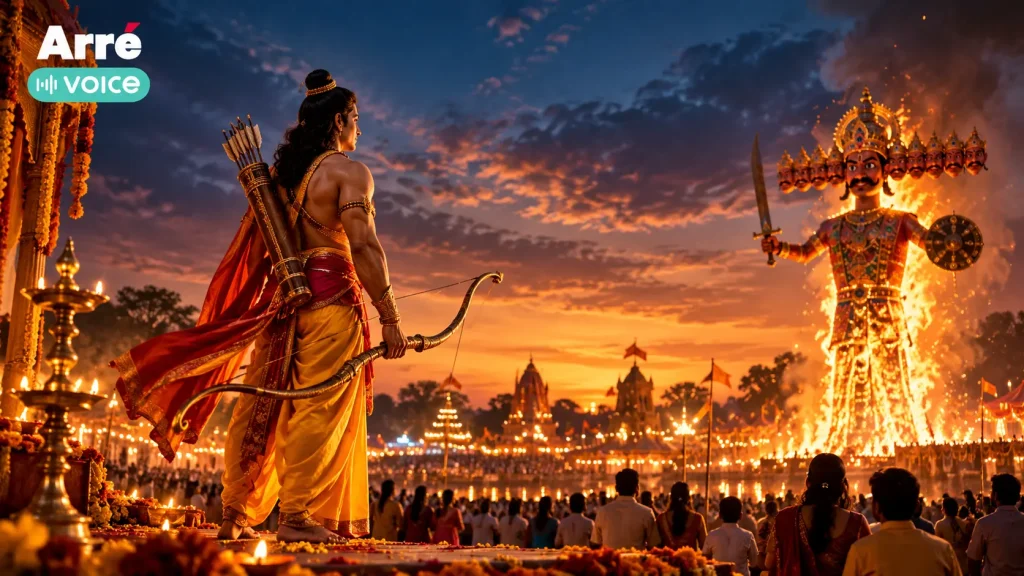
Dussehra, also known as Vijayadashami, is one of India’s most significant Hindu festivals, celebrating the victory of good over evil. Rooted in the stories of Lord Rama’s triumph over Ravana and Goddess Durga’s victory over Mahishasura, the festival represents courage, righteousness and the power of truth.
Dussehra 2026 falls on Tuesday, October 20, across most of India, while some regional Vijayadashami observances take place on October 21.
From Ravan Dahan and Ramlila performances to Durga Puja and traditional rituals, Dussehra brings India’s diverse cultural traditions together through stories that have been passed down for generations.
What Is Dussehra?
Dussehra is a major Hindu festival that celebrates the triumph of righteousness over evil. Also called Vijayadashami or Dasara, it is observed on the tenth day of the bright fortnight (Shukla Paksha) of the Hindu lunar month of Ashwin.
The festival is traditionally associated with Lord Rama’s victory over the demon king Ravana in the Ramayana and Goddess Durga’s triumph over the buffalo demon Mahishasura.
The name Vijayadashami combines Vijaya, meaning victory, and Dashami, referring to the tenth lunar day.
Across India, Dussehra is celebrated through different regional customs, including Ramlila performances, Ravan Dahan, religious processions, Durga Puja ceremonies and the worship of tools, books and instruments.
Beyond its religious significance, Dussehra reminds people of the importance of courage, humility, justice and making the right choices.
When Is Dussehra in 2026?
Dussehra 2026 is celebrated on Tuesday, October 20, in most parts of India. The date is determined by the Hindu lunar calendar and the observance of Ashwin Shukla Dashami.
Some regional traditions, particularly Bengal’s Bijoya Dashami observances, fall on October 21, 2026.
Dussehra 2026 Date and Day
The main Dussehra festival details for 2026 are:
| Festival detail | Date |
| Festival | Dussehra / Vijayadashami |
| Main observance | October 20, 2026 |
| Day | Tuesday |
| Bengali Bijoya Dashami | October 21, 2026 |
| Hindu lunar day | Ashwin Shukla Dashami |
Dussehra generally marks the culmination of Navratri celebrations, although rituals, traditions and observance dates can differ between regions.
Vijayadashami Tithi and Regional Observances
According to Hindu Panchang calculations for India, the Dashami Tithi begins at approximately 12:50 PM on October 20, 2026, and ends at 2:11 PM on October 21, 2026.
Because the lunar tithi spans two calendar days, regional religious traditions may observe Vijayadashami differently.
In much of North and West India, Dussehra celebrations, including Ravan Dahan, take place on October 20. In West Bengal, Bijoya Dashami rituals associated with the conclusion of Durga Puja are observed on October 21.
Devotees should consult their local Panchang for location-specific puja timings and auspicious periods.
Why Is Dussehra Celebrated?
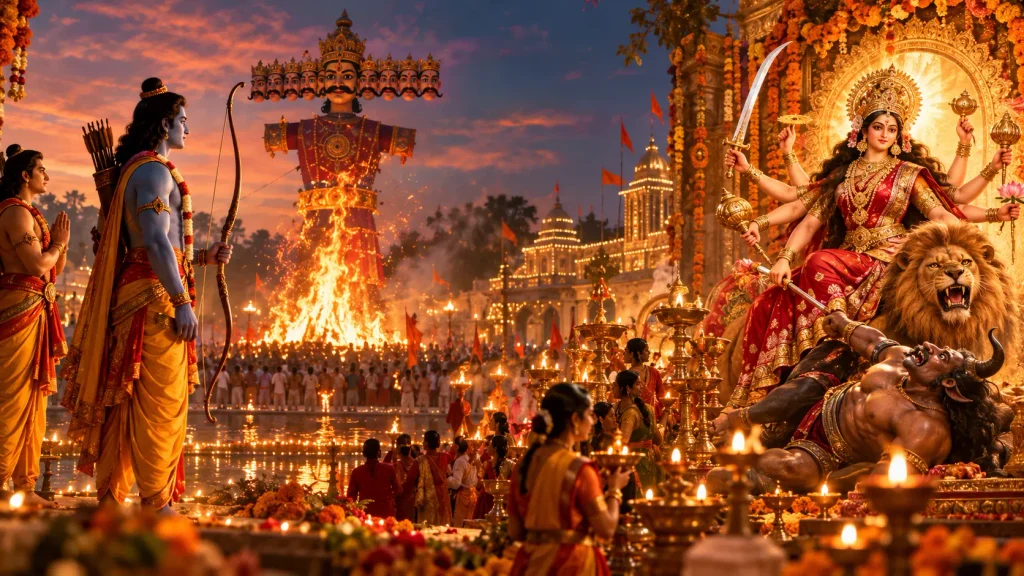
Dussehra is celebrated to honour the victory of good over evil, particularly through two important Hindu religious narratives: Lord Rama’s defeat of Ravana and Goddess Durga’s victory over Mahishasura.
Although the stories differ, both convey the importance of overcoming injustice, arrogance and destructive forces.
The festival also signifies the conclusion of important Navratri traditions and the beginning of renewed hope and positive action.
Lord Rama’s Victory Over Ravana
According to the Ramayana, Lord Rama defeated Ravana, the powerful king of Lanka, after Ravana abducted Rama’s wife, Sita.
Rama, supported by Lakshmana, Hanuman and the Vanara army, fought to rescue Sita and confront Ravana’s wrongdoing.
The battle culminated in Ravana’s defeat, symbolizing the victory of dharma (righteousness) over adharma (unrighteousness).
In many parts of North India, this victory is commemorated through Ravan Dahan, a tradition in which large effigies of Ravana, often accompanied by those of Meghnad and Kumbhakarna, are burned.
The ritual represents the destruction of negative qualities such as pride, greed, anger and arrogance.
Goddess Durga’s Victory Over Mahishasura
Another major tradition associates Vijayadashami with Goddess Durga’s victory over Mahishasura, a powerful demon who threatened the cosmic order.
According to Hindu mythology, Mahishasura possessed extraordinary strength and could change his form. The gods sought divine intervention, and Goddess Durga emerged as a powerful manifestation of Shakti, or divine feminine energy.
After a fierce battle, Durga defeated Mahishasura, restoring order and symbolizing the triumph of divine power over destructive forces.
This story forms an important part of Durga Puja celebrations, particularly in eastern India.
While the Rama and Durga traditions emphasize different divine figures, they share a central message: righteousness, courage and determination can overcome oppression and injustice.
The Story of Dussehra in the Ramayana
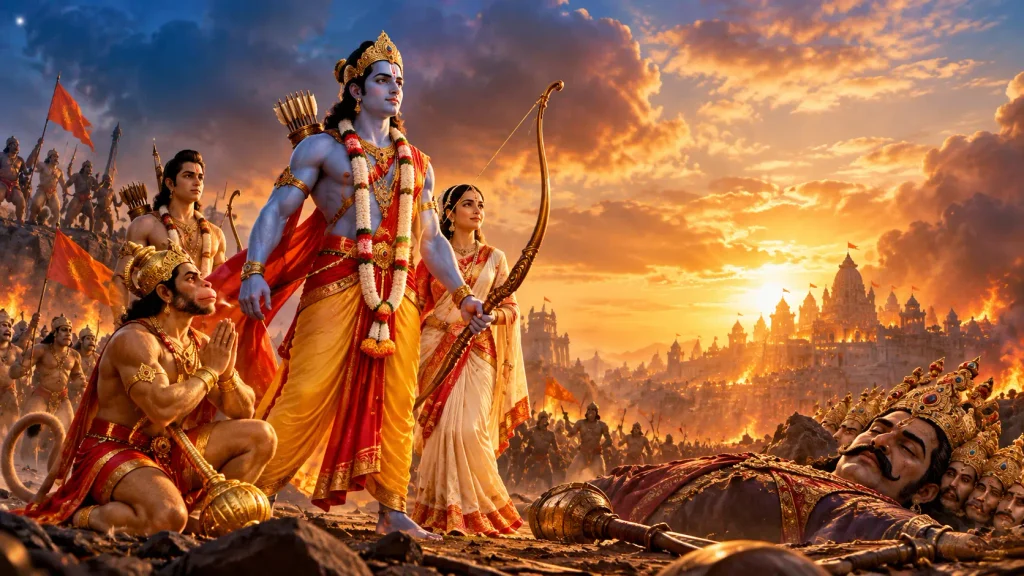
The Dussehra story in the Ramayana centres on Lord Rama’s battle against Ravana, the king of Lanka, following Sita’s abduction. Rama’s journey to rescue her leads to alliances, extraordinary acts of devotion and a decisive confrontation between righteousness and arrogance.
The story is retold through religious texts, oral storytelling, folk performances and Ramlila traditions, with variations across different regional versions of the Ramayana.
How the Battle Between Rama and Ravana Began
The conflict began during Rama’s fourteen-year exile from Ayodhya.
Rama lived in the forest with Sita and his younger brother Lakshmana. During their exile, Ravana abducted Sita and took her to his kingdom in Lanka.
Determined to find her, Rama began a journey that brought him into contact with Hanuman and Sugriva, the Vanara king.
Hanuman played a crucial role in locating Sita in Lanka and conveying Rama’s message of hope. Rama subsequently assembled an army with the support of Sugriva and his allies.
According to the epic tradition, the Vanara army built a passage across the sea to reach Lanka.
Before the decisive confrontation, opportunities for reconciliation were offered, but Ravana refused to release Sita.
A major battle followed between Rama’s forces and Ravana’s army, involving powerful warriors, difficult sacrifices and moments of extraordinary courage.
The conflict ultimately became a struggle to restore justice and uphold dharma.
The Defeat of Ravana and Its Symbolism
The battle reached its climax when Rama confronted Ravana in a decisive encounter.
Despite Ravana’s immense power, military strength and knowledge, his arrogance and refusal to correct his wrongdoing led to his downfall.
In the Ramayana tradition, Rama ultimately defeated Ravana, marking the restoration of righteousness and the path toward Sita’s return.
Ravana’s defeat is remembered on Dussehra as a symbol of the victory of good over evil.
The story also carries a deeper moral meaning. Ravana is often portrayed as a learned and accomplished ruler whose pride and actions brought destruction upon himself and his kingdom.
His downfall reminds people that knowledge and power cannot replace ethical judgment.
Through Ramlila performances and Ravan Dahan celebrations, communities continue to revisit this story, reflecting on the importance of humility, self-control, courage and choosing what is right.
What Is the History and Significance of Dussehra?
Dussehra has its roots in Hindu religious traditions celebrating the victory of righteousness over evil. Associated with the Ramayana and Goddess Durga’s victory over Mahishasura, the festival has evolved over centuries into a major cultural celebration across India.
Its historical traditions include Ramlila performances, royal Dasara celebrations and regional worship practices passed down through generations. Although the festival’s religious narratives are ancient, its present-day celebrations reflect India’s diverse cultural history.
Religious and Cultural Significance
The religious significance of Dussehra lies in the belief that truth, courage and righteousness ultimately prevail over arrogance and injustice.
For devotees of Lord Rama, it commemorates his victory over Ravana. In traditions dedicated to Goddess Durga, Vijayadashami celebrates divine feminine power and the defeat of Mahishasura.
Culturally, the festival brings communities together through storytelling, performances, processions and shared rituals. Ramlila, a traditional theatrical retelling of the Ramayana, was inscribed on UNESCO’s Representative List of the Intangible Cultural Heritage of Humanity in 2008.
Know more about>>>
Ramayana Characters and Indian Storytelling Traditions
Why Dussehra Symbolizes the Victory of Good Over Evil
Dussehra represents the victory of good over evil because its central stories show righteousness overcoming wrongdoing and destructive power.
Rama’s defeat of Ravana highlights the importance of dharma, while Durga’s victory over Mahishasura represents courage and the restoration of order.
The festival also encourages personal reflection. Ravana’s downfall is often interpreted as a warning against unchecked pride, anger and greed.
In this sense, Dussehra is not only a celebration of divine victory but also a reminder to overcome negative tendencies in everyday life.
How Is Dussehra Celebrated in India?
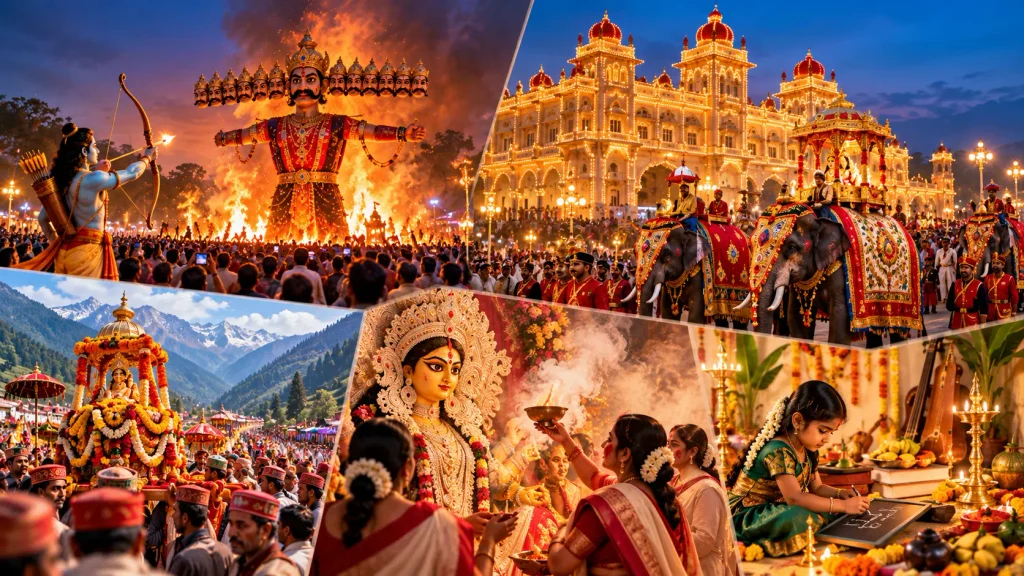
Dussehra is celebrated across India through Ramlila performances, Ravan Dahan, religious processions, Durga Puja, temple rituals and the worship of tools and instruments.
While the central theme is the triumph of good over evil, celebrations vary by region. North India emphasizes Rama’s victory, Mysuru honours Goddess Chamundeshwari, West Bengal observes the conclusion of Durga Puja, and several southern traditions focus on gratitude, knowledge and new beginnings.
Ramlila and Ravan Dahan in North India
In many parts of North India, Dussehra celebrations feature Ramlila, a theatrical performance of episodes from the Ramayana.
These performances portray Rama’s exile, Sita’s abduction, Hanuman’s devotion and the battle against Ravana.
On Dussehra, communities often gather to witness Ravan Dahan, when large effigies of Ravana, Meghnad and Kumbhakarna are set alight.
Cities such as Delhi, Varanasi and Ayodhya are associated with prominent Ramayana-related festivities.
Ramlila also preserves India’s oral storytelling traditions, bringing the epic to life through dialogue, music, costumes and community participation.
Mysuru Dasara in Karnataka
Mysuru Dasara is Karnataka’s celebrated Nada Habba, or state festival, honouring Goddess Chamundeshwari’s victory over Mahishasura.
The celebrations feature an illuminated Mysuru Palace, cultural programmes, traditional worship and the grand Jamboo Savari procession.
During the procession, a decorated elephant carries the idol of Goddess Chamundeshwari in a golden howdah, accompanied by ceremonial displays and performers.
The royal Dasara tradition developed under the Wadiyar dynasty, with celebrations documented from 1610.
In 2026, the official Mysuru Dasara programme runs from October 11 to 21, with Jamboo Savari scheduled for October 21.
Kullu Dussehra in Himachal Pradesh
Kullu Dussehra is a distinctive week-long festival that begins around Vijayadashami rather than concluding on that day.
Held at Dhalpur Maidan in Himachal Pradesh’s Kullu Valley, it centres on Lord Raghunath, a form of Lord Rama.
Local deities are brought in ceremonial processions from surrounding villages to participate in the festivities.
The celebration is traditionally associated with Raja Jagat Singh and the establishment of Lord Raghunath’s worship in the seventeenth century.
Unlike many North Indian Dussehra celebrations, Kullu’s main tradition does not revolve around burning large Ravana effigies.
Instead, it emphasizes local deity traditions, community gatherings and regional cultural heritage.
Durga Puja and Vijayadashami in West Bengal
In West Bengal, Vijayadashami marks the conclusion of Durga Puja, one of the region’s most significant religious and cultural celebrations.
Elaborately decorated pandals, artistic idols and devotional ceremonies honour Goddess Durga’s victory over Mahishasura.
On Vijayadashami, devotees offer prayers and bid farewell to the goddess before the immersion of her idols, known as Visarjan.
Many Bengali communities also observe Sindoor Khela, a tradition involving the ceremonial application of vermilion.
The festival expresses devotion, artistic creativity, family togetherness and the belief that Goddess Durga will return the following year.
Ayudha Puja and Saraswati Puja in South India
In parts of South India, Dussehra is closely connected with Ayudha Puja, Saraswati Puja and Vijayadashami traditions.
Ayudha Puja involves cleaning, decorating and worshipping tools, vehicles, machinery and instruments used in daily life and work.
Saraswati Puja honours the goddess of learning, music and wisdom. Books and musical instruments may be placed before the deity as a mark of respect for knowledge.
In Kerala, Vijayadashami is particularly associated with Vidyarambham, a ceremony introducing young children to their first letters.
These customs emphasize gratitude for work, reverence for learning and the value of beginning important activities with dedication.
What Is the Difference Between Dussehra and Vijayadashami?
Dussehra and Vijayadashami generally refer to the same festival, but their names and cultural associations can differ across India.
Dussehra is widely associated with Lord Rama’s victory over Ravana, particularly in North India. Vijayadashami, meaning the victorious tenth day, is also associated with Goddess Durga’s victory over Mahishasura.
| Dussehra | Vijayadashami |
| Commonly associated with Rama’s victory over Ravana | A broader name for the victorious tenth lunar day |
| Often marked by Ramlila and Ravan Dahan | Observed through Durga Puja, processions and regional rituals |
| Widely used in North Indian festival traditions | Common across different Indian regional traditions |
The terms are frequently used interchangeably. They should not be treated as two entirely separate festivals.
What Is the Connection Between Navratri and Dussehra?
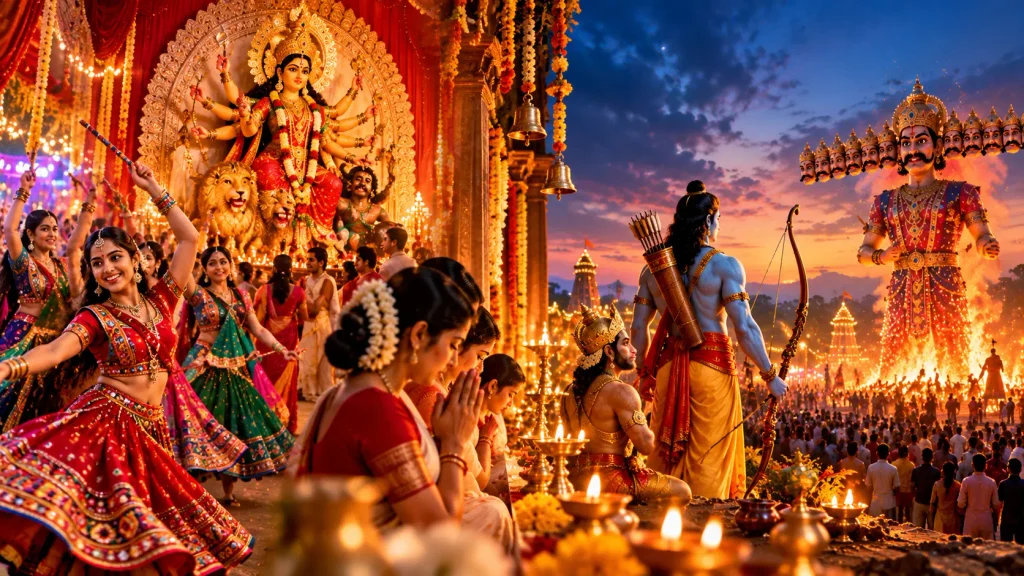
Navratri and Dussehra are closely connected because Dussehra generally falls on the tenth day, following the nine-night Navratri festival.
Navratri is dedicated to worshipping different forms of Goddess Durga and celebrating divine feminine energy. The nine nights involve fasting, prayers, devotional music, dance and regional traditions.
Dussehra, or Vijayadashami, marks the culmination of this festive period and celebrates the victory of righteousness.
In North India, Ramlila performances often take place during the Navratri period and conclude with Ravana’s defeat.
In other regions, the festival concludes with Durga Puja ceremonies, Ayudha Puja or the beginning of educational activities.
Although their rituals differ, Navratri and Dussehra form an interconnected period of devotion, celebration and renewal.
What Are the Important Rituals and Traditions of Dussehra?
Important Dussehra traditions include Ravan Dahan, Ramlila, Shami Puja, Ayudha Puja, Saraswati worship and Vidyarambham.
These customs vary across India, but they share themes of righteousness, gratitude, learning and renewal.
Ravan Dahan and Its Symbolism
Ravan Dahan is the ceremonial burning of Ravana’s effigy to symbolize the defeat of evil and the victory of righteousness.
It is particularly popular in North India, where communities gather after Ramlila performances to witness the symbolic destruction of Ravana.
In many celebrations, effigies of Meghnad and Kumbhakarna are also burned.
Beyond retelling the Ramayana, this tradition encourages people to reflect on qualities such as anger, arrogance, dishonesty and greed.
Shami Puja and Ayudha Puja
Shami Puja and Ayudha Puja are Dussehra-related traditions expressing reverence for auspiciousness, work and the instruments of daily life.
Shami Puja involves worshipping the Shami tree, which is associated with episodes from the Mahabharata and regional Vijayadashami customs.
Ayudha Puja focuses on tools, equipment, vehicles and professional instruments.
Families, workers, artisans and businesses may clean and decorate these objects before offering prayers.
Together, these rituals emphasize respect for work, responsibility and the resources that support daily life.
Vidyarambham and Saraswati Worship
Vidyarambham is a traditional ceremony that introduces children to learning, commonly observed on Vijayadashami in Kerala and some other southern communities.
During the ceremony, children may be guided to write their first letters on rice or another traditional surface.
Saraswati worship honours the goddess associated with knowledge, wisdom, music and the arts.
Students, teachers and musicians may offer prayers and seek blessings for their studies or creative pursuits.
These traditions reflect the belief that learning is an auspicious journey and that knowledge should be approached with humility and dedication.
What Does Dussehra Teach Us? Five Lessons From the Ramayana
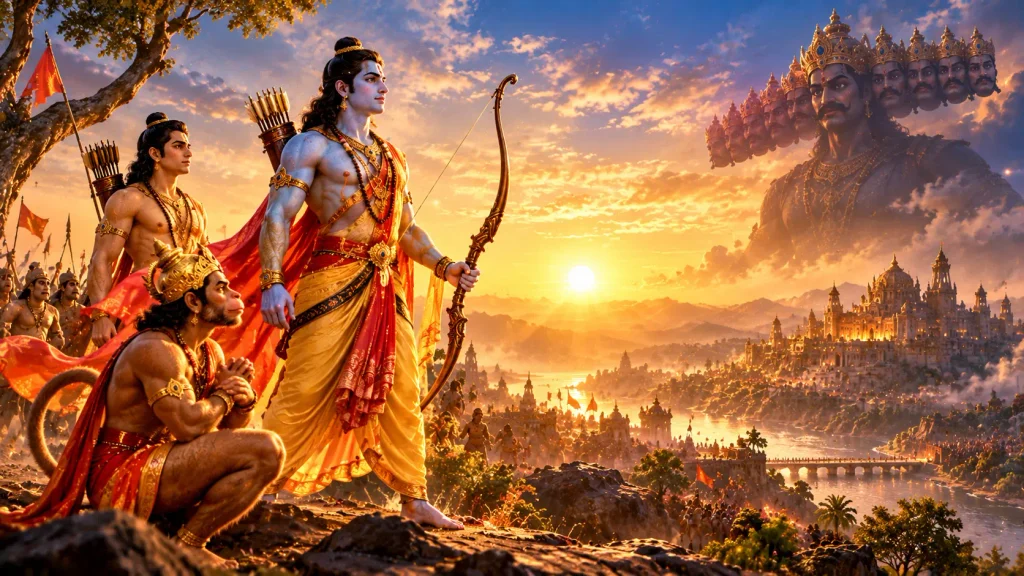
Dussehra teaches us that righteousness, courage, humility and perseverance are more important than power or wealth. Through Lord Rama’s victory over Ravana, the Ramayana offers timeless lessons about making ethical choices, overcoming personal weaknesses and standing against injustice.
Here are five important life lessons associated with Dussehra:
1. Righteousness Is More Important Than Power
Rama’s commitment to dharma, or righteous conduct, demonstrates the importance of doing what is right even during difficult circumstances. His victory reminds us that power should be guided by responsibility and moral judgment.
2. Pride Can Lead to Destruction
Ravana possessed great knowledge and extraordinary abilities, but his arrogance and refusal to acknowledge his wrongdoing contributed to his downfall. His story teaches the importance of humility and self-awareness.
3. Courage Means Standing Against Injustice
Rama’s determination to rescue Sita represents the courage needed to confront wrongdoing. Dussehra encourages people to stand up for what is right rather than remain silent in the face of injustice.
4. Loyalty and Teamwork Matter
Hanuman, Lakshmana and the Vanara army played essential roles in Rama’s journey. Their contributions highlight how trust, cooperation and dedication help people overcome difficult challenges.
5. Good Choices Shape Our Future
The conflict between Rama and Ravana shows how decisions have consequences. Dussehra encourages us to reflect on our actions, learn from mistakes and choose honesty, kindness and responsibility.
These lessons make Dussehra more than a religious celebration. They give its stories continuing relevance in everyday life.
Dussehra Stories and the Tradition of Indian Storytelling
Dussehra stories have been preserved through generations of Indian storytelling, including oral narration, Ramlila performances, folk theatre, devotional songs and written versions of the Ramayana.
These traditions help communities remember the story of Rama and Ravana while passing cultural values from one generation to another.
How Ramlila Preserves the Story of Rama
Ramlila is a traditional theatrical retelling of the Ramayana performed during the Dussehra festival season, particularly in North India.
Through narration, dialogue, music and dramatic performances, Ramlila recreates important episodes, including Rama’s exile, Sita’s abduction, Hanuman’s journey to Lanka and Ravana’s defeat.
Families and communities often participate as performers, organizers and audiences, making Ramlila a shared cultural experience.
Recognizing its cultural importance, UNESCO inscribed Ramlila on the Representative List of the Intangible Cultural Heritage of Humanity in 2008.
Listening to Ramayana and Dussehra Stories Through Audio
Audio storytelling offers another way to experience Ramayana and Dussehra stories through narration, character voices, dialogue and sound.
Listeners can explore familiar episodes, understand the motivations of different characters and reconnect with traditional stories while travelling, relaxing or performing everyday activities.
Audio also allows stories to reach audiences who prefer listening over reading or watching videos.
On Arré Voice, listeners can discover voice-led stories and creator content. Relevant Ramayana audio episodes can provide another opportunity to experience these traditional narratives.
By bringing storytelling into a voice-first format, digital audio platforms can complement traditional performances and help introduce Indian epics to new audiences.
Frequently Asked Questions
Why is Dussehra celebrated?
Dussehra is celebrated to mark the victory of good over evil. It commemorates Lord Rama’s victory over Ravana and, in several Hindu traditions, Goddess Durga’s victory over Mahishasura. The festival symbolizes righteousness, courage, truth and the importance of overcoming negative qualities such as arrogance and greed.
When is Dussehra in 2026?
Dussehra 2026 is celebrated on Tuesday, October 20, across most of India. However, some regional Vijayadashami observances, particularly Bengali Bijoya Dashami celebrations, take place on Wednesday, October 21. Festival dates vary according to regional traditions and Hindu Panchang calculations.
Is Dussehra and Vijayadashami the same?
Yes, Dussehra and Vijayadashami generally refer to the same Hindu festival. Dussehra is commonly associated with Rama’s victory over Ravana, while Vijayadashami is also connected to Goddess Durga’s victory over Mahishasura. The names and rituals vary across different regions of India.
Why is Ravana burned on Dussehra?
Ravana’s effigy is burned on Dussehra to symbolize the destruction of evil and the victory of righteousness. The ritual, known as Ravan Dahan, commemorates Rama’s defeat of Ravana in the Ramayana. It also represents overcoming negative traits such as pride, greed, anger and dishonesty.
Why is Dussehra celebrated for 10 days?
Dussehra is associated with a ten-day festive period because it follows the nine nights of Navratri and culminates on Vijayadashami, the tenth lunar day. In many regions, Ramlila performances continue throughout this period. However, celebrations vary, and Kullu Dussehra traditionally continues for approximately a week beginning around Vijayadashami.
Which places are famous for Dussehra celebrations?
Mysuru, Kullu, Delhi, Varanasi, Ayodhya and Kolkata are among India’s well-known destinations for Dussehra and Vijayadashami celebrations. Mysuru is famous for its Dasara procession, Kullu for its gathering of local deities, North Indian cities for Ramlila and Ravan Dahan, and Kolkata for Durga Puja.
What is the difference between Dussehra and Diwali?
Dussehra celebrates the victory of good over evil, while Diwali is the festival of lights, associated with prosperity, hope and different regional religious traditions.
In many North Indian Ramayana traditions, Dussehra marks Rama’s victory over Ravana, while Diwali celebrates his return to Ayodhya after exile. Diwali generally occurs about twenty days after Dussehra.
Conclusion: The Timeless Meaning of Dussehra
Dussehra remains a powerful celebration of the victory of righteousness over evil. From Rama’s defeat of Ravana to Durga’s triumph over Mahishasura, the festival reminds us that courage, humility and integrity are values worth carrying into everyday life.
Across India, Dussehra continues to unite communities through traditions, rituals and storytelling.
Whether experienced through Ramlila, family conversations or audio narratives, these stories preserve an important part of India’s cultural heritage and pass their lessons to future generations.
The true significance of Dussehra lies not only in celebrating victory, but also in choosing what is right.