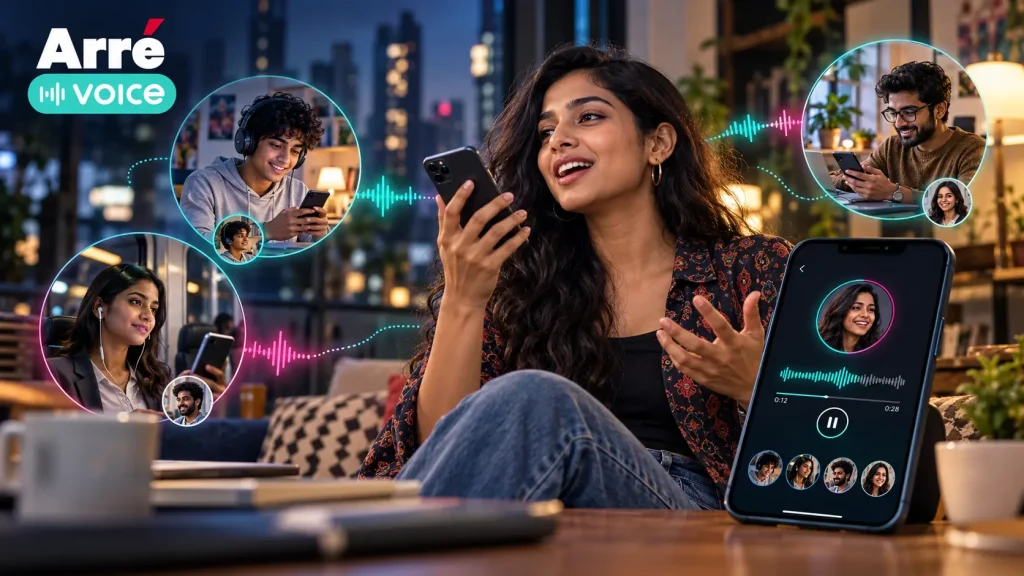
Social media has traditionally revolved around photographs, videos, captions, and text-based conversations. But what if you could share a personal experience, express an opinion, or connect with people simply by speaking?
That is the idea behind a voice-based social media app.
Instead of relying primarily on written posts or visual content, voice first platforms allow people to communicate through audio recordings, spoken responses, and voice communities. A short recording can capture excitement, humour, curiosity, or emotion in ways that written words may not fully communicate.
For example, imagine someone sharing a childhood memory in their native language. Rather than typing a lengthy post or recording a video, they can tell the story naturally through their voice and invite others to listen or respond.
In 2026, voice-based social media offers an alternative way to participate in digital conversations, particularly for people interested in audio storytelling, creator communities, and communication without constant on-camera participation.
Understanding how these platforms work can help everyday users, independent creators, and community members decide whether voice-first social networking suits their interests.
What Is a Voice Based Social Media App?
A voice based social media app is a digital platform where users primarily create, share, discover, and interact with content through spoken audio. Instead of depending on photographs, text, or videos, these applications emphasize voice posts, audio conversations, spoken responses, and interest-based communities to support social interaction.
Some platforms specialize in short recorded audio updates, while others focus on live conversations or community participation. The common feature is that voice plays a central role in how people express themselves and connect.
Voice-Based Social Media Meaning and Definition
Voice based social media refers to social networking experiences where spoken audio serves as a primary form of communication.
Traditional social platforms typically allow users to express themselves through text, images, videos, and other media. Voice-first platforms shift greater attention toward what people say, how they say it, and the conversations their voices create.
For example, someone wanting to share a personal experience could record a short audio message rather than write a long caption.
Listeners may hear the person’s tone, pauses, laughter, and emotional expression, which can provide additional context beyond the words alone.
Voice based social networking generally involves three activities:
- Voice content creation: Recording spoken thoughts, stories, opinions, or other audio content.
- Audio discovery: Finding recordings, creators, topics, and conversations relevant to personal interests.
- Social participation: Responding to content, joining discussions, following creators, or engaging with communities through supported features.
These activities distinguish voice-based social media from simply recording an audio file.
The platform must also provide opportunities for content discovery, audience interaction, or social relationships.
For instance, a voice recorder stores audio, but it does not automatically function as a social network. A voice-first social app adds ways to share recordings and connect with other people.
Voice-based platforms also belong to the broader category of social audio, which includes several forms of spoken digital interaction.
To understand that wider category, explore social audio and how voice communication supports online engagement.
How Does a Voice-Based Social Media App Work?
A voice-based social media app works by allowing users to record or participate in audio content, share it through supported publishing features, and interact with other people.
Although individual platforms offer different tools, the overall experience often follows a recognizable process.
1. Create an account and establish your profile
Users begin by setting up an account and choosing how they want to present themselves.
Depending on the platform, a profile may contain a display name, short biography, interests, and published audio content.
Creators can use this information to communicate what types of conversations or stories they intend to share.
2. Discover relevant audio content
Users explore recordings, creators, or conversations based on their interests.
Some applications organize content into categories, topics, communities, or personalized discovery feeds.
For example, someone interested in Indian storytelling may look for regional-language stories, fictional narratives, or conversations about cultural traditions.
The available discovery methods depend on the platform.
3. Record or participate in voice content
On recorded-audio platforms, users can create voice posts by speaking into their device’s microphone.
A creator might share a short personal story, discuss a question, or express an opinion about an everyday experience.
On live audio platforms, participation may involve joining an ongoing room or conversation and speaking when permitted.
4. Share content with an audience
Once a recording is prepared, the creator can publish it using the application’s supported tools.
Some platforms allow public posts, while others provide additional participation or audience controls.
The published content may appear on a profile, in a community, or within a discovery feed.
5. Engage through conversations and responses
Social interaction is what separates voice-based social media from ordinary audio storage.
Depending on the application, listeners may respond with audio, participate in discussions, follow creators, or engage with content through other interaction features.
For example, a user could share a spoken question about a favourite childhood story and invite others to contribute their own memories.
6. Continue building connections
Repeated participation can help people discover familiar creators, identify shared interests, and develop ongoing conversations.
The experience is not limited to publishing individual recordings. It can also involve listening, exchanging perspectives, and participating in communities.
In simple terms, voice-based social media connects recording, publishing, discovery, and conversation within a social platform.
What Makes Voice-First Social Networking Different?
Voice-first social networking differs from other digital communication formats because spoken expression becomes the central experience rather than an occasional additional feature.
The distinction is not simply that users can upload audio.
Many messaging services and conventional social platforms support voice messages. A voice-first social network is designed to make audio creation, discovery, and participation core parts of the platform.
Several characteristics define this experience.
Communication through vocal expression
Voice carries qualities such as tone, pace, emphasis, and emotional expression.
A humorous observation may sound playful when spoken, while the same words in a text post could be interpreted differently.
These vocal cues can provide useful emotional context, although listeners may still interpret them differently.
Less dependence on visual presentation
Voice-first content allows creators to communicate without making their physical appearance central to every post.
Someone who enjoys storytelling but feels uncomfortable recording videos can concentrate on what they want to say.
This does not mean the platform is automatically anonymous or that sharing audio presents no privacy risks.
Listening as a social activity
Voice-first platforms can make listening an active part of social participation.
Instead of only consuming finished content, listeners may respond, contribute their perspectives, or discover conversations that lead to further interaction.
Greater emphasis on spoken creativity
Voice-based social media can support short fiction, narration, humour, poetry, personal reflections, and conversational content.
A creator’s language, delivery, and storytelling style can become recognizable aspects of their online identity.
Community experiences built around conversation
Some applications organize participation through interest-based groups or shared prompts, allowing people to interact around common themes.
This reflects a broader shift from simply publishing content toward using content as the starting point for social exchange.
For more context on the underlying communication approach, explore voice-first technology and its applications across digital experiences.
What Are the Main Features of Voice-Based Social Media Apps?
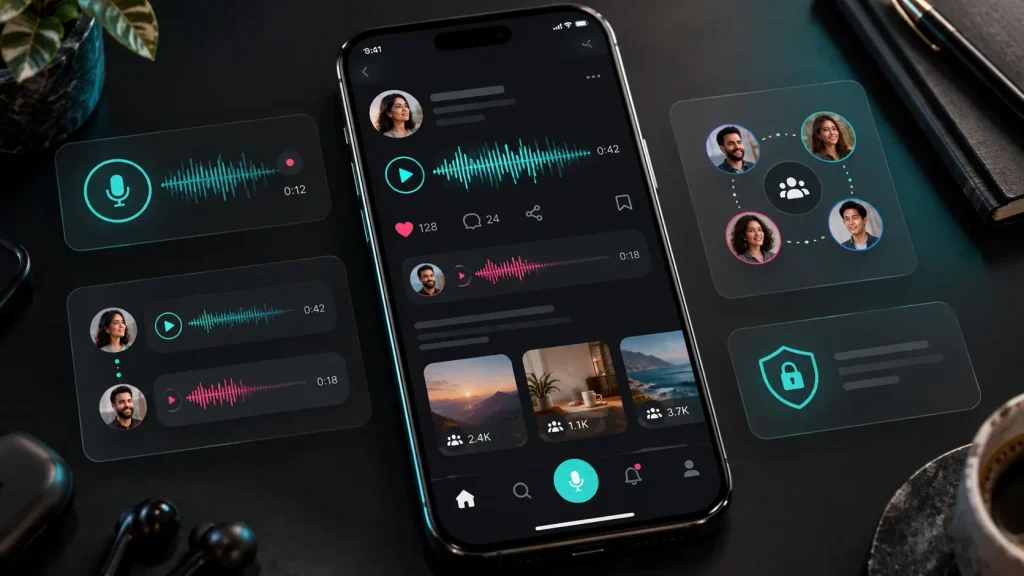
The main features of voice-based social media apps typically include voice posts, audio conversations, interest-based communities, content discovery, creator profiles, and audio recording tools. Some applications also provide editing features, privacy controls, and moderation systems to support safer participation.
However, not every social audio platform includes every feature. Recorded voice-sharing apps, live conversation platforms, and community-focused services may offer different experiences.
Voice Posts and Short Audio Updates
Voice posts are one of the defining features of audio-based social media platforms.
A voice post is a recorded audio update that users share with others through a social application.
It can contain a personal thought, brief story, opinion, question, or creative performance.
For example, a creator might publish a short recording describing an interesting conversation they had during their morning commute.
Instead of writing a caption about the experience, they narrate it in their own voice.
This format can be useful for:
- Sharing personal experiences and everyday observations.
- Creating short fictional stories or spoken poetry.
- Discussing a topic without producing video.
- Asking questions that encourage audience participation.
- Publishing brief educational or entertaining audio updates.
The length of a voice post depends on the platform. Some services emphasize very short recordings, while others support longer audio.
Short-form voice content often benefits from a simple structure: introduce one idea, communicate it clearly, and finish with a meaningful thought or question.
For example, a spoken post could begin:
“What’s one sound that instantly reminds you of your childhood?”
The creator might then describe a familiar memory and invite listeners to reflect on their own experiences.
A simple question can become the starting point for a wider audio conversation.
Audio Conversations and Voice Responses
Audio conversations allow users to communicate beyond publishing individual recordings.
Depending on the application, these interactions may happen through recorded replies, structured discussion prompts, or live spoken exchanges.
Recorded voice responses allow participants to contribute at different times.
A listener might hear a post about a favourite book and record a response explaining why they enjoyed a different title.
The original creator and other participants can engage with the discussion when convenient.
This is known as asynchronous communication because participants do not need to be online simultaneously.
Live audio conversations, by contrast, involve people speaking in real time.
Participants may join a digital conversation space where speakers exchange ideas while other users listen.
The experience is closer to a live discussion or group call, although the available participation controls vary.
Both formats offer opportunities for social engagement.
Recorded responses can be convenient for people who prefer to think before speaking, while live conversations allow immediate exchanges.
The most appropriate format depends on whether users want spontaneous interaction or the flexibility to participate at different times.
Voice Communities and Interest-Based Groups
Voice communities bring together people who share interests and want to connect through spoken content.
These communities might focus on storytelling, entertainment, poetry, regional culture, personal interests, or creative hobbies.
For example, a group of people interested in Hindi poetry could use a voice-based community to share recitations, discuss writing styles, and introduce lesser-known poets.
Similarly, regional-language communities might encourage members to exchange stories, memories, and cultural experiences in the languages they know best.
Community features can support several forms of participation:
Shared interests: Members gather around topics they enjoy discussing.
Recurring conversations: Familiar themes encourage people to return and participate.
Creator-listener interaction: Audiences can contribute perspectives rather than only consume finished content.
Community identity: Shared language, culture, or creative interests can make participation more relevant.
However, a large number of members does not automatically create a meaningful community.
Healthy participation depends on relevant conversations, respectful behaviour, and opportunities for members to contribute.
Users who want to understand how these relationships develop can explore voice communities and the role of audio participation in online groups.
Audio Content Discovery and Creator Profiles
Content discovery helps people find voice recordings and creators that match their interests.
Without useful discovery features, even well-produced audio content may be difficult for potential listeners to encounter.
Voice-based social media apps may organize recordings through categories, topics, community spaces, creator profiles, or recommendation systems.
For example, someone interested in fictional mysteries might explore audio storytelling content, discover a creator whose narration they enjoy, and return for future posts.
Creator profiles can make this process easier by giving audiences a recognizable place to explore a person’s work.
Depending on the platform, a profile may include published recordings, descriptive information, and supported ways to follow or interact with the creator.
Effective discovery serves two audiences.
For listeners, it reduces the effort required to find relevant conversations and content.
For creators, it provides opportunities to reach people beyond their existing personal networks.
However, recommendations are not identical across platforms. Some services use algorithmic feeds, while others rely more heavily on categories, communities, or manual exploration.
Creators should therefore understand how their chosen platform organizes and presents content.
Recording, Editing and Audio Creation Tools
Audio creation tools help users turn spoken ideas into content suitable for sharing.
At a basic level, recording requires a microphone and a way to capture audio.
Many smartphones already provide the necessary hardware, making voice content creation accessible without specialized recording equipment.
Depending on the platform, additional tools may include:
- Voice recording: Capture narration, dialogue, or spoken updates.
- Audio import: Use an existing recording where the application supports uploads.
- Trimming and editing: Remove unwanted sections or improve the flow of a recording.
- Music and sound effects: Add relevant audio elements to support creative expression.
- Script assistance: Organize thoughts before recording, sometimes using AI-assisted suggestions.
- Audio enhancement: Improve recording clarity where suitable processing tools are available.
For example, a creator producing a short fictional story might begin with a simple script, record the narration, remove an unnecessary pause, and add a subtle environmental sound.
The finished recording should remain easy to understand.
Additional effects are useful only when they improve the listening experience.
Creators who regularly produce audio content may also benefit from learning basic microphone positioning, vocal delivery, and sound editing techniques.
The most important production priority is clear communication, not elaborate equipment.
Privacy, Accessibility and Community Safety
Privacy, accessibility, and safety are essential considerations when choosing or using a voice-based social media app.
Voice recordings can contain personal information even when no photographs or videos are shared.
A person’s voice may reveal recognizable characteristics, emotional states, languages, or details about their surroundings.
Users should therefore understand what information they are sharing and how the application handles it.
Privacy controls
Before publishing, review the platform’s available audience settings, account controls, data practices, and reporting options.
Avoid sharing sensitive information such as private addresses, financial details, or personal contact information in public recordings.
Accessibility features
Audio-first platforms may present challenges for people who cannot hear recordings clearly or who prefer written communication.
Accurate transcripts, captions, compatible navigation controls, and alternative ways to access important information can make an experience more inclusive.
Availability varies between applications.
Community moderation
Voice-based conversations can involve harassment, misleading information, impersonation, or inappropriate content, just like other social platforms.
Useful safeguards may include reporting, blocking, participation controls, and clear community rules.
Responsible audio creation
Creators should avoid recording or publishing another person’s voice without appropriate permission.
Synthetic speech and voice-cloning tools also require care because realistic audio can potentially be used to misrepresent someone’s identity.
A trustworthy voice-first platform should make its safety practices understandable and provide users with meaningful ways to manage their experience.
How Is Voice-Based Social Media Different From Traditional Social Media?

Voice-based social media differs from traditional social media by making spoken audio the primary format for creating content and interacting with others. Conventional social platforms typically emphasize combinations of text, photos, and videos, while voice-first services focus on recordings, audio conversations, and spoken participation.
However, these categories overlap. A platform may support several media formats, and voice-based communication is not inherently better than visual or written communication.
Voice-Based Social Media vs Text and Video Platforms
The main difference between voice-based social media and text or video platforms is the format users rely on to communicate.
Text-based social networking emphasizes written expression.
Video-based platforms combine moving images, speech, music, and other visual elements.
Voice-first platforms place spoken communication at the centre of the experience.
The following comparison highlights common differences.
| Feature | Voice-based social media | Text-based social media | Video-based social media |
| Primary content | Spoken audio | Written posts | Recorded or live video |
| Main creative focus | Voice, dialogue, and sound | Language and written expression | Visual presentation and audiovisual storytelling |
| Camera required | Generally no | No | Usually yes for original filmed content |
| Typical creation process | Record and review audio | Write and edit text | Film and edit video |
| Audience experience | Listening and audio participation | Reading and text interaction | Watching and listening |
| Common strengths | Vocal expression and screen-light participation | Scannability and precise written information | Visual demonstrations and audiovisual context |
| Common limitations | Audio can be difficult to skim or access without transcripts | Tone can be misunderstood | Filming and editing may require more effort |
These differences influence the kind of content people choose to create.
For example, a cooking creator demonstrating a complicated recipe may prefer video because viewers need to see the process.
A writer sharing a detailed argument may prefer text because readers can scan and revisit specific points.
Someone recounting a funny incident may prefer voice because timing, laughter, and expression contribute to the experience.
Voice-based social media can also appeal to people who want to explore less visually demanding digital experiences.
However, listening does not automatically reduce overall screen time or improve wellbeing. Those outcomes depend on individual usage habits and platform design.
For further discussion of mindful technology use, explore reduce screen time and approaches to creating healthier digital routines.
Voice-Based Social Media vs Podcasts
Voice-based social media and podcasts both use audio, but their primary purposes and patterns of interaction can differ.
Podcasts are generally organized audio programmes published as episodes, while voice-based social media focuses on sharing spoken content within a social network that supports discovery and participation.
A podcast may feature a host presenting interviews, discussions, fictional stories, or educational content.
Listeners commonly discover episodes through podcast applications, subscribe to programmes, and listen when convenient.
A voice-based social media app may instead encourage users to publish shorter audio updates, respond to conversations, and interact with creators or communities.
| Aspect | Voice-based social media | Podcasts |
| Main purpose | Social expression and interaction | Publishing and listening to audio programmes |
| Content organization | Posts, conversations, creators, or communities | Shows, seasons, and episodes |
| Typical content length | Often short, but varies | Often longer, but varies |
| Audience participation | May include voice replies and community interaction | Often through separate feedback or community channels |
| Publishing structure | Frequently conversational and flexible | Frequently organized around recurring programmes |
| Creator experience | Can emphasize everyday posting and participation | Can emphasize planned episode production |
For example, a creator might produce a weekly 30-minute podcast exploring Indian folklore.
On a voice-based social platform, the same creator might share a short reflection about a folktale and invite others to contribute memories or interpretations.
Both formats can support storytelling, but they offer different participation experiences.
Some podcast platforms include community tools, and some voice-based social platforms support longer recordings. The categories are therefore not mutually exclusive.
The useful distinction is whether the experience is primarily built around an episodic audio programme or around social interaction through voice.
Voice-Based Social Media vs Live Audio Chat Apps
Voice-based social media is sometimes confused with live audio chat applications.
The difference is that voice-based social networking can include recorded audio posts and asynchronous interaction, while live audio chat apps primarily facilitate conversations happening in real time.
In a live audio room, participants usually need to be present during the conversation to speak and respond immediately.
Recorded voice-sharing platforms allow people to create and consume content at different times.
For example, consider a discussion about the future of regional-language entertainment.
In a live audio room, participants might join at a scheduled time and exchange opinions as the conversation unfolds.
On a recorded voice-sharing platform, one user might publish a spoken observation in the morning. Another person could listen and contribute a response later in the day, depending on the application’s features.
Both approaches support audio interaction, but they suit different preferences.
Live audio is useful when:
- Participants want immediate discussion.
- An event benefits from spontaneous questions.
- Speakers are available at the same time.
- Real-time interaction is central to the experience.
Recorded social audio is useful when:
- Participants prefer flexible listening.
- Creators want to review content before publishing.
- Audiences live in different time zones.
- Conversations do not require everyone to be present simultaneously.
Some platforms combine live and recorded experiences, so users should compare actual features before choosing an application.
When Should Someone Choose a Voice-First Platform?
A voice-first platform may be a good choice for people who enjoy speaking, listening, storytelling, or participating in conversations without making video production central to their online activity.
The format can be useful for several types of users.
Everyday social media users
Someone who prefers talking rather than typing may find voice posts a more natural way to share everyday experiences.
Independent creators
Writers, storytellers, poets, comedians, and commentators can experiment with spoken content without needing extensive visual production.
For example, a fiction creator might share a short character monologue or narrated scene.
Regional-language speakers
People who communicate more comfortably in their native language can explore spoken expression without always having to compose lengthy written posts.
The availability of relevant language communities will vary by platform.
Community participants
Users interested in exchanging experiences and opinions may enjoy topic-based audio discussions.
People exploring alternatives to video-focused content
Voice-first applications allow users to participate without continuously appearing on camera.
However, they are not ideal for every activity.
Visual demonstrations, detailed diagrams, searchable instructions, or situations requiring silent communication may work better through video or text.
Audio can also be inconvenient in noisy environments or shared spaces, and it may require accessibility alternatives.
Before choosing a platform, consider four practical questions:
- Do I want to create content, participate in conversations, or primarily listen?
- Do I prefer recorded audio posts or live discussions?
- Are the topics, creators, and language communities I care about available?
- Does the platform offer suitable privacy, safety, and accessibility features?
The best voice-based social media app is the one that matches how you want to communicate and the communities you want to join.
Voice-first social networking is most valuable when spoken expression contributes something meaningful to the experience, whether that means telling a personal story, sharing a creative idea, or connecting with people through conversation.
What Are Some Examples of Voice-Based Social Media Apps?
Examples of voice-based social media apps include Arré Voice, Clubhouse, and X Spaces, although each supports a different type of audio interaction. Arré Voice focuses on short voice posts, audio conversations, and communities. Clubhouse emphasizes live voice chats, while X Spaces brings real-time audio discussions into a broader social network.
Understanding these differences helps users choose a platform based on whether they want to publish voice recordings, participate in live conversations, discover creators, or build relationships around shared interests.
If you want to share short recorded stories or spoken thoughts, Arré Voice offers an audio-first social experience. If you prefer real-time group discussions, platforms such as Clubhouse and X Spaces are designed around live audio conversations. The right choice depends on whether you prefer recorded voice posts, live interactions, or interest-based communities.
Short-Form Voice Sharing Platforms
Short-form voice sharing platforms allow users to publish brief audio recordings instead of relying primarily on written captions, photographs, or videos.
These recordings may contain personal opinions, short stories, spoken questions, creative performances, or everyday observations.
Arré Voice is an example of a short-form voice-based social media app. Its Voicepods feature allows users to create 30-second audio posts that others can discover and engage with.
For example, someone interested in films could record a brief opinion about a recently watched movie. Another creator might share a short fictional scene, a funny experience, or a thought-provoking question.
The format encourages users to communicate one idea clearly rather than develop an extended audio programme.
Short-form voice sharing can be useful for:
- Posting everyday thoughts without recording a video.
- Sharing brief stories, jokes, poetry, or personal experiences.
- Experimenting with spoken creative content.
- Introducing discussion topics through audio.
- Developing a recognizable voice-based online identity.
Unlike conventional audio recordings stored privately on a device, voice posts are designed for discovery and interaction within a social environment.
Their value comes not only from the recording itself but also from the conversations and connections it may encourage. For readers comparing different ways to communicate through audio, our guide to social audio apps explains how short voice posts, live audio conversations, and community-based platforms differ.
Live Audio Conversation Platforms
Live audio conversation platforms allow people to communicate through voice in real time.
Instead of publishing a recording and waiting for others to respond, users join ongoing discussions where participants speak and listen simultaneously.
Clubhouse is an example of a social audio app focused on live voice conversations.
Its live rooms bring people together around shared topics. Participants can listen to ongoing discussions, while hosts and moderators manage speaking opportunities.
A live room might feature a conversation about entrepreneurship, books, entertainment, or creative careers.
Listeners can follow the discussion and, where permitted, request to contribute their perspectives.
X Spaces is another example of live audio interaction.
Spaces allows users to host and join real-time audio conversations within X. Hosts can introduce topics, invite speakers, and manage participation while listeners follow the discussion.
For example, a film enthusiast could host a conversation about regional cinema and invite participants to share their opinions.
Live audio platforms are especially relevant when immediate discussion is the main objective.
They can support interviews, audience questions, informal debates, and conversations about current topics.
However, live sessions also require coordination. Participants may miss discussions because of timing, connectivity, or other commitments.
This distinguishes live audio conversations from recorded voice posts, which can generally be accessed after publication.
Community-Based Audio Platforms
Community-based audio platforms organize participation around shared interests, recurring conversations, and relationships between members.
Rather than concentrating only on individual recordings or one-time live sessions, they provide ways for people to discover others who enjoy similar topics.
For example, a community interested in regional-language poetry might encourage members to share original recitations, discuss favourite poets, and exchange creative feedback.
Another community could focus on audio fiction, with participants discussing characters, sharing short performances, and recommending stories.
Community-based social audio can support:
Interest-based discovery: Users find people who enjoy similar topics.
Recurring participation: Members return to contribute to ongoing conversations.
Creator collaboration: People exchange ideas or participate in shared creative activities.
Audience relationships: Listeners interact with creators and other community members.
Clubhouse supports interest-based participation through its Houses and live rooms.
Arré Voice also offers a community-oriented experience through Voiceclubs, which bring voice content and social participation together around shared interests.
For a deeper exploration of community development beyond individual posts, read about creator communities and how shared interests can support ongoing relationships.
Arré Voice as an Example of Voice-First Social Networking
Arré Voice demonstrates how a voice-based social media app can combine content creation, discovery, and social participation.
Rather than functioning only as a live audio chat service or a conventional podcast platform, Arré Voice organizes experiences around short recorded content and community interaction.
Its main social audio formats include:
| Arré Voice feature | What it does |
| Voicepods | Allow users to create and share 30-second audio posts |
| Voicepools | Enable users to respond to questions or prompts with audio contributions |
| Voiceclubs | Provide community spaces organized around shared interests |
| Playlists | Allow users to collect and revisit Voicepods |
| Creator Studio | Provides tools for developing and enhancing audio content |
These features serve different purposes within the same voice-first experience.
For example, a creator interested in storytelling could publish a short fictional moment as a Voicepod.
To encourage participation, the creator could start a Voicepool asking listeners to describe a memorable character from a story.
People interested in similar content could also explore relevant Voiceclubs and discover other creators.
The platform therefore supports more than individual audio publishing. It connects spoken content with discovery, participation, and shared interests.
For users exploring voice-first social networking in India, Arré Voice provides a practical example of how short audio content can become part of an interactive social experience.
Example of a Short-Form Voicepod
A practical way to understand voice-based social media is to explore a short Voicepod on Arré Voice.
Voicepods allow creators to communicate a focused thought, story, opinion, or experience through a 30-second recording. This format brings spoken expression into a social environment where people can discover content and explore voices connected to their interests.
A real Voicepod example can demonstrate how a creator uses tone, pacing, and personal expression to communicate an idea without relying on video.
Readers can explore more voice-based content through Arré Voice.
Why Are People Exploring Voice-Based Social Media?

People explore voice-based social media because it offers ways to communicate without depending on visual content, express personality through speech, and participate in conversations around shared interests. Voice-first platforms can make everyday storytelling and spoken interaction more accessible to users who prefer talking over typing or appearing on camera.
However, audio-first communication also has limitations, including accessibility challenges, privacy concerns, and situations where text or video may be more convenient.
Sharing Thoughts Without Appearing on Camera
One reason people explore voice-based social media is the opportunity to express themselves without making their appearance central to the content.
On many video-focused platforms, creators must consider lighting, camera angles, visual presentation, and editing.
Voice-first social networking places greater emphasis on spoken expression.
For example, a student who wants to share an opinion about a favourite novel could record a short audio post rather than prepare a video.
Similarly, someone who enjoys telling stories might feel more comfortable narrating an experience without appearing on camera.
This approach can be useful for people who:
- Prefer speaking to recording videos.
- Want to share spontaneous thoughts or short stories.
- Enjoy audio-based creative expression.
- Have limited video production equipment.
- Want to focus more on communication than visual presentation.
However, not appearing on camera does not guarantee anonymity.
A recognizable voice, personal details, or background sounds may reveal information about the speaker.
Users should therefore consider privacy before sharing recordings publicly.
Voice-first social media offers another way to participate, but it should be understood as a communication choice rather than a completely private alternative to visual platforms.
Expressing Emotion and Personality Through Voice
Voice can communicate emotional and conversational cues that are difficult to reproduce through written words alone.
Tone, rhythm, emphasis, hesitation, and laughter can influence how a message is understood.
Consider the sentence:
“That was an interesting experience.”
Spoken with excitement, it may communicate enthusiasm.
Delivered slowly with an uncertain tone, it could suggest discomfort or disappointment.
The words remain the same, but vocal expression changes their meaning.
This makes voice-based social media particularly relevant for storytelling, humour, poetry, and personal reflections.
A creator describing a funny childhood incident can use timing and laughter to communicate the experience.
Someone sharing a meaningful personal memory might use pauses and a softer speaking style to express emotion.
These qualities can help listeners understand the speaker’s intended tone and personality.
However, voice does not eliminate misunderstandings.
Listeners may interpret vocal cues differently depending on cultural background, language, context, and personal expectations.
The strongest audio communication therefore combines expressive delivery with clear language and a recognizable message.
Listening and Participating During Everyday Activities
Audio content can fit into situations where continuously watching a screen is inconvenient.
People may choose to listen to voice posts while walking, performing household tasks, travelling as passengers, or taking a break from visually demanding activities.
For example, someone commuting on public transport might listen to short audio stories or discussions about topics they enjoy.
Another person might follow a spoken conversation while completing a routine household activity.
This flexibility is one of the practical benefits of voice-based social media.
Listening does not always require continuous visual attention, although interacting with the app may still involve its screen and controls.
The experience can be especially useful for short updates, conversations, storytelling, and content that does not require visual demonstrations.
However, multitasking has limitations.
Complex information may be harder to understand when attention is divided, and users should avoid activities that require full concentration, such as driving, when listening would create a distraction.
Voice-based social networking is most useful when the listening experience fits safely and comfortably into the user’s routine.
Connecting Through Shared Interests and Conversations
Social media is not only about publishing content. It also provides opportunities to discover people with similar experiences and interests.
Voice-based platforms can support this through spoken discussions, audio prompts, creator interactions, and community spaces.
Imagine a person who enjoys traditional Indian folktales.
They might discover a creator narrating a regional story, listen to related recordings, and participate in a conversation about similar stories from their childhood.
Another user interested in music might respond to a prompt asking which song reminds them of their hometown.
These interactions can create opportunities for personal expression and shared discovery.
Voice communities may be organized around subjects such as entertainment, literature, humour, regional culture, or creative interests.
Language can also play an important role.
For people who prefer communicating in Hindi, Tamil, Telugu, Marathi, Bengali, or another language, spoken content may provide a comfortable way to express familiar experiences.
The availability of relevant language communities and content varies between applications.
Importantly, meaningful online relationships do not develop simply because people can hear one another.
Respectful communication, recurring participation, and shared interests remain essential.
Voice creates another way to interact, while the quality of the conversations determines their value.
Understanding the Limitations of Audio-First Communication
Although voice-based social media offers useful alternatives to text and video, audio is not ideal for every situation.
One important limitation is content accessibility.
People who are deaf or hard of hearing may need accurate transcripts or alternative formats to access spoken content.
Audio can also be inconvenient in noisy surroundings or situations where listening aloud is inappropriate.
Another challenge is information discovery.
A written post can often be scanned quickly, while listeners may need more time to identify a specific point within an audio recording.
Other limitations include:
Limited visual communication: Some topics, such as design demonstrations or detailed instructions, are easier to explain through images or video.
Recording quality: Background noise, unclear speech, and inconsistent volume can reduce the listening experience.
Privacy concerns: Voice recordings may reveal identifying information or be copied and redistributed.
Language barriers: Listeners may struggle to understand unfamiliar accents or languages without suitable accessibility tools.
Moderation challenges: Spoken content can contain harassment, misinformation, or impersonation, requiring effective reporting and safety measures.
These challenges do not make voice-first platforms less valuable. They show why audio should complement other communication formats rather than replace them entirely.
The best social media experience depends on the user’s communication preferences, accessibility needs, and intended activities.
How Can Creators Use Voice-Based Social Media Apps?
Creators can use voice-based social media apps to share personal stories, produce short audio entertainment, start conversations, develop a recognizable creative style, and engage with listeners through communities. These platforms allow creators to experiment with spoken content without making video production a requirement.
For beginners, the most effective approach is to choose a clear topic, develop a natural speaking style, and create content that gives audiences a reason to listen or participate.
Share Personal Stories and Everyday Experiences
Personal storytelling is one of the simplest ways to begin creating voice content.
Everyday experiences can become interesting audio posts when they contain a recognizable situation, emotion, or observation.
A creator might describe an unexpected conversation, a funny misunderstanding, a meaningful childhood memory, or an experience from travelling.
For example, imagine a short voice post beginning:
“I never realized how much I missed my hometown until I heard the evening temple bell again.”
The creator could continue with a brief memory explaining why that sound matters.
A familiar experience becomes a personal narrative through the speaker’s own voice.
To make everyday stories engaging, creators should focus on:
A clear opening: Introduce the situation without unnecessary background information.
One central experience: Avoid covering too many unrelated events in a short recording.
Natural expression: Speak in a conversational style that reflects the intended emotion.
A meaningful ending: Finish with an observation, reflection, or question.
Personal stories do not always need dramatic events.
Small moments can create relatable content when they reveal something meaningful about a person’s experiences.
Creators interested in developing their storytelling abilities can explore real-life stories and different approaches to transforming everyday experiences into engaging narratives.
Create Short Audio Entertainment and Fiction
Voice-based social media can also support creative entertainment through fictional dialogue, spoken poetry, short dramas, humour, and storytelling.
Unlike longer audio programmes, short voice posts usually benefit from focusing on one memorable scene or idea.
For example, a creator could produce a brief mystery around the following opening:
“Every night at exactly eleven, someone knocks on my door. The strange part is that I live alone.”
The next few seconds could introduce a surprising detail or develop the mystery before ending with a meaningful revelation.
Even a compact narrative can use basic storytelling principles:
- Introduce a character or situation.
- Establish curiosity or conflict.
- Develop one meaningful event.
- End with a clear payoff or purposeful unresolved question.
Voice performance can make these stories more engaging.
Changes in speaking pace, emphasis, and timing can distinguish characters and communicate emotional shifts.
Creators may also experiment with permitted background music or sound effects where their chosen platform supports them.
However, effects should reinforce the story rather than distract from the narration.
Independent creators can begin with simple recordings and improve their production skills through practice.
For additional creative approaches, explore short audio stories and how concise narratives can communicate meaningful experiences.
Start Conversations Through Questions and Prompts
Voice-based social media becomes more interactive when creators invite listeners to contribute their own perspectives.
Questions and prompts can turn individual audio posts into conversations.
For example, a creator interested in storytelling might ask:
“Which fictional character would you invite to dinner, and why?”
A music enthusiast could ask:
“What’s one song you never skip, no matter how many times you’ve heard it?”
These prompts provide a clear starting point for participation.
Effective conversation prompts usually share three characteristics.
They are easy to understand. Listeners should recognize the question without requiring a long explanation.
They encourage personal responses. Questions about experiences, preferences, and memories can invite different perspectives.
They suit the platform’s format. A short audio response should be sufficient to make a meaningful contribution.
Creators can also use prompts to develop recurring themes.
A weekly storytelling question, for example, could encourage participants to return with new experiences.
On platforms that support structured audio responses, these interactions can become part of a wider conversation rather than remaining isolated posts.
Arré Voice’s Voicepools feature is one example of a prompt-based audio participation format.
However, creators should avoid treating engagement as a competition for responses.
A thoughtful conversation with a smaller group may provide more meaningful participation than a popular prompt that generates little genuine discussion.
Develop a Recognizable Creator Voice
A recognizable creator identity helps audiences understand what type of content to expect.
In voice-based social media, that identity can emerge through the creator’s topics, speaking style, personality, and recurring storytelling approach.
For example, one creator might become known for humorous observations about everyday life.
Another might focus on regional-language folktales delivered through expressive narration.
A third could specialize in brief educational explanations using simple language.
These creators may use similar recording tools, but their content feels different because of the way they communicate.
A recognizable creator voice develops through several choices.
Choose a clear content direction
Identify the topics or experiences you genuinely enjoy discussing.
Maintain a natural speaking style
Avoid imitating another creator’s personality simply because their content is popular.
Use familiar content formats
Recurring themes can help audiences understand your creative focus.
Improve vocal delivery
Practice articulation, pacing, emphasis, and microphone technique.
Remain open to experimentation
A recognizable style does not mean repeating the same recording format indefinitely.
Creators can change their approach while maintaining a consistent identity.
For people exploring online content creation, digital creators offers broader context on developing creative work and participating in digital platforms.
Build Relationships With Listeners and Communities
Building an audience through voice-based social media involves more than regularly publishing recordings.
Creators also need to participate in conversations, understand audience interests, and contribute to communities where their content is relevant.
For example, someone producing short mystery stories could participate in discussions about fiction, ask listeners which narrative themes they enjoy, and respond thoughtfully to feedback.
Over time, these interactions may help the creator develop relationships with people who appreciate their content.
Practical approaches include:
Participate consistently: Share content and engage in conversations at a sustainable pace.
Respond meaningfully: Acknowledge useful suggestions and contribute to relevant discussions.
Explore appropriate communities: Join groups or conversations that match your creative interests.
Encourage thoughtful participation: Ask questions that invite genuine perspectives rather than superficial reactions.
Learn from feedback: Identify which topics listeners understand, enjoy, or want to explore further.
Creators should also respect the boundaries and expectations of community members.
Avoid repeatedly promoting unrelated content, pressuring people to engage, or sharing other people’s recordings without permission.
Audience growth is not guaranteed by posting frequency alone.
It depends on factors such as content quality, relevance, discoverability, consistency, and the relationships creators develop.
A useful starting point is to focus on producing content that people value and participating in conversations where the creator has something meaningful to contribute.
Voice-based social media gives creators a way to build their presence through spoken expression, but lasting engagement develops through meaningful content and genuine participation.
How to Get Started With Voice-Based Social Media
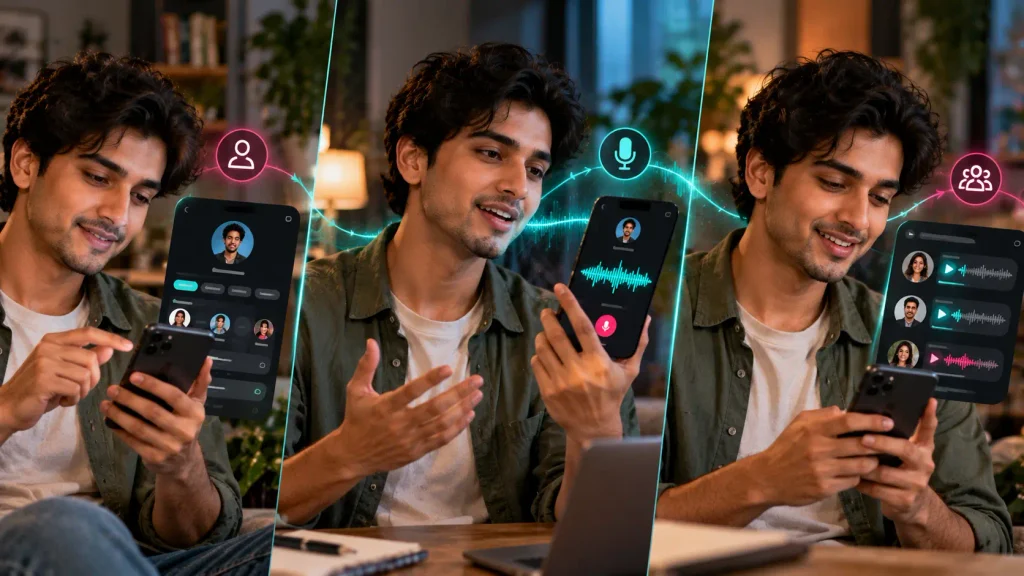
Getting started with voice-based social media involves choosing a suitable platform, creating a profile, planning a short audio post, recording your voice, and participating in relevant conversations. Beginners can use a smartphone to create their first recording without investing in professional equipment or developing complicated production skills.
The following six steps explain how to begin sharing voice content while developing a natural speaking style and understanding what listeners find engaging.
Step 1: Choose a Platform That Matches Your Goals
Before joining a voice-based social media app, decide what you want to achieve through audio communication.
Some platforms emphasize live conversations, while others support recorded voice posts, storytelling, or interest-based communities.
For example, someone who enjoys spontaneous discussions may prefer a platform with live audio rooms. A creator interested in short fictional stories might benefit from an application designed for recording and sharing audio posts.
Consider these factors when comparing social audio apps:
- Content format: Does the platform support short recordings, longer audio, live discussions, or multiple formats?
- Audience interests: Can you discover people interested in your preferred topics?
- Community features: Are there opportunities to participate in conversations and groups?
- Creation tools: Can you easily record, review, and prepare your audio?
- Language support: Does the platform accommodate your preferred language and audience?
- Safety and privacy: Are reporting tools and relevant account controls available?
Choosing the right platform begins with understanding how you want to communicate rather than simply selecting the application with the most features.
If storytelling is your primary interest, explore how a storytelling app can support audio creation and sharing before deciding which experience best suits your goals.
Step 2: Set Up Your Creator Profile
After choosing a platform, create a profile that helps other users understand your interests and the type of audio content you want to share.
A useful creator profile does not need an elaborate description.
It should simply communicate who you are comfortable presenting yourself as and what listeners can expect.
For example, someone interested in regional storytelling might use a description such as:
“Sharing short Hindi stories, childhood memories, and everyday observations through voice.”
A creator focused on entertainment could describe their interests in films, fictional characters, or humorous conversations.
When setting up your profile:
Choose a recognizable display name. Use a name or creator identity that suits your content and privacy preferences.
Write a concise description. Mention your primary topics or creative interests.
Select relevant interests. Where the platform supports them, choose categories that reflect the content you want to explore.
Review your account settings. Understand what profile information and recordings may be visible to others.
Keep your presentation consistent. A recognizable identity makes it easier for returning listeners to identify your content.
You do not need to establish a complete personal brand before sharing your first recording.
Your profile and creative direction can develop as you gain experience.
Step 3: Plan Your First Voice Post
A successful first voice post usually begins with one clear idea.
Rather than trying to introduce everything about yourself, focus on a subject you can explain naturally within the recording duration supported by the platform.
Beginners can start with topics such as a favourite childhood memory, a personal observation, an interesting question, or a short fictional moment.
For example, imagine creating a voice post around the question:
“What’s one sound that instantly reminds you of home?”
You could briefly describe a familiar sound and explain why it matters to you.
A simple planning structure works well:
Opening: Introduce the topic or ask an engaging question.
Main message: Share one experience, opinion, or idea.
Closing: Finish with a meaningful observation or invitation to participate.
For a short recording, avoid including too many unrelated points.
You can write a complete script if that makes you comfortable, but it is equally useful to prepare a few speaking notes.
The goal is to communicate clearly without making the recording sound unnecessarily rehearsed.
Step 4: Record and Review Your Audio
Once your idea is ready, record the audio using your chosen platform’s recording feature or another supported method.
A smartphone microphone can be sufficient for a first recording, particularly in a quiet environment.
Choose a location with minimal background noise and hold the device at a consistent distance while speaking.
Before recording the complete post, perform a short sound check.
Listen for unwanted noise, distorted speech, or sudden changes in volume.
During recording, focus on three essentials:
Clarity: Speak at a comfortable pace so listeners can understand your words.
Expression: Allow natural changes in tone and emphasis to communicate your personality.
Timing: Keep the recording focused on its central idea and within the platform’s duration limits.
After recording, listen to the entire audio before publishing.
Ask yourself whether the opening is understandable, the main point is clear, and the ending feels complete.
If the platform provides editing tools, remove distracting mistakes or unnecessary pauses.
For most first-time creators, clear and authentic communication matters more than elaborate audio effects.
Step 5: Publish and Join Relevant Conversations
Publishing your first voice post is only one part of participating in a voice social network.
The next step is to explore conversations, creators, and communities related to your interests.
Where supported, add an appropriate title, category, or description that helps users understand your recording.
After publishing, explore other audio posts and listen to how creators communicate.
For example, someone interested in storytelling could discover short fiction creators and participate in conversations about favourite characters or memorable stories.
A person interested in regional culture might explore audio discussions connected to local traditions and languages.
When participating, aim to contribute something meaningful.
A thoughtful response, relevant question, or shared experience can be more valuable than repeatedly promoting your own content.
Avoid posting unrelated recordings in communities simply to attract attention.
Voice-based social media works best when users approach it as a space for communication rather than only a channel for distributing posts.
Step 6: Improve Your Content Through Listener Feedback
Your first voice recording does not need to be perfect.
Creating engaging audio becomes easier when you learn which topics, formats, and speaking styles work for your intended audience.
After publishing several posts, review the feedback and engagement information your platform makes available.
Consider questions such as:
- Do listeners understand the message you are sharing?
- Which topics encourage relevant conversations?
- Are your recordings easy to hear and follow?
- Do people respond more to stories, opinions, or questions?
- Which parts of your content could be shorter or clearer?
When possible, ask trusted listeners for specific feedback.
Instead of asking whether a recording was good, ask which moment they found most interesting or whether anything was difficult to understand.
Experiment with different openings, storytelling approaches, and content themes.
For example, you might compare a short personal story with a direct question about the same topic.
The objective is not to imitate every popular creator.
It is to develop an approach that communicates your interests effectively and gives listeners a reason to return.
Starting with voice-based social media is straightforward: choose a format, share something meaningful, listen to others, and improve through participation.
How Is Voice-Based Social Media Evolving in 2026?
In 2026, voice-based social media is evolving through mobile-first audio creation, AI-assisted production, multilingual content, and community-focused experiences. These developments are expanding the ways people can create and participate in spoken digital content while raising important questions about accessibility, privacy, authenticity, and responsible voice technology.
Rather than replacing traditional social media, voice-first communication is developing as another format within the broader digital content ecosystem.
Short-Form Audio and Mobile-First Social Experiences
Short-form audio offers an alternative to visually demanding social content.
Instead of preparing an extended podcast or recording a video, users can communicate an idea through a brief spoken update.
Smartphones provide a practical foundation for this format because they combine microphones, audio playback, internet connectivity, and social applications in a single device.
A creator might record an observation during a break, share a short fictional scene, or ask a question that encourages others to participate.
The mobile-first approach can reduce some production barriers, although publishing and discovering content still depend on the chosen application’s features.
Short-form audio is particularly suitable for:
- Everyday thoughts and personal reflections.
- Brief fictional stories or spoken entertainment.
- Questions that encourage community participation.
- Short educational explanations.
- Regional-language conversations and cultural expressions.
However, shorter recordings are not automatically more engaging.
A compelling audio post still needs a clear idea, appropriate pacing, and a meaningful conclusion.
Creators should prioritize communicating one useful or entertaining message rather than filling every available second.
Mobile-first experiences also benefit from practical design choices, including understandable navigation, clear recording controls, and audio that remains intelligible across common listening devices.
AI-Assisted Audio Content Creation
Artificial intelligence is changing how digital creators prepare scripts, produce recordings, and edit audio.
AI-assisted tools can help transform an initial idea into structured content, making it easier for beginners to overcome challenges such as deciding what to say or organizing a recording.
For example, a creator interested in producing a short mystery could use an AI writing tool to develop an opening sentence or explore different story directions.
The creator could then personalize the script, record the narration, and refine the audio.
AI-supported creation workflows may include:
Idea development: Generating possible topics, questions, or narrative concepts.
Script preparation: Organizing a creator’s thoughts into a clear spoken structure.
Audio editing: Supporting noise reduction, transcription, and other editing tasks.
Synthetic speech: Generating voice output where appropriate tools, rights, and permissions exist.
Language adaptation: Helping creators prepare multilingual content, subject to human review.
These capabilities vary between tools and platforms.
Not every social audio app supports AI-generated scripts, synthetic voices, or automatic audio enhancement.
More importantly, AI-assisted production should not eliminate the creator’s responsibility for the content.
Automatically generated dialogue may sound unnatural, misrepresent facts, or overlook important cultural details.
Creators should review and personalize AI outputs before publication.
For a deeper explanation of creative workflows, explore AI voice creator and how AI can support the process from initial ideas to finished audio.
Regional Languages and Multilingual Voice Communities
Regional-language content is an important opportunity for voice-based social media, particularly in linguistically diverse markets such as India.
Spoken communication allows creators to express thoughts using familiar vocabulary, pronunciation, conversational rhythms, and culturally relevant expressions.
For example, a Marathi storyteller might share a childhood memory using expressions that feel natural in everyday conversation.
A Tamil creator could narrate a short fictional scene, while a Hindi-speaking participant might start a discussion about familiar regional traditions.
These experiences can offer cultural relevance that may be lost when content is translated without sufficient context.
Voice-first platforms can support regional-language participation through several approaches:
- Encouraging original storytelling in local languages.
- Helping users discover content relevant to their linguistic interests.
- Supporting conversations around regional entertainment and culture.
- Providing multilingual creation tools where available.
- Offering appropriate accessibility and transcription features.
AI-assisted translation and speech technologies may also help creators prepare content for different languages.
However, automated translation cannot always reproduce humour, dialect, emotional nuance, or culturally specific references.
Human review remains essential when accuracy and authenticity matter.
For creators, the opportunity is to develop content that reflects how their communities actually speak, rather than treating regional language as a superficial translation choice.
Creator-Led Communities and Participatory Audio
Voice-based social media can support experiences where audiences participate in content rather than simply consume it.
Creator-led communities organize conversations around shared interests, familiar voices, and recurring themes.
For example, a creator producing short fictional mysteries might invite listeners to discuss possible endings or contribute their own interpretations.
A poetry creator could encourage members to share original verses around a common theme.
An entertainment community might explore favourite characters, regional films, or memorable performances through spoken discussions.
This approach moves beyond isolated audio posts toward participatory audio experiences.
Creators may use recurring prompts, community discussions, and collaborative activities to encourage meaningful interaction.
For listeners, participation provides an opportunity to contribute personal perspectives.
For creators, community conversations can reveal which topics audiences find relevant and what they would like to explore next.
However, building a community requires more than providing audio interaction features.
Respectful communication, thoughtful moderation, consistency, and shared interests contribute to a more useful experience.
The broader creator economy also includes multiple forms of audience participation, from educational communities to entertainment-focused networks.
The distinctive opportunity for social audio is to make spoken expression part of these relationships.
Privacy, Moderation and Responsible Voice Technology
As audio creation becomes easier, social platforms and creators must address the risks associated with recording, distributing, and generating voices.
One concern is voice impersonation.
Synthetic speech technology can reproduce realistic vocal characteristics, which creates opportunities for authorized creative production but also risks when used without permission.
Creators should avoid generating or distributing recordings that falsely represent real people.
Privacy is another important consideration.
Public voice recordings may contain recognizable speech patterns, names, background conversations, or other personal details.
Users should understand that audio shared publicly may be copied or redistributed beyond its original context.
Responsible voice-based social media should consider:
- Clear information about recording and publishing controls.
- Appropriate consent when using another person’s identifiable voice.
- Reporting and moderation processes for harmful content.
- Accessible alternatives for users who cannot hear spoken content.
- Transparent treatment of AI-generated or manipulated audio.
- Community standards that discourage harassment and impersonation.
For creators, responsible participation begins with understanding what they record and respecting other people’s privacy.
For platforms, community safety requires ongoing attention to moderation, accessibility, and abuse prevention.
These considerations are especially important as AI-generated audio becomes more realistic and widely accessible.
The future of voice-based social networking will depend not only on better creation tools but also on whether people can participate with confidence and trust.
How Can You Create and Share Voice Content on Arré Voice?
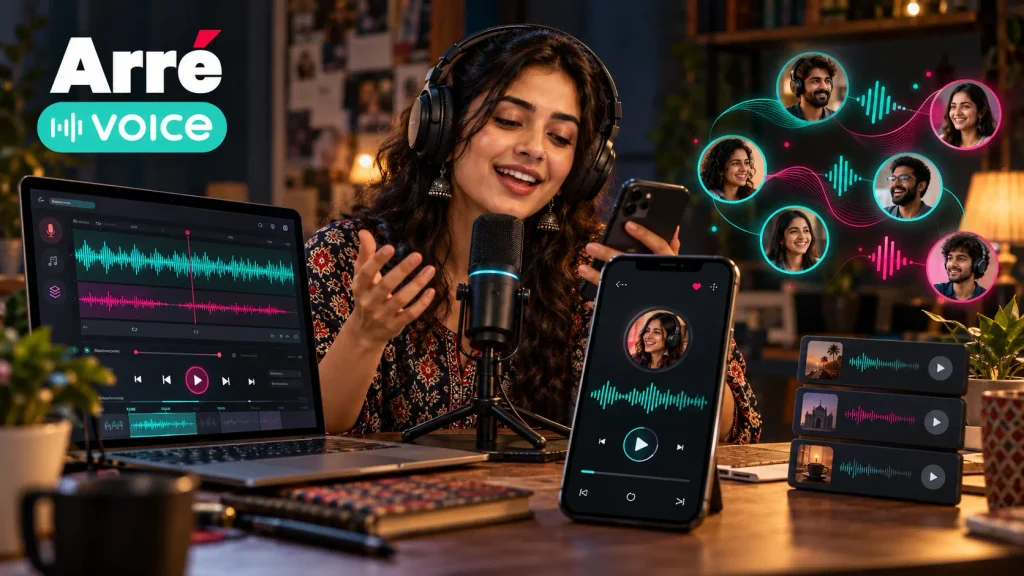
You can create and share voice content on Arré Voice by exploring short audio posts, participating in conversations, joining interest-based communities, and using Creator Studio to prepare recordings. The platform combines audio creation with social discovery, giving users opportunities to express themselves through voice and connect with people who share similar interests.
Unlike a conventional podcast hosting service or an exclusively live audio chat app, Arré Voice centres its experience on short voice content and community participation.
Discover Short Voice Content Through Voicepods
Voicepods are 30-second audio posts on Arré Voice that allow creators to share stories, thoughts, opinions, and other spoken content.
The short format encourages creators to communicate a focused idea through their own voice without producing a lengthy audio programme or appearing on camera.
For example, someone interested in entertainment could create a Voicepod about a memorable film scene.
A storyteller might narrate a brief fictional moment, while another creator could share a personal experience or an observation about everyday life.
Voicepods can support different creative approaches:
- Personal reflections: Share an experience or meaningful observation.
- Short audio fiction: Narrate a brief scene or character moment.
- Entertainment opinions: Discuss films, music, books, or cultural interests.
- Spoken creativity: Experiment with poetry, humour, or expressive narration.
- Conversation starters: Introduce a topic that other users may want to discuss.
Because the format is limited to 30 seconds, creators benefit from a clear opening, one central message, and a concise ending.
Listeners can also discover voices and ideas without committing to a long programme.
Arré Voice provides playlists for organizing favourite Voicepods, making it possible to collect recordings around preferred themes and revisit them later.
Participate in Audio Conversations With Voicepools
Voicepools are Arré Voice’s participatory audio format, allowing users to contribute spoken thoughts and join conversations around shared topics.
While Voicepods focus on individual short audio posts, Voicepools emphasize interaction through voice contributions.
For example, a creator might introduce a discussion with the question:
“Which childhood tradition do you think future generations should remember?”
Participants could share their own experiences through audio responses, creating a conversation shaped by different perspectives.
Voicepools can be useful for:
Community questions: Invite people to discuss subjects they care about.
Personal experiences: Encourage participants to share memories or opinions.
Creative prompts: Start collaborative storytelling ideas or imaginative discussions.
Cultural conversations: Explore regional traditions, entertainment, language, and shared experiences.
Creator participation: Develop discussions that involve listeners instead of limiting interaction to one original recording.
Arré Voice also describes threaded Voicepools, through which connected audio contributions can support longer discussions.
The value of a Voicepool comes from the different voices contributing to the topic.
A thoughtful question may encourage a more meaningful exchange than one designed simply to attract responses.
For beginners, participating in an existing Voicepool can also provide a practical introduction to community-based audio communication.
Explore Interest-Based Communities Through Voiceclubs
Voiceclubs are Arré Voice’s community-focused spaces for connecting people around shared interests through voice-based participation.
Rather than treating each recording as an isolated post, Voiceclubs create opportunities for users to explore a wider community experience.
Someone interested in storytelling might look for people who enjoy fictional narratives, spoken performances, or cultural stories.
Another user might prefer discussions about entertainment, music, poetry, or everyday experiences.
Interest-based communities can support ongoing participation by helping users discover familiar themes and different perspectives.
For example, a group of regional-language storytellers might use a community space to explore oral traditions, exchange creative ideas, and discover new voices.
For creators, community participation can provide opportunities to:
- Discover listeners interested in similar topics.
- Learn from other audio creators.
- Participate in discussions outside their own recordings.
- Explore new creative themes and perspectives.
- Develop relationships through repeated, meaningful interaction.
However, creating a strong community requires more than joining a group.
Respectful participation, relevant contributions, and genuine interest in other people’s experiences remain important.
Voiceclubs represent the community dimension of Arré Voice’s social networking experience, complementing the individual creation of Voicepods and the conversational nature of Voicepools.
Prepare and Record Content Using Arré Voice Creator Studio
Arré Voice Creator Studio provides tools that help creators develop ideas and prepare audio content without depending on complicated production workflows.
For beginners, one challenge is deciding what to say once recording begins.
A creator may have an interesting experience or story in mind but struggle to turn it into a concise spoken post.
Creator Studio’s published workflow addresses this challenge through idea development, script assistance, recording, editing, and sound enhancements.
The process can be understood through three main stages.
Prepare Your Script Using Creator Studio
Begin with a clear content idea.
For example, you might want to create a short voice post about a memorable journey, a favourite fictional character, or an interesting everyday observation.
Arré Voice’s published Creator Studio workflow describes the ability to begin with an idea, select a category and language, and generate a suggested script.
The script provides a starting structure for the recording.
A useful preparation process is:
- Choose one topic or creative concept.
- Identify the message you want listeners to understand.
- Select the relevant category and language in the supported workflow.
- Generate or prepare a short script.
- Review the wording and personalize it before recording.
For example, an initial idea such as “a funny experience during a train journey” could become a short spoken narrative with a recognizable situation and a clear ending.
AI-assisted script suggestions can help organize the idea, but the creator should still check whether the final words sound natural.
For content intended as a 30-second Voicepod, read the script aloud and simplify it if necessary.
A concise recording usually communicates one memorable idea more effectively than several unrelated points.
Creators can explore the Arré Voice Creator Studio to begin preparing audio content.
Record or Import Your Audio
Once the script is prepared, move to the audio recording stage.
Arré Voice’s published Creator Studio workflow supports recording a creator’s voice and preparing spoken content for editing.
Before recording, choose a quiet environment and perform a short microphone test.
Speak at a comfortable pace and maintain a consistent distance from the microphone.
For example, if you are creating a fictional mystery, your opening line might be:
“I found a letter addressed to me, but it was written fifty years ago.”
The sentence introduces a surprising situation and gives listeners a reason to continue.
Record the narration with appropriate expression, allowing your speaking style to reflect the intended tone.
If you already have an audio file, check whether the current Creator Studio interface provides a compatible import or upload option. The public product information reviewed for this article confirms recording, but does not independently establish which external file-import controls or formats are available.
Regardless of the recording method, prioritize clarity and natural delivery.
A clean recording creates a stronger foundation for the editing stage.
Edit and Prepare Your Voice Content
Editing helps transform a raw recording into audio that is easier and more enjoyable to hear.
Arré Voice describes Creator Studio as supporting audio editing and creative enhancements, including music and sound effects.
Begin by listening to the complete recording.
Identify unclear sentences, distracting noises, or unnecessary pauses.
Then refine the audio using the tools available in the current Creator Studio workflow.
Focus on four essential areas.
Voice clarity: Ensure that listeners can understand the main message.
Timing: Maintain a natural pace and keep the recording within the intended format.
Sound effects: Add relevant sounds only when they contribute to the content.
Overall balance: Keep music and background audio from overpowering the spoken message.
For example, a short fictional story set during a storm might benefit from subtle rainfall ambience.
However, loud thunder throughout the recording could make the narration difficult to understand.
The purpose of editing is to strengthen communication rather than make every recording sound elaborate.
Before publishing, review the finished audio through headphones or a familiar listening device.
Check that the opening is clear, the central message is complete, and the recording ends naturally.
Publish Voice Content and Connect With Listeners
After preparing the recording, the next step is to publish it through Arré Voice’s supported sharing workflow.
Before publishing, review the content for clarity, relevance, and appropriate permissions.
Make sure the recording does not reveal private information or contain audio belonging to another person without suitable authorization.
Once published, the voice content becomes part of a wider social experience where users can discover recordings, explore creators, and participate in relevant conversations.
For example, a creator who publishes a short fictional Voicepod could also explore Voicepools related to storytelling or participate in a Voiceclub that matches their creative interests.
Playlists can help users organize favourite Voicepods around themes they enjoy.
Instead of treating every publication as a separate activity, creators can develop a simple ongoing process:
Create → Publish → Discover → Participate → Learn → Create Again
This approach encourages creators to explore both sides of voice-based social media: expressing their own ideas and listening to others.
Over time, regular creative practice and meaningful participation may help users develop a recognizable voice and discover communities that share their interests.
Arré Voice brings together short-form audio creation, voice-based conversations, and community discovery, offering a social networking experience built around what people have to say rather than what they look like.
Frequently Asked Questions About Voice-Based Social Media Apps
What Is a Voice Based Social Media App in Simple Words?
A voice-based social media app is a platform where people communicate by recording, sharing, and responding to spoken audio instead of relying mainly on text, photos, or videos. Users can share personal stories, opinions, questions, and creative content through voice posts. Some apps also offer live conversations, creator profiles, and interest-based communities.
What Is an Example of a Voice-Based Social Media App?
Arré Voice is an example of a voice-based social media app that supports short audio posts, conversations, and community participation. Its features include 30-second Voicepods, prompt-based Voicepools, and interest-based Voiceclubs. Clubhouse is another example, focusing on live audio discussions. These platforms demonstrate different approaches to connecting people through spoken content.
How Do Voice-Based Social Media Apps Work?
Voice-based social media apps allow users to create accounts, discover audio content, record voice posts, and interact with others. Depending on the platform, users may respond to recordings, join live discussions, follow creators, or participate in interest-based communities. The main difference from ordinary audio recording is that these applications connect spoken content with social discovery and interaction.
Can I Use Social Media Without Showing My Face?
Yes, you can use social media without showing your face. Voice-first platforms allow users to share spoken stories, opinions, questions, and creative content without recording videos of themselves. Text-based platforms also support participation without appearing on camera. However, voice recordings may reveal identifying information, so users should review privacy settings and avoid sharing sensitive personal details.
What Is the Difference Between Social Audio and Podcasts?
Social audio emphasizes spoken interaction between users through voice posts, live conversations, or community discussions. Podcasts are usually organized into episodes created by hosts or producers for audiences to listen to. While podcasts can include audience participation, social audio platforms often integrate interaction more directly into the experience. Some services combine elements of both formats.
Are Voice-Based Social Media Apps Free to Use?
Some voice-based social media apps are free to download and use, while others may offer subscriptions, paid features, or additional services. Pricing depends on the platform and can change over time. Before joining, users should check the current app listing, account requirements, and any in-app purchases to understand which recording, listening, and community features are available without payment.
Can You Create Audio Content Using Only a Smartphone?
Yes, you can create audio content using only a smartphone. Most modern smartphones include a microphone suitable for recording basic voice posts, personal stories, and short conversations. Choose a quiet location, speak clearly, and review your recording before publishing. If your chosen platform supports editing, you can improve timing and remove mistakes without purchasing professional recording equipment.
How Do Creators Build an Audience Through Voice?
Creators can build an audience through voice by sharing relevant content consistently, developing a recognizable speaking style, and participating in meaningful conversations. Short stories, personal experiences, and engaging questions can encourage listener interest. Joining suitable voice communities and responding thoughtfully to feedback may help creators develop relationships with people who appreciate their content.
Are Voice-Based Social Media Apps Safe?
Voice-based social media apps can offer useful communication experiences, but safety depends on platform policies, moderation practices, and user behaviour. Potential risks include harassment, impersonation, privacy exposure, and unauthorized sharing of recordings. Users should review available privacy controls, avoid revealing sensitive information, and use reporting or blocking features when necessary. No social platform can guarantee complete safety.
How Is AI Changing Voice-Based Social Media?
AI is changing voice-based social media by supporting script writing, audio editing, transcription, synthetic speech, and multilingual content creation. Some tools help creators prepare recordings more efficiently or improve audio clarity. However, AI-generated voices introduce concerns about consent, impersonation, authenticity, and misinformation. Creators should review generated content and use voice technology responsibly.


[…] To explore the broader category, read our guide to voice-based social media apps. […]