
Every story begins with something worth sharing. It might be a childhood memory, a family tradition, a personal achievement or an experience that changed someone’s perspective. Digital storytelling brings these experiences to life through audio, video, images, text and interactive media.
Today, people can tell meaningful stories using little more than a smartphone and their own voice. A student can explain a historical event through a short video, a grandparent can preserve family memories through an audio recording, and a creator can turn an everyday experience into a story that reaches listeners across different communities.
Understanding digital storytelling is not simply about learning new technology. It is about discovering how to combine human experiences with digital formats to communicate ideas clearly, creatively and meaningfully.
What Is Digital Storytelling?
Digital storytelling is the process of creating and sharing stories using digital media such as audio, video, photographs, text and interactive elements. It combines traditional narrative techniques with technology to communicate experiences, explain ideas and engage audiences through digital platforms.
Unlike content that merely presents information, a digital story usually has a clear perspective, a meaningful sequence of events and a message that connects with its audience.
Digital Storytelling Meaning and Definition
The meaning of digital storytelling becomes easier to understand when we separate its two essential components: the story and the medium used to communicate it.
The story provides the purpose, characters, experiences and message. Digital media provides the tools through which that story is recorded, presented and shared.
According to Monash University’s digital storytelling guide, digital storytelling combines the longstanding practice of sharing human knowledge and experiences with digital technologies. It can involve spoken language, visuals, sound and other modes of communication.
Student Academic Success
For example, someone describing their first day at college is practicing storytelling. When they record that experience as a narrated audio story or combine it with photographs and music, they create a digital story.
A digital story does not need expensive equipment, professional editing or elaborate visual effects. A thoughtfully recorded voice narrative can communicate an experience just as effectively as a carefully produced video.
How Digital Storytelling Works
Digital storytelling works by transforming an idea or experience into a structured narrative and presenting it through a suitable digital format.
The process begins with identifying what the creator wants to communicate. This could be a personal memory, a lesson, an observation or a fictional experience. The creator then organizes the material into a beginning, middle and ending.
Next comes the choice of format. A story that depends on personal emotion might work well as an audio recording, while a travel experience may benefit from photographs and video. A story involving audience decisions may require interactive elements.
Consider a student who wants to share an experience of overcoming stage fright. They could begin with their fear of speaking, describe the moment they decided to participate in a college event, and conclude with what they learned.
Recording this narrative in their own voice adds tone, hesitation, excitement and reflection. The result is more than a collection of facts; it becomes an experience listeners can follow.
Monash University emphasizes that effective digital narratives need a coherent beginning, middle and end, with an opening that captures attention and a conclusion that communicates the storyteller’s perspective.
Student Academic Success
Digital Storytelling vs Traditional Storytelling
Traditional and digital storytelling share the same foundation: communicating experiences through a meaningful narrative. Their primary difference lies in how stories are presented, distributed and experienced.
| Aspect | Traditional storytelling | Digital storytelling |
| Medium | Spoken narration, printed text or live performance | Audio, video, images, text or interactive media |
| Audience | Often physically present or reached through conventional publishing | Can be reached through websites, apps and digital platforms |
| Presentation | Primarily oral, written or performed | Can combine multiple media formats |
| Participation | Often involves immediate listening or discussion | Can include comments, responses and interactive choices |
| Distribution | In-person events, books and other established channels | Digital publishing and online sharing |
| Preservation | Relies on memory, physical records or recordings | Can be stored, copied and accessed digitally |
Neither approach is inherently better. Traditional storytelling can create a powerful connection between a storyteller and a live audience, while digital storytelling offers additional ways to preserve, adapt and distribute a narrative.
A grandmother telling a childhood story during a family gathering is practicing traditional oral storytelling. Recording the same story and sharing it with relatives living elsewhere creates a digital version of that experience.
What changes when a story becomes digital?
When a story becomes digital, its original meaning can remain intact, but the audience’s experience may change.
The story can be replayed, shared across distances, combined with supporting media or made accessible through transcripts and captions. Digital formats also allow audiences to discover stories outside their immediate social circles.
However, technology introduces new responsibilities. Creators must consider consent, copyright, accessibility and whether added effects genuinely support the narrative.
The most effective digital storytelling preserves the authenticity of the original experience while using technology to make that experience easier to understand, access and share.
What Are the Seven Elements of Digital Storytelling?

The seven elements of digital storytelling are point of view, dramatic question, emotional content, the gift of your voice, soundtrack, economy and pacing. Together, they help creators develop focused narratives that attract attention, communicate meaning and maintain audience interest.
This influential framework is associated with the Center for Digital Storytelling, now known as StoryCenter. The University of Houston’s educational digital storytelling resource documents the seven elements and their application to story creation.
digitalstorytelling.coe.uh.edu
Point of View and the Dramatic Question
Point of view establishes whose story is being told and what the storyteller wants the audience to understand.
A personal story about moving to a new city might focus on independence, loneliness, friendship or cultural adjustment. The events may be similar, but the chosen perspective determines the message.
A strong point of view helps creators decide which details belong in the narrative and which can be removed.
The dramatic question creates curiosity by introducing something the audience wants to discover.
For example, a story about a student entering a singing competition might raise the question: Will someone who has always been afraid of performing find the courage to sing?
The audience continues listening because they want to know what happens.
A dramatic question does not require a dramatic incident. Even a simple uncertainty, such as whether two old friends will reconnect, can give a personal story direction.
Emotional Content and the Storyteller’s Voice
Emotional content helps audiences understand why a story matters.
Emotions such as happiness, uncertainty, disappointment, hope and gratitude can make an ordinary experience meaningful. The goal is not to exaggerate feelings but to communicate them through believable details.
Instead of saying, “I was nervous before my performance,” a storyteller might describe standing backstage, hearing their name announced and noticing their hands trembling.
These details help listeners imagine the experience.
The fourth element, traditionally called the gift of your voice, refers to the personal quality a narrator brings to a story.
A familiar accent, a thoughtful pause or a moment of laughter can communicate personality in ways that written words alone may not capture.
For voice-based digital storytelling, this element is especially important. A natural speaking style can make the listener feel that someone is sharing an experience directly with them.
The University of Liverpool’s educational guidance similarly identifies the storyteller’s own voice as a valuable way to connect with an audience.
University of Liverpool
Soundtrack, Pacing and Economy
The remaining three elements shape how a story sounds, flows and holds attention.
Soundtrack refers to music and other sounds that support the narrative. A gentle background sound might reinforce a reflective memory, while environmental audio can help establish a setting.
However, music is not essential to every digital story. Silence can be equally effective, especially when a storyteller wants listeners to focus on a meaningful statement.
Pacing determines how quickly or slowly the narrative progresses. A suspenseful moment may benefit from a pause, while an exciting event might be described with a quicker rhythm.
Economy means including only the details necessary to communicate the story effectively.
A short story about learning to ride a bicycle does not need to describe every practice session. It might focus on the first failed attempt, the encouragement received and the moment of finally riding independently.
Economy helps creators respect their audience’s attention without removing the details that make a story personal.
How These Elements Work Together
The seven elements are most effective when they support one another rather than being treated as separate requirements.
Imagine a young musician sharing the experience of performing publicly for the first time.
The point of view establishes why the experience matters. The dramatic question introduces uncertainty about whether the musician will overcome their fear. Emotional details help listeners understand the pressure of the moment.
The storyteller’s voice communicates hesitation and excitement, while pacing builds anticipation before the performance. Sound can support the atmosphere, and economy ensures the story remains focused.
Together, these elements turn a simple account of an event into a complete narrative.
The framework is a useful creative guide, not a rigid formula. Different digital formats may emphasize different elements, and a strong story does not need to force music or visual effects into every scene.
Example of the seven elements in a short personal story
Consider this original illustrative story, titled The First Time I Spoke Up.
“I used to sit in the last row of every classroom, hoping nobody would ask me a question. One day, our teacher invited volunteers to speak about their dreams. My heart started racing, but I raised my hand. I stumbled through the first few sentences. Then I looked up and saw my best friend smiling. I finished my speech. I didn’t win a prize that day, but I discovered something more important: my voice deserved to be heard.”
Here is how the seven elements appear:
| Element | Application in the story |
| Point of view | A student’s personal experience of finding confidence |
| Dramatic question | Will the student overcome the fear of speaking? |
| Emotional content | Nervousness, encouragement and personal growth |
| Gift of voice | The student’s own narration communicates vulnerability |
| Soundtrack | Optional classroom ambience or silence |
| Economy | Only the essential moments are included |
| Pacing | A slower opening, tension before speaking and a reflective ending |
The same story could be recorded as a short voice narrative, adapted into a video or presented as a sequence of photographs with narration.
What makes it effective is not the technology alone, but the clarity of its message and the emotional journey it communicates.
What Are the Different Types of Digital Storytelling?
The main types of digital storytelling include audio stories, video narratives, interactive experiences, educational stories and social media storytelling. Each format offers different ways to combine personal expression, narrative structure and digital technology.
The choice of format depends on the story’s purpose, its intended audience and the resources available to the creator. Some stories become more engaging through visuals, while others rely on spoken narration or audience participation.
Monash University’s digital storytelling resources recognize a broad range of formats, including podcasts, web-based narratives, interactive media and video.
Student Academic Success
Audio and Voice-Based Digital Stories
Audio storytelling uses spoken narration, dialogue, music and sound to communicate a story without requiring visual content.
This format is particularly effective for personal experiences, fictional narratives, poetry, cultural memories and reflective storytelling. Listeners can focus on the narrator’s words, tone and emotions while imagining the events being described.
For example, someone might record a two-minute story about returning to their hometown after several years. The sound of a railway station, a familiar greeting or a brief pause in the narration can help communicate the experience.
Audio-based digital storytelling also gives creators the flexibility to express themselves in their preferred language and natural speaking style.
A creator does not necessarily need a camera or professional production equipment. A clear voice recording and a well-structured narrative can provide the foundation for an engaging story.
For a closer look at this format, readers can explore audio stories and how spoken narratives communicate experiences through sound.
Video and Short-Form Digital Stories
Video storytelling combines moving images, spoken narration, text and sound to present a narrative visually.
It can be used to document everyday experiences, share travel memories, explain social issues or present fictional stories. Short-form videos often focus on one event, idea or emotional moment rather than a lengthy sequence of developments.
For example, a creator documenting their first day at a new workplace might combine short clips of their commute, workplace surroundings and a personal voiceover.
The story becomes more meaningful when the visuals support a clear narrative rather than appearing as an unrelated collection of clips.
An effective short-form digital story generally needs an engaging opening, a focused middle and a conclusion that gives the audience something to remember.
Captions and readable on-screen text can also make the story easier to follow when viewers cannot listen to the audio.
Interactive and Multimedia Stories
Interactive digital storytelling allows audiences to participate in how a narrative unfolds.
Instead of following only one fixed sequence, users may explore different paths, select responses, interact with images or make decisions that influence the experience.
For example, an educational story about protecting a local river might ask readers to choose between different environmental actions. Each choice could reveal a different consequence and encourage reflection.
Multimedia storytelling can also combine photographs, written passages, maps, audio recordings and video clips within one experience.
A digital account of a historic neighborhood might include an interactive map, residents’ voice recordings, archival photographs and short descriptions of important locations.
These elements give audiences different ways to explore the subject while maintaining a connected narrative.
Interactive experiences require thoughtful design. Additional features should make the story easier to understand or explore rather than distract from its central message.
Educational and Documentary Stories
Educational digital storytelling presents information through narrative structures that help audiences understand a subject.
Teachers, students, researchers and communicators can use stories to explain historical events, scientific ideas, social experiences and real-world problems.
For example, a lesson about water conservation could follow a family’s experience during a summer water shortage. The narrative could introduce the problem, describe its consequences and explain practical conservation measures.
Documentary digital storytelling uses interviews, observations, photographs, recordings and other evidence to communicate real experiences.
A short documentary about a traditional craft might combine an artisan’s personal memories with images of their work and explanations of the production process.
The University of Liverpool’s digital storytelling guide describes educational applications that involve developing scripts, recording stories, combining media and publishing completed narratives.
University of Liverpool
For educational and documentary stories, factual accuracy matters as much as creative presentation. Creators should verify information, represent people fairly and distinguish documented events from dramatized scenes.
Social Media and Community Storytelling
Social media storytelling involves sharing narratives through digital communities where audiences can discover, discuss and respond to content.
Stories may appear as short videos, audio posts, photo sequences or connected updates. Unlike a traditional one-way presentation, community storytelling can encourage conversations between creators and their audiences.
For example, someone might share a personal experience about learning a regional language. Listeners could respond with similar memories, cultural expressions or experiences from their own communities.
These interactions can introduce additional perspectives and turn an individual story into a wider discussion.
Voice-led communities offer a particularly personal form of participation because creators and listeners can communicate through spoken experiences rather than relying entirely on written comments.
Platforms such as Arré Voice provide opportunities to explore voice-based content and engage with creators through audio-centered experiences.
The important distinction is that community storytelling is not simply about publishing frequently. It is about creating meaningful narratives that invite relevant participation and respectful exchange.
What Are Some Examples of Digital Storytelling?
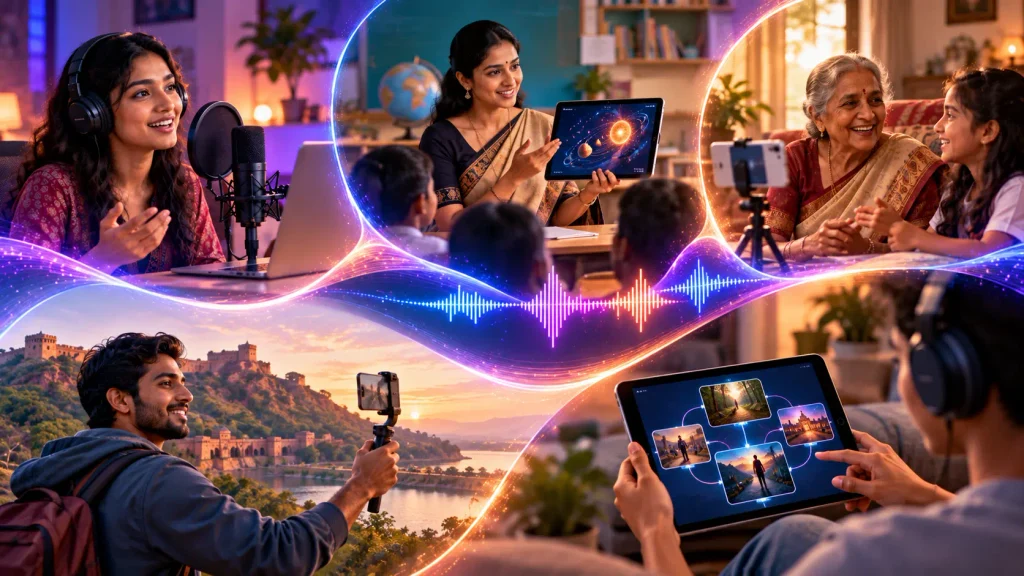
Examples of digital storytelling include personal voice recordings, educational explainers, regional language narratives, short social media stories and interactive experiences. A digital story can be fictional or based on real events, provided it communicates a recognizable narrative through digital media.
The following examples are original illustrations designed to show how different storytelling formats work.
Personal Stories Told Through Voice
Imagine a college student recording a short story titled The Call I Almost Didn’t Make.
The narrative begins with the student describing a disagreement with a childhood friend. Several months pass without communication, until an unexpected memory encourages the student to reconnect.
Through a simple voice recording, the storyteller describes the hesitation before making the call, the conversation that follows and the relief of rebuilding the friendship.
This is an example of personal digital storytelling because it communicates a meaningful experience through a recorded narrative.
The storyteller’s natural voice carries much of the emotional impact. Pauses, changes in tone and the choice of personal details help listeners understand the experience.
The recording could be shared as an individual voice story or become part of a collection exploring friendship, relationships and personal growth.
Educational Stories That Explain Complex Ideas
Digital storytelling can also make unfamiliar subjects easier to understand by connecting information with everyday experiences.
Consider an educational audio story titled A Drop of Water’s Journey.
The narrator follows a fictional drop of water as it moves through evaporation, condensation, rainfall and a river system. Each stage introduces a scientific concept through a connected narrative.
Instead of presenting the water cycle only as a series of definitions, the story gives learners a sequence they can imagine and remember.
A teacher could develop the same idea as a narrated animation, illustrated slideshow or audio lesson.
This approach does not replace scientific explanations. Rather, it provides a narrative structure through which accurate information can be introduced and reinforced.
Educational storytelling is most effective when the creative elements support the learning objective and do not distort the underlying facts.
Cultural and Regional Language Narratives
Digital storytelling can help people document and share traditions, memories and experiences associated with their communities.
Imagine a young creator recording their grandmother’s memories of preparing traditional food during a local festival.
The grandmother explains the ingredients, describes family gatherings and recalls how the celebration has changed over time. The recording preserves not only the information but also the speaker’s expressions, pronunciation and personal recollections.
A transcript or translation could make the story accessible to people who do not understand the original language.
This example illustrates how digital storytelling can support the documentation of cultural experiences while allowing storytellers to communicate in languages they know best.
For Indian creators, stories told in Hindi, Tamil, Malayalam, Bengali, Marathi and other languages can represent perspectives that may be less visible in mainstream English-language content.
Such narratives also connect naturally with India’s broader oral storytelling heritage. Readers interested in this relationship can explore Indian storytelling traditions.
When documenting another person’s experiences, creators should obtain permission before recording or publicly sharing personal stories.
Short-Form Stories on Social Platforms
A short-form digital story can communicate a complete experience within a limited duration.
For example, a creator might share a story titled Thirty Seconds That Changed My Day.
The opening introduces a difficult morning. The middle describes a small act of kindness from a stranger. The ending explains how that unexpected moment changed the creator’s outlook.
The story could be presented through a short video, narrated photo sequence or voice recording.
Its effectiveness depends on selecting details that establish the situation, communicate the turning point and deliver a meaningful conclusion.
A short duration does not automatically make a story engaging. A collection of unrelated clips may attract attention, but a well-developed narrative gives viewers or listeners a reason to care about what happens.
For creators experimenting with shorter formats, a useful approach is to focus on one experience and one clear takeaway.
Interactive Stories With Audience Choices
Interactive storytelling gives audiences an opportunity to influence how they explore a narrative.
Imagine a fictional story called The Missing Letter.
The reader discovers an old letter inside a library book. At a decision point, they can choose whether to search for the sender, contact the intended recipient or investigate the letter’s historical background.
Each option leads to a different sequence of events.
The audience becomes actively involved in discovering the story, while the creator designs the possible narrative paths.
Interactive storytelling can also be educational. A story about online privacy, for example, might let learners explore the consequences of different digital decisions.
The value of interactivity comes from meaningful choices rather than the number of buttons or pathways included.
One story idea presented in three digital formats
Consider a single story idea: A young woman returns to her childhood hometown after ten years and discovers that the old neighborhood library is about to close.
The central narrative explores memory, community and the importance of shared spaces.
It could be adapted into three distinct digital storytelling formats.
| Format | Storytelling approach | Audience experience |
| Audio story | First-person narration describing memories, conversations and sounds from the library | Listeners imagine the setting through voice and sound |
| Short video | Visual scenes of the neighborhood, library shelves and conversations, supported by narration | Viewers experience the setting through images and audio |
| Interactive story | A digital map and collection of memories that readers can explore in different sequences | Audiences discover different perspectives at their own pace |
In the audio version, the storyteller might begin:
“The library door still made the same sound. For a moment, I was twelve again, carrying three borrowed books and wondering which story I would read first.”
In the video version, that narration could accompany a close-up of the library entrance, old bookshelves and familiar streets.
In the interactive version, audiences could select locations on a neighborhood map to hear memories from different residents.
The core story remains the same, but each format offers a different way to experience it.
This example demonstrates an important principle: digital storytelling is not defined by the number of technologies used, but by how effectively the chosen medium communicates the story.
A creator should begin with the narrative and then select the format that best supports its meaning.
How to Create a Digital Story Step by Step
To create a digital story, identify your audience, develop a clear narrative, choose a suitable format, record or prepare your content, edit it and publish the finished story. These six steps can help beginners turn everyday experiences into engaging digital narratives without requiring professional production equipment.
The most important starting point is the story itself. Technology should support the message rather than determine what the creator wants to say.
Step 1: Choose Your Story’s Purpose and Audience
Every effective digital story begins with a clear purpose. Before recording or designing anything, consider what you want the audience to understand, feel or remember.
Your purpose might be to share a personal experience, explain an idea, entertain listeners or preserve a meaningful memory.
For example, suppose you want to tell a story about your first day living away from home. You could focus on homesickness, independence, unexpected friendships or the excitement of discovering a new city.
Choosing one central theme gives the narrative direction.
Next, identify your intended audience. A story created for school students may require simpler explanations than one intended for working professionals. Similarly, a story shared with a local community may benefit from familiar cultural references or regional language expressions.
Before moving forward, write one sentence that summarizes your message.
Example: “I want to show how a difficult first day away from home helped me become more confident.”
This sentence becomes a guide for deciding what belongs in the story.
Step 2: Write a Clear Script and Narrative Outline
A digital storytelling script organizes your ideas into a sequence that audiences can easily follow.
A practical beginner-friendly structure includes three parts:
- Beginning: Introduce the situation and give the audience a reason to continue.
- Middle: Describe the experience, challenge or turning point.
- Ending: Reveal the outcome and explain why the experience matters.
For a personal story about moving away from home, the opening might describe arriving in an unfamiliar city. The middle could explore the difficulty of adjusting, while the ending reflects on a moment that made the new environment feel welcoming.
Avoid including every detail. Focus on moments that contribute to the central message.
Writing for spoken narration also requires a conversational style. Short sentences, familiar vocabulary and natural transitions are generally easier to deliver aloud than lengthy, complicated passages.
Creators who need help organizing their ideas can explore storytelling techniques before developing a complete script.
Arré Voice also provides a Creator Studio where creators can develop and edit scripts, organize narrative sections and prepare content for recording. Its AI-assisted script features can support the writing process, while creators remain responsible for reviewing the final narrative.
Step 3: Select the Right Digital Format
The best digital storytelling format depends on the story’s message and the way audiences are expected to experience it.
An emotional personal memory may work well as an audio story because listeners can focus on the narrator’s voice. A travel experience may benefit from photographs or video, while an educational narrative could combine spoken explanations with diagrams.
Ask yourself whether the audience needs to see something to understand the story.
If the answer is no, voice-based storytelling may be a suitable starting point. It allows creators to concentrate on narration, expression and pacing without needing to prepare visual scenes.
If visual details are essential, consider a narrated slideshow or video. For stories involving decisions or exploration, an interactive format may be more appropriate.
Beginners should choose a format they can complete confidently. A short, well-produced voice story is often more effective than an ambitious multimedia project that lacks a clear narrative.
Step 4: Record Your Voice or Prepare Visuals
Once the script and format are ready, begin creating the digital content.
For voice-based stories, choose a relatively quiet environment and position the microphone at a comfortable distance. Read the script naturally rather than trying to sound like a professional announcer.
Record a short sample first to check clarity, background noise and speaking volume.
Pay attention to emotional changes within the story. A reflective memory may need a slower pace, while an exciting moment may benefit from a more energetic delivery.
If the story uses images or video, collect visuals that directly support the narrative. Avoid adding unrelated material simply to make the content appear more elaborate.
Creators using Arré Voice Creator Studio can record voice content in the browser while following a prepared script. The Studio workflow includes adjustable script-reading speeds, helping creators manage their narration during recording.
The platform also supports importing audio and video, allowing creators to work with existing recordings.
Step 5: Edit for Clarity, Pacing and Accessibility
Editing helps transform raw material into a complete digital story.
Begin by listening to or reviewing the entire recording. Identify unnecessary repetitions, long pauses, distracting background sounds and sections that do not contribute to the message.
A useful editing question is: Does this part help the audience understand the story or experience its emotional journey?
If the answer is no, consider shortening or removing it.
For audio stories, prioritize clear speech and consistent volume. Background music should support the narration without making the speaker difficult to hear.
For video, check whether the visuals match the spoken content and whether transitions are easy to follow.
Accessibility should also be considered during editing. Transcripts can help people who prefer reading or cannot listen to audio. Captions are important for video content, while readable text and descriptive language can make stories easier to understand.
Arré Voice Creator Studio supports audio editing after recording, allowing creators to refine their work before publishing.
Step 6: Publish and Gather Feedback
Publishing makes a digital story available to its intended audience.
Before sharing, choose a descriptive title that reflects the narrative. A title such as My First Day Away From Home communicates more clearly than a generic title such as My Story.
Where the publishing platform allows it, add a short description that explains what listeners can expect. Relevant categories and language settings can also help organize content for discovery.
For voice-based creators, Arré Voice offers a way to publish audio content to its platform through the web experience, with published content available within the Arré Voice ecosystem.
After publishing, pay attention to meaningful audience responses.
Did listeners understand the central message? Were any parts confusing? Did the story encourage someone to share a similar experience?
Feedback can help creators improve future narratives, but it should not replace their own creative judgment.
A story’s success is not determined only by views or reactions. Its ability to communicate a meaningful experience is equally important.
A beginner’s digital storytelling checklist
Use this checklist before publishing your first digital story.
Digital story publishing checklist
- I have identified one clear purpose and intended audience.
- My story has a beginning, middle and ending.
- I have selected a digital format that supports the message.
- My script sounds natural when read aloud.
- My recording or visuals are clear and relevant.
- I have removed unnecessary details and distracting elements.
- I have considered transcripts, captions or other accessibility needs.
- I have permission to use any third-party music, images or recordings.
- My title accurately describes the story.
- I have reviewed the final version before publishing.
Why Is Digital Storytelling Important?

Digital storytelling is important because it helps people communicate experiences, explain information, preserve cultural memories and share perspectives through accessible digital formats. It connects the emotional value of traditional storytelling with new opportunities for creation, participation and distribution.
Its importance extends beyond entertainment. Digital storytelling can support education, personal expression, community communication and the documentation of everyday experiences.
Building Emotional Connections With Audiences
Stories can create emotional connections by helping audiences understand experiences from another person’s perspective.
A factual statement might explain that moving to a new city can be difficult. A personal story describing the first lonely evening in an unfamiliar apartment allows listeners to experience that challenge more directly.
Digital media can strengthen this connection through voice, images and meaningful sound.
In voice-based storytelling, the narrator’s tone and expression can communicate emotions that might be difficult to capture through written text alone.
A thoughtful pause, a moment of excitement or a familiar regional accent can make a story feel personal and authentic.
However, emotional connection depends on sincerity. Exaggerated effects or forced dramatic language may distract from the experience being shared.
Making Learning and Information More Engaging
Digital storytelling can help explain information by placing it within a recognizable narrative.
Instead of presenting a topic only through definitions and isolated facts, educators can introduce a situation, follow its development and explain the outcome.
For example, a story about a family managing household expenses could introduce concepts such as budgeting, saving and financial planning.
Similarly, a narrated journey through a historical location could help learners understand events through the experiences of people who lived there.
The educational value comes from connecting accurate information with a meaningful sequence of events.
Digital storytelling does not automatically improve learning. Its effectiveness depends on the quality of the explanation, the appropriateness of the format and how well the story supports the learning objective.
Preserving Personal and Cultural Experiences
Many meaningful experiences are shared informally through conversations between family members, friends and communities.
Digital storytelling provides ways to document these experiences so they can be revisited and shared with future audiences.
A recorded family memory, a traditional song, a local festival experience or an account of a disappearing craft can become part of a community’s digital record.
Voice recordings are particularly valuable for preserving elements of spoken communication, including pronunciation, expression and personal speaking styles.
In India, where storytelling traditions exist across numerous languages and communities, digital formats can provide additional opportunities to document regional experiences.
Preservation also requires responsibility. Creators should respect the wishes of storytellers, obtain appropriate consent and avoid sharing private or culturally sensitive information without permission.
Helping More People Share Their Perspectives
Digital storytelling can reduce some practical barriers to creative expression.
A person who does not have access to professional filming equipment may still be able to record a meaningful story using a smartphone or computer.
Voice-based formats can be especially useful for creators who feel more comfortable speaking than writing lengthy articles or appearing on camera.
A student, homemaker, working professional or retired individual may have experiences worth sharing even without formal storytelling training.
Digital platforms can make these perspectives available beyond immediate personal networks.
However, access remains unequal. Internet connectivity, device availability, language support, digital literacy and accessibility all influence who can participate.
The broader value of digital storytelling lies in creating more opportunities for people to express themselves while recognizing these continuing barriers.
How Is Digital Storytelling Evolving in 2026?
Digital storytelling in 2026 is evolving through mobile-first content, short-form video, audio narratives, interactive experiences, AI-assisted production and multilingual expression. These developments are expanding the ways creators can tell stories, although their adoption varies across platforms, audiences and formats.
The underlying principle remains unchanged: meaningful stories depend on a clear perspective, relevant details and a connection with the audience.
Short-Form and Mobile-First Narratives
Mobile devices have become important tools for creating, consuming and sharing digital stories.
Creators can record everyday experiences, edit short narratives and publish content without relying on traditional production equipment.
Short-form storytelling encourages creators to communicate one central idea within a limited duration. This might involve a personal realization, an unexpected conversation or a memorable moment.
India provides a useful example of changing consumption patterns. A June 2026 report published by Meta found that 89% of surveyed Gen Z respondents engaged with Reels daily. The report also highlighted strong engagement across urban and rural audiences on Meta’s platforms.
about.fb.com
These findings indicate the significance of mobile-first video within Meta’s ecosystem. They do not establish that every storytelling format has experienced the same growth.
For creators, the practical lesson is to make the opening meaningful, keep the narrative focused and ensure the story works on the devices their audience uses.
Audio Series and Voice-First Experiences
Audio storytelling offers an alternative to formats that require continuous visual attention.
A voice-based digital story can communicate personal experiences, fictional events, cultural memories or reflections through spoken narration.
Creators can also develop connected stories around a common theme. For example, a series titled Stories From My Hometown might feature separate episodes about childhood friendships, local festivals and memorable places.
Each recording can work as an individual story while contributing to a larger collection.
Voice-first experiences are particularly relevant for creators who prefer spoken expression over appearing on camera.
Platforms such as Arré Voice provide a digital environment for publishing and discovering voice-led content. Its Creator Studio supports script preparation, recording and editing, helping creators move from an idea to a publishable audio story.
This does not mean audio has replaced video or written storytelling. Rather, it offers another creative format that can be appropriate for particular narratives and audiences.
Interactive Stories and Audience Participation
Digital storytelling is also developing through formats that invite audiences to participate rather than only consume content.
Interactive narratives can allow readers to choose story paths, explore locations or reveal information in different sequences.
Community-based storytelling offers another form of participation.
For example, a creator might share a voice story about a childhood festival and invite others to contribute memories from their own regions.
The resulting discussion can introduce perspectives that were not part of the original narrative.
These approaches differ technically, but both demonstrate how digital environments can support participation around stories.
Creators should choose interactive features carefully. Meaningful participation can enrich a narrative, while unnecessary complexity may make it harder to follow.
AI-Assisted Production and Human Creativity
AI-assisted tools can help creators develop scripts, organize ideas, generate supporting material and experiment with digital production.
For example, a beginner may use an AI-assisted script tool to develop an outline for a personal story. They can then revise the wording, add authentic details and record the narration in their own voice.
The technology supports the creative process, but the storyteller remains responsible for accuracy, originality and the final message.
Arré Voice Creator Studio includes AI-assisted script generation and prompt-based music and song creation alongside recording and editing capabilities.
These features can help creators experiment with storytelling formats, but generated material should be reviewed before publication.
A personal story becomes meaningful through the creator’s experiences, choices and interpretation—not simply because technology makes production faster.
Readers interested specifically in this distinction can explore AI storytelling.
Multilingual Storytelling and Accessibility
Digital storytelling can support expression across different languages and communication preferences.
A creator might narrate a childhood memory in their mother tongue because familiar words and expressions communicate the experience more naturally.
Another creator might publish an educational story in a regional language to reach an audience that prefers learning in that language.
For multilingual audiences, transcripts and translations can make stories easier to understand across language boundaries.
Accessibility also matters.
The World Wide Web Consortium’s Web Accessibility Initiative recommends transcripts for prerecorded audio-only content and captions for prerecorded videos containing meaningful audio. These features help people access stories when listening or hearing is difficult.
Creators should also consider readable text, clear narration and accessible media controls.
A story becomes more inclusive when people can engage with its message through formats suited to their needs.
Why originality, consent and disclosure still matter
New creative technologies do not remove the responsibilities associated with publishing.
Creators should avoid presenting fictional or AI-generated events as verified personal experiences. They should obtain appropriate consent before sharing another person’s private information, voice or identifiable recordings.
If AI-generated content could mislead an audience about who is speaking or whether an event occurred, clear disclosure can help establish transparency.
Originality also matters. A story that reflects a creator’s actual perspective, observations or creative interpretation offers value beyond a generic collection of familiar statements.
Technology can help produce a digital story, but trust depends on how responsibly the creator uses it.
How Can Creators Make Digital Stories More Engaging?
Creators can make digital stories more engaging by starting with a strong opening, using natural narration, including meaningful details, choosing relevant media and making content accessible. Effective storytelling focuses on helping audiences understand and experience the narrative rather than overwhelming them with effects.
The following practices apply across audio, video and multimedia storytelling.
Start With a Strong Opening
The opening gives audiences their first reason to pay attention.
A strong beginning might introduce an unexpected event, a meaningful question or a moment of uncertainty.
For example, compare these openings:
Ordinary opening: “Today I want to share a story about my childhood.”
More engaging opening: “I hadn’t visited my childhood home in fifteen years, but I still remembered exactly how the front door sounded.”
The second opening introduces a specific detail and creates curiosity.
A good opening should also be relevant to the rest of the narrative. Promising a dramatic event that never occurs may attract initial attention but weaken the audience’s trust.
Use Natural Voice and Meaningful Details
Natural narration helps a story feel personal.
Creators do not need to imitate professional broadcasters or use exaggerated expressions. A comfortable speaking style often communicates sincerity more effectively.
Meaningful details help audiences imagine an experience.
Instead of saying, “The marketplace was crowded,” a storyteller might describe vendors calling out prices, people moving between stalls and the smell of freshly prepared food.
These details establish the setting without requiring a lengthy explanation.
For voice stories, pacing and pronunciation are also important. Speak clearly, allow appropriate pauses and vary emphasis when the narrative changes.
Choose Sound and Visuals That Support the Story
Sound and visuals should contribute to the audience’s understanding.
A story about a rainy evening might benefit from a brief recording of rainfall. A historical narrative might use relevant photographs to establish the setting.
However, adding music, animations or visual transitions to every moment can become distracting.
When the main content is spoken narration, background sound should remain low enough for listeners to understand the words comfortably.
Creators should evaluate every addition by asking whether it strengthens the narrative or merely makes the production more complicated.
Add Captions, Transcripts and Accessible Formats
Accessibility helps more people experience a digital story.
For audio-only narratives, a transcript provides a written version of the spoken content. For video stories, synchronized captions help audiences understand speech and important sounds.
Captions and transcripts serve different purposes, and creators should select the appropriate accessibility support for each format.
Accessible storytelling also involves using clear language, avoiding unnecessarily complex text and ensuring that essential information is not communicated through sound or visuals alone.
Avoid Copyright and Privacy Mistakes
Digital stories may include photographs, music, recordings and personal information involving other people.
Before publishing, creators should confirm that they have permission to use third-party materials.
Music found online is not automatically free to reuse, and crediting the original creator does not necessarily replace the need for a license.
Similarly, recording a private conversation or sharing another person’s personal experience may require consent.
Creators should be especially careful when publishing stories involving children, sensitive experiences or identifiable individuals.
Responsible storytelling protects both the people represented in the narrative and the creator’s credibility.
How Can You Share Voice-Based Digital Stories on Arré Voice?
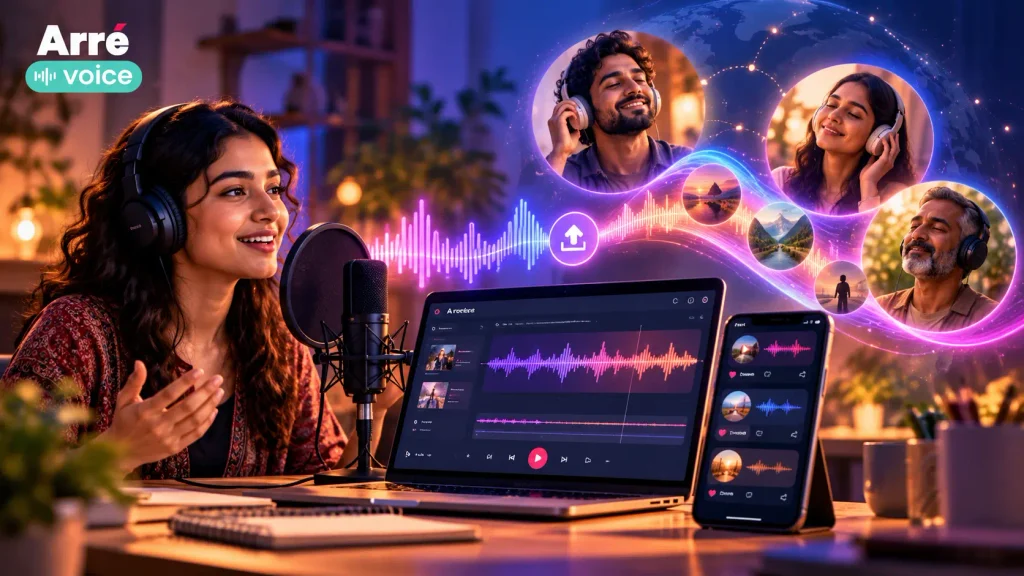
You can create and share voice-based digital stories on Arré Voice by preparing a script, recording or importing audio, editing the recording and publishing it through Creator Studio. The platform connects the creative process with a voice-focused environment where people can discover spoken stories and perspectives.
For creators who prefer expressing themselves through speech, Arré Voice provides a way to turn personal experiences and creative ideas into shareable audio content.
Turning Everyday Experiences Into Short Voice Stories
A digital story does not need an extraordinary event.
A memorable conversation, an unexpected journey, a childhood memory or a small personal achievement can become the foundation for a meaningful voice narrative.
For example, imagine a creator developing a story titled The Last Bus Home.
The story begins with the creator missing their usual bus after a difficult day. During the journey home, an unexpected conversation with another passenger changes how they think about their situation.
The creator could organize this experience into a short script, record it naturally and edit the audio to maintain a clear narrative flow.
Using Arré Voice Creator Studio, creators can prepare scripts, record audio in the browser, edit their recordings and publish directly to Arré Voice.
The platform’s Quick and Studio modes offer different approaches to the creation process, while script-writing assistance can help organize ideas before recording.
This workflow makes voice-based digital storytelling a practical option for people who want to share experiences without producing a video.
Exploring Stories Through Voice-Led Communities
Digital storytelling is not limited to publishing individual narratives. It can also involve discovering how other people experience similar situations.
A story about moving to a new city may resonate with students, professionals or families who have experienced relocation.
A memory of a regional festival may encourage listeners to explore traditions from other communities.
Arré Voice’s voice-focused environment provides opportunities to discover spoken content and explore perspectives shared by different creators.
Readers interested in the broader role of spoken interaction can explore voice communities and how shared experiences can contribute to online participation.
Listening to other storytellers can also help creators understand different narrative approaches, speaking styles and cultural perspectives.
The purpose is not to copy another person’s story, but to discover new ways of expressing authentic experiences.
Encouraging Listeners to Respond and Share Perspectives
A meaningful digital story can become the beginning of a conversation.
Creators can encourage participation by ending with a relevant question or inviting listeners to reflect on a similar experience.
For example, a voice story about a childhood friendship might conclude:
What is one friendship you still remember, even after many years?
This gives listeners a natural opportunity to connect the narrative with their own lives.
Participation should remain relevant to the story rather than relying on repeated requests for engagement.
Creators can also develop future stories around questions, themes or perspectives that resonate with their audience.
For someone beginning their digital storytelling journey, the most useful first step is often simple: choose one experience, give it a clear beginning and ending, and record it in a natural voice.
Start creating your voice story with Arré Voice Creator Studio.
Frequently Asked Questions
What Is Digital Storytelling in Simple Words?
Digital storytelling means using technology to create and share stories through audio, video, photographs, text or interactive media. It combines traditional storytelling with digital tools to communicate personal experiences, educational ideas and creative narratives. For example, recording a childhood memory and sharing it online is a simple form of digital storytelling.
What Are the Seven Elements of Digital Storytelling?
The seven elements of digital storytelling are:
- Point of view: The storyteller’s perspective and message.
- Dramatic question: A question or challenge that keeps audiences interested.
- Emotional content: Feelings and experiences that create a connection.
- The gift of your voice: Personal narration that brings authenticity to the story.
- Soundtrack: Music or sound that supports the narrative.
- Economy: Including only meaningful and necessary details.
- Pacing: Controlling the rhythm and flow of the story.
These elements, associated with StoryCenter’s digital storytelling framework, help creators develop focused and engaging narratives.
What Is an Example of Digital Storytelling?
An example of digital storytelling is a student recording a two-minute voice story about overcoming their fear of public speaking. The recording introduces the student’s challenge, describes a meaningful turning point and concludes with a personal lesson.
The student can edit the recording and share it through an audio platform such as Arré Voice. Other examples include narrated travel videos, educational animations, digital photo essays and interactive stories.
What Is the Difference Between Digital Storytelling and AI Storytelling?
Digital storytelling is the broader practice of creating stories using digital media, while AI storytelling specifically involves artificial intelligence in the creative process.
Digital storytelling can be entirely human-created, using voice recordings, photographs, video or text. AI storytelling may use technology to generate scripts, suggest ideas, create voices or assist with production.
For example, recording a personal experience using your own voice is digital storytelling. Using AI to develop a story outline before recording is AI-assisted digital storytelling.
Both approaches can overlap, but AI is not required to create a digital story. Learn more about AI storytelling and its creative applications.
Can You Create a Digital Story Without Video?
Yes. A digital story can be created entirely through audio, without a camera or video recording. Voice-based storytelling uses narration, dialogue and optional sound effects to communicate experiences.
For example, someone can record a personal memory, fictional story or cultural experience using a smartphone or computer microphone.
With Arré Voice Creator Studio, creators can prepare scripts, record and edit audio online, and publish voice stories to Arré Voice. This makes digital storytelling accessible to creators who prefer speaking rather than appearing on camera.
How Is Digital Storytelling Used in Education?
Digital storytelling is used in education to explain concepts, encourage creativity and help students communicate what they have learned.
Teachers may use narrated videos to explain historical events, while students can create audio stories about scientific concepts, social issues or personal learning experiences.
For example, a student could develop a short digital story explaining the water cycle through the journey of a raindrop.
Digital storytelling can support communication, research and digital literacy skills when activities are designed around clear learning objectives and accurate information.
What Makes a Good Digital Story?
A good digital story has a clear message, an engaging beginning, a meaningful narrative and an ending that leaves audiences with something to remember.
Effective digital stories generally include a focused perspective, relevant details, natural narration and appropriate pacing. Audio, visuals and music should support the message rather than distract from it.
Authenticity is especially valuable in personal storytelling. A simple voice recording that communicates a genuine experience can be more engaging than a technically elaborate production without a clear purpose.
For beginners, the best approach is to start with one meaningful experience, organize it into a short narrative and choose a digital format that communicates it effectively.




[…] a broader understanding of how stories work across modern platforms, explore digital storytelling and its role in communicating narratives through digital […]