An audio drama script transforms a written story into an experience audiences can hear and imagine. Unlike a screenplay that relies on visual action, an audio drama uses dialogue, character performances, sound effects and silence to establish settings, develop conflicts and reveal emotions.
Whether you’re writing a two-minute mystery, a fictional conversation or a multi-episode drama, understanding audio drama script formatting helps you create stories that actors can perform and sound designers can produce.
This guide explains the essential script elements, demonstrates production-friendly formatting and provides an original audio drama example to help you begin writing your own.
What Is an Audio Drama Script?
An audio drama script is a written blueprint for a fictional story performed through sound. It includes character dialogue, scene descriptions, performance directions, sound effects, music cues and pauses. Actors and production teams use these instructions to create a complete narrative that listeners can understand without watching a screen.
An audio drama script may tell a story through a single narrator, several characters or a combination of spoken narration and dramatic scenes.
For example, a mystery about two strangers waiting at an empty railway station could use distant train horns, approaching footsteps and whispered conversations to create suspense.
The audience never needs to see the station. The script provides the information necessary to imagine it.
What Makes an Audio Drama Different From an Audiobook?
The main difference between an audio drama and an audiobook is how the story is performed. An audiobook typically presents a narrated reading of written material, while an audio drama uses dramatized scenes, character dialogue and sound design to tell the story.
An audiobook may feature one narrator performing several character voices. An audio drama may also use one performer, but its writing is structured around scenes and actions intended to be heard.
| Feature | Audio drama | Audiobook |
| Primary format | Dramatized scenes and dialogue | Narration of a written work |
| Script structure | Character lines, sound cues and scene directions | Prose or a narration manuscript |
| Voice performance | One or multiple performers | Often one narrator, sometimes a full cast |
| Sound effects | Frequently used to establish action and setting | Optional and often limited |
| Story progression | Revealed through performance and audible events | Commonly described through narration |
| Listener experience | Resembles a play experienced through sound | Resembles listening to a book being read |
Consider a scene in which a character enters an abandoned house.
An audiobook might describe the dark hallway, broken furniture and character’s growing fear through narration.
An audio drama could communicate the same moment through a creaking door, hesitant footsteps and a whispered line:
MAYA: (quietly) Someone’s been here. The lights are still on.
Neither format is inherently superior. The choice depends on whether the creator wants to present a narrated literary work or dramatize events through sound.
For examples of completed audio fiction productions, explore Arré Voice’s guide to audio drama podcasts.
Audio Drama Script vs Radio Play Script
An audio drama script and a radio play script serve closely related purposes. Both use dialogue, sound effects, music and performance directions to communicate a story without requiring visual scenes.
The distinction is primarily one of production context and terminology.
Historically, radio plays were written for broadcast radio. Today, audio dramas may be distributed through podcasts, websites, audio apps or other digital channels.
A radio play script may follow formatting requirements established by a particular broadcaster, while an independently produced audio drama may use a format designed for its own cast and production team.
There is no single universally mandatory audio drama script layout. What matters is that the format clearly distinguishes spoken dialogue from instructions intended for performers, editors and sound designers.
A well-formatted script should allow everyone involved to understand what happens, what is heard and when each sound occurs.
How Voice, Dialogue and Sound Tell a Story
Audio drama depends on three closely connected storytelling tools: voice, dialogue and sound.
Voice communicates character. A speaker’s tone, rhythm, hesitation and emotional delivery can reveal personality and relationships. A confident character might speak in short, direct sentences, while an anxious character may hesitate or interrupt themselves.
Dialogue communicates events. Characters reveal information through conversations, questions, disagreements and reactions. Effective dialogue allows listeners to follow the action without requiring lengthy explanations.
Sound establishes the environment. Footsteps, traffic, rainfall, opening doors and other audible details help listeners understand where events occur and what characters are doing.
Imagine a scene beginning with the following cues:
ILLUSTRATIVE SCRIPT EXCERPT
SFX: HEAVY RAIN. DISTANT THUNDER. SFX: METAL GATE CREAKS OPEN. MAYA: (whispering) Are you sure this is the right place? ARJUN: (quietly) The address matches. But someone was here before us. SFX: FOOTSTEPS ON WET CONCRETE. STOP ABRUPTLY.
The audience can infer that the characters are outdoors, the weather is stormy and something unexpected has interrupted their arrival.
The script achieves this without visual descriptions that listeners cannot experience.
For audio drama writers, the central question is not simply What happens in the scene? It is How will the listener understand what happens?
What Is the Standard Audio Drama Script Format?
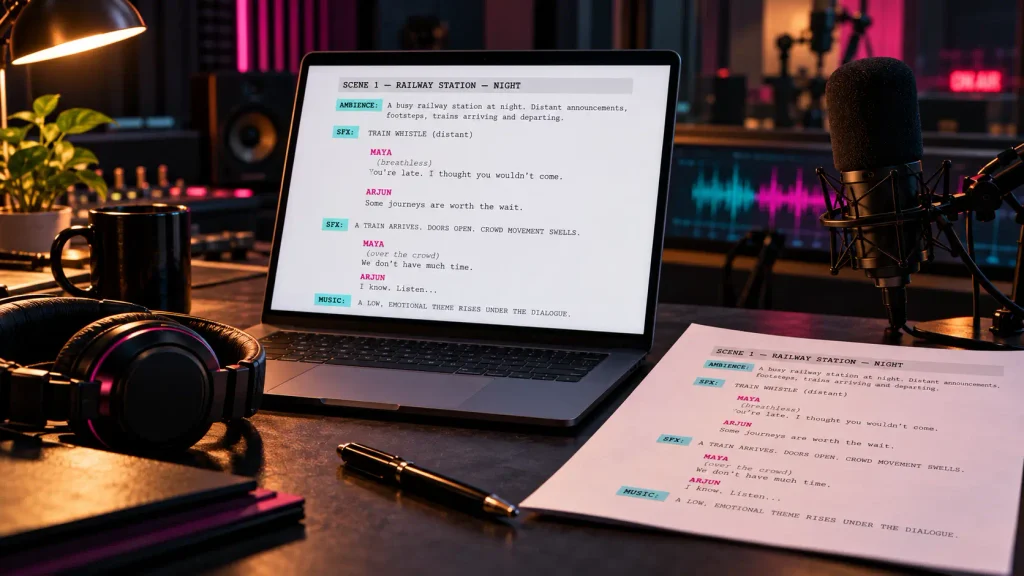
A standard audio drama script format separates scene headings, character names, dialogue, performance directions and sound cues so the production team can interpret them easily. Although formatting conventions vary, a clear and consistent layout helps actors perform their lines and sound designers identify the audio required for each scene.
A practical script typically includes a title, character list, numbered scenes, spoken dialogue and technical instructions.
Scene Headings and Character Names
Scene headings identify where and when a scene takes place.
A clear heading might look like this:
SCENE 1 — RAILWAY STATION — NIGHT
This tells the production team that the first scene occurs at a railway station during nighttime.
Other examples include:
SCENE 2 — MAYA’S APARTMENT — MORNING
SCENE 3 — EMPTY CORRIDOR — CONTINUOUS
In audio drama, the location heading primarily helps the production team. Listeners still need audible clues to understand the setting.
Character names should be presented consistently, often in uppercase, before the corresponding dialogue.
MAYA:
Did you hear that?
ARJUN:
I thought it was the wind.
For a larger cast, a character list at the beginning of the script can include brief descriptions of vocal characteristics and relationships.
Avoid relying only on names that look different on the page. If several characters sound similar, the dialogue and performance must help listeners distinguish them.
Dialogue and Voice Performance Directions
Dialogue is the spoken content of an audio drama.
It should sound believable when performed aloud, reflect each character’s personality and contribute to the scene’s development.
Performance directions indicate how a particular line should be delivered.
MAYA: (whispering)
Don’t turn around.
ARJUN: (confused)
Why? What’s behind me?
MAYA: (urgently)
Just keep walking.
Directions such as (whispering), (laughing) or (out of breath) can clarify the intended performance.
However, excessive directions may restrict an actor’s interpretation.
Instead of specifying an emotion for every sentence, use directions where the delivery is important to understanding the scene.
Writers should also avoid explaining information that characters would not naturally say.
For example, this line sounds artificial:
“Arjun, my younger brother who has lived with me for ten years, why are you standing beside the kitchen door?”
A more natural version might be:
“Arjun, why are you standing there? You know that door never opens by itself.”
The second line communicates concern while allowing the audience to discover the relationship and setting through the wider story.
Sound Effects (SFX), Ambience and Music Cues
Sound cues describe audio elements that are not part of the characters’ spoken dialogue.
Three common cue types are:
- SFX (sound effects): Specific sounds such as a door closing, a phone ringing or footsteps approaching.
- Ambience: Continuing environmental sound such as rain, traffic, wind or a crowded marketplace.
- Music: Musical elements that introduce a scene, support a transition or establish a particular atmosphere.
For example:
AMBIENCE: QUIET RAILWAY PLATFORM. LIGHT RAIN.
SFX: DISTANT TRAIN HORN.
MUSIC: LOW SUSPENSE THEME. FADE IN SLOWLY.
Sound cues should describe what the audience needs to hear rather than provide vague emotional instructions.
Compare:
Less useful: SFX: SOMETHING SCARY HAPPENS.
More useful: SFX: THREE SLOW KNOCKS ON A METAL DOOR.
The second cue gives the sound designer a specific production requirement.
Sound should also have a narrative purpose. An unnecessary effect can distract listeners, while a carefully timed sound can communicate an important event without dialogue.
Pauses, Silence and Scene Transitions
Silence is an important storytelling tool in audio drama.
A pause can communicate hesitation, uncertainty, emotional tension or a character’s reaction to unexpected information.
For example:
ARJUN:
I found the letter.
PAUSE: TWO SECONDS.
MAYA: (quietly)
Then you know the truth.
The pause gives listeners time to anticipate the significance of the letter.
Writers can distinguish between a brief performance pause and a deliberate moment of complete silence.
PAUSE: TWO SECONDS.
SILENCE: THREE SECONDS. ALL AMBIENCE CUTS OUT.
Scene transitions should also be clear.
A transition may use a fade, a change in ambience, a musical bridge or a distinct sound that establishes the next location.
SFX: TRAIN DEPARTS. FADE OUT.
TRANSITION: BRIEF SILENCE.
AMBIENCE: QUIET APARTMENT. WALL CLOCK TICKING.
The goal is to help listeners understand that the story has moved to another time or place without relying on visual cuts.
How to Format a Script for Actors and Sound Designers
A production-friendly audio drama script should be easy to read during rehearsals and recording sessions.
Actors need to locate their lines quickly, understand the context and identify important performance directions.
Sound designers need to distinguish individual effects from continuing ambience and music.
A simple format can achieve both purposes:
TITLE: THE LAST PLATFORM
WRITER: [AUTHOR NAME]
CHARACTERS:
MAYA — Curious but cautious.
ARJUN — Practical, increasingly nervous.
SCENE 1 — RAILWAY STATION — NIGHT
AMBIENCE: LIGHT RAIN ON AN EMPTY PLATFORM.
SFX: DISTANT TRAIN HORN.
MAYA: (whispering)
I thought the station closed at midnight.
ARJUN:
It did. Look at the clock.
SFX: ELECTRIC CLOCK BUZZES, THEN STOPS.
MAYA:
Why did it stop at 11:59?
For longer productions, writers may also include scene numbers, revision dates and production notes.
Maintain consistent capitalization, spacing and cue labels throughout the document. A production team should not need to guess whether a line is spoken dialogue or an instruction.
Single-column vs two-column script layouts
Two common approaches to audio drama script formatting are single-column and two-column layouts.
| Layout | How it works | Best suited for |
| Single-column | Dialogue, scene descriptions and sound cues appear in sequence | Beginners, small casts, independent audio dramas |
| Two-column | Dialogue and production instructions appear in separate columns | Productions requiring coordinated technical cue tracking |
Single-column example
SFX: PHONE RINGS TWICE.
MAYA:
Hello?
ARJUN: (through phone)
Don’t go to the station.
Two-column example
| Dialogue / performance | Sound / production |
| MAYA: Hello? | SFX: Phone rings twice before the line |
| ARJUN: Don’t go to the station. | Phone-filter effect on Arjun’s voice |
Neither layout is universally required.
For beginners, a single-column format is usually easier to draft and revise. A two-column format may be useful when a production involves complex sound timing or detailed coordination between performers and technical teams.
Choose one layout based on your production requirements and use it consistently.
What Does an Audio Drama Script Look Like?
An audio drama script looks like a screenplay designed for listening rather than viewing. It combines scene headings, character names, spoken dialogue, sound effects, music and performance directions. Each element tells actors and sound designers how to create a story that audiences can follow entirely through sound.
The following original example demonstrates how these elements work together in a short mystery.
Original Short Audio Drama Script Example
Title: The Last Platform | Genre: Mystery / Suspense | Characters: Maya and Arjun | Estimated runtime: 2–3 minutes, depending on performance and sound timing. Original illustrative script.
THE LAST PLATFORM — Audio Drama Script
SCENE 1 — RAILWAY STATION — NIGHT AMBIENCE: STEADY RAIN. WIND MOVING THROUGH AN EMPTY PLATFORM. SFX: DISTANT TRAIN HORN. MAYA: (whispering) I thought the last train left an hour ago. ARJUN: (nervously) It did. The station’s been closed since midnight. SFX: FOOTSTEPS APPROACH SLOWLY, THEN STOP. MAYA: Arjun, did you hear that? ARJUN: Footsteps. But there’s nobody here. SFX: OLD STATION SPEAKER CRACKLES. RECORDED VOICE: (distorted) Attention, passengers. The final train will arrive on platform three. MAYA: Platform three? They shut that platform years ago. ARJUN: Look at the clock. SFX: CLOCK TICKS THREE TIMES, THEN STOPS. MAYA: Eleven fifty-nine. That’s impossible. It was past midnight when we arrived. PAUSE: TWO SECONDS. SFX: A METAL OBJECT FALLS NEARBY. ARJUN: There’s something under that bench. SFX: PAPER RUSTLES. A SMALL METAL KEY JINGLES. MAYA: (reading) To whoever finds this: the station clock is broken. Please return the key to the control room. ARJUN: (relieved) A maintenance note. That explains the clock. MAYA: But what about the announcement? SFX: SPEAKER CRACKLES AGAIN. RECORDED VOICE: This is a scheduled equipment test. Please disregard previous announcements. ARJUN: (laughs nervously) Well, that explains the ghost train. MAYA: Almost. Who dropped the key? SFX: DISTANT FOOTSTEPS RETREAT DOWN THE PLATFORM. PAUSE: TWO SECONDS. ARJUN: Let’s return it in the morning. MAYA: Agreed. And next time, we’re taking a taxi. SFX: THEIR FOOTSTEPS MOVE AWAY. AMBIENCE: RAIN CONTINUES, THEN FADES. MUSIC: BRIEF MYSTERY THEME. FADE OUT. END.
This short script establishes a location, introduces an apparent mystery, develops tension and resolves the main uncertainty through an equipment-test announcement and maintenance note. The unexplained footsteps leave a small final question for listeners.
It also demonstrates that audio drama does not require lengthy narration. Dialogue and carefully selected sounds can carry much of the storytelling.
How to Read Character and Sound Cues
Every line in an audio drama script serves a specific production purpose.
Character names identify who speaks, while dialogue communicates the words audiences will hear. Performance directions guide delivery, and sound cues indicate the effects or background audio needed to establish events.
In The Last Platform, the instruction MAYA: (whispering) tells the performer to lower their voice. It is not dialogue that should be spoken aloud.
Similarly, SFX: CLOCK TICKS THREE TIMES, THEN STOPS describes an audible event that becomes part of the mystery.
The RECORDED VOICE lines represent a station announcement. In production, these could be performed by a third voice actor or prerecorded by an existing performer using an appropriate audio effect.
Sound cues should be specific enough to produce consistently, but they do not need to prescribe every technical detail. A sound designer can determine the most suitable recording or effect while preserving the writer’s intended action.
How the Example Creates Suspense Without Visuals
The script creates suspense through the gradual introduction of unfamiliar sounds and information.
The rain and distant train horn establish the setting. Approaching footsteps suggest another presence, while the station announcement contradicts what the characters believe about the closed platform.
The stopped clock adds uncertainty, and the falling key directs the characters toward an explanation.
Notice that the script does not describe a shadowy figure standing behind the characters. Such a detail would be invisible to listeners unless communicated through sound, dialogue or narration.
Instead, the story uses audible clues and character reactions to help audiences imagine what might be happening.
The equipment-test announcement provides a plausible explanation for the unusual sounds, while the final retreating footsteps preserve a sense of mystery.
This technique demonstrates an important audio drama writing principle: give listeners enough audible information to understand the action, while allowing their imagination to complete the scene.
Annotated sample with dialogue, SFX and silence
The following breakdown explains how individual script elements contribute to the scene.
| Script element | Example | Storytelling function |
| Scene heading | SCENE 1 — RAILWAY STATION — NIGHT | Establishes location and time for the production team |
| Ambience | STEADY RAIN | Creates a consistent environmental background |
| Sound effect | FOOTSTEPS APPROACH | Suggests movement and introduces uncertainty |
| Dialogue | Did you hear that? | Reveals a character’s reaction and directs listener attention |
| Performance direction | (whispering) | Communicates caution through vocal delivery |
| Pause | PAUSE: TWO SECONDS | Creates anticipation before the next event |
| Recorded announcement | The final train will arrive… | Introduces information that drives the mystery |
| Music cue | BRIEF MYSTERY THEME. FADE OUT. | Signals the ending and reinforces the atmosphere |
Writers can use this approach when reviewing their own scenes. Each line should have a clear purpose, whether it develops a character, advances the plot, establishes the setting or influences the listener’s emotional experience.
A useful final test is to read the dialogue aloud while imagining only the sounds explicitly included in the script. If an important action becomes impossible to understand without seeing it, the scene may need clearer dialogue or an additional sound cue.
How to Write an Audio Drama Script Step by Step
To write an audio drama script, choose a story idea, develop recognizable characters, outline the conflict, write natural dialogue, add sound cues, revise through rehearsals and prepare a recording draft. These seven steps help transform a fictional idea into a script that performers and sound designers can bring to life.
Step 1: Choose Your Genre and Core Story Idea
Start by choosing a genre such as mystery, comedy, romance, thriller or family drama. Your genre influences the characters, pacing, dialogue and sound design.
Next, express your story in one sentence.
For example: Two friends waiting at an abandoned railway station hear an announcement for a train that supposedly stopped running years ago.
This premise establishes a location, characters and a mystery. It also offers opportunities for sound-based storytelling.
Keep your first audio drama focused on one central conflict rather than introducing several unrelated storylines.
Step 2: Build Characters With Distinct Voices
Listeners must recognize characters without seeing their faces. Give each character a clear personality, motivation and speaking style.
In the railway-station story, Maya might be curious and impulsive, while Arjun is cautious and analytical.
Their dialogue should reflect these differences.
MAYA: “Someone has to find out what’s happening.”
ARJUN: “Or we could leave before something else happens.”
Distinctive voices come from vocabulary, sentence structure, emotional responses and performance—not necessarily exaggerated accents.
For a beginner’s script, two or three characters are often easier to manage than a large cast.
Step 3: Outline Scenes and the Central Conflict
Organize the story into a beginning, middle and ending before writing the complete dialogue.
For a short mystery, the outline might look like this:
| Story stage | Example | Purpose |
| Beginning | Two friends arrive at a deserted station | Establish characters and setting |
| Conflict | They hear an impossible train announcement | Introduce uncertainty |
| Development | They investigate the platform and discover a key | Build suspense |
| Resolution | A maintenance announcement explains part of the mystery | Resolve the main question |
| Final moment | Unexplained footsteps continue | Leave a memorable ending |
Each scene should introduce information, develop conflict or change the characters’ situation.
If a scene does none of these, consider removing or combining it.
Step 4: Write Dialogue That Sounds Natural
Audio drama dialogue must communicate information while sounding like something people might actually say.
Avoid making characters explain facts they already know merely for the listener’s benefit.
Instead of:
MAYA: “As you know, Arjun, we are standing at the abandoned railway station that closed five years ago.”
Write:
MAYA: “They closed this station five years ago. So why are the lights still on?”
The revised line establishes the setting and creates curiosity.
Read dialogue aloud while writing. If a sentence feels awkward to speak, simplify it.
For additional help with character delivery, explore voice acting tips.
Step 5: Add Sound Effects and Atmosphere
Sound effects help listeners understand actions and environments that cannot be seen.
Use SFX for individual events, AMBIENCE for continuing environmental sounds and MUSIC for musical cues.
For example:
AMBIENCE: LIGHT RAIN ON AN EMPTY PLATFORM.
SFX: METAL GATE CREAKS OPEN.
MAYA:
Did you leave that gate unlocked?
ARJUN:
I haven’t touched it.
These cues establish the location and introduce a new development without unnecessary narration.
Only include sounds that contribute to the story. Too many simultaneous effects can make dialogue difficult to understand.
Step 6: Edit the Script by Reading It Aloud
A script that looks effective on the page may sound unnatural during performance.
Read the complete script aloud, preferably with someone performing the other characters.
Check whether listeners can understand the setting, recognize the speakers and follow the action without visual explanations.
Time the reading, including meaningful pauses and sound-only sequences.
During revision, remove repetitive dialogue, shorten unnecessary exposition and clarify confusing transitions.
A useful test is to ask someone unfamiliar with the story to listen without reading the script. Their questions may reveal information the dialogue or sound design has failed to communicate.
Step 7: Prepare the Final Recording Draft
The final recording draft should be organized so performers and editors can work without guessing.
Include the script title, writer’s name, character list, scene numbers, dialogue, performance directions and clearly labeled sound cues.
Mark any sounds that must occur at an exact moment. Separate essential effects from optional atmospheric details.
For example:
SCENE 2 — CONTROL ROOM — NIGHT
AMBIENCE: LOW ELECTRICAL HUM.
SFX: DOOR CLOSES BEHIND MAYA.
MAYA: (startled)
Arjun? Did you shut the door?
PAUSE: ONE SECOND.
ARJUN: (from outside)
Maya, I’m still in the corridor.
The recording team can immediately identify the characters’ positions and the timing of the sound effect.
Creators developing voice-led fiction can also use Arré Voice Creator Studio to prepare scripts and record audio online.
Checklist for a production-ready audio drama script
Before recording, confirm that:
- The story has a clear beginning, conflict and resolution.
- Every character has a recognizable speaking style.
- Scene headings identify the location and time.
- Dialogue sounds natural when performed aloud.
- Sound effects and ambience are clearly labeled.
- Important pauses and transitions are marked.
- Actors can distinguish dialogue from production instructions.
- The script has been rehearsed and timed.
- The recording team understands all essential sound cues.
- The final draft includes a version number or revision date.
A production-ready script does not need elaborate formatting. It needs to communicate the writer’s intentions consistently and clearly.
How Do You Write Dialogue for Audio Drama?

Good audio drama dialogue reveals character, advances the plot and helps listeners understand actions they cannot see. It should sound natural when spoken, avoid unnecessary explanations and use pauses or reactions where they contribute to the narrative.
Because dialogue carries much of an audio drama’s storytelling, even small changes in wording can influence how listeners understand a scene.
Make Each Character Recognizable by Voice
Characters should have different ways of speaking.
One character might ask direct questions, another might use humor during difficult situations, while a third may respond cautiously.
For example:
MAYA: “There’s a light in the control room. Let’s check.”
ARJUN: “Or let’s consider why someone would leave a light on in an abandoned station.”
Both characters react to the same situation, but their responses reveal different personalities.
Avoid relying exclusively on accents or unusual vocal effects to distinguish characters. Their attitudes, vocabulary and reactions should also make them recognizable.
Use Dialogue to Reveal Action Naturally
Audio drama writers must communicate important physical actions without visual descriptions.
However, characters should not narrate every movement.
Compare these approaches:
Unnatural dialogue: “I am opening the wooden door with my right hand, and now I am walking into the room.”
More natural dialogue:
SFX: WOODEN DOOR CREAKS OPEN.
MAYA:
There’s someone inside.
ARJUN:
Then don’t go any farther.
The sound effect communicates the action, while the dialogue reveals its significance.
This approach allows listeners to imagine events without excessive explanation.
Avoid Excessive Exposition and Unnecessary Narration
Exposition provides background information, but too much can interrupt the story.
Instead of explaining a character’s complete history in one conversation, reveal relevant details gradually through conflict and decisions.
For example, rather than stating that Maya has been searching for her missing brother for several years, another character might ask:
ARJUN: “You’ve checked every station in the city. What makes this one different?”
MAYA: “His last message mentioned platform three.”
These lines establish motivation while moving the story forward.
Narrators can be useful, especially for time transitions or complex settings, but they are not essential to every audio drama.
Use Silence, Interruptions and Reactions Effectively
Real conversations contain hesitation, unfinished sentences and emotional reactions.
Audio drama can use these features to communicate tension and uncertainty.
MAYA:
I found the recording. It says—
SFX: LOUD KNOCK ON THE DOOR.
ARJUN: (whispering)
Don’t answer it.
PAUSE: TWO SECONDS.
MAYA:
Then who is knocking?
The interruption changes the direction of the conversation, while the pause allows suspense to develop.
Use silence deliberately. Frequent unexplained pauses may slow the narrative without adding meaning.
How Do You Write Sound Effects in an Audio Drama Script?
Write sound effects in an audio drama script as clearly labeled production cues, usually beginning with SFX, followed by a specific description of the sound and its timing. Sound cues should help listeners understand actions, locations and emotional changes without overwhelming the dialogue.
For example, SFX: FOOTSTEPS APPROACH, THEN STOP is more useful than SFX: SCARY NOISE.
When to Use SFX, Ambience and Music
Each audio element serves a different purpose.
| Cue | Purpose | Example |
| SFX | Communicates a specific action or event | SFX: GLASS BREAKS |
| AMBIENCE | Establishes a continuing environment | AMBIENCE: BUSY MARKETPLACE |
| MUSIC | Supports transitions or emotional atmosphere | MUSIC: SOFT PIANO THEME. FADE OUT. |
Use sound effects when an audible event changes the story or helps establish an important action.
Use ambience when listeners need to understand the surrounding environment.
Use music selectively to support a scene’s atmosphere or transition.
Not every scene requires all three.
How to Format Sound Cues Clearly
Keep sound instructions specific, concise and consistent.
A practical cue includes the sound source, action and relevant timing.
SFX: PHONE RINGS THREE TIMES, THEN STOPS.
SFX: FOOTSTEPS APPROACH FROM THE DISTANCE.
AMBIENCE: NIGHT INSECTS. CONTINUE UNDER DIALOGUE.
MUSIC: SUSPENSE THEME. FADE IN, THEN CUT.
If timing is essential, place the cue immediately before the dialogue or action it affects.
Avoid vague directions such as “make everything dramatic.” Instead, describe the audible result needed to support the scene.
How Sound Establishes Location, Movement and Mood
Sound can establish a setting before a character speaks.
The combination of traffic, vehicle horns and footsteps may suggest a busy street. Birds, wind and distant flowing water may suggest an outdoor natural environment.
Movement can also be communicated through changing sound intensity.
For example:
SFX: MOTORCYCLE ENGINE APPROACHES, PASSES, THEN FADES.
This suggests movement through the listening space.
Mood develops through the relationship between sounds, dialogue and timing. A ticking clock may feel ordinary during a relaxed conversation but unsettling during a tense silence.
Sound design should reinforce the story rather than attempt to replace it.
Common Sound Design Mistakes to Avoid
One common mistake is including too many effects simultaneously. Constant music, loud ambience and frequent sound cues can make dialogue difficult to understand.
Another is using sounds without a clear narrative purpose.
A third is writing cues that are difficult to produce or interpret, such as “the sound of someone realizing the truth.” That emotion is better communicated through performance or a specific audible reaction.
Writers should also avoid depending on subtle sounds to communicate essential plot information without supporting dialogue.
For example, if a key falls onto a carpet, listeners may not recognize the sound. A brief character reaction can clarify what happened.
Example: Writing a scene with dialogue and sound alone
The following original excerpt demonstrates how an audio drama can communicate a complete action without a narrator.
SCENE 1 — OLD LIBRARY — EVENING
AMBIENCE: QUIET ROOM. WALL CLOCK TICKING.
SFX: BOOK SLIDES FROM A SHELF.
MAYA:
Did you move that?
ARJUN:
I’m standing beside you.
SFX: BOOK FALLS TO THE FLOOR.
MAYA:
There’s a note inside.
SFX: PAPER UNFOLDS.
ARJUN: (reading)
“Return this before midnight.”
SFX: CLOCK STRIKES TWELVE.
PAUSE: TWO SECONDS.
MAYA:
I think we’re too late.
The scene establishes a location, introduces an unusual event and creates a consequence through sound and dialogue.
The clock striking midnight changes the meaning of the note without requiring visual explanation.
Free Audio Drama Script Template for Beginners
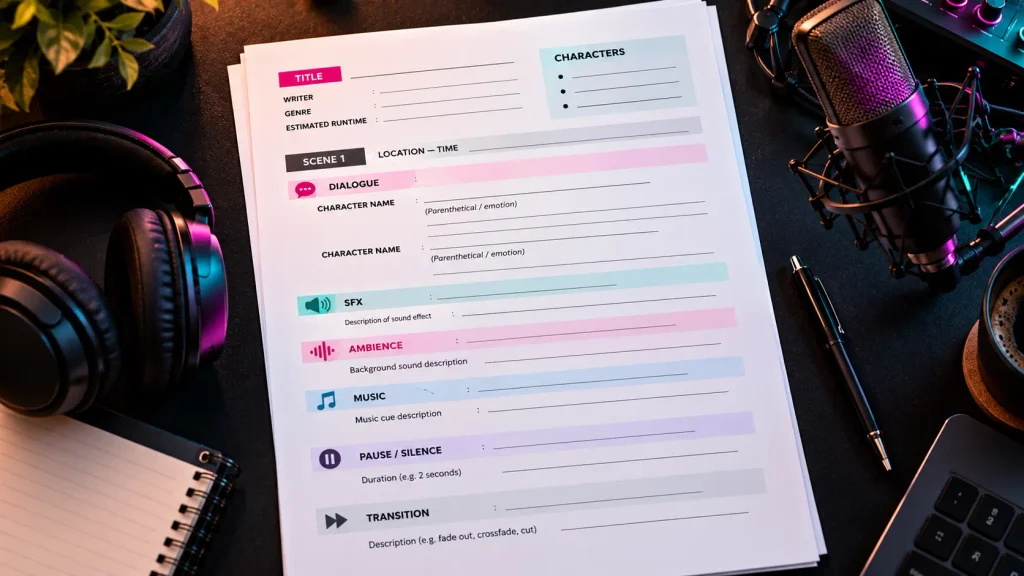
A beginner-friendly audio drama script template should include a title, character list, scene headings, dialogue, sound effects, ambience, music and performance directions. The following reusable format can be adapted for mysteries, comedies, romances and other audio fiction genres.
Copy-and-Paste Script Template
Copy the template below into a document and replace the bracketed placeholders with your own story details.
TITLE: [AUDIO DRAMA TITLE]
WRITER: [YOUR NAME]
GENRE: [GENRE]
ESTIMATED RUNTIME: [MINUTES]
DRAFT VERSION: [VERSION / DATE]
CHARACTERS:
[CHARACTER 1] — [VOICE / PERSONALITY]
[CHARACTER 2] — [VOICE / PERSONALITY]
SCENE 1 — [LOCATION] — [TIME]
AMBIENCE: [BACKGROUND ENVIRONMENT]
SFX: [SPECIFIC SOUND]
CHARACTER 1: (performance direction)
[Opening dialogue]
CHARACTER 2:
[Response]
SFX: [ACTION OR EVENT]
CHARACTER 1:
[Dialogue that introduces conflict]
PAUSE: [DURATION IF NECESSARY]
CHARACTER 2:
[Reaction]
TRANSITION: [FADE / CUT / MUSIC]
SCENE 2 — [LOCATION] — [TIME]
AMBIENCE: [NEW ENVIRONMENT]
CHARACTER 1:
[Dialogue]
SFX: [IMPORTANT ACTION]
CHARACTER 2:
[Dialogue leading toward resolution]
MUSIC: [OPTIONAL ENDING CUE]
END.
This is a flexible working template, not a mandatory broadcaster format. Adjust it to match your performers’ and production team’s needs.
Character List, Scene Headings and Cue Format
A character list helps performers understand who appears in the story.
For example:
MAYA: A determined young journalist who speaks directly and asks questions.
ARJUN: Her cautious friend, who prefers evidence before making decisions.
Scene headings should identify the location and time consistently.
Sound cues should use recognizable labels such as SFX, AMBIENCE and MUSIC.
If the script contains multiple scenes, number them in sequence. This makes revisions and recording discussions easier.
For more complex productions, add notes identifying off-microphone dialogue, recorded announcements or other special performance requirements.
Template for a Five-Minute Audio Drama
A five-minute audio drama works best when it focuses on a manageable conflict.
The following timing structure provides a starting point:
| Approximate time | Story section | What to include |
| 0:00–0:45 | Opening | Introduce characters, setting and a compelling question |
| 0:45–1:45 | Conflict | Reveal the main problem |
| 1:45–3:30 | Development | Build tension through dialogue and action |
| 3:30–4:30 | Resolution | Reveal the outcome or major turning point |
| 4:30–5:00 | Ending | Deliver the final emotional moment or closing sound |
For example, a five-minute mystery could follow two characters investigating an unexpected telephone call.
The opening establishes the call. The conflict reveals that the caller knows a private secret. The middle develops the investigation, and the ending resolves the mystery.
Keep locations and character changes limited unless the story requires them.
This structure is illustrative. A comedy, experimental drama or emotional monologue may need different pacing.
How to Adapt the Template for Multiple Episodes
A serialized audio drama requires continuity across episodes.
Keep a record of recurring characters, relationships, important events and unresolved conflicts.
Each episode should offer a meaningful development while contributing to the larger narrative.
For example, a mystery series could introduce a different clue in every episode, gradually revealing the central secret.
A recurring opening theme or consistent scene-heading format can help maintain production continuity.
For more detailed planning, explore serialized storytelling and how connected narratives develop across episodes.
How Long Should an Audio Drama Script Be?
An audio drama script’s length depends on the target runtime, speaking pace, pauses, sound effects and music. As a preliminary estimate, writers can plan around 120–150 spoken words per minute, then add time for sound-only sequences and transitions. The final duration should always be checked through a timed reading.
Unlike conventional screenplays, audio drama scripts do not follow a universally reliable one-page-per-minute rule.
Planning a 2–5-Minute Audio Story
Short audio dramas are suitable for beginners because they allow writers to practice dialogue, pacing and sound design without managing a complicated production.
A two-minute drama might contain approximately 200–260 spoken words if it includes several pauses and sound effects.
A five-minute drama could contain roughly 500–650 spoken words under similar conditions.
These are planning estimates, not fixed requirements.
For short fiction, focus on one central event, a small cast and a clear ending.
A single well-developed scene can be more effective than several rushed locations.
Writing a 10–15-Minute Fiction Episode
A longer audio drama gives writers more room to develop relationships, introduce secondary complications and build tension.
A 10-minute episode might contain approximately 1,100–1,300 spoken words, depending on the amount of non-dialogue audio.
A 15-minute episode might contain approximately 1,650–1,950 spoken words under similar assumptions.
Longer episodes benefit from an outline that identifies each scene’s purpose.
Avoid extending dialogue simply to reach a target duration. Additional scenes should introduce meaningful developments.
Estimating Runtime From Dialogue and Sound Cues
A useful preliminary calculation is:
Estimated runtime = spoken-word duration + sound-only duration + pauses and transitions.
For example, consider a script containing 480 spoken words delivered at 140 words per minute, plus 45 seconds of non-overlapping sound and pauses.
Spoken duration:
480 ÷ 140 = approximately 3 minutes 26 seconds.
Additional sound and pauses:
45 seconds.
Estimated total runtime: approximately 4 minutes 11 seconds.
Do not double-count background ambience that plays underneath dialogue.
The following calculator can help estimate the duration of your own audio drama script.
{@body const [words,setWords] = DIL.useState(“480”)}
{@body const [pace,setPace] = DIL.useState(140)}
{@body const [extra,setExtra] = DIL.useState(“45”)}
{@body const seconds = (Math.max(0,Number(words)||0)/pace)*60+Math.max(0,Number(extra)||0)}
{@body const fmt = s=>${Math.floor(s/60)} min ${Math.round(s%60)} sec}
<box border radius=”xl” padding={3} gap={3}>
<text weight=”medium”>Audio drama runtime estimator</text>
<grid columns={2} gap={3}>
<grid-item>
<label>Spoken words</label>
<input inputType=”number” value={words} onChange={setWords}/>
</grid-item>
<grid-item>
<label>Sound-only time (seconds)</label>
<input inputType=”number” value={extra} onChange={setExtra}/>
</grid-item>
</grid>
<row align=”center” justify=”between”>
<label>Speaking pace</label>
<text weight=”medium” tabularNums>{pace} words/min</text>
</row>
<slider min={100} max={180} step={5} value={pace} onChange={setPace}/>
<box background=”surface-secondary” radius=”lg” padding={3} gap={1}>
<text color=”secondary” size=”xs”>Estimated runtime</text>
<title size=”xl” tabularNums>{fmt(seconds)}</title>
<caption>Excludes ambience playing simultaneously with dialogue. Verify with a timed rehearsal.</caption>
</box>
</box>
How to Pace Cliffhangers and Scene Transitions
A cliffhanger introduces an unresolved question or unexpected development that encourages listeners to continue.
For example, an episode might end with a character discovering that a familiar voice is coming from an abandoned building.
A strong cliffhanger should emerge naturally from the story rather than appear as an unrelated surprise.
Scene transitions also influence pacing. A sudden sound cut can create urgency, while a gradual fade may communicate a reflective or emotional shift.
For serialized fiction, balance unresolved questions with satisfying developments. Listeners should feel that each episode offers meaningful progress, even when the larger story continues.
Before finalizing the script, perform a complete timed reading with the planned pauses and major sound cues. This is the most reliable way to determine whether the episode fits its intended duration.
How Are Audio Drama Scripts Evolving in 2026?
Audio drama scripts in 2026 are adapting to mobile listening, shorter episodes, multilingual storytelling and AI-assisted production. These developments give creators more ways to write, record and distribute audio fiction. However, strong dialogue, thoughtful sound design and believable performances remain essential to an engaging listening experience.
Modern audio drama writing increasingly involves considering not only the story but also how audiences will hear it, whether through headphones, smartphones or other listening devices.
Mobile-First Audio Fiction and Short Episodes
Mobile listening offers creators opportunities to experiment with shorter, self-contained audio dramas.
A five-minute mystery, for example, can introduce a character, establish a conflict and deliver a satisfying ending without requiring a long episode.
Short-form audio fiction can also work as part of a connected series, with each episode exploring a different event or continuing a larger narrative.
For mobile-friendly audio drama scripts, prioritize clear dialogue, recognizable character voices and sound effects that remain understandable through ordinary headphones.
Avoid making important plot details depend entirely on subtle background sounds that listeners might miss.
There is no universally ideal episode length. A compelling story should determine its duration rather than being unnecessarily shortened or extended to follow a trend.
Multilingual and Regional-Language Audio Dramas
Multilingual audio drama creates opportunities to tell fictional stories through the languages and expressions familiar to different audiences.
In India, writers can explore narratives in Hindi, Tamil, Telugu, Bengali, Marathi, Malayalam and other regional languages, including stories that naturally involve more than one language.
A fictional family conversation, for example, may feel more authentic when characters use expressions common to their community.
When writing a multilingual audio drama script, identify each character’s language preferences and indicate important language changes clearly.
SCENE 2 — FAMILY HOME — EVENING
MAYA: (in Hindi, warmly)
[Dialogue]
ARJUN: (in English)
[Dialogue]
This illustrates how to mark language changes; the placeholders should be replaced with the actual spoken lines before recording.
Translations, contextual explanations or transcripts can help audiences who are unfamiliar with a particular language.
Writers should also respect cultural context and avoid reducing regional characters to exaggerated accents or stereotypes.
AI-Assisted Script Drafting and Voice Production
AI-assisted tools can support several stages of audio drama development, including brainstorming, outlining scenes, revising dialogue and preparing production ideas.
For example, a writer may use AI to generate alternative opening situations for a mystery. They can then select an idea, develop original characters and rewrite the dialogue to reflect their intended tone.
AI tools may also assist with synthetic voice generation or sound production, depending on the software used.
However, generated dialogue can sound repetitive or overly explanatory. Writers should review every line for character consistency, emotional credibility and narrative purpose.
Arré Voice Creator Studio includes AI-assisted script drafting alongside browser-based recording and editing capabilities. This provides a workflow in which creators can develop a script and prepare a voice-led production.
AI assistance is most useful when it supports creative decisions rather than replacing them.
Human Performance, Consent and Originality
Human performance remains central to many compelling audio dramas.
Actors communicate meaning through timing, hesitation, emphasis and emotional interpretation. Even a short exchange can change dramatically depending on how it is delivered.
When using AI-generated voices or voice-cloning technology, creators should obtain appropriate permission before reproducing an identifiable person’s voice.
Writers must also respect copyright when using music, recordings or third-party scripts.
Originality is equally important. A distinctive audio drama should reflect meaningful creative choices in its characters, conflicts, dialogue and sound design.
Technology can simplify production tasks, but it does not remove the creator’s responsibility for accuracy, consent and the final work.
When AI assistance helps and when it weakens a story
AI assistance can be useful for organizing scene outlines, identifying repetitive dialogue and exploring alternative plot developments.
It may weaken a story when writers accept generic dialogue without revision, allow characters to lose their distinctive voices or rely on synthetic performances that fail to convey the intended emotion.
A practical approach is to use AI-generated suggestions as working material, then revise them through human judgment and spoken rehearsals.
The final test is whether the story sounds believable, remains coherent and communicates the writer’s intended experience.
How Can You Turn an Audio Drama Script Into a Voice Story?
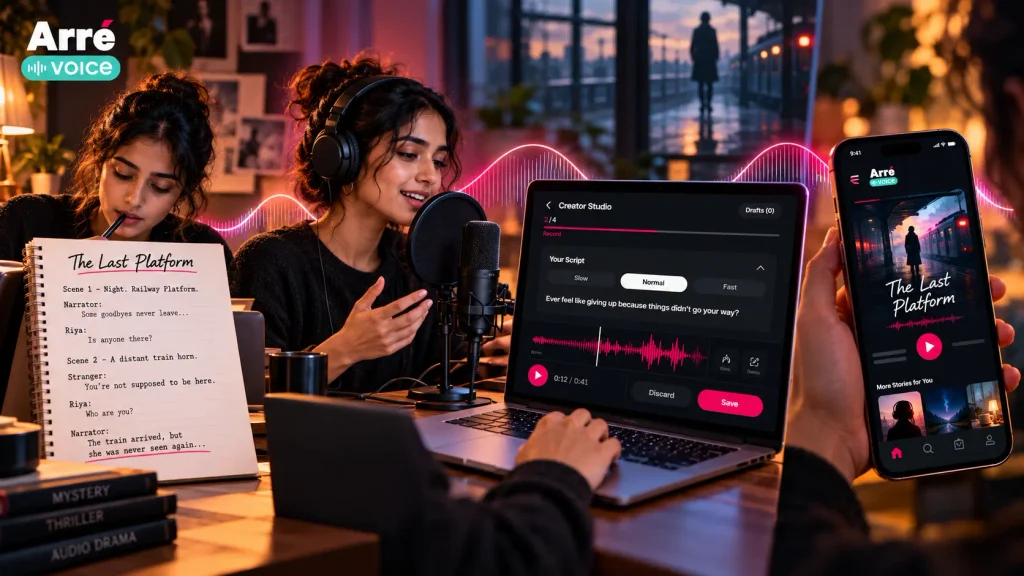
To turn an audio drama script into a voice story, rehearse the dialogue, record the performances, edit the audio, add essential sound effects and publish the finished production. A clear script makes recording easier, while careful editing helps listeners follow the characters and action without visuals.
You do not necessarily need a professional recording studio to begin. A quiet environment, a suitable microphone and a manageable script can be enough to produce a simple voice-led story.
Rehearse and Record Your Character Dialogue
Begin by reading the complete script aloud.
Pay attention to pronunciation, speaking pace, character distinctions and the timing of important pauses.
For productions involving multiple performers, rehearse conversations together when possible. This helps actors respond naturally rather than delivering isolated lines.
For a single-performer audio drama, record each character with a consistent speaking style.
Choose a relatively quiet recording space and test the microphone before beginning.
Record a short sample to identify distracting background noise, uneven volume or unclear dialogue.
If a line does not sound natural, revise the script rather than repeatedly attempting to force an awkward delivery.
Creators can explore voice acting tips for additional guidance on vocal performance.
Edit Voices, Background Sound and Transitions
After recording, organize the dialogue according to the script’s scene structure.
Remove unnecessary mistakes, distracting noises and pauses that interrupt the intended pacing.
Next, add sound effects that communicate important actions.
For example, a door opening, footsteps approaching or a phone ringing can help establish what happens between spoken lines.
Use background ambience carefully. Rain, traffic or environmental sounds should support the setting without overpowering the performers.
Music can help introduce a scene or reinforce a transition, but it should not substitute for effective dialogue.
Listen to the complete production through ordinary headphones or speakers before publishing. Check whether every important line remains understandable and whether transitions clearly communicate changes in location or time.
Share Short Fiction and Invite Listener Feedback
Once the recording is complete, give the audio drama a clear title and description.
A title such as The Last Platform: A Short Audio Mystery immediately communicates the story’s subject and genre.
Where the publishing platform supports descriptions or categories, use them to help audiences understand what they are about to hear.
After sharing, invite meaningful feedback.
You might ask listeners whether they could distinguish the characters, understand the setting or follow the mystery without additional explanation.
These responses can reveal weaknesses in dialogue, sound cues or pacing.
For recurring fiction, audience feedback can also help identify which characters and themes are most engaging, while the creator retains control over the story’s direction.
Explore Voice-Led Storytelling on Arré Voice
Arré Voice provides a voice-focused environment for creating and sharing spoken content.
Through Arré Voice Creator Studio, creators can prepare scripts, record audio through a browser, import existing audio or video, edit recordings and publish content to Arré Voice.
This workflow can be useful for writers experimenting with short audio fiction, character monologues or narrated dramatic scenes.
For a multi-character audio drama, creators can arrange the performances and any specialized sound design according to their production needs, then prepare the resulting audio for publication.
Beginners can start with a single scene and a small cast before developing longer stories.
If you have completed your first audio drama script, the next step is to hear how it works in performance.
Explore Arré Voice Creator Studio and begin turning your written story into a voice-led creation.
Frequently Asked Questions
How Do You Format an Audio Drama Script?
Format an audio drama script with a title, character list, scene headings, dialogue, performance directions and clearly labeled sound cues. Use consistent labels such as SFX, AMBIENCE and MUSIC so actors and sound designers can identify instructions quickly.
A single-column layout is suitable for many beginner productions, although some broadcasters and production teams use different formats. Always follow the requirements of the organization receiving the script.
What Is an Example of an Audio Drama Script?
An audio drama script example is a fictional scene written through character dialogue and sound instructions.
SCENE 1 — EMPTY HOUSE — NIGHT
SFX: DOOR CREAKS OPEN.
MAYA: (whispering)
I thought nobody lived here.
ARJUN:
Then why is the television on?
SFX: TELEVISION STATIC. SUDDENLY CUTS OUT.
This original example establishes a location, introduces two characters and creates suspense through dialogue and audible events.
How Do You Write Sound Effects in a Script?
Write sound effects using SFX followed by a specific description of the audible event. Include timing or movement when necessary.
For example:
SFX: FOOTSTEPS APPROACH, STOP OUTSIDE THE DOOR.
Use AMBIENCE for continuing environmental sounds and MUSIC for musical instructions. Clear cues help production teams understand what listeners should hear.
Can One Person Perform an Audio Drama?
Yes, one person can perform an audio drama by narrating the story, voicing multiple characters or presenting a dramatic monologue.
A single performer can distinguish characters through changes in speaking rhythm, vocabulary and emotional delivery.
For example, a one-person mystery might involve a character recording voice messages while investigating an unusual event.
Sound effects and editing can help establish different locations and moments without requiring additional performers.
How Many Pages Is a Five-Minute Audio Drama Script?
A five-minute audio drama script does not have a fixed page count. Its length depends on formatting, dialogue density, pauses and sound effects.
As a starting estimate, a five-minute production might contain approximately 500–650 spoken words if it includes meaningful sound-only moments.
That could occupy roughly three to five pages in a spacious, single-column script layout, but different formatting choices can change the count substantially.
A timed read-through is more reliable than page count for estimating runtime.
Can You Write an Audio Drama Script Without a Narrator?
Yes. An audio drama can tell a complete story without a narrator by using character dialogue, sound effects, ambience and silence.
For example, listeners can understand that someone has entered a room through a door-opening sound followed by a character’s reaction.
Narrator-free scripts often rely on carefully written conversations and clear sound cues to communicate actions.
Narration remains an option when it genuinely helps explain time, setting or information that would otherwise be difficult to convey naturally.
What Is the Difference Between an Audio Drama and a Podcast Script?
An audio drama script is written for a fictional performance, while a podcast script can support many formats, including interviews, discussions, educational episodes and scripted fiction.
An audio drama typically includes characters, scenes, dialogue and sound cues.
An interview podcast script may instead contain an introduction, host questions, discussion points and closing remarks.
Audio dramas can also be distributed as podcasts. The distinction is therefore primarily about the content and production format, not the distribution platform.