What Is an Audio Storytelling Platform?
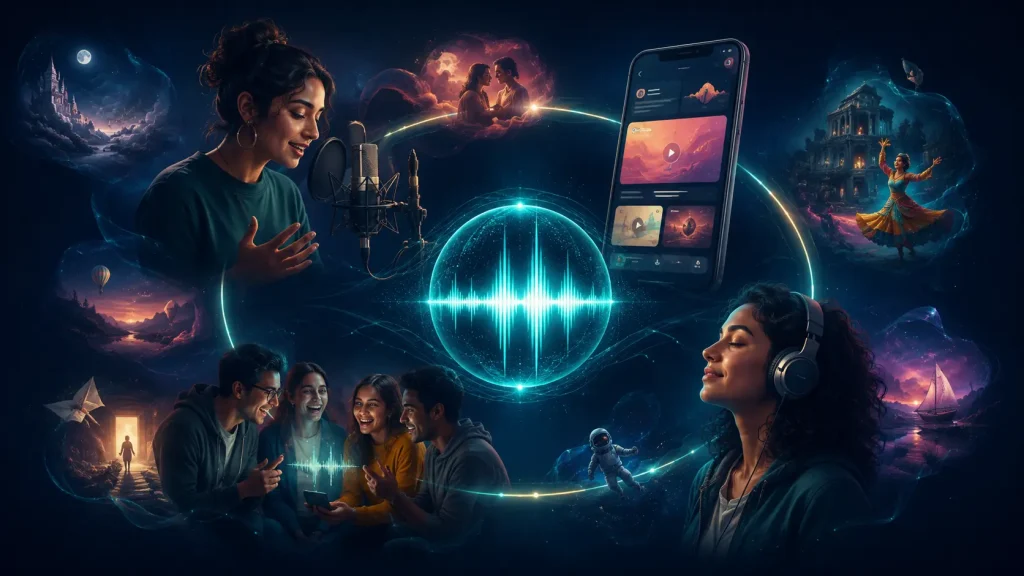
An audio storytelling platform is a digital space where creators can record, produce, publish and share stories through voice, while listeners discover and engage with audio content. It serves writers, storytellers, voice artists, independent creators and communities. Unlike ordinary audio streaming services that mainly distribute finished content, audio storytelling platforms can bring creation, publishing, discovery and audience interaction into one experience.
In simple terms: an audio storytelling platform brings story creation, publishing, discovery and listener engagement into one audio-first ecosystem.
What Is an Audio Storytelling Platform?
Definition of an Audio Storytelling Platform
An audio storytelling platform is a digital platform built around stories told through voice and sound. It allows creators to transform ideas, scripts, personal experiences or fictional narratives into audio content that listeners can discover and enjoy on smartphones, websites or other connected devices.
What makes these platforms different from conventional audio libraries is their focus on the broader storytelling journey. Depending on the platform, creators may be able to record or upload audio, organize stories into episodes or series, publish content, build profiles and connect with listeners.
For audiences, the experience goes beyond simply pressing play. Listeners may discover new storytellers, follow creators, explore genres, interact with communities and find stories based on their interests, language or listening preferences.
What Types of Stories Can Be Published?
Audio storytelling is flexible because a story does not need to follow one fixed format. Creators can experiment with different lengths, genres and narrative styles.
Common formats include:
- Short audio stories: concise narratives designed for quick listening.
- Serialized fiction: stories released in multiple episodes or chapters.
- Personal stories: first-person experiences, memories and real-life narratives.
- Audio dramas: scripted stories featuring dialogue, characters, music and sound effects.
- Cultural stories: folklore, oral traditions and stories connected to communities or regions.
- Poetry: spoken-word poetry and expressive voice performances.
- Comedy: humorous stories, sketches and character-driven audio.
- Horror: suspenseful narratives that use voice, pacing and sound to build atmosphere.
- Romance: emotional or character-focused relationship stories.
- Educational storytelling: stories designed to explain ideas, history, culture or learning topics.
- Voice-first community content: creator-led conversations and stories that encourage interaction among listeners.
The defining element is not the genre. It is the use of voice and audio as the primary storytelling medium.
Who Uses Audio Storytelling Platforms?
Audio storytelling platforms can serve both creators and audiences.
Creators use them to develop and publish voice-based content without depending entirely on traditional media or publishing channels.
Writers can adapt written stories, scripts or fictional ideas into audio formats and reach listeners who prefer listening over reading.
Voice artists can use narration, character performance and vocal expression to bring stories to life.
Independent storytellers can publish directly and build an audience around their own style, subjects or language.
Listeners use these platforms to discover stories, follow creators and explore content across different genres and formats.
Communities can form around shared interests, languages, cultures, genres or individual creators, making storytelling more participatory than one-way audio distribution.
How Does an Audio Storytelling Platform Work?
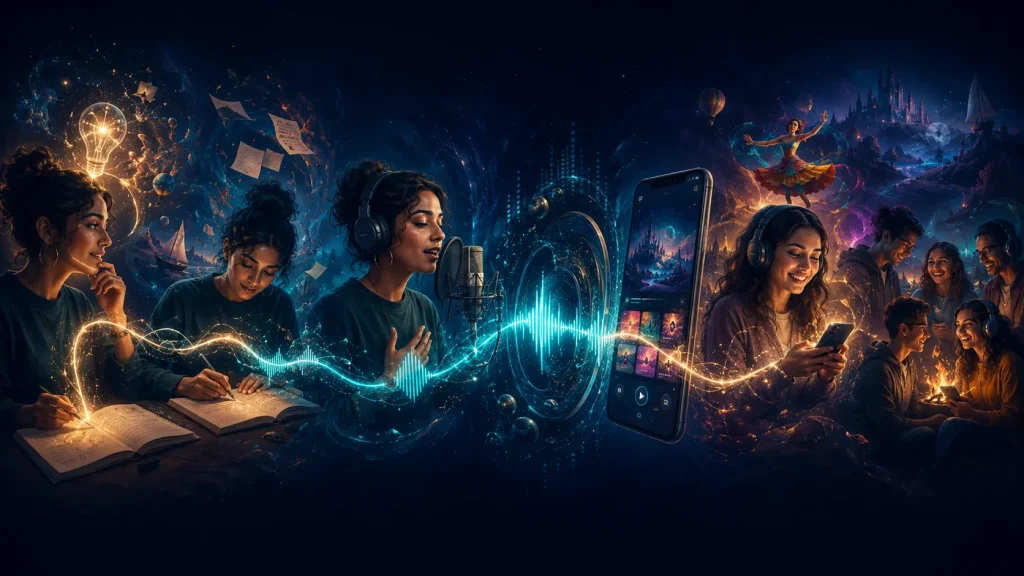
An audio storytelling platform typically connects the complete creator and listener journey:
Idea → Create → Record or Narrate → Enhance → Publish → Discover → Engage → Grow
1. Story Creation
The process starts with an idea. A creator may develop an original story, adapt an existing script, share a personal experience or plan a serialized narrative.
At this stage, creators decide the format, audience, tone and length of the story. Some platforms may also support digital or AI-assisted tools that help with ideation, scripting or content preparation.
2. Voice Recording or Narration
The story is then converted into spoken audio.
Creators may record their own voice using a smartphone, microphone or recording setup. Depending on the platform and workflow, narration can also include multiple speakers, character voices or AI-assisted voice generation.
The goal is to turn the written or imagined story into an audio experience that feels natural and engaging.
3. Audio Production
Raw narration can be enhanced before publishing.
Production may include:
- trimming unwanted sections
- adjusting volume
- improving voice clarity
- adding background music
- using sound effects
- arranging dialogue
- creating transitions between scenes
For simple stories, this process may be minimal. More immersive audio dramas can involve several layers of sound.
4. Publishing
Once the audio is ready, the creator publishes it to the platform.
The story may be uploaded as a single piece or organized into episodes, chapters or a series. Creators can also add supporting elements such as cover artwork, genre information and other discovery details.
Publishing converts the audio file into content that audiences can find and listen to.
5. Story Discovery
After publication, the platform helps connect stories with potential listeners.
Discovery can happen through categories, creator profiles, recommendations, communities, search features or personalized feeds.
This stage is important because creating a strong story is only one part of the process. Creators also need a way for the right audience to find it.
6. Listener Engagement
Listeners can then experience the story and, where platform features allow, interact with the creator or community around it.
Engagement may include following creators, reacting to stories, commenting, sharing content or joining conversations related to a particular genre or subject.
This turns audio storytelling from passive consumption into a more connected experience.
7. Creator Community
Over time, creators can build relationships with recurring listeners and other storytellers.
A strong audio storytelling ecosystem can help creators understand what audiences enjoy, experiment with new formats and develop a recognizable voice or storytelling identity.
The result is a continuous cycle:
Create → Publish → Get Discovered → Engage → Learn → Create Again
Audio Storytelling Platform vs Podcasts vs Audiobooks vs Social Audio
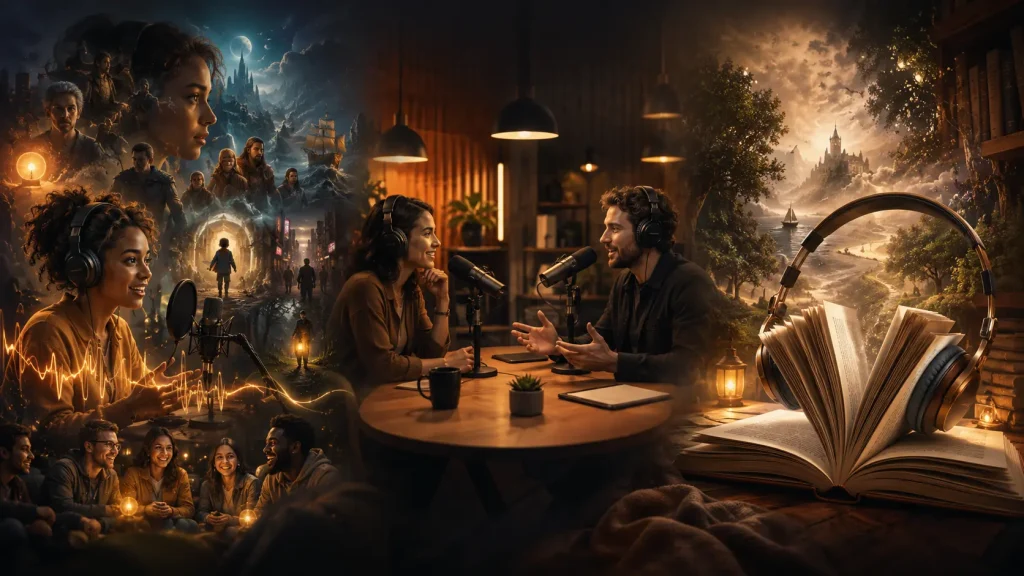
Audio storytelling platforms overlap with podcasts, audiobooks and social audio, but they are not identical. The biggest difference is what the platform is designed around: storytelling platforms organize the experience around narratives and creators, podcast platforms around shows and episodes, audiobook services around books, and social audio around voice-led interaction.
| Feature | Audio Storytelling Platform | Podcast Platform | Audiobook Platform | Social Audio |
| Primary format | Stories and narratives | Episodes and shows | Books | Conversations |
| Creator publishing | Often supported | Usually supported | More selective | Usually supported |
| Short stories | Common | Possible | Less common | Possible |
| Serialized fiction | Common | Possible | Available | Less common |
| Community interaction | Often built in | Usually limited | Usually limited | Strong |
| Discovery | Story and creator based | Show and topic based | Book and author based | Community based |
| User-created content | Often | Yes | Usually limited | Yes |
| Typical experience | Create, discover and engage | Subscribe and listen | Read or listen | Participate and interact |
The boundaries are becoming less rigid. Pocket FM, for example, describes itself around audio series and serialized storytelling, supported by a creator community of writers, storytellers and voice artists. Storytel, by comparison, centers its service on audiobooks, ebooks and Storytel Originals, with more than 400,000 titles promoted on its Indian service.
For users, this distinction matters. Someone looking for an audiobook may primarily want a professionally produced book, while someone searching for an audio storytelling platform may also want to create stories, discover independent voices and interact with creators or communities.
What Features Should an Audio Storytelling Platform Have?
The best audio storytelling platform is not necessarily the one with the largest catalogue. For creators, the stronger platform is usually the one that makes it easier to move from idea to published story to audience. For listeners, discovery, variety and listening experience matter just as much.
Easy Story Creation and Publishing
Creators should be able to turn an idea into published audio without an unnecessarily complex workflow. Recording, uploading, organizing episodes and publishing should be accessible even to people without professional production experience.
Voice Recording and Narration
Built-in recording can reduce the barrier to entry for new storytellers. More advanced platforms may also provide editing, music, sound effects, teleprompters or other narration tools.
Arré Voice, for example, currently supports short Voicepods, longer Threads and creative audio tools, including music and effects, according to its Google Play listing.
Story Discovery and Recommendations
Publishing alone is not enough. A useful platform should help listeners discover stories through feeds, genres, recommendations, playlists, search or interest-based discovery.
Creator Profiles
Creator profiles give listeners a clear place to find more work from a storyteller. They also help creators build an identity around their voice instead of treating each audio post as an isolated piece of content.
Followers and Community Features
Following, communities and collaborative formats can turn one-time listeners into recurring audiences.
Arré Voice’s current product includes Voiceclubs for creator communities and Voicepools where users can respond to prompts with their own audio contributions.
Comments and Listener Interaction
Reactions, comments and voice responses create feedback loops between storytellers and listeners. These features are particularly valuable when the platform is designed around community rather than passive consumption.
Multiple Story Formats
Creators should not be restricted to a single format. Useful options can include micro-fiction, short stories, serialized episodes, long-form narration, personal experiences, audio drama and community-led storytelling.
Regional and Multilingual Support
Language support is especially important in markets such as India, where storytelling audiences span many linguistic communities.
Pratilipi FM currently promotes audio storytelling in Hindi, Bengali, Tamil, Marathi, Malayalam, Gujarati, Telugu, Kannada and English.
Creator Analytics
Useful analytics can show creators whether people are discovering, starting and completing their stories. More advanced insights can help storytellers understand which formats or subjects build stronger listener engagement.
Monetization Opportunities
For creators who want to build a business around storytelling, useful monetization options may include subscriptions, premium episodes, creator rewards, advertising, paid content or fan support.
AI-Assisted Creation Tools
AI can support—not replace—the creative process through idea generation, script assistance, voice tools, artwork or audio enhancement. The value is greatest when these tools reduce production friction while leaving creative control with the storyteller.
Mobile Listening Experience
Because audio is often consumed while travelling, exercising, working or relaxing, the mobile experience should make playback, discovery, saving and returning to stories easy.
Best Audio Storytelling Platforms for Creators and Listeners in 2026
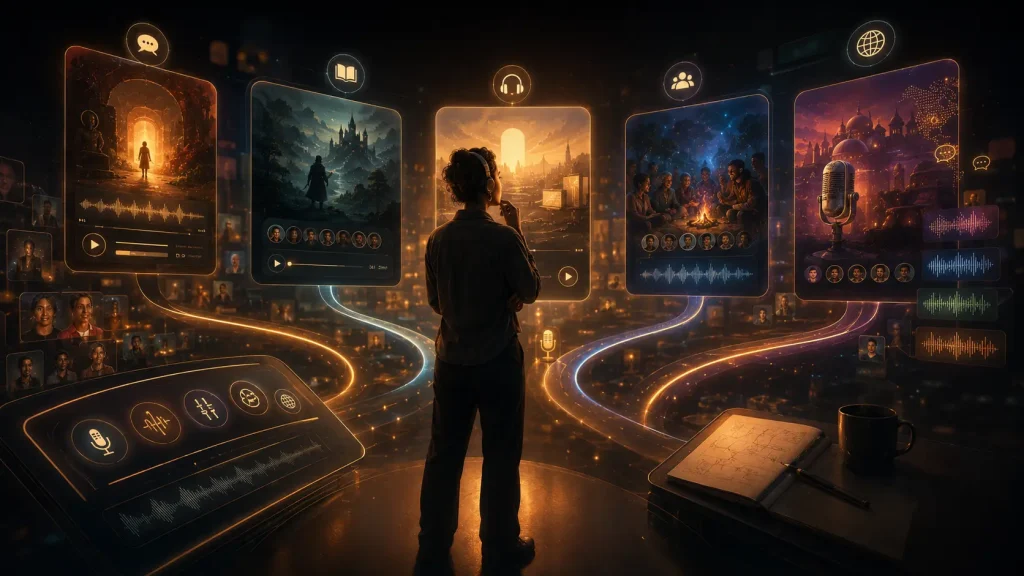
There is no single platform that is best for every storyteller or listener. The right choice depends on whether the priority is social creation, serialized fiction, Indian-language content, audiobooks or community interaction.
| Platform | Best For | Content Type | Creator Tools | Community | Language Focus | Listening Model |
| Arré Voice | Social voice storytelling | Short audio, Threads, community audio | Strong | Strong | India-focused | Social discovery |
| Pocket FM | Serialized audio fiction | Audio series | Creator ecosystem | Moderate | Multi-market | Episodic listening |
| Pratilipi FM | Indian-language stories | Audio stories, series, audiobooks | Content ecosystem | Limited/moderate | Strong Indian-language focus | Catalogue discovery |
| Storytel | Audiobooks and published stories | Audiobooks, ebooks, Originals | Selective | Limited | 10+ languages on India service | Subscription library |
| Naripod | Personal voice stories | User-recorded stories | Direct recording and analytics | Strong | Language-filtered discovery | Community feed |
| Storiyaa | Cultural and creator-led storytelling | Recorded stories, folklore, cultural narratives | Recording, editing and AI assistance | Creator-oriented | English, Spanish, Hindi currently | Free and premium stories |
Arré Voice — Best for Voice-First Social Storytelling and Community
Arré Voice is positioned as a social audio platform for creators, storytellers and listeners, rather than simply an audio library. Its current product supports 30-second Voicepods, longer multi-part Threads, Voicepools for collaborative responses, Voiceclubs for communities and playlists for discovery.
Its main differentiator is the combination of creation + social interaction + discovery. That makes it particularly relevant for creators interested in short-form voice content, community participation and direct audience interaction rather than only uploading finished long-form productions.
Pocket FM — Best for Serialized Audio Fiction
Pocket FM is built heavily around the audio-series format. Its official site describes a catalogue exceeding 100,000 hours and more than 75,000 audio series, spanning genres such as fantasy, science fiction, thriller, romance, horror and drama.
It is therefore a stronger fit for listeners who enjoy long-running serialized narratives and creators interested in episodic fiction.
Pratilipi FM — Best for Indian-Language Audio Stories
Pratilipi FM has one of the clearest regional-language propositions in this comparison. Its current website presents stories across nine languages, while its Google Play listing describes audio series, audiobooks, podcasts and audio dramas across more than 16 genres.
For users specifically seeking Indian-language storytelling across genres such as romance, horror, comedy and drama, that multilingual catalogue is a major differentiator.
Storytel — Best for Audiobooks and Published Stories
Storytel is better understood primarily as an audiobook and ebook subscription service than as an open social storytelling network. Its Indian service currently promotes more than 400,000 titles, 10+ languages and exclusive Storytel Originals.
It is therefore more suitable for listeners whose priority is professionally published books, established authors and long-form listening rather than creator-led community interaction.
Emerging Voice Storytelling Platforms
Smaller platforms are also experimenting with more creator-first models.
Naripod describes itself as a voice-only storytelling platform where people can record personal stories, discover other storytellers, follow creators, comment and view story analytics.
Storiyaa focuses on culturally rooted audio storytelling, allowing creators to record, edit and publish stories while listeners explore areas such as mythology, folklore and bedtime storytelling. Its current service lists English, Spanish and Hindi, with additional languages planned.
These emerging products show how the category is expanding beyond traditional podcasts and audiobooks toward voice creation, community, cultural storytelling and creator-led discovery.
Which Audio Storytelling Platform Is Right for You?
The right audio storytelling platform depends on what you want to create, how you want listeners to discover it, and whether your priority is publishing, community, language reach or long-form listening.
Best for New Story Creators
New creators should look for a platform with a low barrier to entry: simple recording, straightforward publishing and built-in discovery.
Arré Voice is particularly accessible for creators experimenting with short-form voice content because its current features include 30-second Voicepods, longer Threads, collaborative Voicepools and Voiceclubs.
Best for Independent Voice Creators
Independent creators benefit most from platforms where their voice and identity remain central rather than disappearing inside a large catalogue.
Platforms with creator profiles, followers, community interaction and direct publishing can help a storyteller build a recognizable presence around recurring content.
Best for Serialized Fiction
For long-running fictional stories released in episodes, Pocket FM is a strong option. Its platform is specifically organized around audio series and currently reports more than 75,000 audio series and over 100,000 hours of content.
Best for Indian-Language Stories
Creators targeting regional audiences should prioritize language availability and regional discovery.
The wider Pratilipi ecosystem supports publishing and consumption across multiple Indian languages and includes audio as part of its storytelling ecosystem.
Best for Audiobook Listeners
For listeners primarily interested in professionally produced books rather than community publishing, Storytel is a better fit. Its Indian service currently promotes more than 400,000 audiobooks and ebooks across 10+ languages, alongside Storytel Originals.
Best for Community-Based Storytelling
If interaction matters as much as listening, choose a platform where creators and audiences can respond to one another.
Arré Voice’s Voicepools and Voiceclubs are designed around audio responses, collaborative participation and creator communities rather than one-way listening alone.
Best for AI-Assisted Story Creation
For AI-assisted storytelling, focus less on whether a platform simply advertises “AI” and more on what AI actually helps you do.
Useful capabilities may include:
- story ideation
- script assistance
- voice generation
- multilingual narration
- audio enhancement
- cover creation
- sound effects
AI should shorten production work without taking control of the creator’s voice, rights or creative direction.
| If Your Priority Is… | Consider… |
| Easy social voice creation | Arré Voice |
| Serialized audio fiction | Pocket FM |
| Indian-language storytelling | Pratilipi ecosystem / Pratilipi FM |
| Audiobooks and published titles | Storytel |
| Community-led voice interaction | Arré Voice |
| AI-assisted production | Compare platforms by specific AI tools |
| Building a personal creator identity | A creator-first social audio platform |
How to Choose the Right Audio Storytelling Platform
Choosing a platform should begin with your creative goals—not with whichever service has the largest content library.
Define What You Want to Create
Decide whether your focus is short stories, serialized fiction, personal narratives, audio drama, educational storytelling or community conversations.
A platform designed for audiobooks may not suit someone publishing short creator-led stories, and a social audio platform may not be ideal for someone seeking only professionally narrated books.
Check Publishing Options
Look at how easily you can record, upload, organize and update your work.
If you plan to create a series, check whether the platform supports episodes, collections or multi-part storytelling rather than only individual audio posts.
Evaluate Audience Discovery
Ask a simple question:
What happens after I publish?
Look for search, recommendations, categories, playlists, feeds, creator profiles and other discovery mechanisms that can introduce your work to people who do not already follow you.
Look at Community Features
If audience relationships matter, evaluate:
- follows
- comments
- reactions
- audio replies
- groups or communities
- creator-to-creator collaboration
A large audience is useful, but an engaged audience can be more valuable to an independent storyteller.
Check Language Support
Language support matters beyond the recording interface. Check whether listeners can also discover content by language and whether recommendations work effectively for regional audiences.
Review Creator Tools
Useful creator tools can include recording, editing, scheduling, artwork, audio effects, playlists, episodic publishing and AI-assisted production.
Choose tools that remove friction from your workflow rather than adding complexity.
Consider Monetization
If storytelling is part of your professional creator strategy, examine whether the platform offers subscriptions, paid episodes, creator programs, advertising revenue, rewards or other monetization models.
Also check eligibility requirements before assuming that publishing automatically leads to earnings.
Evaluate Ownership and Content Rights
This is one of the most important checks for serious creators.
Before uploading original stories, understand:
- who retains copyright
- what licence you grant the platform
- whether content can be adapted
- whether exclusivity applies
- how content can be removed
- what happens to your rights if you leave
For example, Pratilipi explains that selected stories may be considered for adaptations into formats such as audio, comics, books, microdramas or video, with specific rights requested when an adaptation is pursued.
Check Analytics and Audience Insights
Analytics can help creators learn what is working.
Useful metrics may include:
- plays
- unique listeners
- completion rate
- follower growth
- engagement
- story performance
- audience geography
- repeat listening
For creators planning content consistently, these insights can influence what they create next.
Benefits of Audio Storytelling Platforms for Creators
Audio storytelling platforms can reduce the distance between having a story idea and finding people willing to listen to it.
Publish Without Traditional Gatekeepers
Independent creators no longer need every story to pass through a publisher, broadcaster or large production company before reaching an audience.
Creator-first platforms can make direct digital publishing possible from a smartphone or basic recording setup.
Build an Audience Around Your Voice
Voice carries tone, timing, personality and emotion in ways that written text alone cannot reproduce.
When listeners repeatedly hear the same storyteller, that voice can become part of the creator’s identity.
Experiment With Short and Long Formats
Creators can test multiple storytelling structures rather than committing to one format.
A short personal story may take less than a minute, while serialized fiction or an audio drama can continue across dozens of episodes.
Reach Listeners Across Languages
Audio can create opportunities for creators who are more comfortable speaking than writing in a particular language.
Multilingual platforms also allow regional stories, folklore and contemporary experiences to reach audiences looking for content in their own language.
Turn Stories Into Communities
Stories often generate responses, interpretations and conversations.
When a platform adds community features, an audio story can become the starting point for audience participation rather than the end of the experience.
Build a Recognizable Creator Identity
Consistent themes, storytelling style, genre and voice can help creators establish a recognizable presence.
Over time, listeners may return not only for a specific story but because they value who is telling it.
Explore Monetization Opportunities
As audiences grow, creators may be able to explore premium content, platform creator programs, subscriptions, partnerships or adaptations.
Monetization should be treated as a longer-term outcome of useful content + consistent publishing + audience trust, rather than the reason to choose a platform by itself.
Benefits of Audio Storytelling Platforms for Listeners
Audio storytelling platforms give listeners more than another library of things to play. Their value comes from combining story discovery, flexible listening, creator relationships and community participation in an audio-first experience.
Discover New Voices
Traditional publishing and entertainment channels tend to concentrate attention around established titles and creators. Creator-led audio platforms can expose listeners to independent storytellers, emerging voice artists and stories that may not appear in mainstream audiobook catalogues.
This creates space for personal narratives, experimental fiction, cultural storytelling and niche genres alongside professionally produced content.
Listen Anywhere
Audio works well when looking at a screen is inconvenient. Stories can accompany commuting, walking, cooking, exercising or downtime.
Pocket FM provides a useful indicator of this behaviour: the company reports more than 100,000 hours of content and says its listeners spend an average of 120 minutes per day with its audio series.
Explore Stories by Genre
Listeners can move between romance, horror, thriller, fantasy, comedy, drama, personal stories and other formats without being tied to one type of audio.
An effective audio storytelling platform should make those genres easy to discover while also recommending new creators and stories based on listening interests.
Discover Regional and Cultural Stories
Audio can preserve the personality of a language in ways that translation alone may not. Pronunciation, expressions, humour, rhythm and emotion can remain part of the storytelling experience.
Pratilipi FM currently presents more than 1,000 stories across nine languages, including Hindi, Bengali, Tamil, Marathi, Malayalam, Gujarati, Telugu, Kannada and English.
Follow Favorite Storytellers
Listeners may begin with one story but return because they enjoy the creator behind it.
Following creators makes storytelling more continuous: audiences can discover new episodes, series and experiments from voices they already recognise.
Participate in Voice Communities
Community-led platforms can make listening participatory rather than entirely passive.
Listeners may react, respond, discuss stories or interact with creators and people who share similar interests. This adds a social layer that is usually less central to traditional audiobook consumption.
Why Audio Storytelling Is Growing
Audio storytelling is being shaped by several trends happening at the same time: mobile internet use, serialized entertainment, independent publishing, regional-language demand and easier production technology.
Audio Fits Into Everyday Routines
Audio does not require continuous visual attention, which gives it a practical advantage during activities where reading or watching video is difficult.
Pocket FM itself promotes listening during activities such as workouts, cooking and driving, while reporting a daily average listening time of 120 minutes among its audience.
Rise of Audio-First Entertainment
Digital audio is increasingly being designed as entertainment in its own right rather than simply as a spoken version of written content.
Pocket FM, for example, describes its catalogue as containing more than 75,000 audio series and over 100,000 hours of content, built around genres including fantasy, science fiction, thriller, romance, horror and drama.
That scale illustrates how serialized stories can support extended listening behaviour similar to episodic television, while remaining audio-first.
Growth of Independent Creators
Digital storytelling also lowers some of the distribution barriers faced by independent writers and storytellers.
Pratilipi says its broader storytelling ecosystem contains more than 300,000 self-publishing writers, demonstrating the scale that creator-led story platforms can reach when publishing tools are opened directly to users.
Mobile-First Content Consumption
India had 886 million active internet users in 2024, with rural users accounting for 488 million, according to the IAMAI–Kantar Internet in India report as summarized by IBEF. Mobile devices remained the dominant means of internet access.
For audio storytelling platforms, this creates an important opportunity: the creation device, publishing device and listening device can increasingly be the same smartphone.
Demand for Regional-Language Stories
Language is especially important in India. The same IAMAI–Kantar findings reported that Indic-language content was being accessed by almost all internet users, while 57% of urban internet users preferred regional-language content.
This helps explain why platforms built around Indian storytelling increasingly treat multilingual discovery as a core product feature rather than an optional translation layer.
AI Is Reducing Audio Production Barriers
AI-assisted tools can shorten parts of the production process, including script development, speech generation, translation and audio enhancement.
India’s Ministry of Information and Broadcasting has itself encouraged development of multilingual text-to-audio, video and graphic generation through its Kalaa Setu initiative, highlighting the growing relevance of automated multilingual media production.
For storytellers, the practical opportunity is not simply “AI-generated content.” It is reducing the technical work between having an idea and producing an audio experience.
Audio Storytelling in India: Languages, Culture and Creator Opportunity
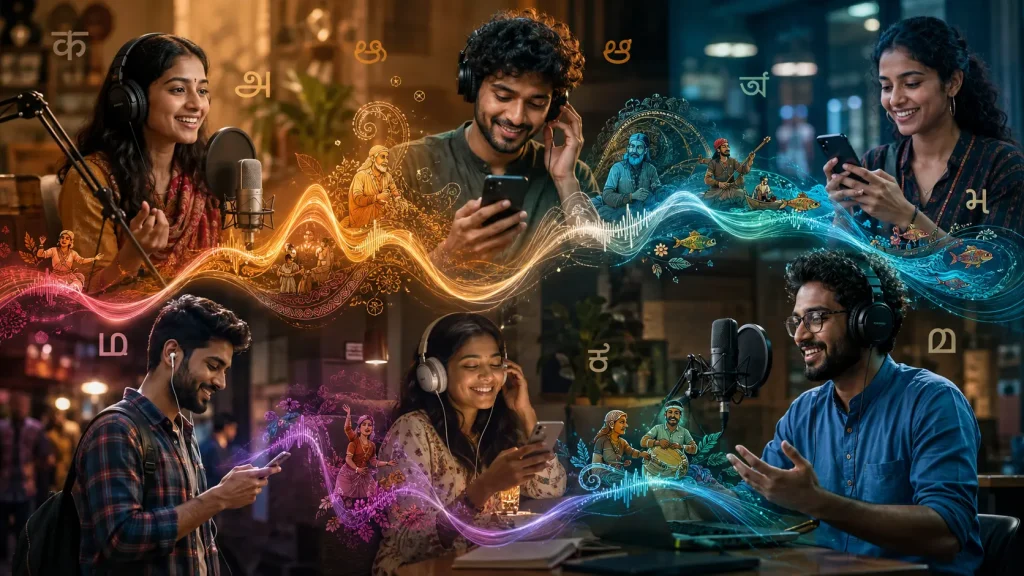
India gives audio storytelling an unusual combination of advantages: a long tradition of oral narratives, enormous linguistic diversity, rapidly expanding digital access and a large population consuming content through mobile devices.
India’s Tradition of Oral Storytelling
Indian storytelling existed through spoken traditions long before digital platforms arrived. Folktales, epics, devotional narratives, family stories and regional legends were often transmitted through performance and voice.
Digital audio does not replace that tradition. It creates another distribution layer for it.
For a deeper exploration of this history, read Indian Storytelling Traditions.
Regional-Language Audio Stories
The potential audience is not limited to Hindi or English.
Current digital storytelling ecosystems already support languages including:
- Hindi
- Tamil
- Telugu
- Marathi
- Bengali
- Malayalam
- Kannada
- Gujarati
Pratilipi FM currently organizes its audio offering across those eight Indian languages plus English and describes itself as offering more than 1,000 stories across nine languages.
Why Voice Works Well for India’s Multilingual Internet
Voice can reduce dependence on typing conventions, spelling familiarity and long-form reading while allowing creators to communicate in the language and speaking style they use naturally.
This matters in a market where regional-language internet consumption is substantial. India’s active internet population reached 886 million in 2024, while Indic-language content was a major driver of digital participation.
Opportunities for Regional Story Creators
A Tamil storyteller does not necessarily need to become an English-language creator to participate online. The same applies to Telugu, Marathi, Bengali, Malayalam, Kannada, Gujarati and other language communities.
Regional creators can build around:
- local fiction and folklore
- contemporary personal stories
- comedy and spoken word
- regional history
- children’s storytelling
- serialized drama
- community conversations
The opportunity is therefore larger than translating successful English content. It is about enabling stories that originate in Indian languages to be created, discovered and valued in those languages.
How AI Is Changing Audio Storytelling Platforms
AI is becoming part of audio production, but its most useful role is as a creative assistant and production layer, not as a replacement for storytellers.
AI-Assisted Story Writing
AI tools can help creators brainstorm plots, explore character directions, organize scripts or overcome an empty first page.
The final narrative still benefits from human decisions about emotion, culture, humour, pacing and meaning.
See also: AI Storytelling Tools.
AI Voice Narration
Synthetic voice technology can convert written scripts into spoken audio and give creators another production option when recording every line themselves is impractical.
It can be particularly useful for prototypes, multiple characters or content produced at scale.
Learn more in AI Voice Narration.
AI Voice Characters
Different generated voices can help distinguish fictional characters, ages, personalities and speaking styles.
The strongest use is not simply creating many voices, but ensuring that each voice contributes meaningfully to the story.
See AI Voice Characters.
Multilingual Voice Creation
AI translation and speech technologies can make it easier to experiment with storytelling across languages.
India’s Kalaa Setu initiative specifically called for multilingual text-to-audio technology designed to generate expressive content for audiences in different regional languages, showing how important this capability is becoming at a national level.
AI Sound and Audio Production
AI can also assist with background sound, cleanup, editing and other production tasks.
For independent creators, this can reduce the need for a large production setup and allow more time to be spent on the story itself.
Human Creativity vs AI Assistance
AI can accelerate execution. Humans still determine why the story deserves to exist.
Personal experience, cultural understanding, original observation and emotional judgment are difficult to reduce to a production shortcut. The strongest workflow therefore combines technology with a recognizable human point of view.
Consent, Authenticity and Voice Rights
As generated voices become more realistic, creators and platforms should treat consent and authenticity as part of responsible production.
A person’s recognizable voice should not be treated as just another reusable sound asset. Creators should know whether a voice is human, licensed, synthetic or cloned and should obtain appropriate permission before reproducing another person’s vocal identity.
For audio storytelling platforms, trust may ultimately become as important as technical voice quality.
How to Create and Publish Your First Audio Story

Creating an audio story does not require a professional studio. A clear idea, a simple recording setup and the right audio storytelling platform are enough to begin.
Step 1 — Choose Your Story Idea
Start with one clear idea: a personal experience, fictional scene, cultural story, mystery, comedy or educational narrative. For your first story, choose something focused enough to tell without unnecessary complexity.
Step 2 — Write or Prepare the Script
Create a simple script that sounds natural when spoken. Write for the ear rather than the page: use shorter sentences, clear transitions and conversational language.
Read the script aloud before recording. This quickly reveals sentences that look good in writing but sound unnatural in narration.
Step 3 — Record or Generate Narration
You can record directly with a smartphone, external microphone or supported platform tools. Choose a quiet environment and prioritize clear speech over expensive equipment.
AI narration can also support workflows where creators need additional voices, characters or faster production. The key is maintaining consistency in tone and storytelling.
For a deeper workflow, internally link this section to Create Audio Stories Using AI.
Step 4 — Add Music and Sound Carefully
Sound effects, ambience and music can strengthen atmosphere, but they should support the story rather than compete with the narrator.
Use sound selectively to establish location, emotion or transitions between scenes.
Step 5 — Choose an Audio Storytelling Platform
Evaluate where your intended audience already listens and whether the platform supports the format you want to create.
Consider:
- publishing flexibility
- story discovery
- community interaction
- language support
- creator tools
- analytics
- content rights
Step 6 — Publish the Story
Before publishing, review the audio from beginning to end. Add relevant artwork, genre information and other discovery details available on the platform.
For serialized stories, keep naming and episode structure consistent so listeners can follow the sequence easily.
Step 7 — Build Your Listener Community
Publishing is the beginning of audience building, not the end.
Respond to listeners, invite feedback, experiment with formats and publish consistently enough for audiences to recognize your storytelling style.
How Arré Voice Fits Into Audio Storytelling
Arré Voice combines voice creation, content discovery and social participation within the same audio environment. Its current product supports short Voicepods, longer Threads, collaborative Voicepools, Voiceclubs and curated playlists.
Voice-First Creation
Voicepods let creators record 30-second audio posts with music and effects, while Threads can combine up to 100 audio clips into longer narratives of up to 50 minutes.
That allows creators to experiment with both short-form storytelling and more developed multi-part narratives.
Story Discovery
Playlists help listeners explore audio by themes and interests rather than relying only on creators they already know. Arré Voice also positions discovery around finding creators and voice content across different genres.
Creator Profiles
A creator-led platform works best when audiences can connect individual stories with the person behind them. This makes the creator’s voice, interests and recurring content part of the discovery experience.
Community and Interaction
Voicepools allow people to respond to prompts with their own audio, while Voiceclubs are designed around creator groups, fan communities and collaborative interaction.
Short Audio Experiences
The 30-second Voicepod format makes it possible to publish micro-fiction, personal thoughts, jokes and other bite-sized audio without producing a full podcast episode.
Multilingual Voice Content
For a multilingual country such as India, voice-first creation can create opportunities for storytellers who want to communicate in the languages and speaking styles they use naturally.
Within the broader audio storytelling journey, Arré Voice can therefore be understood through four connected actions:
Create → Share → Discover → Connect
The Future of Audio Storytelling Platforms
The next stage of audio storytelling is likely to make stories shorter or more interactive when needed, easier to create across languages, more personalized and increasingly immersive.
Short-Form Audio Stories
Short audio formats can lower the commitment required from both creators and listeners. A creator can test an idea quickly, while a listener can discover new voices without beginning a long series.
This also creates a natural internal-link opportunity to your upcoming Short Audio Stories article.
Interactive Audio Stories
Future storytelling experiences can give listeners more influence over what happens next through choices, responses or branching narratives.
The distinction between storyteller and audience may therefore become less rigid, particularly on community-oriented platforms.
AI-Assisted Storytelling
AI speech technology is already moving toward more expressive narration. Google’s current Gemini text-to-speech technology supports control over characteristics such as style and pacing across more than 70 languages, demonstrating how quickly generated speech is becoming more controllable and multilingual.
For creators, this can mean faster prototyping, character experimentation and lower production barriers.
Personalized Story Discovery
Recommendation systems can increasingly help listeners move beyond broad categories such as “romance” or “horror” toward stories aligned with individual interests, creators, languages and listening behaviour.
The opportunity is not simply to recommend more content, but to help listeners discover the right story at the right moment.
Multilingual Audio
Language barriers are also becoming easier to cross. Google’s latest speech-to-speech translation technology supports more than 70 languages while preserving elements such as intonation, pacing and pitch.
For audio platforms, multilingual technology could make regional storytellers accessible to audiences far beyond their original language community.
Creator-Led Voice Communities
Audio platforms can evolve from content libraries into spaces where creators and listeners build relationships around shared stories, interests and languages.
Community participation may become especially important for independent storytellers who want an audience that does more than press play.
Immersive and Spatial Audio
Spatial audio can place voices, ambience and effects around the listener instead of presenting everything on a flat stereo plane. Dolby already promotes Atmos specifically for immersive podcasts and audiobooks, while Apple provides spatial-audio tools intended to support new storytelling experiences.
For fiction and audio drama, that opens possibilities for stories where listeners do not simply hear a scene—they feel positioned inside it.
Frequently Asked Questions
What is an audio storytelling platform?
An audio storytelling platform is a digital service where creators can record, publish and share stories through voice, while listeners discover and engage with audio content. Unlike a simple streaming library, many storytelling platforms also include creator profiles, recommendations, episodic publishing and community features that connect storytellers directly with audiences.
Which is the best audio storytelling platform?
There is no single best platform for everyone. Arré Voice suits creator-led social audio and community storytelling, Pocket FM focuses on serialized audio fiction, and Storytel is stronger for audiobooks and professionally published titles. The best choice depends on whether your priority is creating, community interaction, serialized fiction or long-form listening.
What is the difference between an audio storytelling platform and a podcast?
An audio storytelling platform is primarily organized around stories, storytellers, discovery and sometimes community participation. Podcast platforms are generally organized around shows and episodes covering conversations, interviews, commentary or narratives. The formats can overlap, but storytelling platforms place the story and creator experience at the center rather than the podcast-show format alone.
Are audio stories the same as audiobooks?
No. An audiobook is usually an audio version of a published book, while an audio story can be created specifically for listening and may be short, serialized, interactive or community-generated. Services such as Storytel primarily organize listening around audiobooks and ebooks, whereas creator-first platforms can support more flexible audio formats.
Where can I publish my audio stories?
You can publish audio stories on platforms that accept creator-generated voice content or serialized storytelling. Arré Voice supports formats such as Voicepods, Threads and community audio, while Pocket Studio enables writers to create and publish audio series. Always compare publishing rules, audience discovery, rights, monetization and supported formats before choosing a platform.
Can anyone become an audio storyteller?
Yes. You do not necessarily need professional broadcasting experience or an expensive studio to start audio storytelling. A clear story, understandable narration and a basic smartphone or microphone can be enough. Creator-oriented platforms increasingly provide recording and publishing tools that reduce technical barriers for independent storytellers.
Can I create audio stories for free?
Yes, it is possible to begin creating audio stories without investing in professional equipment. Some creator platforms provide basic creation or publishing access, although advanced production, premium content or monetization features may differ by service. Check each platform’s current pricing and creator terms before building your publishing strategy around it.
Can AI create an audio story?
Yes. AI can assist with story development and can convert written scripts into synthetic speech, while creators can use separate tools for editing and audio production. Google Cloud, for example, supports text-to-speech generation with selectable voices and adjustable speaking characteristics. Human review remains important for originality, emotion, accuracy and responsible voice use.
Which platforms support Indian-language audio stories?
Several audio platforms provide Indian-language content, although language coverage varies. Storytel’s Indian catalogue spans multiple languages, while creator and storytelling platforms are increasingly designed for multilingual audiences. When choosing a service, check both language availability and discovery, because being able to upload content in a language does not guarantee that listeners can easily find it.
Can audio storytellers make money?
Yes, but earning models vary considerably between platforms. Depending on the service, creators may access paid content, platform programs, licensing, partnerships or revenue opportunities linked to successful stories. Pocket Studio, for example, explicitly promotes publishing and earning from audio series. Creators should review eligibility, rights and payment terms before assuming that every upload can be monetized.
How do I choose an audio storytelling platform?
Choose a platform based on your content format, target audience, language, publishing tools, discovery features, community options, analytics, monetization and content rights. A short-form creator may need different features from someone producing serialized fiction or audiobooks. Compare the complete creator journey—from recording to audience growth—rather than choosing solely by catalogue size.
Is Arré Voice an audio storytelling platform?
Yes. Arré Voice can be considered an audio storytelling and social-audio platform because it supports voice-based creation, short Voicepods, longer Threads, collaborative Voicepools, Voiceclubs and playlist-based discovery. Its current positioning combines creating, discovering and interacting through voice, making community participation a central part of the experience rather than limiting users to passive listening.


[…] You can explore more about the evolution of audio storytelling in our guide on AI Voice Stories and Audio Storytelling Platforms. […]
[…] more about→ Audio Storytelling Platforms → AI Voice […]
[…] more about → Audio Storytelling Platforms→ AI Voice […]