
How Indian Fables Preserve Stories and Wisdom Across Generations

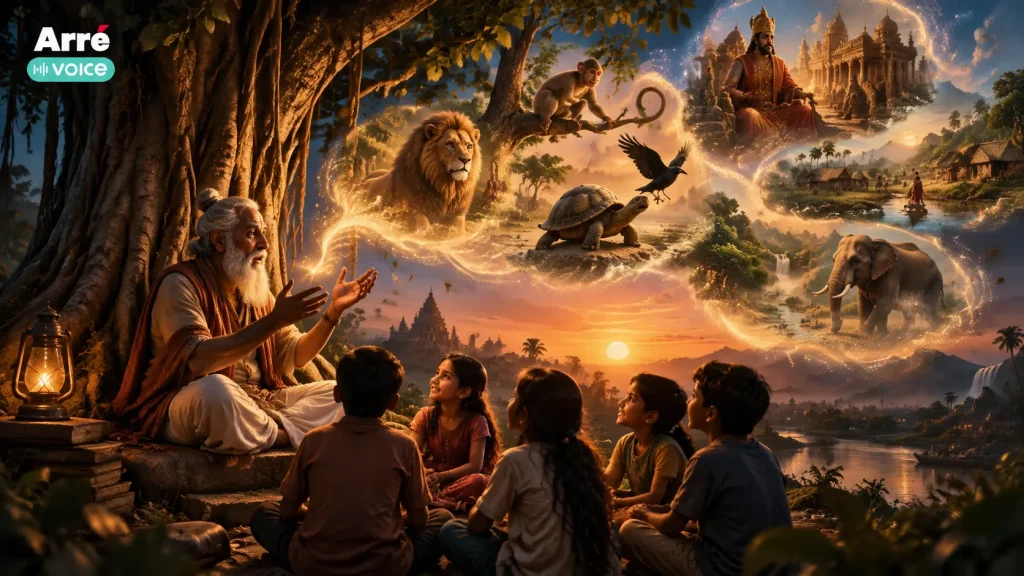
Indian fables are traditional stories that use animals, humans, and fictional characters to share moral lessons, cultural values, and life wisdom. These stories have been passed down through generations and continue to influence modern storytelling, literature, and digital experiences.
Storytelling has always been an important part of Indian culture. Long before books and digital platforms existed, stories were shared through spoken traditions, where storytellers used their voices, expressions, and imagination to pass knowledge from one generation to another. Among these storytelling forms, Indian fables hold a special place because they combine simple narratives with deeper lessons about human behaviour, relationships, and values.
Indian fables often use animals, symbolic characters, and everyday situations to explain complex ideas in an easy-to-understand way. A clever animal solving a problem, a king learning an important lesson, or a character facing the consequences of their choices are examples of how these stories communicate timeless wisdom.
Collections such as the Panchatantra and Jataka Tales have influenced storytelling across the world. Their themes of intelligence, friendship, leadership, compassion, and decision-making continue to remain relevant even today.
In the modern digital age, Indian fables are finding new audiences through animated stories, podcasts, audiobooks, and voice-based storytelling platforms. While the format has changed, the purpose remains the same — using stories to educate, inspire, and connect people emotionally.
With the rise of audio storytelling, traditional fables are being transformed into immersive experiences where voice, character performances, and sound design help listeners experience these timeless stories in new ways.
What Are Indian Fables?
Indian fables are traditional stories that use fictional characters, animals, and symbolic situations to communicate moral lessons and practical wisdom. Unlike simple entertainment stories, fables are designed to teach important lessons about life, choices, relationships, and human nature.
The word “fable” generally refers to a short story where characters represent certain qualities or behaviours, often ending with a lesson or message. Indian fables are unique because they are deeply connected with the country’s philosophical traditions and cultural values.
These stories commonly include:
- Animal characters with human-like qualities
- Human experiences represented through symbolic storytelling
- Moral lessons about right and wrong
- Cultural and philosophical ideas
- Practical lessons about decision-making and relationships
For example, a clever fox in an Indian fable may represent intelligence and strategy, while a powerful lion may represent authority and strength. Through these symbolic characters, storytellers explain human behaviours in a simple and memorable way.
Indian fables are not limited to children’s stories. While many are introduced to children for their moral lessons, their deeper meanings often explore complex ideas such as leadership, ethics, responsibility, and understanding human emotions.
Difference Between Indian Fables, Folktales, Myths, and Moral Stories
Although these storytelling forms are often connected, they have different purposes.
Indian Fables
Indian fables usually feature symbolic characters, especially animals, to communicate life lessons and wisdom. The focus is often on practical knowledge and human behaviour.
Folktales
Folktales are stories passed through communities and generations. They often reflect local traditions, customs, and cultural experiences.
Myths and Legends
Myths and legends usually involve gods, heroes, supernatural events, or extraordinary characters. They often explain beliefs, origins, or cultural values.
Moral Stories
Moral stories focus directly on teaching a lesson, often with a clear message about good behaviour, honesty, kindness, or responsibility.
Indian fables stand out because they combine storytelling with philosophy, allowing audiences to learn through characters and situations rather than direct instructions.
History and Origins of Indian Fables
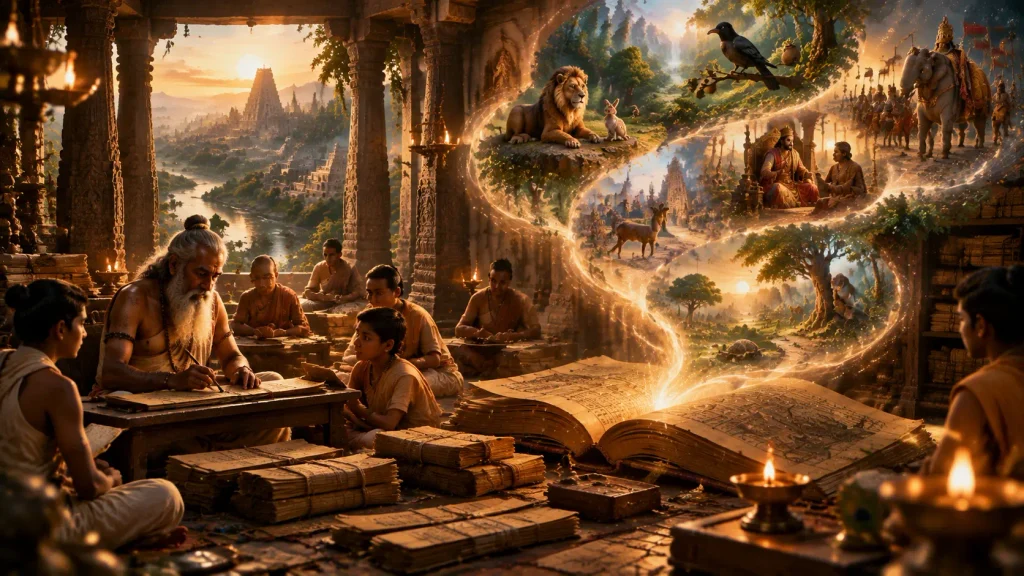
Indian fables have their roots in ancient storytelling traditions that existed thousands of years before modern publishing. These stories were originally preserved through oral narration, where storytellers passed knowledge, values, and experiences from one generation to another.
Unlike written literature, oral storytelling depended heavily on memory, voice expression, and audience interaction. A skilled storyteller could make the same story feel different each time through changes in narration, character voices, and emotional delivery.
Ancient Indian Storytelling Traditions
Ancient Indian storytelling was closely connected with education and knowledge sharing. Stories were not only used for entertainment but also as a way to teach philosophy, ethics, leadership, and social values.
The guru-shishya tradition played an important role in preserving knowledge. Teachers used stories, examples, and narratives to explain complex ideas in a simple manner.
Through oral traditions, stories were shared in:
- Families
- Communities
- Educational settings
- Religious gatherings
- Cultural events
This storytelling culture helped preserve countless narratives, many of which continue to influence Indian literature today.
The power of Indian storytelling has always been connected to the human voice. The emotions, pauses, and expressions of a storyteller helped audiences connect deeply with characters and lessons.
Panchatantra: The Foundation of Indian Fables
The Panchatantra is one of the most influential collections of Indian fables and is considered a foundation of storytelling traditions worldwide. Originally created as a collection of stories about wisdom and practical life lessons, it uses animals and characters to explain human behaviour.
The stories of the Panchatantra focus on themes such as:
- Friendship
- Leadership
- Intelligence
- Strategy
- Decision-making
Animals play a central role because they allow storytellers to represent human qualities in an engaging way. A clever character may demonstrate the importance of intelligence, while a careless character may show the consequences of poor decisions.
The influence of Panchatantra stories extends beyond India. These tales have been translated into several languages and have inspired storytelling traditions across different cultures.
Know more about>>>>
→ Indian Storytelling Traditions
Jataka Tales and Buddhist Storytelling
Jataka Tales are another important collection of Indian stories that focus on moral values, compassion, and ethical behaviour. These stories are traditionally associated with the previous lives of Buddha and often feature animals, humans, and symbolic situations.
Many Jataka Tales highlight values such as:
- Kindness
- Patience
- Selflessness
- Wisdom
- Compassion
Like other Indian fables, these stories use simple narratives to communicate deeper philosophical ideas. Their focus on empathy and moral choices has helped them remain relevant across generations.
Hitopadesha and Other Indian Fable Collections
The Hitopadesha is another important collection of Indian fables that shares similarities with the Panchatantra. It combines stories, wisdom, and practical advice to teach readers about relationships, leadership, and human behaviour.
These collections demonstrate how Indian storytelling has traditionally used narratives as a tool for learning. Rather than presenting lessons directly, they allow audiences to understand values through characters and experiences.
The influence of these fable collections can still be seen in modern books, animation, films, podcasts, and digital storytelling formats.
What Makes Indian Fables Unique?
Indian fables are unique because they combine simple storytelling with deeper philosophical and cultural ideas. Their ability to communicate universal lessons through memorable characters has allowed them to survive across centuries.
Unlike stories that focus only on events, Indian fables often focus on human behaviour and the consequences of choices.
Stories With Moral Lessons
A defining feature of Indian fables is their ability to teach values through storytelling. Instead of explaining what is right or wrong directly, these stories allow readers and listeners to understand lessons through characters and situations.
Common lessons found in Indian fables include:
- Think before making decisions
- Intelligence can overcome strength
- Actions have consequences
- Trust and friendship require understanding
- Wisdom is more valuable than power
These lessons make fables useful for both children and adults because they address situations that remain relevant throughout life.
Animals as Storytelling Symbols
Animals are one of the most recognizable elements of Indian fables. They allow storytellers to represent human qualities in an interesting and memorable way.
Examples include:
- Lion representing power and authority
- Fox representing intelligence and strategy
- Crow representing cleverness and problem-solving
By giving animals human-like personalities, fables make complex ideas easier to understand. A listener may remember a story about a clever crow or a wise animal more easily than an abstract lesson.
This symbolic approach is one reason Indian fables continue to inspire modern storytelling formats.
Simple Stories With Deep Meaning
Indian fables often use simple plots, but their meanings can be surprisingly deep. A short story about animals or ordinary characters may explore themes related to leadership, relationships, emotions, and decision-making.
Their simplicity makes them accessible to different audiences, while their deeper messages allow them to remain meaningful over time.
This balance between simplicity and wisdom is one of the strongest reasons these stories continue to be adapted into books, films, podcasts, and audio experiences.
Cultural and Philosophical Wisdom
Indian fables often reflect broader philosophical ideas that are deeply connected with Indian traditions.
Common themes include:
- Dharma — understanding responsibility and right action
- Ethics — making thoughtful and responsible choices
- Compassion — understanding others and acting with kindness
- Intelligence — using wisdom to overcome challenges
- Self-awareness — understanding emotions and behaviour
Through storytelling, these fables preserve cultural wisdom while making it accessible to audiences across generations. Their ability to connect philosophy with everyday situations makes them powerful examples of timeless storytelling.
Famous Indian Fables and Their Lessons
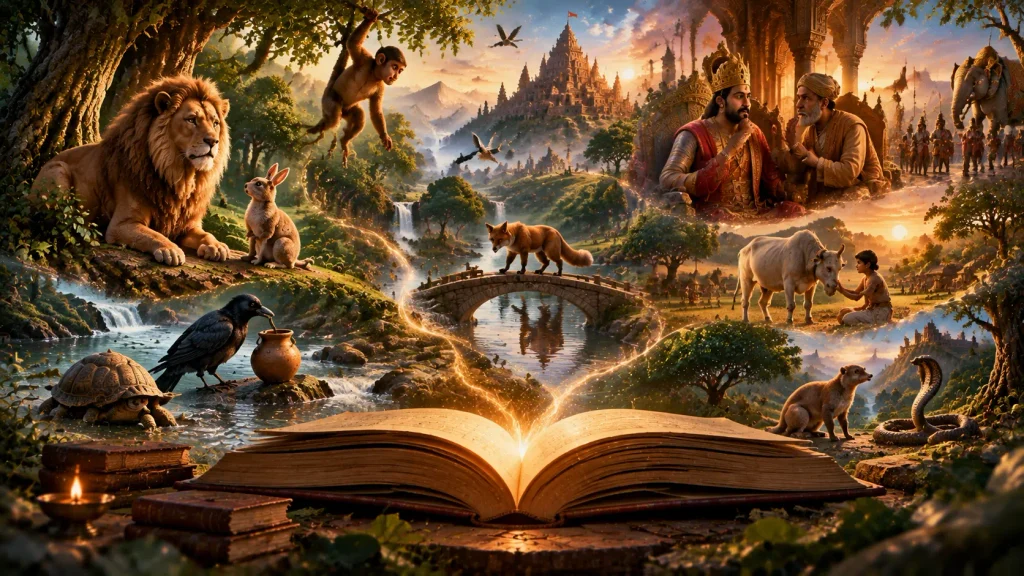
Indian fables have remained popular because they transform everyday situations into meaningful lessons about intelligence, relationships, responsibility, and human behaviour. Many of these stories use animals and ordinary characters to explain complex ideas in a simple and memorable way.
Collections such as the Panchatantra and other traditional Indian storytelling texts contain hundreds of such narratives, many of which continue to be adapted into books, animations, podcasts, and digital storytelling experiences.
Here are some of the most well-known Indian fables and the lessons they continue to teach.
The Lion and the Rabbit
Story Summary
The story of the Lion and the Rabbit is one of the most famous Panchatantra fables. It tells the tale of a powerful lion that terrorises the animals of a forest by hunting them every day. To protect themselves, the animals decide to send one animal to the lion each day as food.
One day, a clever rabbit is chosen. Instead of directly going to the lion, the rabbit arrives late and tells the lion that another powerful lion stopped him on the way. Curious and angry, the lion asks to see this rival.
The rabbit takes the lion to a well and shows him his own reflection in the water. Believing it to be another lion challenging him, the lion jumps into the well and falls to his death.
Moral Lesson
The story teaches that intelligence and strategic thinking can overcome physical strength. Power without wisdom can lead to poor decisions, while creativity and presence of mind can help solve difficult situations.
This fable highlights the importance of:
- Using intelligence before taking action
- Thinking strategically during challenges
- Understanding that strength is not the only form of power
The Monkey and the Crocodile
Story Summary
The Monkey and the Crocodile is a popular Indian fable about friendship, trust, and quick thinking. The story follows a monkey who lives on a tree near a river and becomes friends with a crocodile.
The monkey regularly shares fruits from the tree with the crocodile. Over time, they develop a friendship. However, the crocodile’s wife becomes jealous and asks him to bring the monkey’s heart because she believes it must be very special after eating so many sweet fruits.
The crocodile invites the monkey for a ride across the river but reveals his real intention midway. The clever monkey quickly thinks of a solution and tells the crocodile that he left his heart on the tree. When they return to the shore, the monkey escapes back to safety.
Moral Lesson
The story teaches the importance of presence of mind and intelligent decision-making during difficult situations.
Key lessons include:
- True friendship requires trust and honesty
- Quick thinking can help overcome danger
- Remaining calm during challenges leads to better decisions
The fable also shows that intelligence and awareness can protect someone even in unexpected circumstances.
The Clever Crow and the Pitcher
Story Summary
The Clever Crow and the Pitcher is a well-known Indian fable about creativity and problem-solving. The story begins with a thirsty crow searching for water on a hot day.
The crow eventually finds a pitcher with a small amount of water at the bottom. However, the water level is too low for the crow to reach with its beak.
Instead of giving up, the crow observes its surroundings and finds small stones nearby. The crow drops the stones into the pitcher one by one, causing the water level to rise. Eventually, the crow is able to drink the water and satisfy its thirst.
Moral Lesson
The story teaches that creativity, patience, and persistence can help overcome obstacles.
Important lessons include:
- Problems can be solved through innovative thinking
- Small efforts can create meaningful results
- Persistence is often more powerful than giving up
The story remains relevant because it encourages people to approach challenges with curiosity and determination.
The Tortoise and the Geese
Story Summary
The Tortoise and the Geese is a traditional Indian fable about discipline and the importance of listening to advice.
The story describes a tortoise who lives near a lake with two geese. When the lake begins to dry up, the geese decide to move to another place. They offer to help the tortoise travel with them by holding a stick between them while the tortoise bites the middle.
The geese warn the tortoise not to speak while travelling because opening his mouth would make him fall. However, when people below comment on the unusual sight, the tortoise becomes eager to respond. He opens his mouth, falls, and faces the consequences of ignoring the advice.
Moral Lesson
The story teaches the importance of self-control, discipline, and listening carefully before acting.
Key lessons include:
- Avoid speaking without thinking
- Control emotions and impulses
- Good advice should not be ignored
The fable highlights how a lack of discipline can undo even the best opportunities.
The Brahmin and the Mongoose
Story Summary
The Brahmin and the Mongoose is a famous Indian fable that teaches the importance of patience and careful judgement.
The story follows a Brahmin family that keeps a mongoose as a pet. One day, the Brahmin and his wife leave their baby in the care of the mongoose. While they are away, a snake enters the house. The mongoose fights the snake and saves the baby.
When the Brahmin’s wife returns, she sees blood on the mongoose and assumes that it has harmed the child. Without investigating further, she reacts immediately and kills the mongoose.
Soon after, she discovers the dead snake and realises that the mongoose had protected the baby.
Moral Lesson
The story teaches that acting without proper understanding can lead to regretful decisions.
Important lessons include:
- Do not judge situations without knowing the full truth
- Avoid making decisions based only on emotions
- Patience and observation are essential before taking action
This fable remains relevant because it reflects a common human tendency to react quickly without considering all facts.
Indian Fables vs Western Fables: What Is the Difference?
Indian and Western fables share many similarities. Both use storytelling to communicate values, explain human behaviour, and teach lessons through memorable characters. However, their cultural backgrounds and storytelling approaches often differ.
Indian fables are deeply connected with philosophical ideas, practical wisdom, and concepts such as dharma, responsibility, and self-awareness. Western fables often focus more directly on moral behaviour and social lessons.
| Indian Fables | Western Fables |
| Focus on wisdom and life philosophy | Focus on moral lessons |
| Influenced by Dharma and cultural values | Often based on social behaviour |
| Uses animals and symbolic characters | Uses animals and human characters |
| Connected with ancient traditions | Often linked with European storytelling |
Similarities Between Indian and Western Fables
Despite their differences, fables across cultures share common storytelling principles:
- They use simple narratives to explain complex ideas
- They often feature animals with human qualities
- They teach lessons about choices and consequences
- They reflect universal human experiences
For example, a story about honesty, intelligence, or friendship can connect with audiences regardless of language or cultural background.
The Universal Appeal of Moral Storytelling
The reason fables continue to survive across centuries is their ability to communicate timeless human truths. While the characters and settings may change, the emotions and challenges remain familiar.
Modern storytelling formats, including podcasts, audiobooks, and voice-based experiences, are bringing these traditional narratives to new audiences. Through voice performance and immersive audio, Indian fables continue to evolve while preserving the wisdom that made them memorable for generations.
Why Indian Fables Are Still Popular Today
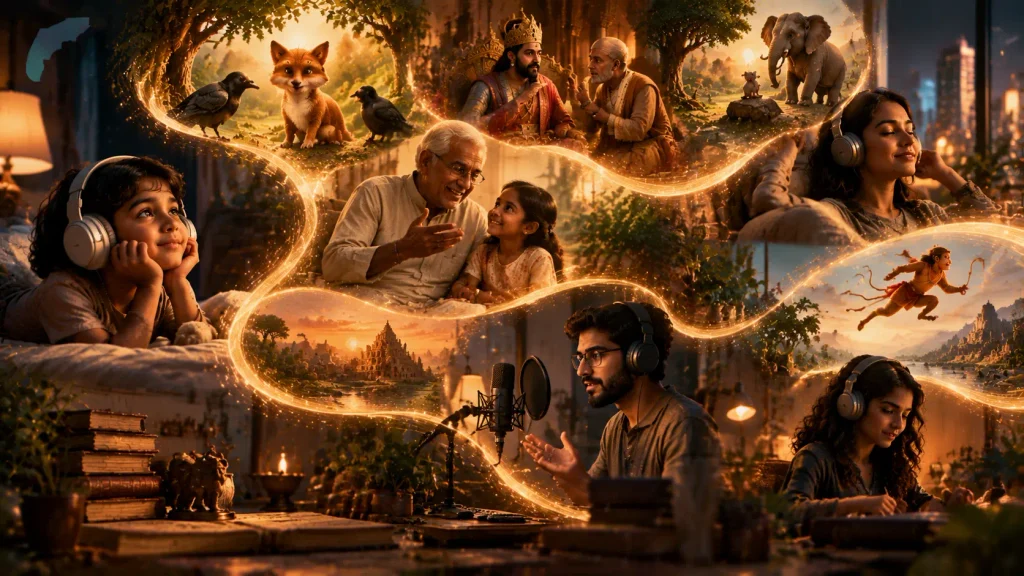
Indian fables have survived for centuries because they continue to address universal human experiences. Although many of these stories originated in ancient times, their themes around relationships, choices, emotions, and values remain relevant even in the modern world.
The simplicity of these stories allows them to connect with audiences of all ages. A child may enjoy the characters and events, while an adult may recognise deeper lessons about decision-making, leadership, and human behaviour.
Today, Indian fables continue to find new audiences through education, entertainment, and digital storytelling formats.
Educational Value
One of the biggest reasons Indian fables remain popular is their ability to teach important values through engaging stories.
Unlike direct lessons or instructions, fables allow children to understand concepts by observing characters and their choices. A story about a clever animal, a careless character, or a difficult decision can help young audiences understand the consequences of their actions.
Indian fables help children develop:
- Moral understanding by exploring ideas of honesty, kindness, responsibility, and patience
- Imagination by introducing symbolic characters and creative worlds
- Critical thinking by encouraging them to analyse problems and solutions
For example, stories like The Clever Crow and the Pitcher teach children to approach challenges creatively, while The Lion and the Rabbit demonstrates how intelligence and strategy can overcome physical strength.
Beyond children’s education, these stories also provide adults with insights into leadership, relationships, and personal growth.
Emotional Connection
Indian fables create strong emotional connections because many people encounter these stories during childhood. Hearing stories from parents, grandparents, teachers, or storytellers often creates memories that remain throughout life.
Traditional storytelling was not only about sharing information; it was also about creating moments of connection between people.
Indian fables continue to create emotional connections through:
- Nostalgia — reminding audiences of childhood memories and familiar stories
- Family storytelling — preserving traditions through shared experiences
- Cultural identity — connecting people with their heritage and values
The emotional impact of these stories comes from their ability to combine entertainment with meaning. A simple tale about an animal or a village character can carry lessons about trust, courage, friendship, and wisdom.
This emotional connection is one reason these stories continue to be adapted into books, films, animations, and modern audio experiences.
Adaptation Into Modern Formats
While Indian fables began as oral stories, they have continuously evolved with changing technology and audience preferences.
Today, these stories appear across multiple formats, including:
- Books and illustrated collections
- Animated series and films
- Podcasts and audio dramas
- Audiobooks
- Digital storytelling platforms
Modern adaptations allow traditional stories to reach audiences beyond geographical and language barriers. A story that was once shared within a local community can now be experienced by listeners worldwide.
Audio storytelling has created a particularly powerful opportunity for Indian fables. Through narration, character voices, music, and sound effects, listeners can experience these stories in a more immersive way.
This evolution shows that while storytelling formats change, the emotional power of a good story remains constant.
Indian Fables in Audio Storytelling
For centuries, Indian fables have been closely connected with the human voice. Before written books became widely available, storytellers used narration, expressions, and performance to bring characters and lessons to life.
Modern audio storytelling continues this tradition by combining the power of voice with digital technology. Podcasts, audio stories, and voice platforms are allowing traditional narratives to reach new generations in engaging formats.
Voice Bringing Characters to Life
Voice plays an important role in making stories memorable. The same words can create different emotions depending on how they are delivered.
In audio storytelling, narration helps listeners:
- Understand character personalities
- Feel the emotions behind the story
- Imagine the world and situations being described
Character voices add another layer of storytelling by making different characters feel unique. A wise character, a humorous character, or a mysterious character can each have a distinct voice identity.
Through expressive narration and voice performances, Indian fables can become immersive experiences rather than simple written stories.
Creating Immersive Audio Experiences
Modern audio storytelling goes beyond narration by combining multiple creative elements.
Immersive Indian fable experiences can include:
- Sound effects that recreate environments and actions
- Background music that builds emotions and atmosphere
- Voice performances that bring characters and conversations to life
For example, the sound of a forest, flowing water, or dramatic music can help listeners feel present inside the story world.
These elements transform traditional fables into cinematic audio experiences while preserving the original lessons and cultural meaning.
Know more about>>>
→ Audio Storytelling Platforms
→ AI Voice Stories
Preserving Traditional Stories Digitally
Digital platforms are helping preserve Indian fables and make them accessible to younger audiences who increasingly consume content through mobile devices.
Audio storytelling provides several advantages:
- Reaching new generations of listeners
- Supporting regional language storytelling
- Making traditional stories accessible anytime and anywhere
Technology also allows creators to adapt stories while maintaining their cultural essence. A traditional fable can now be experienced through different languages, voices, and storytelling styles.
By combining ancient wisdom with modern formats, digital storytelling ensures that Indian fables continue to remain part of contemporary culture.
How Creators Can Adapt Indian Fables Today
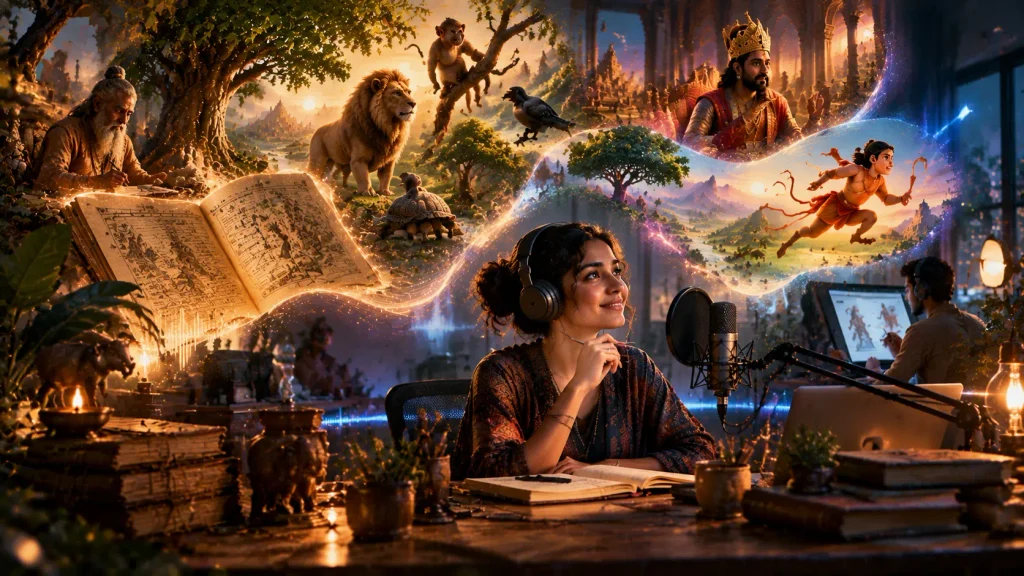
Indian fables provide creators with a rich foundation for developing new storytelling experiences. Their timeless themes, memorable characters, and universal lessons make them suitable for modern adaptations across different formats.
Creators today can reinterpret these stories while preserving their original message and cultural significance.
Story Adaptation
Adapting Indian fables does not mean simply recreating old stories. Modern creators can explore new perspectives while maintaining the core lessons.
Creators can adapt fables by:
- Setting stories in modern environments
- Exploring different character perspectives
- Creating new interpretations of traditional themes
- Connecting ancient lessons with current challenges
For example, a traditional story about decision-making can be adapted into a modern story about technology, relationships, or personal growth.
This approach allows old stories to remain meaningful for contemporary audiences.
Audio Story Creation
Audio provides creators with unique opportunities to transform Indian fables into engaging experiences.
Creators can focus on:
- Professional narration
- Character voice development
- Sound design
- Emotional storytelling
A well-produced audio story can make listeners feel connected with characters and situations while preserving the essence of the original tale.
Voice-based storytelling also allows creators to experiment with different formats, including:
- Short audio stories
- Episodic narratives
- Character-driven experiences
- Interactive storytelling
AI-Assisted Storytelling
Artificial intelligence is creating new possibilities for adapting traditional stories into modern formats. AI tools can support creators throughout different stages of storytelling while keeping human creativity at the centre.
Creators can use AI for:
- Script development and story refinement
- Character creation and personality building
- Voice experimentation and narration workflows
AI-assisted storytelling can help creators explore different interpretations, develop engaging characters, and experiment with new ways of presenting traditional narratives.
Know more about>>>
→ Storytelling Bot
→ AI Voice Characters
By combining cultural stories with modern storytelling technology, creators can introduce Indian fables to wider audiences while preserving the wisdom and imagination that made these stories timeless.
The Role of AI in Preserving Indian Fables
Artificial intelligence is creating new possibilities for preserving and sharing traditional stories like Indian fables. While these stories have survived through oral traditions, books, and cultural practices for centuries, AI-powered tools can help adapt them for modern audiences without losing their original meaning.
AI can support creators, storytellers, and cultural platforms in transforming traditional narratives into engaging digital experiences while maintaining their cultural identity.
AI-Assisted Storytelling
AI tools can help creators explore and develop traditional stories in new ways. From improving scripts to creating different storytelling formats, AI can support the creative process while keeping human imagination at the centre.
Creators can use AI for:
- Developing story variations
- Improving narrative structure
- Creating engaging dialogues
- Adapting stories for different audiences
For example, an ancient fable can be reimagined as an audio drama, interactive story, or modern narrative while preserving its original lesson.
Digital Preservation of Traditional Stories
Many traditional stories were originally passed down through oral traditions, making digital preservation an important step in keeping them accessible for future generations.
AI-powered technologies can help preserve Indian fables by:
- Digitising traditional stories
- Organising cultural narratives
- Creating searchable story collections
- Making stories accessible through digital platforms
This allows timeless stories to reach audiences beyond geographical and cultural boundaries.
Multilingual Voice Experiences
India has a rich diversity of languages, and many traditional stories exist in regional forms. AI-powered voice technologies can help make these stories available in multiple languages while preserving their cultural context.
Multilingual voice experiences can help creators:
- Adapt stories for regional audiences
- Reach listeners in their preferred languages
- Preserve local storytelling styles
- Make cultural stories more inclusive
This creates opportunities for Indian fables to connect with both local and global audiences.
Interactive Characters
AI is also changing how audiences experience stories. Instead of only listening to or reading a story, future storytelling experiences can allow audiences to interact with characters and explore narratives in new ways.
Interactive storytelling can include:
- AI-powered characters
- Conversational story experiences
- Personalised narratives
- Voice-based interactions
These experiences can make traditional stories feel more engaging while introducing ancient wisdom to younger generations.
By combining AI technology with cultural storytelling, Indian fables can continue evolving while preserving the values and lessons that have made them meaningful for centuries.
The Future of Indian Fables in Digital Storytelling
Indian fables represent the connection between ancient wisdom and modern storytelling technology, allowing timeless lessons to reach new generations through digital experiences.
As audiences increasingly consume content through digital platforms, traditional stories are finding new forms through audio, interactive media, and voice-based experiences. The future of Indian fables will not only depend on preserving old stories but also on creating new ways for people to experience them.
Growth of Audio Storytelling
Audio storytelling is bringing traditional narratives closer to modern audiences. Through podcasts, audio platforms, and voice experiences, listeners can experience stories through narration, character voices, and immersive sound design.
For Indian fables, audio provides an opportunity to recreate the original essence of oral storytelling while using modern production techniques.
Future audio experiences may include:
- Character-driven storytelling
- Cinematic sound experiences
- Voice-based narratives
- Interactive audio journeys
Regional Language Experiences
Language plays an important role in preserving cultural identity. Future storytelling platforms can help Indian fables reach wider audiences by supporting regional languages and local storytelling traditions.
Regional language experiences can help:
- Preserve cultural expressions
- Support local creators
- Reach audiences across different communities
- Keep traditional narratives alive
By combining technology with linguistic diversity, Indian fables can continue to grow across generations.
Interactive Storytelling
The future of storytelling is moving beyond passive consumption. Interactive experiences allow audiences to engage with stories, explore characters, and participate in narratives.
Indian fables can evolve through:
- Interactive characters
- Personalised story paths
- Voice-driven experiences
- Audience participation
This creates a new relationship between stories and listeners, where audiences become active participants rather than just observers.
Creator-Driven Cultural Content
Modern creators have an important role in preserving and reinventing traditional stories. With access to digital tools, creators can adapt Indian fables into new formats while bringing their own creative perspectives.
Creators can explore:
- Audio dramas
- Short-form stories
- Regional storytelling
- Character-based experiences
The combination of cultural knowledge, creative expression, and technology can ensure that Indian fables remain relevant in the digital age.
How Arré Voice Helps Bring Indian Stories to Life
Stories have always been powered by voices. From traditional storytellers sharing tales within communities to modern creators producing digital experiences, voice continues to be one of the strongest ways to connect audiences emotionally.
Arré Voice enables creators and listeners to explore stories through voice, emotion, and community-driven storytelling. The platform supports new forms of audio experiences where storytelling, creativity, and technology come together.
Creators can use voice-based storytelling to:
- Develop immersive audio experiences
- Experiment with character-driven narratives
- Share cultural and fictional stories
- Connect with audiences through voice
By combining the power of storytelling with modern audio experiences, platforms like Arré Voice help traditional narratives find new audiences while encouraging creators to explore innovative storytelling formats.
Discover timeless stories and create immersive voice experiences with Arré Voice.
Frequently Asked Questions
What are Indian fables?
Indian fables are traditional stories that use animals, humans, and symbolic characters to share moral lessons, cultural values, and practical wisdom. These stories often explore themes like intelligence, friendship, responsibility, and decision-making. Collections such as the Panchatantra and Jataka Tales are among the most well-known examples of Indian fable storytelling.
What is the oldest Indian fable collection?
The Panchatantra is considered one of the oldest and most influential collections of Indian fables. Originating thousands of years ago, it uses animal characters and engaging narratives to teach lessons about leadership, relationships, strategy, and human behaviour. Its stories have been translated into many languages and influenced storytelling traditions worldwide.
What is the difference between Indian fables and folktales?
Indian fables usually use symbolic characters, especially animals, to communicate moral lessons and practical wisdom. Folktales are broader cultural stories passed through generations that often reflect local traditions, beliefs, and experiences. While both preserve cultural knowledge, fables mainly focus on teaching lessons through characters and their actions.
Why are animals used in Indian fables?
Animals are used in Indian fables because they make complex human behaviours easier to understand. Characters like lions, foxes, and crows represent qualities such as power, intelligence, and cleverness. By giving animals human-like personalities, these stories communicate lessons about emotions, decisions, relationships, and human nature in a memorable way.
What lessons do Indian fables teach?
Indian fables teach valuable lessons about wisdom, honesty, patience, friendship, leadership, and decision-making. They often show how intelligence can overcome challenges, how actions have consequences, and why thoughtful choices matter. These stories use simple narratives to explain deeper ideas about human behaviour and life experiences.
What are some famous Indian fables?
Some famous Indian fables include The Lion and the Rabbit, The Monkey and the Crocodile, The Clever Crow and the Pitcher, The Tortoise and the Geese, and The Brahmin and the Mongoose. Many of these stories come from collections like the Panchatantra and continue to be adapted into modern books, films, and audio stories.
Are Panchatantra stories Indian fables?
Yes, Panchatantra stories are among the most famous examples of Indian fables. They use animals, human characters, and symbolic situations to teach practical lessons about intelligence, friendship, leadership, and social behaviour. The collection has had a significant influence on storytelling traditions across India and many other cultures worldwide.
Why are Indian fables still relevant today?
Indian fables remain relevant because their themes are based on universal human experiences. Lessons about trust, problem-solving, emotions, and decision-making continue to apply in modern life. Today, these stories are being adapted into animations, podcasts, audiobooks, and digital storytelling platforms for new generations.
How are Indian fables used in modern storytelling?
Modern creators adapt Indian fables into different formats, including books, films, animations, podcasts, and audio experiences. Through voice narration, sound design, and digital platforms, these traditional stories can reach wider audiences while preserving their original lessons, cultural identity, and emotional impact.
Can Indian fables be adapted into audio stories?
Yes, Indian fables are highly suitable for audio storytelling because they rely on narration, character interactions, and imagination. Creators can use voice performances, sound effects, and music to bring characters and environments to life. Modern audio platforms help transform these traditional stories into immersive listening experiences.