
AI voice stories are transforming digital storytelling by combining artificial intelligence, voice technology, and human creativity. From AI-generated narration to personalised audio experiences, AI voice stories are creating new possibilities for listeners, creators, and the future of entertainment.
What Are AI Voice Stories?
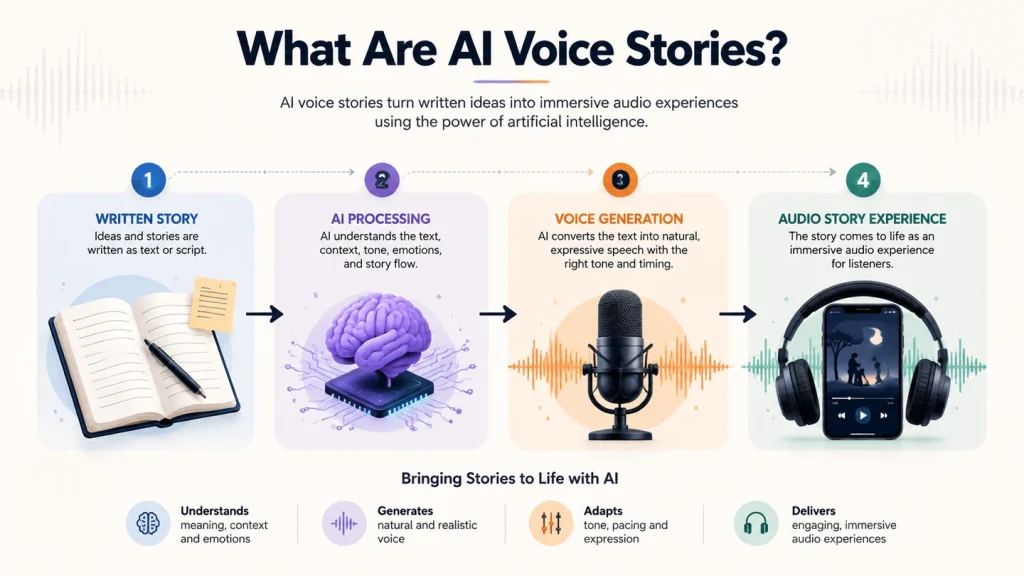
AI voice stories are a new form of digital storytelling that combines artificial intelligence, voice technology, and creative narratives to deliver immersive audio experiences. They transform written stories, scripts, and ideas into spoken content using AI-generated or AI-assisted voices.
As audiences increasingly consume content through audio formats, AI voice stories are creating new possibilities for creators, listeners, and entertainment platforms by making storytelling more accessible, scalable, and personalised.
Definition of AI Voice Stories
AI voice stories are digital narratives created or enhanced using artificial intelligence voice technology to convert written content into natural-sounding audio experiences.
Unlike traditional text-based storytelling, where audiences read a story themselves, AI voice stories allow listeners to experience narratives through voice, tone, pacing, and sound.
An AI voice story typically combines:
- Storytelling: The creative narrative, characters, emotions, and ideas behind the content
- Artificial intelligence: Technology that understands and processes written content
- Voice generation: AI systems that create realistic spoken narration
AI voice stories can be used for different types of content, including:
- Fictional stories
- Audio dramas
- Cultural narratives
- Educational content
- Creator-led storytelling
- Digital entertainment experiences
The goal of AI voice storytelling is not simply converting text into speech. Modern AI voice experiences focus on creating engaging narratives where technology enhances the emotional connection between the story and the listener.
How AI Voice Storytelling Works
AI voice storytelling combines multiple technologies to transform an idea or written script into an audio experience.
The process generally involves four key stages:
1. Story Creation and Script Development
Every AI voice story begins with a narrative.
Creators can start with:
- Original story ideas
- Written scripts
- Articles
- Fictional concepts
- Educational content
- Cultural stories
The quality of the final experience depends on the strength of the storytelling. AI can support production, but creativity, context, and emotional depth remain important parts of the process.
2. AI Language Understanding
Artificial intelligence analyses written content to understand:
- Meaning
- Context
- Sentence structure
- Emotional tone
- Story flow
This allows AI voice systems to generate narration that feels more natural.
For example, a suspense story may require slower pacing and dramatic pauses, while an educational story may require a clearer and more informative delivery style.
3. Voice Generation
After understanding the script, AI voice technology converts written words into spoken audio.
Modern AI voice systems can create:
- Natural-sounding voices
- Different narration styles
- Multiple language versions
- Adjustable tone and pacing
This allows creators to experiment with different storytelling formats without depending only on traditional recording methods.
4. Audio Enhancement and Publishing
The final audio experience can be improved through:
- Background sounds
- Music
- Editing
- Story segmentation
- Digital distribution
The result is a voice-first storytelling experience that audiences can consume across devices and platforms.
Difference Between AI Voice Stories and Traditional Storytelling
Storytelling has always evolved with technology. Traditional storytelling moved from oral traditions to books, radio, television, and digital platforms.
AI voice stories represent another evolution by introducing artificial intelligence into the storytelling process.
| Traditional Storytelling | AI Voice Stories |
| Primarily depends on human narration | Uses AI-generated or AI-assisted narration |
| Production may require recording resources | Can reduce production barriers |
| Usually created in a fixed format | Allows experimentation with multiple formats |
| Limited by narrator availability | Can support scalable content creation |
| Human voice carries the experience | AI voice technology enhances accessibility |
However, AI voice stories are not replacing the foundation of storytelling.
The strongest storytelling experiences still depend on:
- Creative ideas
- Emotional connection
- Cultural understanding
- Meaningful narratives
AI acts as an enabler, helping more creators transform their stories into audio experiences.
How AI Voice Stories Are Changing Digital Storytelling
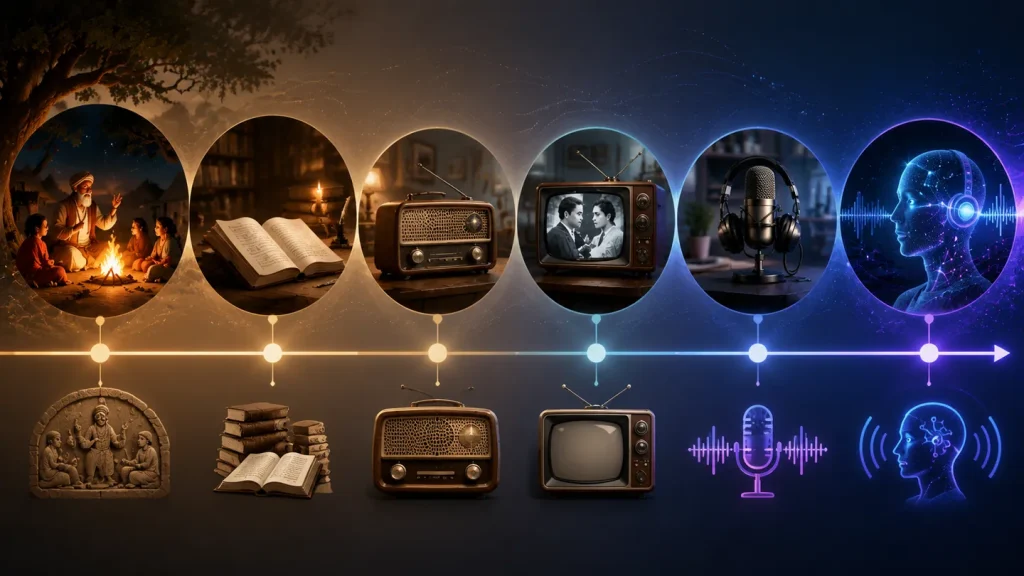
Digital storytelling has continuously evolved based on how audiences create and consume content.
Earlier:
Storytellers → Communities → Oral Traditions
Then:
Books → Radio → Television → Digital Platforms
Today:
Creators → AI Tools → Voice Experiences → Global Audiences
AI voice stories are accelerating this transformation by making voice-based storytelling easier to create, personalise, and distribute.
Evolution From Written Stories to Voice Experiences
For centuries, written stories have been one of the most powerful ways to preserve and share ideas.
Books, articles, and digital content allowed stories to reach millions of people. However, they required audiences to actively read and focus on the written format.
Audio storytelling introduced a different experience.
Voice allows audiences to engage with stories while continuing daily activities such as:
- Travelling
- Exercising
- Working
- Relaxing
AI voice technology expands this opportunity by helping creators convert written narratives into engaging audio experiences faster.
A single story can now move across multiple formats:
Written Story
↓
AI Voice Narration
↓
Digital Audio Experience
↓
Global Audience
This evolution allows stories to become more accessible while creating new ways for audiences to connect emotionally.
Role of Artificial Intelligence in Storytelling
Artificial intelligence is becoming an important creative tool in modern storytelling.
AI can support creators throughout different stages of content creation, including:
Story Development
AI tools can help creators:
- Generate ideas
- Structure narratives
- Explore different formats
Voice Production
AI voice technology helps creators:
- Convert scripts into narration
- Experiment with different voices
- Create multilingual versions
Content Accessibility
AI can help make stories available to wider audiences by reducing barriers related to:
- Language
- Production cost
- Distribution limitations
The role of AI in storytelling is not to replace creativity.
Instead, it allows creators to focus more on ideas, emotions, and storytelling while technology supports production and delivery.
Creating Personalised Storytelling Experiences
One of the biggest opportunities with AI voice stories is personalised listening.
Traditional storytelling usually provides the same experience to every listener.
AI-powered storytelling creates possibilities where experiences can adapt based on:
- Listener preferences
- Language choices
- Interests
- Accessibility needs
- Content consumption habits
Future AI voice experiences may allow listeners to choose:
- Preferred narration styles
- Different languages
- Customised story formats
- Interactive story paths
This creates a shift from:
One Story → Same Experience for Everyone
to:
One Story → Personalised Experiences for Different Audiences
Personalisation can help creators build stronger relationships with listeners by making content feel more relevant and engaging.
The Technology Behind AI Voice Stories
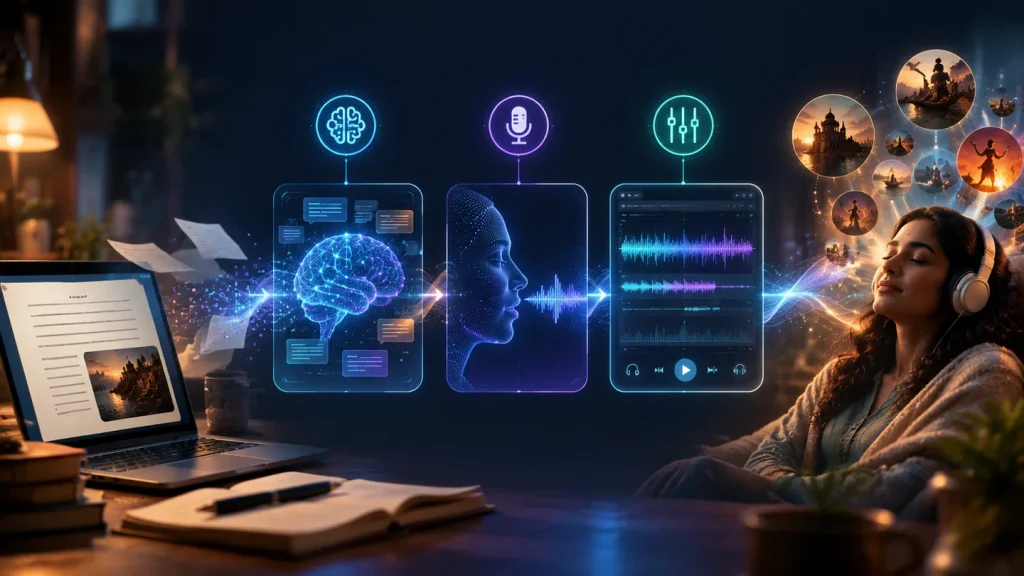
AI voice stories are powered by a combination of artificial intelligence technologies that help transform written narratives into realistic and engaging audio experiences.
Modern AI voice systems go beyond basic text-to-speech conversion. They analyse language, understand context, and generate voices designed to sound more natural and expressive.
AI Voice Generation Explained
AI voice generation is the technology that converts written text into spoken audio using artificial intelligence models.
Unlike older text-to-speech systems that often produced robotic voices, modern AI voice generation focuses on creating more realistic narration.
AI voice systems analyse:
- Words
- Sentence structure
- Context
- Pronunciation
- Speaking patterns
This helps generate voices with improved:
- Clarity
- Natural flow
- Consistency
- Expression
For storytelling, this is important because the delivery of a story influences how audiences experience emotions, characters, and moments.
Natural Language Processing and Storytelling
Natural Language Processing (NLP) helps AI systems understand and interpret human language.
In AI voice storytelling, NLP enables systems to understand:
- Meaning behind sentences
- Story context
- Emotional signals
- Narrative structure
For example, a dramatic moment in a story requires different delivery compared to a simple explanation.
NLP helps AI voice systems recognise these differences and produce narration that better matches the intent of the content.
It also enables creators to:
- Adapt stories into different languages
- Convert written content into audio formats
- Improve voice-based experiences
Voice Synthesis and Realistic Narration
Voice synthesis is the process of creating artificial speech that sounds natural.
Modern AI voice synthesis focuses on improving:
Voice Quality
AI-generated voices are becoming more realistic through improvements in:
- Pronunciation
- Rhythm
- Speech patterns
- Voice consistency
Emotional Expression
Advanced systems can adjust:
- Tone
- Speed
- Pitch
- Emphasis
This helps create more engaging narration.
For storytelling, realistic voice synthesis allows creators to develop experiences that feel closer to traditional narration while benefiting from AI scalability.
Combining AI Technology With Human Creativity
The future of AI voice stories depends on the collaboration between artificial intelligence and human creativity.
AI can support creators with:
- Faster production
- Voice generation
- Content adaptation
- Language expansion
However, humans remain essential for:
- Original storytelling ideas
- Emotional depth
- Cultural context
- Creative decisions
The most effective workflow combines both:
Human Creativity
↓
Story Concept
↓
Script Development
↓
AI Technology
↓
Voice Creation
↓
Audience Experience
AI voice stories are not about replacing storytellers. They are about expanding the ability of creators to tell stories, reach audiences, and explore new forms of digital entertainment.
AI Voice Stories vs Traditional Audio Storytelling
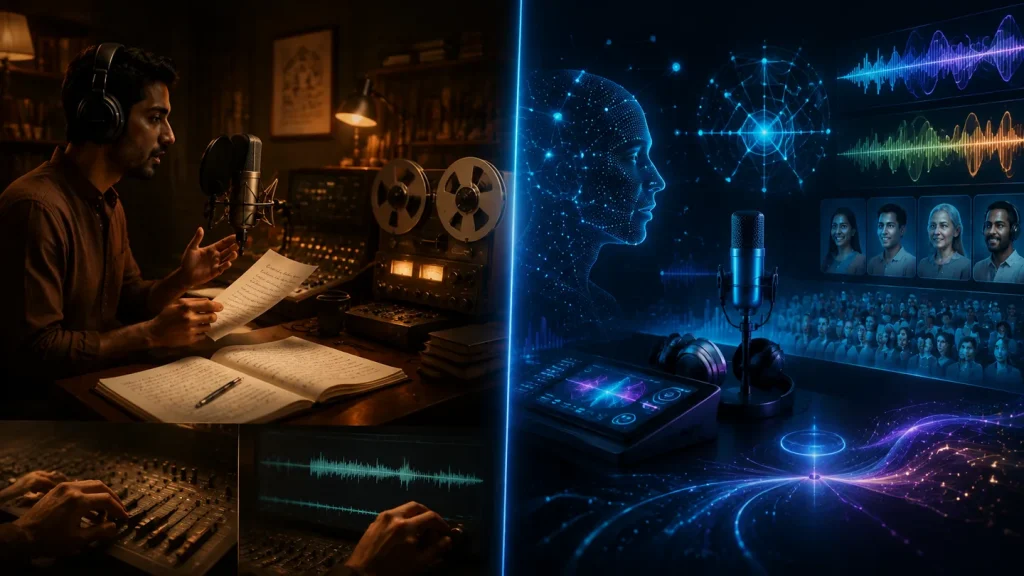
Audio storytelling has always been driven by one powerful element — the human voice.
From traditional oral storytelling and radio dramas to audiobooks and podcasts, listeners have connected with stories through narration, emotion, and imagination.
AI voice stories introduce a new approach by using artificial intelligence to support voice creation and audio production. While both formats aim to create meaningful listening experiences, the difference lies in how stories are produced, personalised, and delivered.
Human Narration vs AI Narration
Human narration has traditionally been at the centre of audio storytelling.
A human storyteller brings unique qualities such as:
- Personal expression
- Emotional understanding
- Cultural context
- Natural storytelling style
- Individual voice identity
These elements create authenticity and emotional connection with listeners.
AI narration, on the other hand, uses artificial intelligence to generate spoken audio from written content.
AI-generated voices provide advantages such as:
- Faster production
- Consistent narration quality
- Multiple voice options
- Language flexibility
- Easier content scaling
The choice between human and AI narration depends on the storytelling objective.
For example:
A personal memoir or creator-led story may benefit from human narration because the storyteller’s own voice adds authenticity.
A large library of fictional stories, educational content, or multilingual narratives may benefit from AI narration because it enables faster creation and wider accessibility.
The future of storytelling is likely to combine both approaches — human creativity supported by AI-powered production.
Differences in Production Process
The biggest difference between traditional audio storytelling and AI voice stories is the production workflow.
Traditional Audio Storytelling Process
Traditional production usually involves:
Story Concept
↓
Script Writing
↓
Voice Recording
↓
Audio Editing
↓
Sound Design
↓
Publishing
This process may require:
- Recording equipment
- Voice artists
- Studio resources
- Editing teams
- Production time
AI Voice Storytelling Process
AI voice stories simplify parts of the production journey:
Story Concept
↓
Script Creation
↓
AI Voice Generation
↓
Audio Enhancement
↓
Publishing
AI can support creators by reducing technical barriers and allowing faster experimentation with different storytelling formats.
However, the creative foundation remains the same.
A successful AI voice story still requires:
- Strong storytelling
- Engaging narratives
- Audience understanding
- Creative direction
AI improves the production process, but the story remains the most important element.
Benefits and Limitations of AI Voice Storytelling
AI voice storytelling creates several opportunities for creators and platforms.
Benefits of AI Voice Stories
Faster Content Production
AI voice technology allows creators to transform written scripts into audio experiences more efficiently.
This helps creators:
- Produce more content
- Test new ideas quickly
- Experiment with different formats
Greater Accessibility
AI voice technology can make storytelling available to more audiences through:
- Multiple languages
- Audio formats
- Flexible consumption options
This is especially valuable for regional storytelling, where language diversity can often limit audience reach.
Content Scalability
Traditional audio production can require significant resources.
AI-assisted workflows allow creators and platforms to expand their content libraries more efficiently.
This creates opportunities for:
- Independent creators
- Storytelling platforms
- Educational publishers
- Digital entertainment companies
Limitations of AI Voice Stories
Despite technological advancements, AI voice storytelling has limitations.
Emotional Depth
Human storytellers naturally bring personal experiences, emotions, and cultural understanding that AI may not fully replicate.
Authenticity
Certain stories rely heavily on the storyteller’s personal identity and lived experiences.
Creative Direction
AI can support storytelling but cannot replace human decisions around:
- Story themes
- Character development
- Emotional impact
The strongest approach is combining AI efficiency with human creativity.
How AI Enhances Traditional Storytelling Formats
AI voice technology does not replace traditional storytelling formats. Instead, it expands their possibilities.
AI can enhance storytelling by helping creators:
Transform Written Stories Into Audio
Books, articles, scripts, and cultural narratives can become voice-based experiences.
Expand Regional Stories
Stories that were previously limited to specific communities can reach wider audiences through digital audio.
Create New Story Formats
AI enables experimentation with:
- Interactive audio stories
- Personalised narratives
- Multilingual storytelling
- Creator-led experiences
Improve Accessibility
Listeners who prefer audio content can discover more stories through voice-based formats.
AI helps preserve the emotional power of traditional storytelling while making it more accessible in the digital age.
AI Voice Stories vs Podcasts – Understanding The Difference
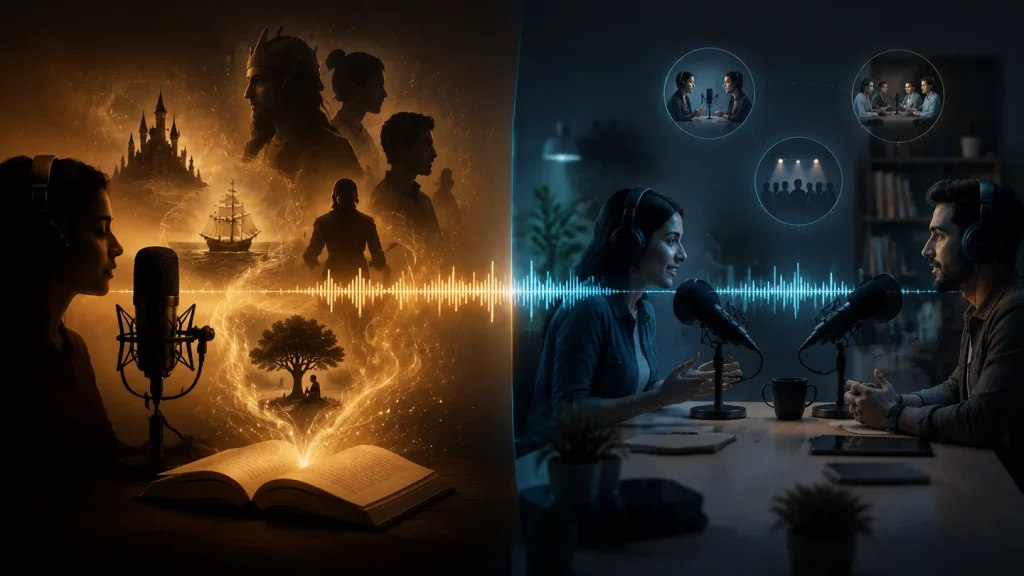
AI voice stories and podcasts are both growing parts of the modern audio ecosystem. However, they serve different purposes and create different types of listener experiences.
Understanding the difference helps creators choose the right format and helps audiences discover content that matches their interests.
What Are Podcasts?
Podcasts are episodic audio programs that usually focus on conversations, discussions, interviews, or personality-driven content.
Common podcast formats include:
- Interviews
- News discussions
- Educational episodes
- Expert conversations
- Opinion-based shows
Podcasts are often built around:
- A host
- Guests
- Discussions
- Personal viewpoints
The connection between the creator and listener usually develops through conversations and recurring episodes.
What Are AI Voice Stories?
AI voice stories are narrative-based audio experiences created or enhanced using artificial intelligence voice technology.
They focus on storytelling elements such as:
- Characters
- Plot
- Narration
- Emotional experiences
- Immersive audio journeys
Examples include:
- Fictional stories
- Cultural narratives
- Audio dramas
- Educational stories
- Digital storytelling experiences
The primary focus is the story itself rather than a conversation between people.
Story-First Experiences vs Conversation-Based Content
The biggest difference between AI voice stories and podcasts is the content structure.
| AI Voice Stories | Podcasts |
| Story-first format | Conversation-first format |
| Focus on narratives and characters | Focus on hosts and discussions |
| Usually scripted experiences | Often conversational |
| Designed for immersive listening | Designed for engagement through dialogue |
For example:
A mystery adventure with characters and a storyline is better suited for an AI voice story.
A discussion between experts about technology trends is better suited for a podcast.
Both formats are valuable, but they create different emotional connections.
Choosing Between AI Voice Stories and Podcasts
Creators should choose based on their goals.
Choose Podcasts When You Want To:
- Build a personality-driven audience
- Share opinions and conversations
- Interview experts
- Create discussion-based content
Choose AI Voice Stories When You Want To:
- Create immersive narratives
- Experiment with storytelling formats
- Produce fictional or cultural stories
- Expand content across languages
The future of audio entertainment will likely include both formats, with creators using different approaches based on audience needs.
Why AI Voice Stories Are Becoming Popular
The rise of AI voice stories is connected to major changes in how people discover and consume digital content.
Audiences increasingly prefer experiences that are:
- Convenient
- Personalised
- Accessible
- Available across devices
AI voice stories combine these expectations with the timeless power of storytelling.
Easy Access to Storytelling
One of the biggest advantages of AI voice stories is that they fit naturally into modern lifestyles.
Listeners can experience stories while:
- Travelling
- Exercising
- Working
- Relaxing
Unlike visual content, audio allows people to enjoy stories without constant screen attention.
This makes voice storytelling a flexible entertainment format for everyday life.
Faster Content Creation
AI voice technology helps creators reduce production challenges.
Creators can use AI assistance to:
- Convert scripts into narration
- Experiment with different voices
- Create audio versions of written content
- Produce content faster
This allows more creators to explore storytelling without requiring expensive production setups.
AI makes storytelling more accessible while allowing creators to focus on ideas and audience connection.
Multilingual Storytelling Opportunities
Language diversity is one of the biggest opportunities for AI voice stories.
AI voice technology can help creators adapt stories into multiple languages, allowing content to reach wider audiences.
This creates opportunities for:
- Regional storytellers
- Cultural creators
- Independent artists
A story created in one language can potentially connect with listeners across different regions.
For platforms focused on Indian storytelling, multilingual voice experiences can help preserve and amplify diverse cultural narratives.
Personalised Listening Experiences
AI voice stories create possibilities for more personalised content experiences.
Future storytelling experiences may adapt based on:
- Listener preferences
- Language choices
- Favourite genres
- Listening habits
Personalisation can help audiences discover stories that feel more relevant and engaging.
The shift is moving from:
Same Story → Same Experience
towards:
Stories Adapted for Individual Audiences
Growth of Audio-First Entertainment
The growth of podcasts, audiobooks, and digital audio platforms shows increasing demand for voice-based content.
Audio-first entertainment works well because it fits into modern lifestyles.
People can consume stories during moments when video or reading may not be practical.
AI voice stories build on this trend by making audio creation more scalable and accessible.
The future of entertainment will not belong to one format alone.
Text, video, and audio will continue evolving together, with voice becoming an increasingly important way audiences discover and experience stories.
How Creators Can Use AI Voice Stories
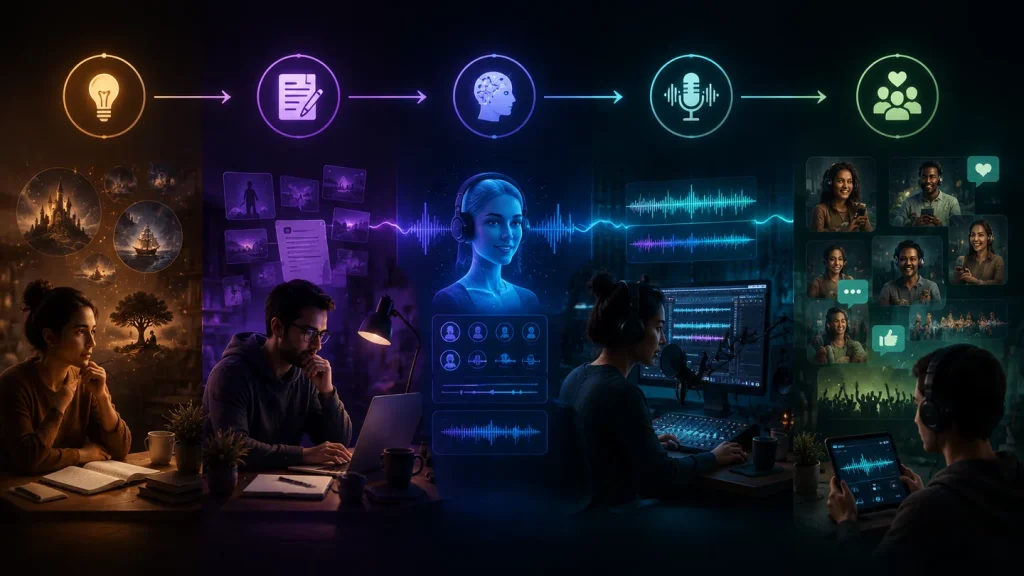
AI voice stories are creating new opportunities for creators by reducing production barriers and enabling new storytelling formats.
For independent creators, writers, and digital storytellers, AI can become a powerful tool for transforming ideas into engaging audio experiences.
Creating Stories With AI Assistance
Creators can use AI throughout different stages of storytelling.
AI can support:
- Story ideation
- Script development
- Voice generation
- Content adaptation
- Audio experimentation
A modern AI-assisted storytelling workflow can look like:
Story Idea
↓
Script Creation
↓
AI Voice Generation
↓
Audio Enhancement
↓
Audience Distribution
The creator remains responsible for the creative vision while AI supports the production process.
AI Narration for Independent Creators
AI narration can help independent creators produce audio content without requiring traditional recording resources.
Creators can experiment with:
- Fictional stories
- Audio series
- Educational content
- Character-based narratives
- Storytelling formats
This creates opportunities for more people to participate in the creator economy.
AI lowers production barriers, allowing creators to focus on developing unique stories and building audiences.
Expanding Stories Into Multiple Languages
AI voice technology can help creators reach audiences beyond language limitations.
Creators can adapt stories into different languages, making content accessible to diverse communities.
This is especially valuable for:
- Regional storytelling
- Cultural narratives
- Local creators
AI can help connect stories with audiences who may otherwise never discover them.
Building Voice-Based Communities
Storytelling has always been connected with communities.
AI voice stories create opportunities for creators to build communities around:
- Shared interests
- Story genres
- Cultural identities
- Creator journeys
Voice creates a personal relationship between creators and listeners.
Future audio platforms will not only distribute stories but also help communities form around meaningful narratives.
Future Opportunities for Storytellers
The future of AI voice stories creates new possibilities for creators.
Emerging opportunities include:
- Personalised storytelling experiences
- Interactive audio narratives
- Multilingual content creation
- Creator-led voice communities
- New digital entertainment formats
AI will not replace the storyteller.
Instead, it will expand who can tell stories, how stories are created, and how audiences experience them.
Benefits of AI Voice Stories for Listeners
AI voice stories are changing how audiences discover and experience digital narratives. By combining the emotional connection of storytelling with the convenience of audio technology, AI-powered voice experiences make stories more accessible, flexible, and personalised.
For listeners, the value of AI voice stories goes beyond simply hearing a narration. They create new ways to discover ideas, cultures, and perspectives through immersive audio experiences.
Listening Anytime and Anywhere
One of the biggest benefits of AI voice stories is the flexibility they offer.
Unlike traditional reading formats or video content that require dedicated attention, audio storytelling allows listeners to experience stories while continuing with their daily activities.
Listeners can enjoy AI voice stories during:
- Daily commutes
- Travel journeys
- Exercise sessions
- Relaxation time
- Personal routines
This convenience makes storytelling a natural part of everyday life.
The growth of smartphones and audio platforms has changed audience expectations. People increasingly prefer content that fits into their schedules rather than requiring separate screen time.
AI voice stories support this shift by allowing audiences to carry meaningful stories wherever they go.
Discovering Diverse Stories
AI voice technology is creating new opportunities for audiences to discover a wider range of stories, creators, and perspectives.
Traditionally, many stories remained limited because of:
- Language barriers
- Geographic limitations
- Limited distribution
- Production challenges
AI-powered storytelling can help overcome these barriers by making it easier to create and distribute audio experiences.
Listeners can discover:
- Regional stories
- Cultural narratives
- Fictional experiences
- Independent creator content
- Unique personal perspectives
For example, a story from a specific community can reach audiences far beyond its original location through digital audio platforms.
This creates a more diverse storytelling ecosystem where more voices and experiences can be discovered.
Accessibility for Different Audiences
AI voice stories can make digital storytelling more accessible to different types of listeners.
Not everyone consumes content in the same way. Many audiences prefer audio because it provides a convenient and inclusive experience.
AI voice storytelling can support:
- People who prefer listening over reading
- Audiences with visual accessibility needs
- Multilingual listeners
- Users who consume content while multitasking
AI voice technology can also help expand content availability by supporting multiple languages and voice formats.
For diverse markets like India, this creates opportunities to bring more regional and cultural stories to wider audiences.
Accessibility is not only about making content available.
It is about enabling more people to participate in storytelling experiences.
Immersive Audio Experiences
Voice has always been one of the strongest tools for storytelling because it creates a direct emotional connection between the storyteller and listener.
AI voice stories build on this tradition by combining:
- Natural voice narration
- Sound design
- Music
- Story structure
- Digital accessibility
Unlike visual formats, audio allows listeners to create their own imagination around a story.
A well-produced audio experience can make audiences feel connected with:
- Characters
- Locations
- Emotions
- Story worlds
AI technology enhances this experience by helping creators experiment with different narration styles, formats, and personalised storytelling approaches.
The result is a more flexible and immersive way to experience digital narratives.
Connecting With New Voices and Perspectives
Stories help people understand experiences beyond their own.
AI voice stories can help listeners connect with new voices from:
- Different regions
- Different cultures
- Independent creators
- Emerging storytellers
This is especially important in a diverse storytelling ecosystem where many unique narratives remain undiscovered.
Digital audio platforms can help bridge the gap between creators and listeners by making more voices accessible.
A listener can discover:
- A regional storyteller
- A cultural narrative
- A personal experience
- A new creative perspective
AI voice stories are not only expanding content formats.
They are expanding opportunities for more stories and voices to be heard.
The Future of AI Voice Stories and Audio Entertainment
The future of AI voice stories will be shaped by the combination of artificial intelligence, human creativity, and changing audience expectations.
As technology advances, storytelling is moving beyond traditional content consumption toward experiences that are more personalised, interactive, and community-driven.
AI will not replace the emotional foundation of storytelling.
Instead, it will provide creators and platforms with new tools to create richer experiences and connect with audiences in innovative ways.
AI-Powered Personalised Storytelling
Personalisation will be one of the biggest opportunities in the future of AI voice stories.
Traditional storytelling usually delivers the same version of a story to every listener.
AI-powered storytelling can create experiences that adapt based on individual preferences.
Future AI voice experiences may consider:
- Preferred language
- Favourite genres
- Listening behaviour
- Story length preferences
- Audience interests
For example, listeners may eventually experience the same story through:
- Different narration styles
- Multiple languages
- Customised formats
- Personalised storytelling journeys
This creates a shift from:
One Story → Same Experience
towards:
One Story → Personalised Experiences
Personalisation can help audiences build deeper emotional connections with digital stories.
Interactive Storytelling Experiences
The next evolution of AI voice stories may involve more interactive experiences.
Instead of only listening to a fixed narrative, audiences may become active participants in the storytelling process.
AI-powered interactive stories could allow listeners to influence:
- Story directions
- Character decisions
- Narrative outcomes
- Learning experiences
For example, an interactive audio adventure could allow listeners to choose how a story develops.
This creates a new relationship between creators and audiences where storytelling becomes more participatory.
Interactive storytelling combines:
- Traditional narrative techniques
- Artificial intelligence
- Audience participation
to create new forms of digital entertainment.
Creator-Led Audio Communities
The future of storytelling will not only be about creating content.
It will also be about building communities around stories.
Traditional storytelling was community-driven. People gathered to listen, discuss, and share experiences.
Digital platforms are bringing this idea into modern formats through:
- Creator communities
- Voice interactions
- Listener discussions
- Shared storytelling experiences
AI tools can help creators produce more content, but communities create long-term relationships.
Future audio platforms may become spaces where:
- Creators build loyal audiences
- Listeners participate in discussions
- Communities grow around shared interests
- New storytellers are discovered
This represents a shift from content distribution to community-driven storytelling.
Regional Stories Reaching Global Audiences
One of the biggest opportunities for AI voice stories is helping regional narratives reach wider audiences.
India has thousands of stories shaped by:
- Languages
- Cultures
- Traditions
- Local experiences
However, many stories remain limited due to:
- Language barriers
- Limited distribution
- Production challenges
AI voice technology can help expand access through:
- Multilingual narration
- Voice adaptation
- Digital distribution
- Easier content creation
A regional story that was once shared within a small community can now reach listeners across cities and countries.
This creates opportunities to preserve cultural storytelling while introducing new audiences to diverse experiences.
Human Creativity Combined With AI Technology
The future of AI voice stories will not be defined by technology alone.
The most meaningful storytelling experiences will come from combining:
Human Creativity + Artificial Intelligence
Human creators bring:
- Original ideas
- Emotional understanding
- Cultural knowledge
- Personal experiences
- Creative vision
AI contributes:
- Faster production
- Voice technology
- Scalability
- Personalisation
- New creative possibilities
The strongest future storytelling ecosystem will not replace human storytellers.
It will empower more people to create, share, and discover stories.
For platforms like Arré Voice, this represents an opportunity to combine India’s storytelling heritage with emerging voice technologies — creating experiences where creators, communities, and listeners connect through meaningful narratives.
AI voice stories are not changing why people love stories.
They are changing how stories are created, shared, and experienced.
How Arré Voice Fits Into The Future of AI Storytelling
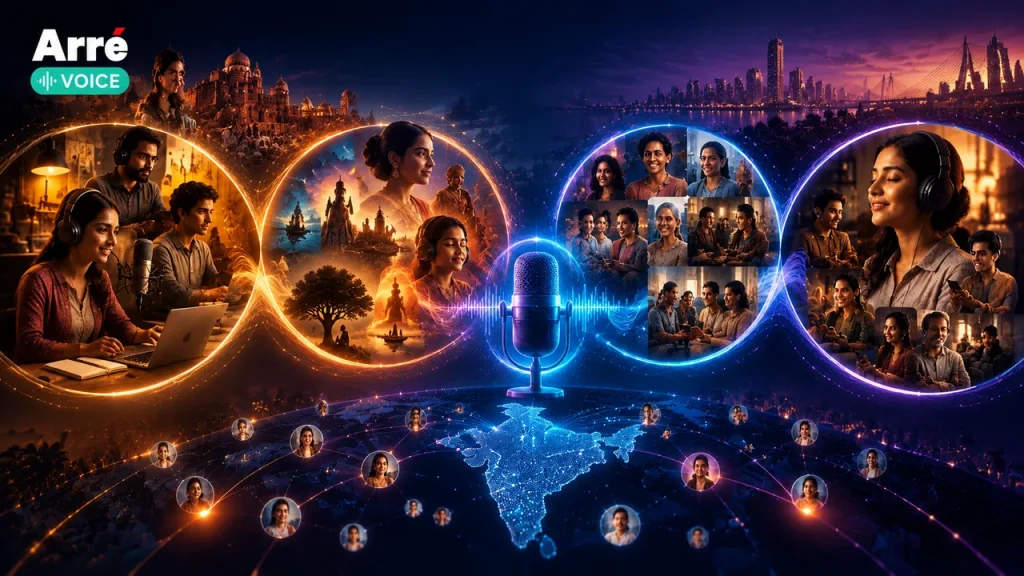
The future of storytelling is being shaped by the combination of technology, creativity, and community.
While artificial intelligence is changing how stories are created and distributed, the core of storytelling remains unchanged — connecting people through meaningful narratives.
Arré Voice represents this evolution by bringing together voice-first experiences, creators, and audiences in a digital environment built around storytelling.
By combining the emotional power of voice with modern technology, Arré Voice aligns with the future of audio entertainment, where stories are not only consumed but discovered, shared, and experienced through communities.
What Is Arré Voice?
Arré Voice is a voice-first storytelling platform designed to help audiences discover and engage with audio-based stories and experiences.
Unlike traditional content formats that primarily focus on written articles or visual media, voice storytelling creates a more personal relationship between creators and listeners.
Arré Voice focuses on the idea that stories have always travelled through voices.
From traditional Indian storytelling traditions where narratives were passed from one generation to another, to modern digital audio experiences, voice continues to be one of the most powerful mediums for sharing emotions, ideas, and perspectives.
The platform connects storytelling with digital accessibility by enabling audiences to:
- Discover original voice-based experiences
- Explore diverse stories and perspectives
- Engage with creator communities
- Experience storytelling through audio formats
As AI voice technology evolves, platforms focused on voice experiences have an opportunity to make storytelling more accessible while preserving the human connection that makes stories meaningful.
Voice-First Storytelling Experiences
Voice has always been central to storytelling.
Before books, streaming platforms, and digital applications existed, stories were shared through:
- Oral traditions
- Family conversations
- Community gatherings
- Cultural performances
The storyteller’s voice carried more than words. It communicated:
- Emotion
- Personality
- Cultural identity
- Human connection
Voice-first storytelling continues this tradition in a digital format.
Arré Voice represents this shift by enabling audiences to experience stories through audio, allowing them to listen while travelling, working, relaxing, or engaging in everyday activities.
Voice-first experiences create unique advantages:
More Personal Connections
A voice creates a direct relationship between the storyteller and listener, making experiences feel more intimate.
Flexible Content Consumption
Listeners can enjoy stories without requiring continuous screen attention.
Discovery of New Perspectives
Audiences can connect with creators, communities, and narratives they may not discover through traditional formats.
As AI-powered storytelling continues to develop, voice-first platforms can create new opportunities where technology enhances accessibility while maintaining emotional storytelling.
Supporting Creators and Communities
The future of storytelling will not only be defined by the content created but also by the communities built around those stories.
Arré Voice supports a creator-driven storytelling ecosystem where individuals can share their voices, connect with audiences, and participate in digital storytelling experiences.
Creators today are looking for platforms that allow them to:
- Share original ideas
- Build meaningful audiences
- Experiment with new formats
- Connect directly with listeners
- Create communities around shared interests
Voice creates a unique opportunity because it allows creators to build stronger emotional connections with audiences.
A listener does not only consume the content — they connect with the voice, personality, and perspective behind the story.
This creates a shift from traditional content models:
Publishers → Content → Audiences
towards a more community-driven model:
Creators → Stories → Communities → Shared Experiences
AI tools can further support this ecosystem by helping creators experiment with new storytelling formats while focusing their energy on creativity and audience relationships.
Bringing Indian Stories to Digital Audiences
India has one of the world’s richest storytelling traditions, shaped by:
- Regional cultures
- Local histories
- Folk narratives
- Languages
- Community experiences
For centuries, these stories have been preserved through voices, performances, and generations of storytellers.
However, many regional stories remain limited because of:
- Language barriers
- Geographic limitations
- Limited access to digital platforms
Voice-first digital platforms create new opportunities to bring these narratives to wider audiences.
Arré Voice can contribute to this evolution by helping connect audiences with diverse Indian storytelling experiences.
This includes opportunities for:
- Regional stories
- Cultural narratives
- Personal experiences
- Fictional storytelling
- Creator-led audio content
With advancements in AI voice technology, stories can become more accessible through:
- Multilingual experiences
- Digital distribution
- New audio formats
- Wider audience discovery
The future of Indian storytelling is not about replacing traditional narratives.
It is about preserving their emotional and cultural value while creating new ways for audiences to discover them.
Connecting Listeners With Meaningful Narratives
At the heart of every storytelling innovation is one simple purpose — creating meaningful connections.
Audiences connect with stories because they help them:
- Understand different perspectives
- Experience emotions
- Discover new ideas
- Feel connected to communities
Arré Voice brings together:
Creators
↓
Stories
↓
Communities
↓
Listeners
This ecosystem reflects the future of digital storytelling, where audiences are not passive consumers but active participants in discovering and sharing narratives.
As AI storytelling technology develops, the importance of authentic storytelling will become even greater.
Technology can help create, personalise, and distribute stories at scale, but meaningful narratives will always depend on:
- Human creativity
- Cultural context
- Emotional depth
- Authentic voices
Arré Voice sits at the intersection of storytelling, technology, and community — creating opportunities for creators and listeners to experience the next generation of voice-based entertainment.
The future of AI storytelling will not belong only to the technology that creates voices.
It will belong to the platforms that help meaningful voices reach the right audiences.
Read more about >>>
Indian Storytelling Traditions – How Stories Connect Generations
Frequently Asked Questions
What are AI voice stories?
AI voice stories are digital narratives created or enhanced using artificial intelligence voice technology. They transform written scripts, stories, or ideas into natural audio experiences using AI-generated narration. AI voice stories combine storytelling, voice technology, and human creativity to create engaging content for entertainment, education, and digital audio platforms.
How do AI voice stories work?
AI voice stories work by using artificial intelligence to analyse written content, understand context, and generate realistic voice narration. The process combines natural language processing, AI voice generation, and audio technology to convert scripts into spoken experiences with natural pronunciation, tone, pacing, and expressive delivery.
Are AI voice stories replacing human storytellers?
AI voice stories are not replacing human storytellers; they are supporting creators with new tools for producing and sharing narratives. AI helps with voice generation, content adaptation, and production efficiency, while human creators continue to provide emotional depth, originality, cultural context, and creative storytelling direction.
What is the difference between AI voice stories and podcasts?
AI voice stories are narrative-focused audio experiences built around characters, plots, and storytelling, while podcasts are generally conversation-based formats featuring hosts, discussions, or interviews. AI voice stories focus on immersive storytelling, whereas podcasts often build connections through conversations, opinions, and personality-driven content.
Can creators make AI voice stories?
Yes, creators can make AI voice stories by combining scripts, storytelling ideas, and AI voice technology. AI tools help creators generate narration, create multilingual versions, and produce audio experiences faster. However, creative direction, storytelling quality, and audience understanding remain essential for creating meaningful voice experiences.
Are AI voice stories the future of entertainment?
AI voice stories represent an important future direction in digital entertainment by enabling personalised, accessible, and scalable storytelling experiences. As AI technology advances, creators can develop interactive narratives, multilingual content, and new audio formats while maintaining the emotional connection that makes storytelling valuable.
What are the benefits of AI storytelling?
AI storytelling helps creators produce content faster, expand stories into multiple languages, and experiment with new formats. For listeners, it improves accessibility, enables flexible audio consumption, and creates opportunities to discover diverse narratives. AI enhances storytelling by supporting creativity, personalisation, and wider audience reach.
How is AI changing audio storytelling?
AI is changing audio storytelling by making voice creation more accessible, improving narration capabilities, and enabling personalised listening experiences. It allows creators to transform written content into audio, reach new audiences, and experiment with innovative formats while combining artificial intelligence technology with human creativity.



[…] can explore more about the evolution of audio storytelling in our guide on AI Voice Stories and Audio Storytelling […]
[…] Know more about>>> AI Voice Stories […]