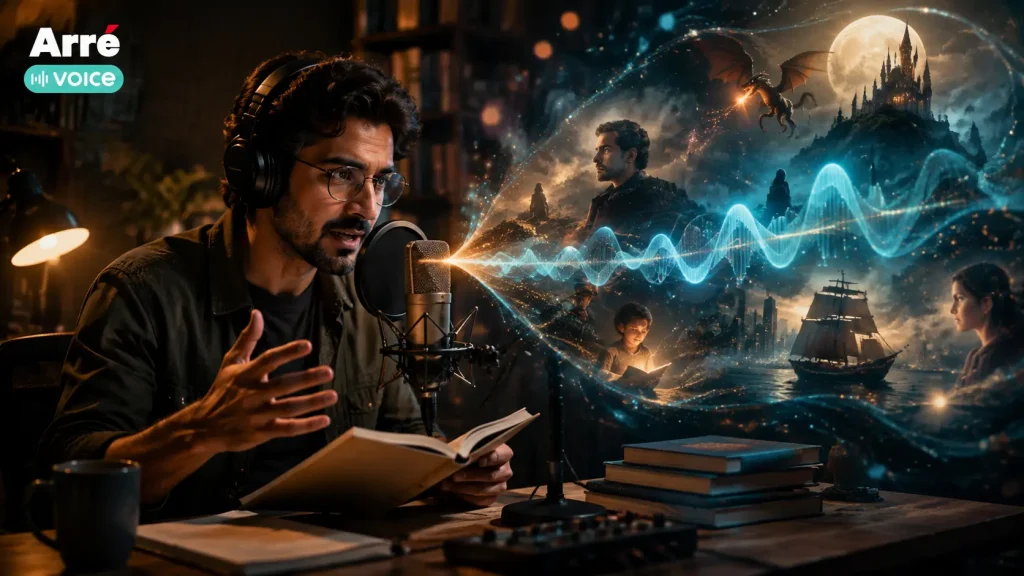
AI story narration uses artificial intelligence to transform written stories into spoken audio experiences. Authors and creators can use AI-generated voices to narrate fiction, personal stories, cultural narratives, and audiobooks with realistic voices, emotional expression, and faster production workflows.
How AI Story Narration Is Transforming Digital Storytelling

Storytelling has always evolved alongside technology. From printed books and radio shows to digital publishing, podcasts, and streaming platforms, creators have continuously explored new ways to share stories with wider audiences.
Today, audio storytelling is becoming one of the most engaging ways for people to experience stories. Listeners can enjoy narrated content while travelling, exercising, working, or completing daily activities without needing to read from a screen.
However, traditional story narration often requires significant resources, including:
- Professional voice actors
- Recording equipment
- Studio setup
- Audio editing expertise
- Time-consuming production workflows
For many independent authors and storytellers, creating professional-quality narrated content has traditionally been difficult due to cost and production limitations.
AI story narration is changing this process by helping creators transform written stories into immersive audio experiences using artificial intelligence. With AI-powered voice technology, authors can generate realistic narration, experiment with different storytelling styles, and create audio content faster.
AI narration technology allows creators to:
- Convert written stories and scripts into spoken audio
- Explore different AI voices for various storytelling formats
- Create multilingual narrated experiences
- Produce audio stories without complex recording setups
- Expand written content into new formats such as audiobooks and podcasts
AI does not replace the creativity, imagination, or emotional connection behind storytelling. Instead, it acts as a creative tool that helps authors and storytellers bring their ideas to life through voice.
What Is AI Story Narration?
AI story narration is the process of using artificial intelligence to transform written stories into realistic spoken audio experiences.
It uses advanced AI technologies such as text-to-speech, natural language processing, and voice generation models to analyse written content and produce human-like narration.
AI story narration combines:
- Story scripts – The written content, including fiction, personal stories, educational content, or creative narratives
- AI-generated voices – Digital voices that deliver the narration in different styles and tones
- Natural language processing – AI technology that helps understand sentence structure, context, and meaning
- Text-to-speech technology – Converts written words into spoken audio
- Emotional voice generation – Adds expression, pacing, and tone variations to make narration more engaging
AI story narration can be used across different storytelling formats, including:
- Fiction stories
- Short stories
- Audiobooks
- Children’s stories
- Cultural narratives
- Personal experiences
- Educational storytelling
- Audio series
Unlike traditional narration methods, AI-powered story narration allows creators to produce audio versions of their stories without requiring a complete professional recording setup.
For authors, this means a written story can become an audio experience with fewer production barriers, allowing more creators to reach audiences who prefer listening over reading.
How Does AI Story Narration Work?
AI story narration works by using artificial intelligence to transform written content into realistic spoken audio. The process involves analysing the story, selecting a suitable AI voice, generating narration, adding emotional expression, and refining the final audio experience.
For authors and storytellers, AI narration simplifies the journey from a written idea to a finished audio story by reducing the technical barriers involved in traditional voice production.
The typical AI story narration workflow includes:
- Preparing the story script
- Selecting an appropriate AI voice
- Generating the narration
- Adding emotion and storytelling expression
- Editing and publishing the final audio experience
Step 1: Prepare Your Story
The AI story narration process begins with a written story or script.
Creators can transform different types of written content into narrated audio, including:
- Fiction manuscripts
- Short stories
- Blog articles
- Personal narratives
- Educational stories
- Character-based storytelling scripts
A well-structured script helps AI narration tools understand the flow, sentence structure, and context of the story.
For better narration quality, creators should focus on:
- Clear storytelling structure
- Proper punctuation
- Natural dialogue formatting
- Character separation
- Emotional moments within the story
A carefully prepared script allows AI voices to deliver a more natural and engaging listening experience.
Step 2: Select an AI Voice
After preparing the story, creators choose an AI voice that matches the style, audience, and emotional tone of the content.
The right voice selection plays an important role in storytelling because different voices create different experiences for listeners.
Important factors to consider include:
- Voice personality
- Language support
- Accent
- Tone
- Speaking style
- Audience preference
For example:
- A mystery or thriller story may require a deep, dramatic voice with suspenseful delivery.
- A children’s story may work better with a warm, friendly, and expressive narration style.
- A personal story may require a natural conversational voice that feels authentic.
Choosing the right AI narrator helps creators maintain the emotional identity of their stories.
Step 3: Generate AI Narration
Once the script and voice are selected, AI voice technology converts the written story into spoken audio.
The AI system analyses the text and generates narration by recreating human-like speech patterns.
During this process, AI creates:
- Natural pronunciation
- Speech rhythm
- Voice pacing
- Sentence flow
- Narration style
Advanced AI narration tools can produce voices with improved realism by understanding context and adjusting delivery based on the meaning of the text.
For example, a question in a story may have a different tone compared to an emotional dialogue or dramatic scene.
This allows AI-generated narration to move beyond simple text conversion and create a more immersive storytelling experience.
Step 4: Add Emotion and Story Expression
Great storytelling is not only about reading words aloud. It is about creating an emotional connection with listeners.
AI story narration technology can enhance storytelling by adding expressive voice characteristics such as:
- Different emotional tones
- Speaking pace adjustments
- Character voices
- Dramatic emphasis
- Natural pauses
These elements help transform a simple script into an engaging audio experience.
For example:
A suspenseful story may benefit from slower pacing and dramatic pauses, while an inspirational story may require a confident and energetic voice style.
The combination of AI voice technology and creative direction allows authors to create more immersive narrated stories.
Step 5: Edit and Publish Your AI Narrated Story
After generating the AI narration, creators can refine the audio before publishing.
The final production stage may include:
- Background music
- Sound effects
- Voice adjustments
- Audio editing
- Volume balancing
These improvements help create a professional listening experience similar to traditional audio storytelling.
Once completed, creators can share their narrated stories through:
- Audio platforms
- Creator communities
- Social media channels
- Digital storytelling platforms
- Audiobook platforms
AI story narration allows creators to move from a written story idea to a published audio experience with a faster and more accessible workflow.
Benefits of AI Story Narration for Authors and Creators

AI story narration is helping authors and creators expand their storytelling possibilities by making professional-quality audio production more accessible.
Instead of limiting stories to written formats, creators can transform their ideas into narrated experiences that reach audiences through voice.
The key benefits include:
Turn Written Stories Into Audio Experiences
AI narration allows authors to convert existing written content into engaging audio formats.
A novel, short story, blog post, or personal narrative can become an audio experience without requiring a traditional recording session.
This helps creators reach audiences who prefer listening to stories instead of reading them.
Common examples include:
- Turning books into audiobooks
- Creating narrated short stories
- Developing podcast-style storytelling
- Producing audio fiction series
Faster Content Production
Traditional narration often requires scheduling voice actors, recording sessions, editing, and multiple production stages.
AI story narration significantly reduces the time required to create audio content.
Creators can:
- Generate narration quickly
- Test different voices
- Experiment with storytelling styles
- Update audio content easily
This allows authors to focus more on creativity while using AI to simplify production workflows.
Lower Production Costs
Professional voice production can require significant investment in:
- Recording studios
- Voice artists
- Audio engineers
- Editing resources
AI narration reduces many of these production barriers by providing creators with accessible voice generation tools.
This makes audio storytelling possible for:
- Independent authors
- New storytellers
- Small creative teams
- Digital content creators
Reach More Audiences Through Audio
Audio content allows creators to connect with audiences in new ways.
Many people consume stories while:
- Travelling
- Exercising
- Working
- Relaxing
By creating narrated versions of their stories, authors can reach listeners who may not engage with traditional written content.
AI story narration helps creators expand their audience beyond readers and connect with the growing audio-first generation.
Create Multilingual Stories
AI narration makes it easier for creators to explore global audiences through multilingual storytelling.
Authors can adapt stories into different languages and create voice experiences for diverse communities.
This enables:
- Regional storytelling
- Global audience expansion
- Multilingual audiobooks
- Cross-cultural storytelling experiences
For creators, AI voice technology opens new opportunities to share stories beyond language barriers.
AI Story Narration for Audio Story Creators

Audio storytelling is more than simply converting written text into spoken words. A successful audio story requires a combination of creative writing, expressive narration, emotional delivery, and immersive sound design.
AI story narration helps creators transform written ideas into engaging audio experiences by combining artificial intelligence with traditional storytelling techniques.
A powerful audio story usually includes:
- Strong narratives – A compelling story structure that keeps listeners engaged
- Expressive voices – Narration that matches the personality and emotion of the story
- Emotional delivery – Voice variations that create connection with listeners
- Sound design – Music, effects, and audio elements that enhance the storytelling experience
With AI narration technology, creators can build different types of audio experiences, including:
- Fiction audio stories
- Character-driven narratives
- Interactive storytelling experiences
- Serialized audio episodes
- Community-based storytelling content
The AI storytelling workflow can be simplified as:
Story Idea → Script → AI Story Narration → Audio Experience → Audience
This workflow allows creators to focus on imagination and storytelling while using AI tools to support the production process.
For authors, this means a written idea can evolve into a complete audio experience that reaches audiences through a more immersive format.
Best AI Story Narration Tools for Creators
Choosing the right AI story narration tool depends on the creator’s goals. Some platforms focus on realistic voice generation, while others help creators develop, publish, and distribute storytelling content.
The best AI narration tools support different stages of the creative process, including:
- Voice generation
- Story development
- Character creation
- Audio production
- Audience engagement
Below are some popular tools creators use for AI-powered storytelling.
Best for Realistic AI Voices
ElevenLabs
ElevenLabs is known for creating highly realistic AI-generated voices and is widely used for narration, voiceovers, and character-based storytelling.
It is suitable for creators who need:
- Natural voice generation
- Realistic story narration
- Character voices
- Expressive AI speech
ElevenLabs focuses primarily on AI voice creation, making it useful for authors and creators who want realistic voices for their stories.
Best Platform for Voice Story Creators
Arré Voice
Arré Voice is designed for creators who want to go beyond generating narration and build meaningful audio storytelling experiences.
Unlike traditional AI voice tools that focus only on voice generation, Arré Voice focuses on the complete creator journey:
Create → Share → Discover → Connect
Creators can use Arré Voice to:
- Publish voice stories
- Share narrated experiences
- Discover audiences
- Connect with storytelling communities
- Build relationships through audio content
For authors and storytellers, AI narration is only one part of the journey. The ability to share stories and build an audience creates a deeper connection between creators and listeners.
Arré Voice helps transform AI-generated narration into a storytelling experience where voices, stories, and communities come together.
Best for Story Development
ChatGPT
OpenAI tools such as ChatGPT can support creators during the story development process.
While it is not primarily an AI narration platform, it can help with:
- Story ideas
- Character development
- Plot improvement
- Script refinement
- Creative brainstorming
Creators can use AI writing assistance alongside AI voice technology to develop complete storytelling workflows.
How to Choose the Right AI Story Narration Tool
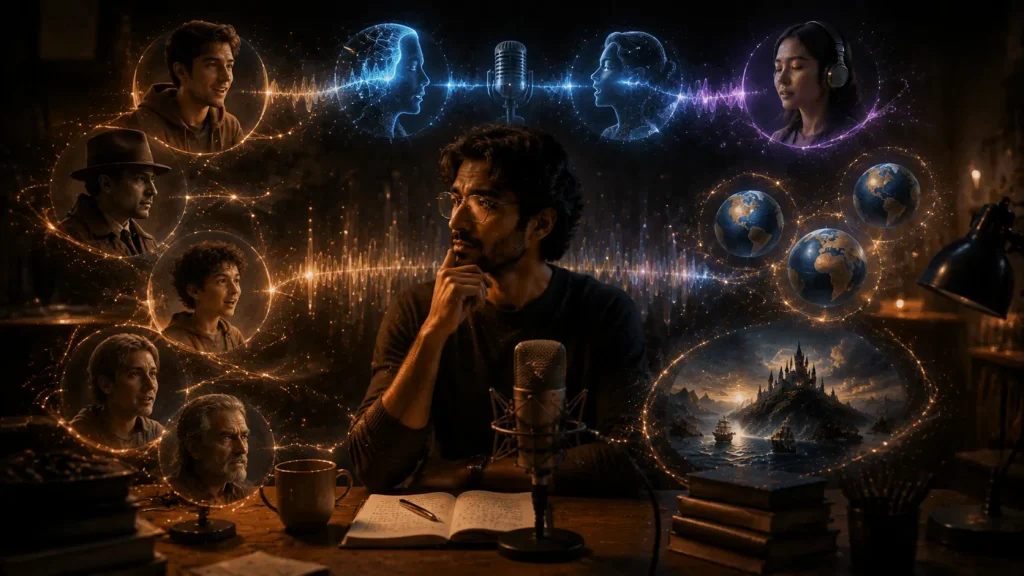
The right AI narration tool depends on what stage of storytelling a creator needs support with.
For example:
| Creator Goal | Best Type of Tool |
| Create realistic voices | AI voice generation platforms |
| Develop story ideas | AI writing assistants |
| Create character voices | Voice cloning and voice design tools |
| Build an audience | Audio storytelling communities |
| Publish voice stories | Creator-focused storytelling platforms |
For authors and storytellers, the ideal workflow often combines multiple tools:
Creative Writing + AI Narration + Audio Publishing + Audience Building
This approach allows creators to use AI as a storytelling partner while maintaining their own creativity and unique voice.
How to Create AI Story Narration Step-by-Step

Creating AI story narration involves transforming a written story into a complete audio experience using artificial intelligence. The process combines storytelling, AI voice technology, and audio production techniques to create engaging narrated content.
Whether you are an author, storyteller, or content creator, the AI narration workflow can help you turn your ideas into professional-quality audio stories without complex recording setups.
The step-by-step process includes:
- Writing or preparing your story
- Choosing an AI narration style
- Selecting a suitable AI voice
- Generating the narration
- Adding audio effects
- Reviewing and improving quality
- Publishing your story
Step 1: Write or Prepare Your Story
The first step is preparing the content you want to transform into audio.
Creators can use:
- Fiction stories
- Book chapters
- Short stories
- Personal narratives
- Educational content
- Blog articles
A well-structured script improves AI narration quality because the voice model can better understand sentence flow, dialogue, and storytelling context.
Before generating narration, creators should review:
- Grammar and punctuation
- Story structure
- Character dialogue
- Emotional moments
- Narration style
A clear script creates a stronger foundation for the final audio experience.
Step 2: Choose an AI Narration Style
The narration style determines how the story feels to listeners.
Different stories require different voice approaches.
Creators can choose styles based on:
- Story genre
- Target audience
- Emotional tone
- Character requirements
Examples:
- A fantasy story may require an immersive and dramatic narration style.
- A children’s story may benefit from a warm and friendly voice.
- A documentary-style story may need a professional and informative tone.
Selecting the right narration style helps ensure the AI voice matches the storytelling purpose.
Step 3: Select a Suitable AI Voice
After choosing the narration style, creators select an AI voice that fits the story.
Important voice factors include:
- Voice personality
- Age style
- Accent
- Language
- Speaking pace
- Emotional range
For character-based stories, creators may choose multiple voices to represent different characters and create a more engaging listening experience.
The right AI voice helps transform written words into a more memorable storytelling experience.
Step 4: Generate the AI Narration
Once the story and voice are selected, AI converts the written content into spoken narration.
The AI system processes the text and generates:
- Natural speech patterns
- Realistic pronunciation
- Voice rhythm
- Sentence pacing
- Emotional delivery
Modern AI narration tools can create voices that sound increasingly natural by analysing context and adapting delivery based on the meaning of the text.
Step 5: Add Audio Effects and Story Enhancements
Professional audio storytelling often includes more than narration.
Creators can improve their AI-generated stories by adding:
- Background music
- Sound effects
- Ambient sounds
- Character transitions
- Audio enhancements
These elements help create a richer listening experience and make stories feel more immersive.
For example:
A mystery story may include suspenseful background sounds, while a fantasy story may use atmospheric effects to enhance the world-building.
Step 6: Review and Improve Audio Quality
Before publishing, creators should review the generated narration and make improvements where necessary.
Important quality checks include:
- Voice pronunciation
- Narration speed
- Emotional expression
- Audio clarity
- Story pacing
Creators can refine sections of the narration to ensure the final audio feels natural and engaging.
AI narration works best when combined with human creative direction and quality control.
Step 7: Publish Your AI Narrated Story
The final step is sharing the completed audio story with an audience.
Creators can publish AI-narrated stories through:
- Audio storytelling platforms
- Creator communities
- Social media channels
- Podcasts
- Audiobook platforms
- Digital content platforms
AI story narration allows creators to move from an initial idea to a published audio experience with fewer production barriers.
Can AI Replace Human Story Narrators?
No, AI cannot replace human storytellers because storytelling is built on creativity, emotion, personal experiences, and cultural understanding.
AI can generate realistic voices and support the production process, but the heart of storytelling comes from human imagination and creative decisions.
AI helps creators with:
- Faster content production
- Voice generation
- Testing different narration styles
- Experimenting with new storytelling formats
Humans provide the elements that make stories meaningful:
- Original ideas
- Emotional understanding
- Cultural context
- Creative direction
- Personal perspective
The future of storytelling is not about AI replacing human creators. Instead, it is about combining human creativity with AI-powered tools to create richer and more accessible storytelling experiences.
Authors and storytellers can use AI as a creative partner that helps them produce, experiment, and share stories with larger audiences.
How Arré Voice Fits Into AI Story Narration
Most AI narration tools focus primarily on one stage of the storytelling process:
Creating the voice
While voice generation is an important part of storytelling, bringing a story to life requires more than just producing audio.
Arré Voice focuses on the complete creator journey:
Create → Share → Discover → Connect
Creators can use AI narration to produce stories and use Arré Voice to:
- Share audio storytelling experiences
- Build audiences around their voices
- Connect with listeners
- Participate in voice-based communities
- Discover new storytelling opportunities
For creators, the journey does not end when an AI voice is generated. The real value comes from connecting stories with people who want to listen.
AI brings stories to life through voice.
Arré Voice helps those stories reach audiences.
Read more:
Frequently Asked Questions
What is AI story narration?
AI story narration is the process of using artificial intelligence to convert written stories into realistic spoken audio. It uses AI voice generation, text-to-speech technology, and language models to create narrated experiences for fiction, audiobooks, short stories, educational content, and digital storytelling. Authors can transform written work into engaging audio formats without traditional recording setups.
How does AI narrate a story?
AI narrates a story by analysing written text and converting it into speech using artificial intelligence. The system processes pronunciation, sentence structure, pacing, and emotional context to generate natural-sounding narration. Advanced AI voice models can adjust tone, rhythm, and expression, helping creators produce more engaging audio stories with realistic voice delivery.
Can AI create realistic voices for storytelling?
Yes, modern AI voice technology can create realistic voices for storytelling by replicating natural speech patterns, pronunciation, emotions, and pacing. The quality depends on the AI model, voice characteristics, and narration settings. High-quality AI voices can deliver expressive storytelling suitable for audiobooks, fiction, podcasts, and character-based audio experiences.
Can authors use AI for audiobook narration?
Yes, authors can use AI narration to convert books, manuscripts, and written stories into audiobook formats. AI voice technology helps independent authors create narrated versions faster, reduce production costs, and reach listeners who prefer audio content. It can support fiction, non-fiction, educational books, and storytelling projects.
What is the best AI story narration tool?
The best AI story narration tool depends on the creator’s requirements, such as voice quality, storytelling features, publishing options, and audience reach. Some tools focus on generating realistic AI voices, while platforms like Arré Voice support creators by combining voice creation, storytelling, sharing, and community engagement.
Can AI narrate fiction stories with different characters?
Yes, AI can narrate fiction stories by generating different voices, tones, and character styles. Creators can use AI narration for novels, fantasy stories, children’s stories, and audio fiction series. Multiple AI voices can help represent different characters and create a more immersive listening experience for audiences.
How do I turn my story into an AI narrated audio?
To create an AI narrated story, start by preparing your written content, selecting a suitable AI voice, generating the narration, improving audio quality, and publishing the final recording. Creators can enhance the experience with background music, sound effects, and editing to make the story more engaging for listeners.
Is AI story narration better than traditional voice recording?
AI story narration offers faster production, lower costs, and flexible voice options compared to traditional recording. However, human narration still provides unique emotional depth and personal expression. Many creators combine AI technology with human creativity to produce engaging stories while improving efficiency and expanding their storytelling possibilities.
Can AI story narration support multiple languages?
Yes, AI story narration can support multiple languages, accents, and regional voice styles depending on the technology used. This allows authors and creators to adapt stories for international audiences. Multilingual AI narration helps expand reach, create localized content, and make storytelling accessible to listeners across different regions.
Will AI replace human storytellers?
No, AI will not replace human storytellers because storytelling depends on creativity, imagination, emotions, and personal experiences. AI helps creators produce narration faster, experiment with voices, and reach wider audiences. The future of storytelling will combine human ideas with AI-powered tools to create more immersive and accessible audio experiences.