

Indian storytelling traditions are rooted in centuries of oral narratives, folk tales, myths, and cultural experiences passed across generations. From regional folk stories and traditional Indian stories to modern digital storytelling, these narratives continue to preserve India’s diverse identity.
What Are Indian Storytelling Traditions?
Storytelling has always been an essential part of Indian culture. Long before books, television, and digital platforms existed, stories travelled through voices, gatherings, performances, and generations of storytellers. Indian storytelling traditions represent the many ways communities have shared knowledge, values, history, beliefs, and imagination through narratives.
At its core, storytelling in India is not only about entertainment. It has been a way of preserving memories, teaching life lessons, explaining traditions, and connecting people with their cultural roots. A story shared by a grandparent, a folk tale performed by an artist, or an ancient epic narrated in a village gathering all carry the same purpose — keeping experiences alive through generations.
Indian storytelling traditions include a wide range of formats such as folk tales, mythology, regional legends, devotional stories, oral histories, and community narratives. These stories often reflect the geography, languages, customs, and beliefs of the communities from which they originate.
For centuries, storytelling has helped different regions of India maintain their unique identities while contributing to a larger shared cultural landscape.
The Role of Stories in Indian Culture
Stories have played a deeper role in Indian society than simply passing time. They have acted as a bridge between generations, allowing knowledge and experiences to move from one era to another.
Many traditional Indian stories carry values such as:
- Respect for relationships
- Importance of compassion
- Understanding of right and wrong
- Connection with nature
- Social responsibilities
For example, stories from the Panchatantra used animals and fictional characters to explain human behaviour and decision-making. Similarly, stories from the Ramayana and Mahabharata have been interpreted across generations because they explore complex ideas around duty, relationships, leadership, and morality.
The strength of cultural storytelling lies in its ability to make important ideas memorable. A lesson explained through a story often stays with people longer than a simple instruction because it connects information with emotions and experiences.
This is why storytelling continues to remain an important part of Indian celebrations, family conversations, theatre, literature, and modern entertainment.
How Storytelling Evolved Over Generations
The journey of Indian storytelling has continuously evolved with changing technology and social habits.
Earlier, stories were primarily shared through:
- Oral traditions
- Community gatherings
- Folk performances
- Religious and cultural events
Storytellers travelled from place to place, carrying narratives that reflected local histories and traditions. Performers such as folk artists, musicians, and theatre groups played an important role in keeping stories alive.
Over time, storytelling moved into written formats through manuscripts, books, newspapers, and magazines. Later, radio, cinema, television, and digital platforms created new ways for audiences to experience stories.
Today, storytelling has entered another transformation phase. Audio platforms, digital communities, and creator-driven content are bringing back the power of voice while making stories accessible to a wider audience.
The format has changed, but the purpose remains the same — connecting people through meaningful narratives.
Modern platforms are creating new possibilities where traditional storytelling values meet digital experiences. A regional story that was once limited to a particular community can now reach listeners across different states and countries.
This evolution shows that storytelling is not disappearing. It is adapting to every generation while continuing to preserve the emotions and experiences behind every story.
The History of Storytelling in India
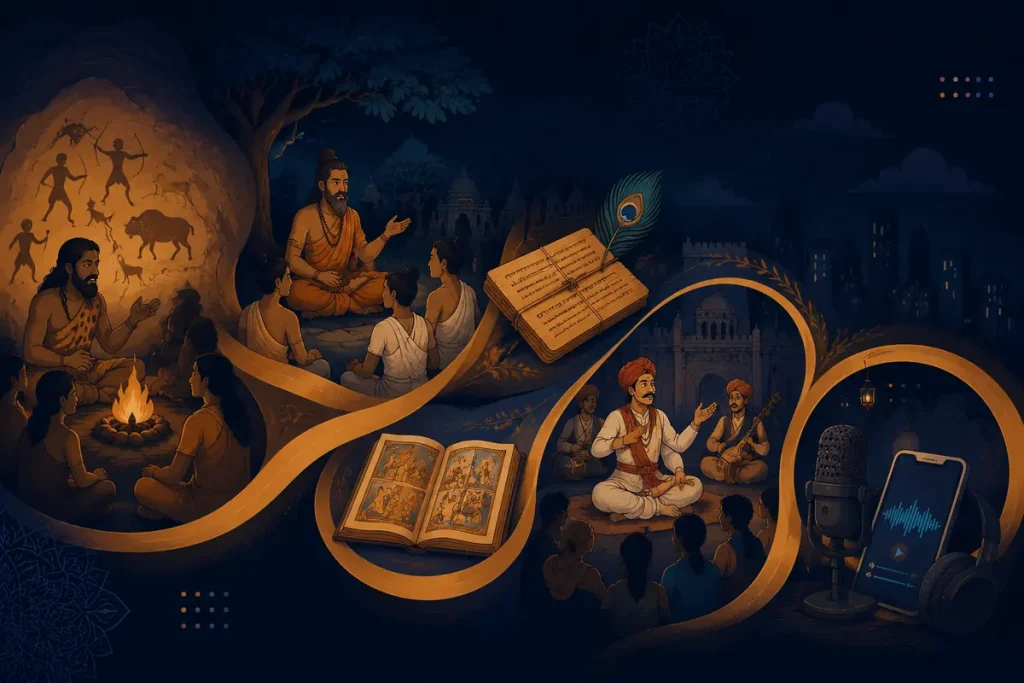
The history of storytelling in India is deeply connected with the country’s cultural, social, and spiritual evolution. For thousands of years, stories have been used to preserve memories, share knowledge, explain traditions, and connect communities. Before written texts became widely available, storytelling existed primarily through voices, performances, and collective experiences.
Indian storytelling traditions developed through a strong oral culture where stories were remembered, adapted, and passed from one generation to another. These narratives were not always fixed. Storytellers often modified them based on the audience, region, language, and social context, allowing the same story to take different forms across India.
This ability to evolve is one of the reasons Indian stories have survived for centuries.
Oral Storytelling Traditions in India
Oral storytelling was one of the earliest forms of cultural storytelling in India. Stories were shared through spoken words, songs, performances, and conversations within families and communities.
In many regions, elders played an important role in passing stories to younger generations. A child listening to stories from grandparents was not only experiencing entertainment but also learning about traditions, values, history, and social practices.
Ancient Indian texts and epics were also preserved through oral traditions before being documented in written forms. The Ramayana, Mahabharata, and various Puranic stories travelled across generations through recitations, performances, and regional adaptations.
Different communities developed their own storytelling styles based on local languages and traditions. A story from one region could carry different characters, settings, and interpretations while preserving the central message.
This made storytelling a living tradition rather than just a recorded piece of history.
Ancient Storytelling Practices and Community Gatherings
Historically, storytelling was closely connected with community life. Stories were often shared during festivals, religious gatherings, village meetings, and family occasions.
Traditional storytelling spaces included:
- Village gatherings
- Temple courtyards
- Community celebrations
- Folk performances
- Family gatherings
These gatherings created a shared experience where people listened, discussed, and connected through stories.
Storytelling was also an important method of education. Before modern learning systems became common, stories were used to explain complex ideas through simple narratives. Moral lessons, historical events, cultural beliefs, and social values were often communicated through memorable characters and situations.
For example, the Panchatantra used animal characters and engaging narratives to teach practical wisdom, leadership, and human behaviour. These stories travelled far beyond India because their lessons remained relevant across cultures and generations.
Storytellers and Performers Who Preserved Indian Narratives
Storytellers and performers have played a crucial role in keeping Indian storytelling traditions alive.
Across India, different communities developed unique storytelling forms where artists combined narration, music, theatre, and visual expression.
Some traditional storytelling forms include:
- Kathakalakshepam from South India, combining storytelling with music and spiritual narratives
- Harikatha, where performers narrated stories through devotional performances
- Pandavani from Chhattisgarh, focusing on stories from the Mahabharata
- Kathputli performances from Rajasthan, using puppetry to narrate folk tales and historical stories
- Pattachitra storytelling traditions from Odisha and West Bengal, where artists used paintings along with narration
These performers were not just entertainers. They were cultural carriers who preserved local histories, beliefs, and community memories.
Their contribution shows that storytelling has always depended on human connection. The storyteller’s voice, emotions, expressions, and relationship with the audience were as important as the story itself.
From Spoken Stories to Written and Digital Formats
Over time, storytelling moved beyond oral traditions and adapted to new formats.
The development of written literature allowed stories to be documented and preserved. Ancient manuscripts, poetry, religious texts, and regional literature helped protect narratives that were previously passed only through memory.
Later, newspapers, novels, radio, cinema, and television introduced new ways of experiencing stories.
Radio, in particular, brought back the power of voice by allowing audiences to imagine stories through sound. This created a connection between traditional oral storytelling and modern audio experiences.
Today, digital platforms are creating another chapter in the evolution of storytelling. Podcasts, audio stories, social communities, and creator platforms are bringing voice-based storytelling back into everyday life.
The medium has changed, but the foundation remains the same: a storyteller sharing an experience with an audience.
Modern digital storytelling is not replacing traditional storytelling. Instead, it is creating new opportunities for regional stories, cultural narratives, and individual voices to reach people beyond geographical boundaries.
The Importance of Indian Folk Stories in Culture
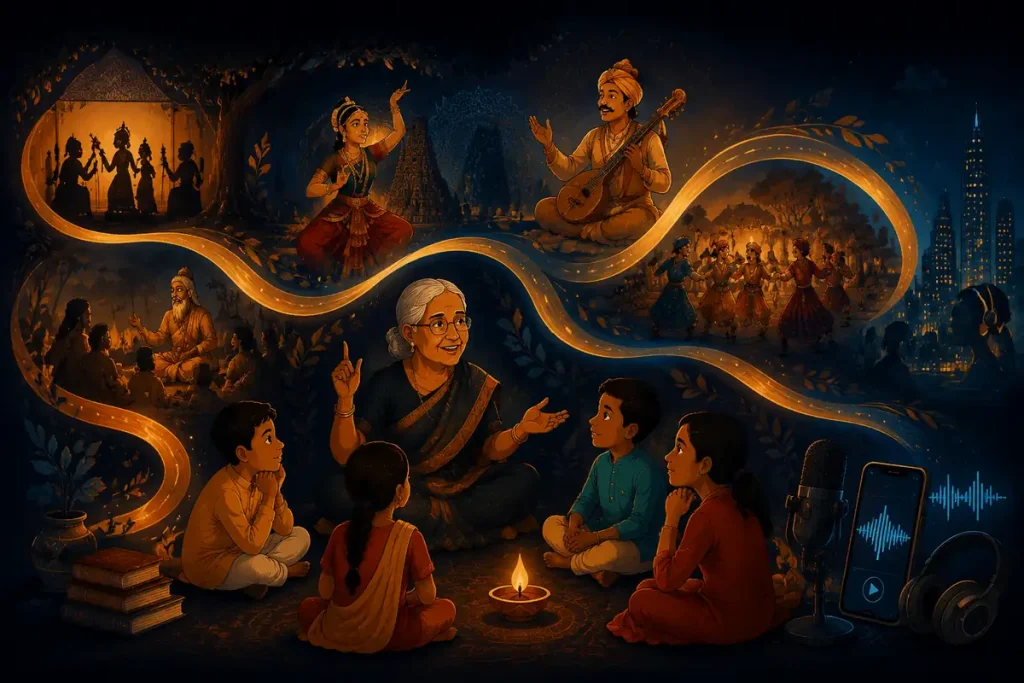
Indian folk stories are among the strongest examples of how communities preserve their identity through narratives. These stories reflect the experiences, beliefs, traditions, and imagination of people across different regions of India.
Unlike stories created only for entertainment, Indian folk stories often carry deeper meanings. They represent the collective wisdom of communities and provide insights into how people understood nature, relationships, society, and human behaviour.
From village legends and local heroes to animal tales and supernatural stories, folk narratives capture the diversity of India’s cultural landscape.
Why Indian Folk Stories Matter
Indian folk stories are important because they preserve cultural knowledge that may otherwise disappear over time.
Many folk stories contain details about:
- Local traditions
- Regional customs
- Historical memories
- Community beliefs
- Relationship between humans and nature
For generations, these stories have helped communities remember their past while adapting their lessons for the present.
A folk story from one region may explain the origin of a festival, describe the bravery of a local figure, or teach values through fictional characters. These narratives create a sense of belonging because they connect individuals with the history of their communities.
Values and Lessons Within Folk Narratives
One of the reasons folk stories continue to survive is their ability to communicate important lessons in simple and memorable ways.
Common themes found in traditional Indian stories include:
- Honesty and integrity
- Courage during difficult situations
- Respect for others
- Importance of wisdom over strength
- Harmony with nature
Stories such as the Panchatantra demonstrate how storytelling can teach practical life lessons through engaging characters and situations.
Similarly, regional folk tales often highlight the importance of community support, kindness, and understanding human emotions.
These lessons remain relevant because they focus on universal experiences rather than a particular time period.
Connection Between Stories and Communities
Stories have always been a way for communities to express who they are.
A region’s stories often reflect:
- Its language
- Its traditions
- Its landscape
- Its history
- Its values
This is why regional storytelling is so diverse across India. The same theme may appear differently in Maharashtra, Rajasthan, Kerala, Bengal, Tamil Nadu, or the Northeast because every community adds its own cultural perspective.
Indian folk stories create a shared connection between generations. A story heard by grandparents can be retold by parents and discovered again by younger audiences in new formats.
Today, digital platforms are giving these stories new life by allowing regional voices and cultural narratives to reach audiences beyond their original communities.
The tradition continues — only the way stories travel has changed.
Different Forms of Traditional Indian Stories
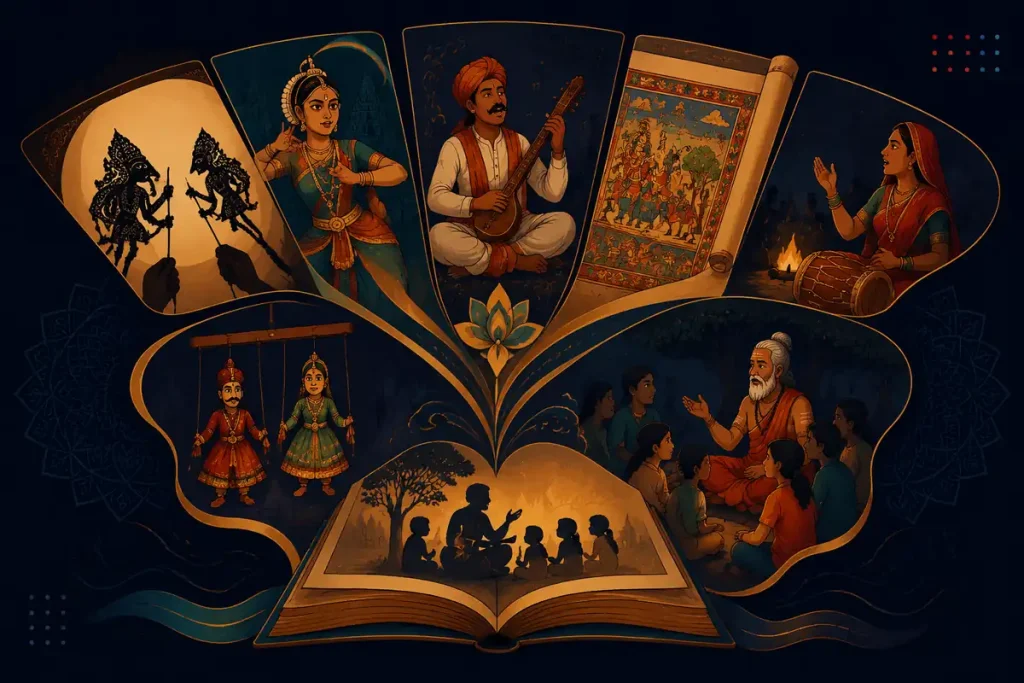
Indian storytelling traditions are diverse because they have evolved across different regions, languages, and communities. The stories told in India are not limited to a single format. They exist through folk narratives, mythology, performances, oral traditions, and regional interpretations that reflect the country’s cultural diversity.
From ancient epics that shaped Indian philosophy to local legends shared within communities, traditional Indian stories have always served as a way to preserve history, values, beliefs, and collective memories.
Each form of storytelling carries its own identity, but they all share a common purpose — connecting people through experiences, emotions, and ideas passed across generations.
Folk Tales and Regional Stories
Folk tales are among the most important forms of traditional storytelling in India. These stories originate from communities and are often inspired by local experiences, historical events, beliefs, and imagination.
Unlike written literature created by a single author, many folk tales developed organically within communities. They were shared through conversations, performances, songs, and gatherings, allowing them to evolve with time.
The diversity of regional stories of India reflects the country’s many languages, traditions, landscapes, and cultural identities. A story from Rajasthan may focus on bravery and local heroes, while a story from Kerala, Bengal, or the Northeast may highlight different relationships between humans, nature, and society.
Local Legends and Community-Based Narratives
Local legends form an important part of India’s storytelling heritage. These stories are often connected with specific places, communities, historical figures, or cultural events.
Many villages and regions have their own narratives about:
- The origin of a place
- Local heroes and leaders
- Spiritual traditions
- Natural landmarks
- Community experiences
These stories help communities preserve their unique identities. They are not only remembered as entertainment but also as a connection to local history.
For example, stories about regional kings, warriors, saints, and folk heroes often represent the values admired by a particular community. They reflect ideas of courage, sacrifice, wisdom, and resilience.
Regional Storytelling Styles Across India
India’s storytelling traditions differ greatly from one region to another because each community has developed its own style of expression.
Some storytelling traditions combine:
- Music
- Dance
- Theatre
- Puppetry
- Poetry
- Visual art
Examples include:
- Kathputli, the traditional puppet storytelling style of Rajasthan
- Yakshagana, a theatre-based storytelling tradition from Karnataka
- Pattachitra storytelling, where artists narrate stories alongside painted scrolls
- Pandavani, a musical storytelling tradition based on the Mahabharata from Chhattisgarh
These forms show that storytelling in India has always been a multi-sensory experience. Stories were not only heard but also performed and experienced by audiences.
Mythological Stories and Epics
Mythological stories and ancient epics form one of the strongest foundations of traditional Indian storytelling. These narratives have influenced literature, art, theatre, festivals, and cultural practices for centuries.
The importance of these stories lies not only in their scale but also in the questions they explore — duty, relationships, morality, leadership, and human emotions.
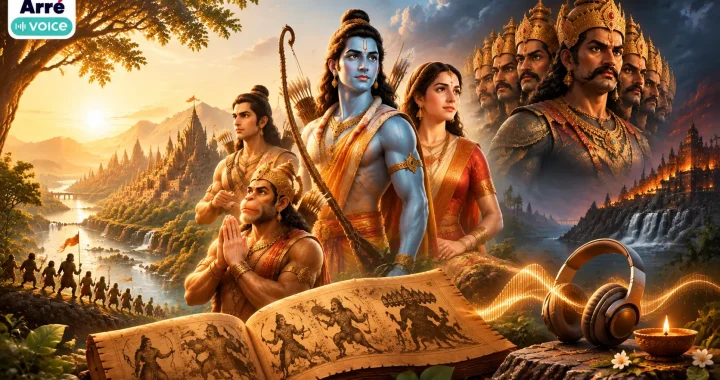
Ramayana: A Story of Values and Relationships
The Ramayana is one of India’s most widely known epics and has been retold in different languages and forms across generations.
At its centre is the journey of Lord Rama, but the story explores much more than a single character. It discusses themes such as:
- Duty and responsibility
- Family relationships
- Leadership
- Loyalty
- Personal choices
Different regions of India have developed their own interpretations of the Ramayana, creating unique versions through literature, theatre, dance, and oral performances.
This adaptability is one reason the epic continues to remain relevant even today.
Mahabharata: A Story of Human Complexity
The Mahabharata is another foundational epic that has shaped Indian storytelling for centuries.
Unlike simple stories of good versus evil, the Mahabharata explores complex human situations involving:
- Conflicting responsibilities
- Difficult choices
- Political struggles
- Family relationships
- Ethical dilemmas
Its characters represent different aspects of human nature, making the story meaningful across generations.
The epic has been adapted into regional performances, television series, literature, and modern interpretations, proving the lasting influence of traditional Indian stories.
Puranic Storytelling Traditions
The Puranas contain a vast collection of stories related to mythology, history, philosophy, traditions, and cultural beliefs.
For centuries, these stories were shared through:
- Religious gatherings
- Temple performances
- Storytelling sessions
- Community discussions
Puranic storytelling helped communities understand complex ideas through accessible narratives.
Rather than presenting information in an abstract way, these stories used characters, events, and emotions to communicate deeper meanings.
Oral Storytelling Traditions in India
Oral storytelling was one of the earliest forms of cultural storytelling in India. Stories were shared through spoken words, songs, performances, and conversations within families and communities.
In many regions, elders played an important role in passing stories to younger generations. A child listening to stories from grandparents was not only experiencing entertainment but also learning about traditions, values, history, and social practices.
Ancient Indian texts and epics were also preserved through oral traditions before being documented in written forms. The Ramayana, Mahabharata, and various Puranic stories travelled across generations through recitations, performances, and regional adaptations.
Different communities developed their own storytelling styles based on local languages and traditions. A story from one region could carry different characters, settings, and interpretations while preserving the central message.
This made storytelling a living tradition rather than just a recorded piece of history.
Ancient Storytelling Practices and Community Gatherings
Historically, storytelling was closely connected with community life. Stories were often shared during festivals, religious gatherings, village meetings, and family occasions.
Traditional storytelling spaces included:
- Village gatherings
- Temple courtyards
- Community celebrations
- Folk performances
- Family gatherings
These gatherings created a shared experience where people listened, discussed, and connected through stories.
Storytelling was also an important method of education. Before modern learning systems became common, stories were used to explain complex ideas through simple narratives. Moral lessons, historical events, cultural beliefs, and social values were often communicated through memorable characters and situations.
For example, the Panchatantra used animal characters and engaging narratives to teach practical wisdom, leadership, and human behaviour. These stories travelled far beyond India because their lessons remained relevant across cultures and generations.
Storytellers and Performers Who Preserved Indian Narratives
Storytellers and performers have played a crucial role in keeping Indian storytelling traditions alive.
Across India, different communities developed unique storytelling forms where artists combined narration, music, theatre, and visual expression.
Some traditional storytelling forms include:
- Kathakalakshepam from South India, combining storytelling with music and spiritual narratives
- Harikatha, where performers narrated stories through devotional performances
- Pandavani from Chhattisgarh, focusing on stories from the Mahabharata
- Kathputli performances from Rajasthan, using puppetry to narrate folk tales and historical stories
- Pattachitra storytelling traditions from Odisha and West Bengal, where artists used paintings along with narration
These performers were not just entertainers. They were cultural carriers who preserved local histories, beliefs, and community memories.
Their contribution shows that storytelling has always depended on human connection. The storyteller’s voice, emotions, expressions, and relationship with the audience were as important as the story itself.
From Spoken Stories to Written and Digital Formats
Over time, storytelling moved beyond oral traditions and adapted to new formats.
The development of written literature allowed stories to be documented and preserved. Ancient manuscripts, poetry, religious texts, and regional literature helped protect narratives that were previously passed only through memory.
Later, newspapers, novels, radio, cinema, and television introduced new ways of experiencing stories.
Radio, in particular, brought back the power of voice by allowing audiences to imagine stories through sound. This created a connection between traditional oral storytelling and modern audio experiences.
Today, digital platforms are creating another chapter in the evolution of storytelling. Podcasts, audio stories, social communities, and creator platforms are bringing voice-based storytelling back into everyday life.
The medium has changed, but the foundation remains the same: a storyteller sharing an experience with an audience.
Modern digital storytelling is not replacing traditional storytelling. Instead, it is creating new opportunities for regional stories, cultural narratives, and individual voices to reach people beyond geographical boundaries.
The Importance of Indian Folk Stories in Culture
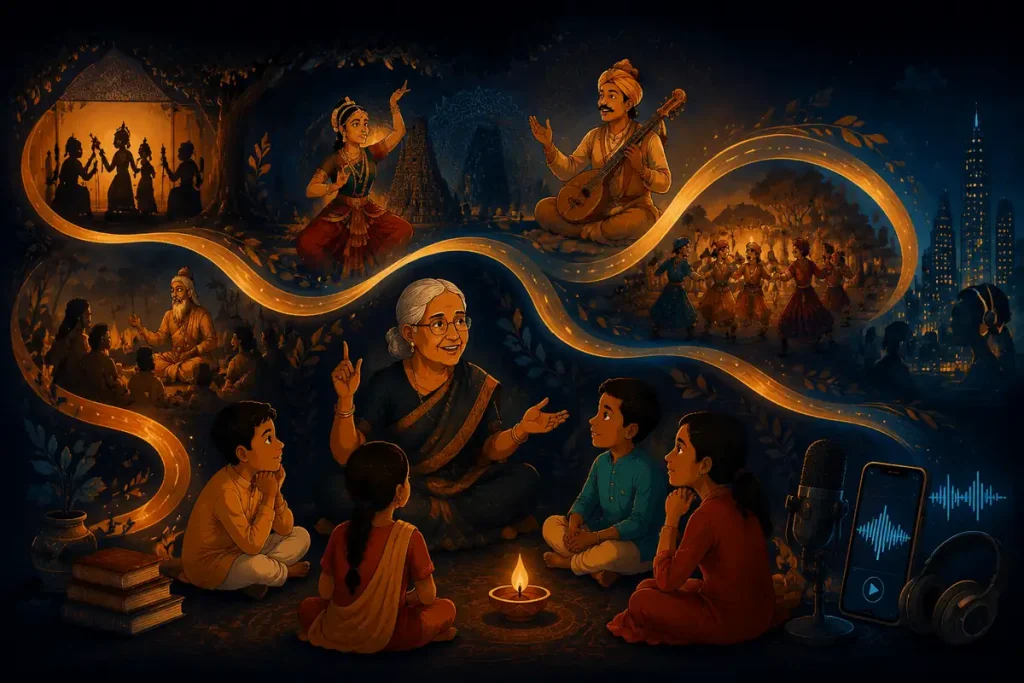
Indian folk stories are among the strongest examples of how communities preserve their identity through narratives. These stories reflect the experiences, beliefs, traditions, and imagination of people across different regions of India.
Unlike stories created only for entertainment, Indian folk stories often carry deeper meanings. They represent the collective wisdom of communities and provide insights into how people understood nature, relationships, society, and human behaviour.
From village legends and local heroes to animal tales and supernatural stories, folk narratives capture the diversity of India’s cultural landscape.
Why Indian Folk Stories Matter
Indian folk stories are important because they preserve cultural knowledge that may otherwise disappear over time.
Many folk stories contain details about:
- Local traditions
- Regional customs
- Historical memories
- Community beliefs
- Relationship between humans and nature
For generations, these stories have helped communities remember their past while adapting their lessons for the present.
A folk story from one region may explain the origin of a festival, describe the bravery of a local figure, or teach values through fictional characters. These narratives create a sense of belonging because they connect individuals with the history of their communities.
Values and Lessons Within Folk Narratives
One of the reasons folk stories continue to survive is their ability to communicate important lessons in simple and memorable ways.
Common themes found in traditional Indian stories include:
- Honesty and integrity
- Courage during difficult situations
- Respect for others
- Importance of wisdom over strength
- Harmony with nature
Stories such as the Panchatantra demonstrate how storytelling can teach practical life lessons through engaging characters and situations.
Similarly, regional folk tales often highlight the importance of community support, kindness, and understanding human emotions.
These lessons remain relevant because they focus on universal experiences rather than a particular time period.
Connection Between Stories and Communities
Stories have always been a way for communities to express who they are.
A region’s stories often reflect:
- Its language
- Its traditions
- Its landscape
- Its history
- Its values
This is why regional storytelling is so diverse across India. The same theme may appear differently in Maharashtra, Rajasthan, Kerala, Bengal, Tamil Nadu, or the Northeast because every community adds its own cultural perspective.
Indian folk stories create a shared connection between generations. A story heard by grandparents can be retold by parents and discovered again by younger audiences in new formats.
Today, digital platforms are giving these stories new life by allowing regional voices and cultural narratives to reach audiences beyond their original communities.
The tradition continues — only the way stories travel has changed.
Different Forms of Traditional Indian Stories
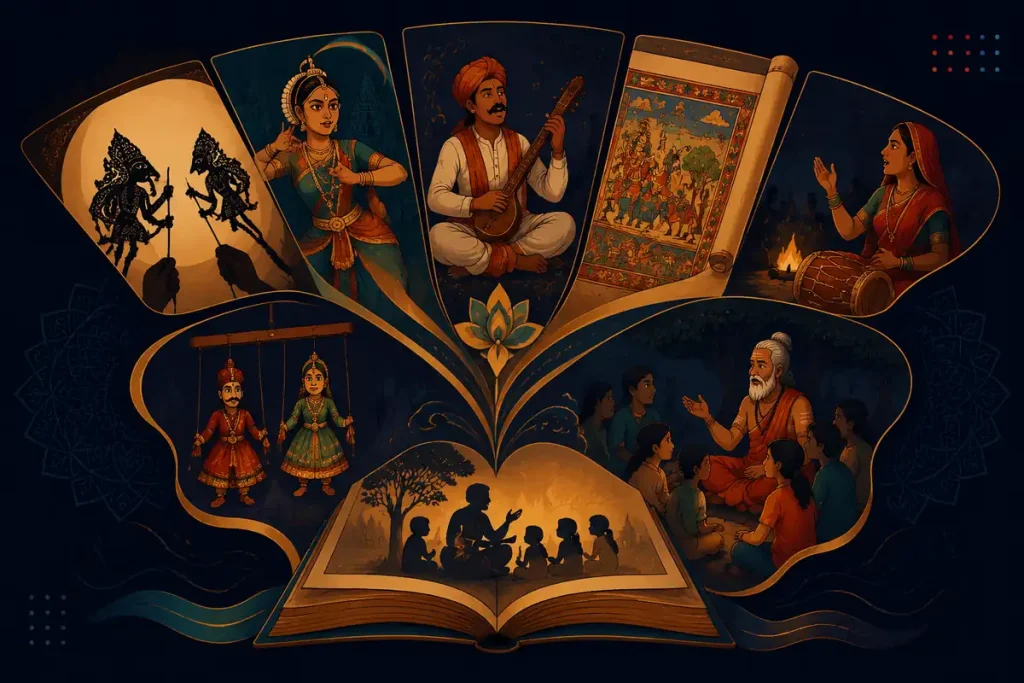
Indian storytelling traditions are diverse because they have evolved across different regions, languages, and communities. The stories told in India are not limited to a single format. They exist through folk narratives, mythology, performances, oral traditions, and regional interpretations that reflect the country’s cultural diversity.
From ancient epics that shaped Indian philosophy to local legends shared within communities, traditional Indian stories have always served as a way to preserve history, values, beliefs, and collective memories.
Each form of storytelling carries its own identity, but they all share a common purpose — connecting people through experiences, emotions, and ideas passed across generations.
Folk Tales and Regional Stories
Folk tales are among the most important forms of traditional storytelling in India. These stories originate from communities and are often inspired by local experiences, historical events, beliefs, and imagination.
Unlike written literature created by a single author, many folk tales developed organically within communities. They were shared through conversations, performances, songs, and gatherings, allowing them to evolve with time.
The diversity of regional stories of India reflects the country’s many languages, traditions, landscapes, and cultural identities. A story from Rajasthan may focus on bravery and local heroes, while a story from Kerala, Bengal, or the Northeast may highlight different relationships between humans, nature, and society.
Local Legends and Community-Based Narratives
Local legends form an important part of India’s storytelling heritage. These stories are often connected with specific places, communities, historical figures, or cultural events.
Many villages and regions have their own narratives about:
- The origin of a place
- Local heroes and leaders
- Spiritual traditions
- Natural landmarks
- Community experiences
These stories help communities preserve their unique identities. They are not only remembered as entertainment but also as a connection to local history.
For example, stories about regional kings, warriors, saints, and folk heroes often represent the values admired by a particular community. They reflect ideas of courage, sacrifice, wisdom, and resilience.
Regional Storytelling Styles Across India
India’s storytelling traditions differ greatly from one region to another because each community has developed its own style of expression.
Some storytelling traditions combine:
- Music
- Dance
- Theatre
- Puppetry
- Poetry
- Visual art
Examples include:
- Kathputli, the traditional puppet storytelling style of Rajasthan
- Yakshagana, a theatre-based storytelling tradition from Karnataka
- Pattachitra storytelling, where artists narrate stories alongside painted scrolls
- Pandavani, a musical storytelling tradition based on the Mahabharata from Chhattisgarh
These forms show that storytelling in India has always been a multi-sensory experience. Stories were not only heard but also performed and experienced by audiences.
Mythological Stories and Epics
Mythological stories and ancient epics form one of the strongest foundations of traditional Indian storytelling. These narratives have influenced literature, art, theatre, festivals, and cultural practices for centuries.
The importance of these stories lies not only in their scale but also in the questions they explore — duty, relationships, morality, leadership, and human emotions.
Ramayana: A Story of Values and Relationships
The Ramayana is one of India’s most widely known epics and has been retold in different languages and forms across generations.
At its centre is the journey of Lord Rama, but the story explores much more than a single character. It discusses themes such as:
- Duty and responsibility
- Family relationships
- Leadership
- Loyalty
- Personal choices
Different regions of India have developed their own interpretations of the Ramayana, creating unique versions through literature, theatre, dance, and oral performances.
This adaptability is one reason the epic continues to remain relevant even today.
Mahabharata: A Story of Human Complexity
The Mahabharata is another foundational epic that has shaped Indian storytelling for centuries.
Unlike simple stories of good versus evil, the Mahabharata explores complex human situations involving:
- Conflicting responsibilities
- Difficult choices
- Political struggles
- Family relationships
- Ethical dilemmas
Its characters represent different aspects of human nature, making the story meaningful across generations.
The epic has been adapted into regional performances, television series, literature, and modern interpretations, proving the lasting influence of traditional Indian stories.
Puranic Storytelling Traditions
The Puranas contain a vast collection of stories related to mythology, history, philosophy, traditions, and cultural beliefs.
For centuries, these stories were shared through:
- Religious gatherings
- Temple performances
- Storytelling sessions
- Community discussions
Puranic storytelling helped communities understand complex ideas through accessible narratives.
Rather than presenting information in an abstract way, these stories used characters, events, and emotions to communicate deeper meanings.
Oral Storytelling Traditions
Before books and digital platforms became common, oral storytelling was the primary way stories travelled across generations.
Oral traditions depended on memory, voice, expression, and interaction between storytellers and listeners.
A storyteller was not simply someone who repeated words. They brought stories to life through emotions, expressions, music, and personal interpretation.
Stories Passed Through Generations
Oral storytelling allowed communities to preserve knowledge without written records.
Stories were passed through:
- Families
- Villages
- Cultural groups
- Traditional performers
Grandparents sharing stories with children is one of the simplest examples of this tradition continuing in everyday life.
Through these conversations, younger generations learned about:
- Family histories
- Cultural values
- Regional traditions
- Social experiences
The Role of Storytellers
Storytellers have always played an important role as cultural preservers.
They carried stories from one generation to another and adapted them according to the audience and environment.
Traditional storytellers often combined:
- Narration
- Music
- Expressions
- Performance
- Local knowledge
Their role was not only to entertain but also to educate and preserve collective memory.
Importance of Voice and Expression
The power of oral storytelling comes from the human connection created through voice.
The same story can feel different depending on:
- The storyteller’s emotions
- Tone of voice
- Timing
- Expressions
- Audience interaction
This is why voice remains such an important part of storytelling even in the digital era.
Modern audio storytelling platforms continue this tradition by using voice as the primary medium to connect creators and audiences. While technology has changed how stories are shared, the emotional impact of a storyteller’s voice remains unchanged.
Regional Storytelling Traditions Across India
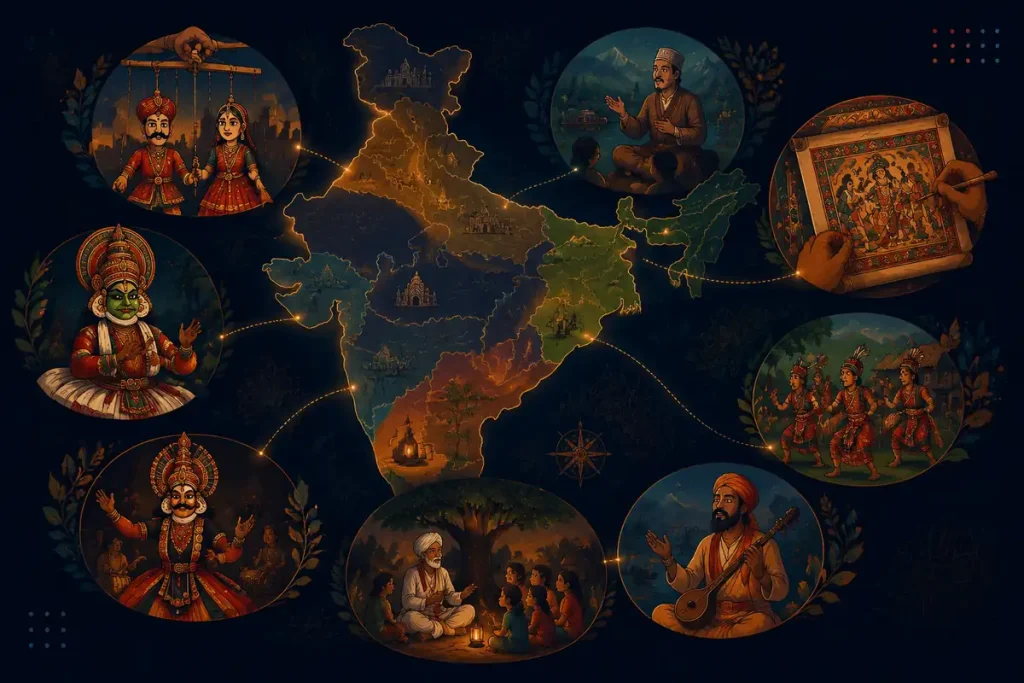
One of the most remarkable aspects of Indian storytelling traditions is the diversity created by India’s many regions, languages, and communities. Every part of the country has developed its own storytelling styles, characters, themes, and methods of expression.
The same emotions — love, courage, sacrifice, wisdom, humour, and human relationships — appear across different stories, but each region presents them through its own cultural lens.
These regional stories of India are not just forms of entertainment. They preserve local histories, community experiences, traditions, and the unique identities of people who have carried these narratives forward for generations.
Stories from North India
North India has a rich storytelling heritage shaped by folk traditions, mythology, history, and community performances. Stories from this region often reflect themes of bravery, devotion, social values, and relationships between people and society.
Many folk narratives originated in villages and were passed through generations through oral performances, songs, and local gatherings.
Folk Traditions of North India
North Indian folk storytelling has traditionally been connected with music, poetry, and performances.
Some important storytelling traditions include:
- Dastangoi – an ancient Urdu storytelling tradition known for imaginative narratives and elaborate performances.
- Ramlila – a dramatic retelling of the Ramayana performed across many parts of North India.
- Alha-Khand – a heroic ballad tradition from the Bundelkhand region celebrating warriors and historical figures.
These traditions demonstrate how stories were not only heard but experienced through performance, community participation, and emotional connection.
Local Legends of North India
North India is home to many local legends that reflect regional histories and cultural beliefs.
Stories of kings, warriors, saints, and ordinary people have been preserved through generations.
Examples include:
- Tales of Rani Lakshmibai representing courage and resistance
- Regional legends around Rajasthan’s folk heroes
- Stories of saints and spiritual figures shared across communities
These narratives continue to influence literature, cinema, theatre, and modern storytelling formats.
Stories from South India
South India has one of the oldest and most diverse storytelling traditions in India. The region’s storytelling heritage combines literature, music, dance, theatre, and mythology.
Traditional narratives from South India often explore themes of devotion, human emotions, nature, relationships, and social values.
Regional Folklore of South India
South Indian folklore includes stories that developed within local communities and were adapted through different languages such as Tamil, Telugu, Kannada, and Malayalam.
Important storytelling forms include:
- Harikatha – a narrative tradition combining storytelling, music, and spiritual teachings.
- Villu Paatu – a Tamil folk storytelling style using music and instruments.
- Yakshagana – a Karnataka performance tradition combining dance, music, and dramatic storytelling.
- Theyyam stories – traditional narratives connected with rituals and local beliefs in Kerala.
These storytelling styles highlight how communities used performance as a way to preserve history and cultural knowledge.
Traditional Narratives of South India
South Indian stories often include:
- Regional legends
- Temple traditions
- Historical narratives
- Mythological adaptations
- Stories connected with nature and local communities
Many traditional stories have been adapted into modern books, films, television, and digital content, showing the continued relevance of regional storytelling.
Stories from East and West India
Eastern and Western India have contributed significantly to India’s storytelling landscape through folk literature, cultural performances, and community-based narratives.
The storytelling traditions of these regions reflect local landscapes, languages, festivals, and social experiences.
Cultural Stories from East India
East India has a strong tradition of folklore, poetry, music, and visual storytelling.
Examples include:
- Pattachitra storytelling from Odisha and West Bengal, where artists use painted scrolls along with narration.
- Baul traditions of Bengal, where music and philosophy come together through storytelling.
- Regional folk tales that reflect local communities, nature, and everyday experiences.
These stories often explore themes of spirituality, human relationships, and the connection between people and their surroundings.
Community Traditions of West India
Western India has a vibrant storytelling culture shaped by folk performances, oral narratives, and regional legends.
Examples include:
- Kathputli, the traditional puppet storytelling style of Rajasthan
- Folk songs and ballads from Gujarat and Maharashtra
- Stories of local heroes, traditions, and cultural figures
These narratives have helped communities preserve their history while creating shared cultural experiences.
The diversity of regional storytelling traditions across India shows that storytelling has always been a reflection of people’s lives. Each region contributes its own voice, but together they create a larger cultural identity that connects millions of people.
How Indian Storytelling Connects Generations
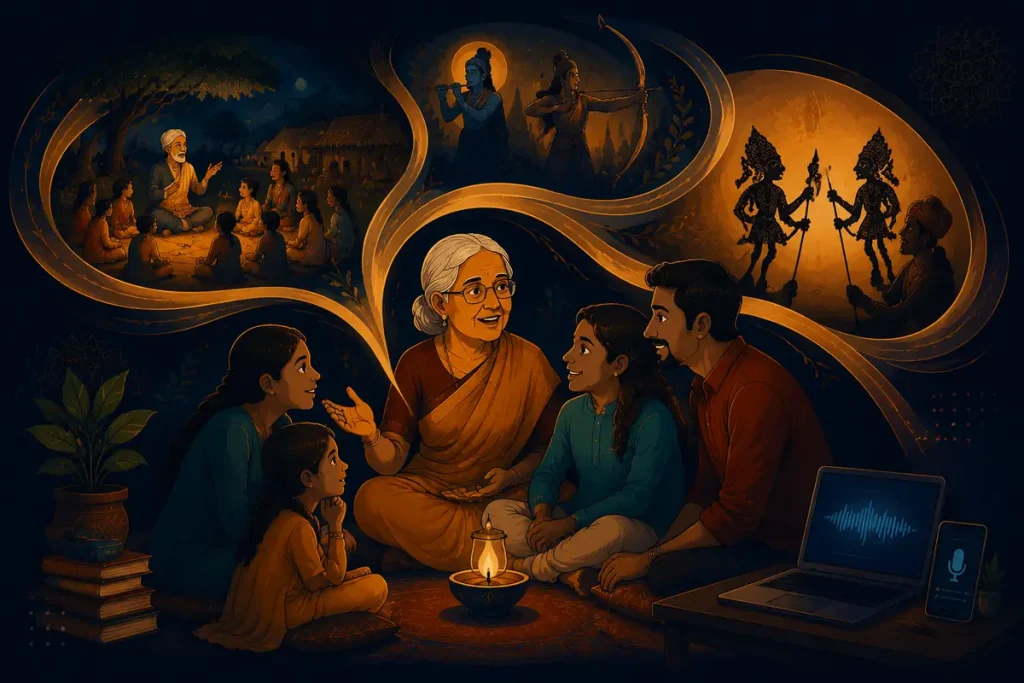
Stories have always been a bridge between generations. In Indian families and communities, storytelling has been one of the most natural ways of sharing experiences, values, and memories.
A story passed from a grandparent to a child is not just a narrative. It carries emotions, traditions, lessons, and a connection to the past.
This ability to connect generations is one of the strongest reasons why traditional Indian stories continue to remain relevant today.
Family Storytelling and Shared Memories
For many Indians, storytelling begins at home.
Family members often share:
- Childhood experiences
- Family histories
- Local legends
- Moral stories
- Cultural traditions
These conversations create emotional connections between different generations.
A grandparent sharing a folk tale or a family story allows younger generations to understand their roots and develop a deeper connection with their heritage.
Stories and Cultural Identity
Stories play an important role in shaping cultural identity.
They help people understand:
- Where they come from
- What values their communities represent
- Which traditions have shaped their lives
Through stories, younger generations learn about languages, customs, festivals, and beliefs.
This is why cultural storytelling remains important even in a rapidly changing world. It helps preserve a sense of belonging while allowing traditions to evolve.
Preserving Memories Through Stories
Many historical events, local traditions, and community experiences survive because they were remembered and retold through stories.
Before modern documentation methods, storytelling helped preserve:
- Community histories
- Local knowledge
- Cultural practices
- Personal experiences
Every storyteller adds another layer to these memories, keeping them alive for future generations.
Passing Traditions Forward
The way stories are shared has changed over time, but the purpose remains the same.
Earlier:
Storytellers → Communities → Oral traditions
Today:
Digital creators → Online communities → Global audiences
Modern platforms, audio storytelling, and digital communities are creating new ways for traditional narratives to reach people.
The voice of a storyteller that once travelled within a village can now reach listeners across cities and countries.
This evolution proves that Indian storytelling traditions are not limited to the past. They continue to adapt, connect generations, and preserve the human need to share stories.
From Oral Stories to Digital Storytelling
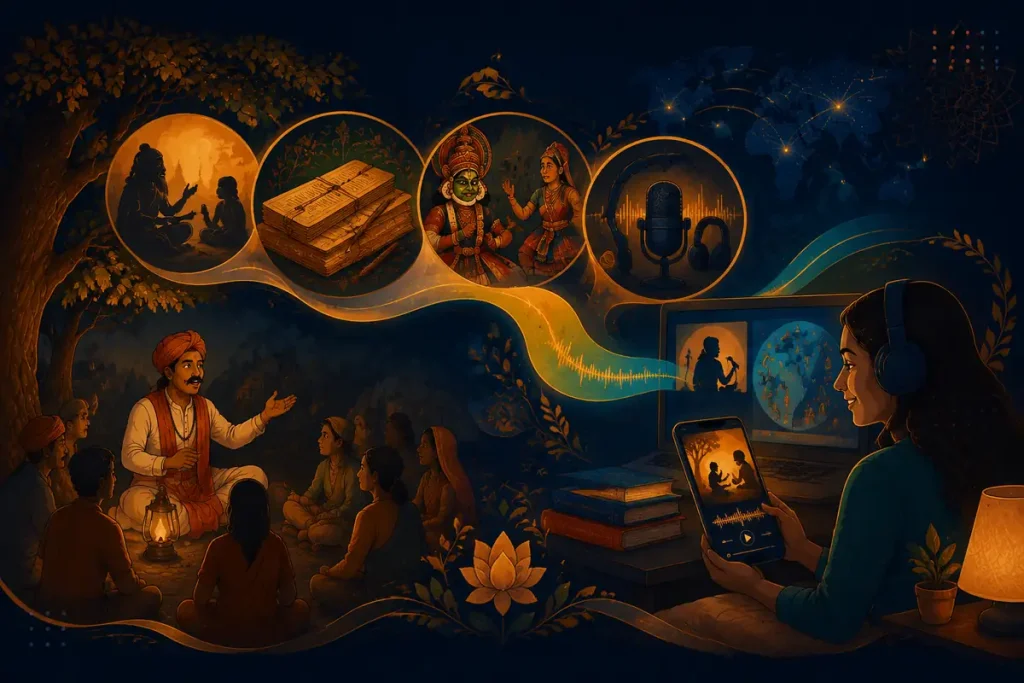
The journey of storytelling in India has always been shaped by the way people communicate and connect with each other. While the mediums have changed over time, the core purpose of storytelling has remained the same — sharing experiences, preserving memories, and creating emotional connections.
For centuries, stories travelled through voices, gatherings, and personal interactions. Today, technology has expanded the reach of these stories, allowing creators and communities to share narratives with audiences beyond geographical boundaries.
The transition can be understood as:
Traditional Storytelling
Storytellers → Communities → Oral Traditions
↓
Modern Storytelling
Audio Platforms → Digital Creators → Online Communities
Traditional Storytellers: The Original Keepers of Stories
Before books, radio, and digital platforms, storytellers were the primary carriers of knowledge and culture.
They travelled between communities, performed in gatherings, and preserved narratives through memory and expression. Their voices carried stories of history, mythology, local traditions, and everyday experiences.
Traditional storytellers played several roles:
- Preserving cultural memories
- Sharing community knowledge
- Teaching values through narratives
- Connecting people through shared experiences
A storyteller was not simply someone who narrated words. Their voice, emotions, expressions, and connection with the audience brought stories to life.
This human element made oral storytelling a powerful form of cultural storytelling across generations.
Communities as the Home of Oral Traditions
Traditional stories survived because communities actively participated in keeping them alive.
Stories were shared during:
- Family gatherings
- Festivals
- Cultural events
- Village meetings
- Religious and social occasions
A single story could travel across generations, with each storyteller adding local experiences and interpretations.
This community-driven nature allowed Indian storytelling traditions to remain diverse. Different regions developed their own versions of stories based on local languages, customs, and beliefs.
The story was not owned by one person. It belonged to the community that preserved and passed it forward.
The Rise of Digital Storytelling
The arrival of digital platforms has created a new chapter in the history of storytelling.
Today, stories are no longer limited by geography or physical gatherings. A creator sitting in one location can share their voice, experiences, and ideas with audiences across the world.
Digital storytelling has introduced new formats such as:
- Audio stories
- Podcasts
- Short-form narratives
- Creator-led content
- Interactive communities
These formats combine the emotional connection of traditional storytelling with the accessibility of modern technology.
Audio Platforms Bringing Back the Power of Voice
Among the many forms of digital storytelling, audio storytelling has created a unique connection between traditional and modern experiences.
Voice has always been central to Indian storytelling. The emotion in a storyteller’s voice, the rhythm of narration, and the imagination created in a listener’s mind have remained powerful for centuries.
Modern audio platforms continue this tradition by allowing creators to share:
- Personal stories
- Cultural experiences
- Fictional narratives
- Community conversations
- Regional voices
The technology may be new, but the foundation remains familiar — one person sharing a story and another person listening.
Digital Creators and Online Communities
The rise of digital creators has changed how stories are created and consumed.
Earlier:
A storyteller shared stories with a local community.
Today:
A creator can build a global community around shared interests.
Online communities allow people to connect through:
- Shared experiences
- Common interests
- Regional identities
- Creative expression
This has created opportunities for voices that may not have reached wider audiences through traditional mediums.
Regional storytellers, independent creators, and community voices can now participate in a larger digital storytelling ecosystem.
The Future of Indian Storytelling
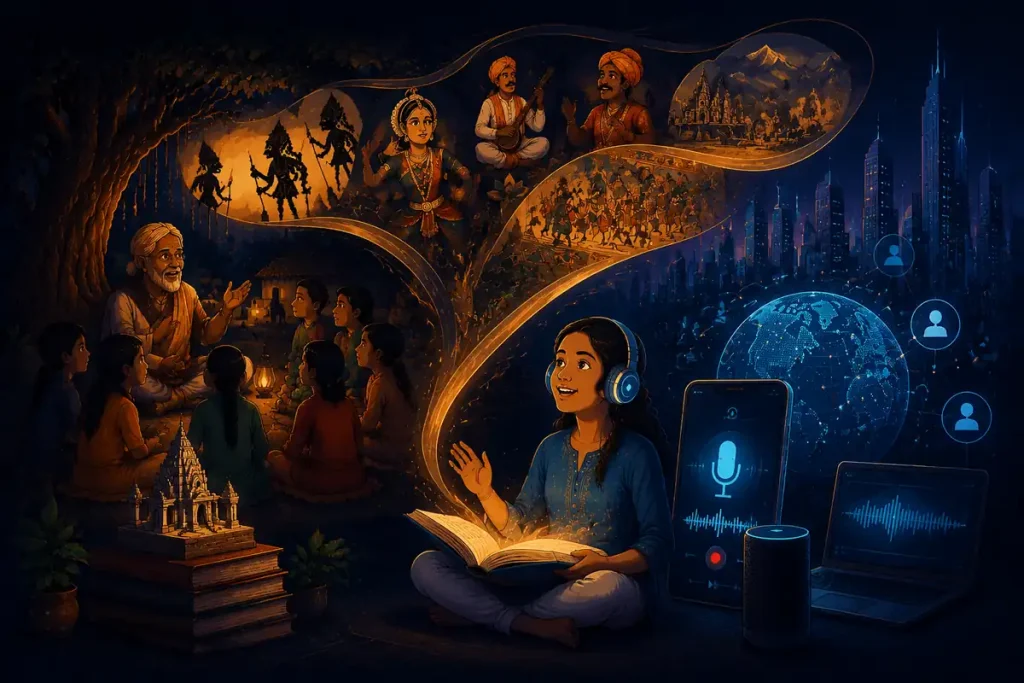
The future of Indian storytelling will be shaped by the combination of tradition, technology, and community.
Storytelling has survived because it adapts to every generation. From oral narratives shared around gatherings to digital experiences available on smartphones, the desire to listen and share stories continues to grow.
The next phase of storytelling will not replace traditional formats. Instead, it will create new ways for cultural stories, regional voices, and individual creators to reach wider audiences.
Digital Storytelling Expanding Access
Digital storytelling is making stories more accessible than ever before.
A regional story that was once limited to a particular community can now reach listeners across India and the world.
Digital platforms allow audiences to discover:
- Stories from different cultures
- Regional narratives
- Independent creators
- Unique perspectives
This expansion creates opportunities for preserving stories while introducing them to new generations.
Audio Storytelling and the Return of Voice-Based Experiences
Audio storytelling is becoming an important part of modern content consumption because it allows people to experience stories while continuing with their daily activities.
Unlike visual content, audio creates a more personal relationship between the storyteller and listener.
Listeners can connect with stories during:
- Travel
- Daily routines
- Relaxation time
- Personal moments
This makes audio storytelling a natural evolution of India’s long tradition of voice-based narratives.
The future of storytelling will likely see more creators using audio formats to build deeper relationships with their audiences.
Creator Communities Building New Story Ecosystems
Creator communities are becoming an important part of the future of storytelling.
Instead of stories flowing in only one direction from publishers to audiences, digital platforms are creating spaces where:
- Creators can share their voices
- Audiences can participate
- Communities can grow around shared interests
This shift is creating a more collaborative form of storytelling where every individual has the opportunity to contribute.
Regional Voices Reaching Wider Audiences
One of the biggest opportunities in the future of Indian storytelling is the ability to bring regional voices to national and global audiences.
India’s diversity has always been its storytelling strength. Thousands of local stories, traditions, and cultural experiences remain waiting to be discovered.
Digital platforms can help preserve and amplify:
- Regional languages
- Local traditions
- Folk narratives
- Community experiences
The future of cultural storytelling will not only be about preserving the past. It will be about giving new voices the ability to tell their own stories.
Indian storytelling traditions have always evolved with time. The next generation of storytelling will continue this journey — combining the emotional power of traditional narratives with the reach of digital platforms.
Frequently Asked Questions
What are Indian storytelling traditions?
Indian storytelling traditions are the cultural practices through which stories, myths, folk tales, histories, and community experiences have been shared across generations. These traditions include oral storytelling, regional folk narratives, mythology, performances, and modern digital storytelling formats that preserve India’s diverse cultural identity.
Why are Indian folk stories important?
Indian folk stories are important because they preserve the cultural values, history, beliefs, and experiences of communities across generations. These stories teach lessons about relationships, morality, nature, and society while helping communities maintain their unique traditions and identities.
What are some examples of traditional Indian stories?
Examples of traditional Indian stories include the Ramayana, Mahabharata, Panchatantra tales, Jataka tales, regional folk stories, and local legends passed through communities. These narratives explore themes such as courage, wisdom, relationships, values, and human experiences across different cultures of India.
How were stories passed through generations in India?
Stories were traditionally passed through generations in India through oral storytelling, family conversations, community gatherings, performances, songs, and traditional storytellers. Before written and digital formats became common, these methods helped preserve cultural knowledge, local histories, and traditional Indian stories.
What are regional stories of India?
Regional stories of India are narratives that originate from specific communities, languages, and cultural backgrounds across different parts of the country. These stories include local legends, folk tales, traditional performances, and community experiences that reflect the unique identity and heritage of each region.
How is digital storytelling changing Indian traditions?
Digital storytelling is changing Indian traditions by allowing cultural stories, regional voices, and creator-led narratives to reach wider audiences through platforms such as audio apps, podcasts, and online communities. It preserves traditional storytelling while introducing new formats for creating and sharing stories.
What is the future of Indian storytelling?
The future of Indian storytelling lies in combining traditional narratives with digital experiences. Audio storytelling, creator communities, and online platforms are helping regional voices reach larger audiences while preserving cultural storytelling traditions for future generations.

[…] Know more about>>>>→ Indian Storytelling Traditions […]
[…] → Indian Storytelling Traditions […]