AI storytelling uses artificial intelligence to help creators develop ideas, write scripts, create characters, generate voices, and produce digital stories. AI does not replace human creativity but provides tools that make storytelling faster, more accessible, and possible across formats such as text, audio, video, and interactive experiences.
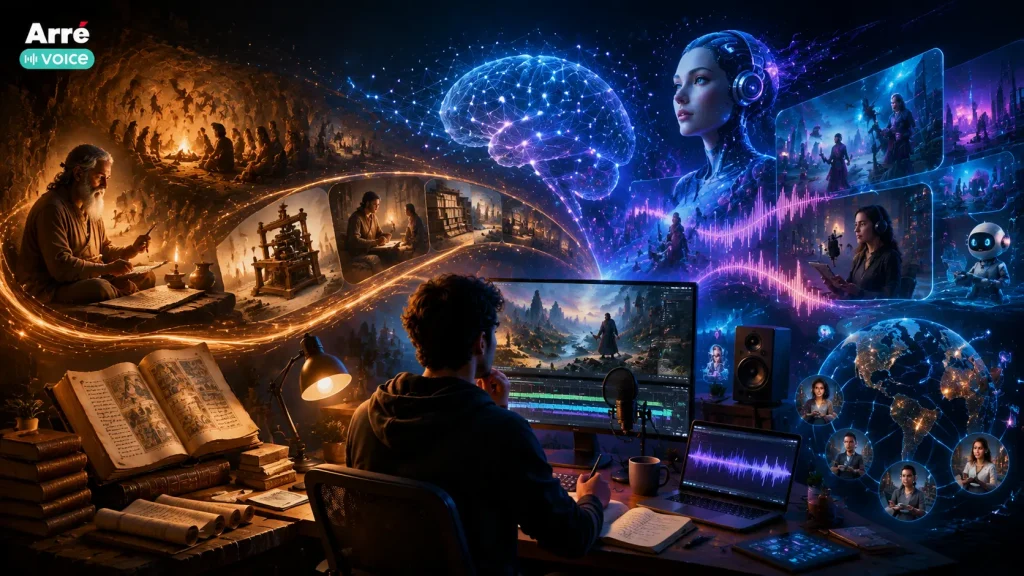
Storytelling has always evolved with the way humans communicate. From ancient oral traditions and handwritten books to radio, films, television, and digital platforms, every technological shift has created new opportunities for creators to share ideas and connect with audiences.
The journey of storytelling has moved through several stages:
Books → Video → Digital Content → AI-Assisted Experiences
The rise of digital platforms changed storytelling by making content easier to create, publish, and distribute. Social media, streaming platforms, podcasts, and creator platforms have allowed individuals to build audiences without traditional publishing or production barriers.
At the same time, the creator economy has transformed storytelling into a profession for millions of writers, artists, video creators, podcasters, and independent storytellers. However, creators often face challenges such as limited resources, production time, and the need to consistently create engaging content.
AI storytelling is changing this process by becoming a creative partner for storytellers. Artificial intelligence can help creators develop ideas, structure narratives, create characters, generate visuals, produce voices, and explore new formats of digital storytelling.
The growth of AI-assisted creativity is also driving the rise of voice-first experiences. Audio content, AI-generated voices, and interactive storytelling are creating new ways for audiences to experience stories beyond traditional screens.
AI does not replace human imagination or creativity. Instead, it provides creators with tools that help transform ideas into richer digital experiences, making storytelling faster, more accessible, and possible across multiple formats.
What Is AI Storytelling?
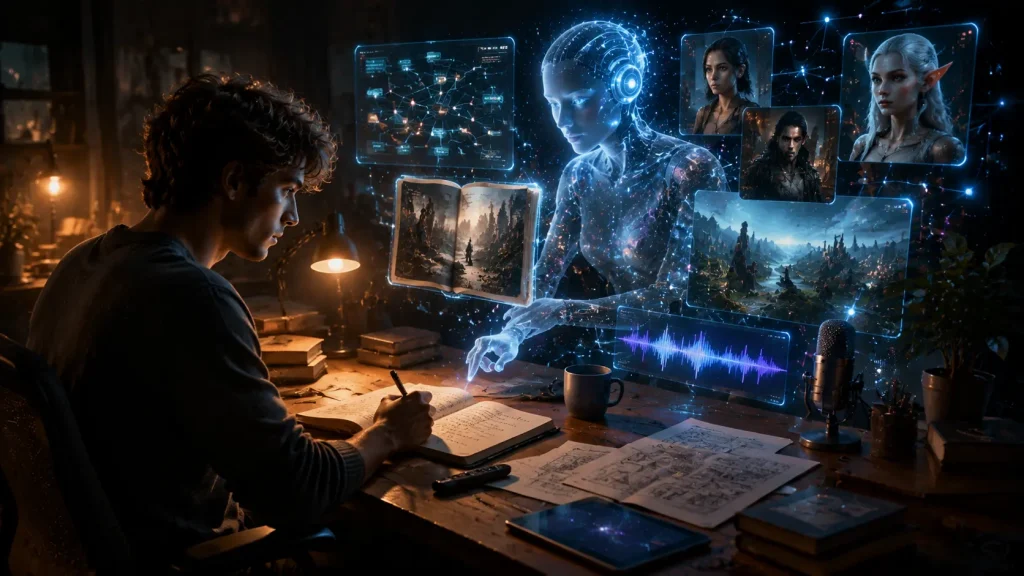
AI storytelling is the use of artificial intelligence technologies to assist creators in developing, producing, and distributing stories across digital formats.
Unlike traditional storytelling methods that depend entirely on manual writing, production, and editing processes, AI storytelling tools support creators throughout different stages of content creation. They can help transform simple ideas into complete storytelling experiences across text, audio, visual, video, and interactive formats.
AI storytelling does not mean that machines create meaningful stories independently. Instead, AI works as a creative assistant that helps writers, creators, and storytellers explore ideas, experiment with formats, and improve their creative workflow.
AI supports different elements of storytelling, including:
Story Ideas
AI can help creators generate and expand story concepts by exploring:
- Themes
- Story directions
- Creative possibilities
- Different narrative approaches
For writers and creators, AI can act as a brainstorming partner that helps overcome creative blocks and discover new perspectives.
Scripts and Narratives
AI storytelling tools can assist with developing:
- Story outlines
- Dialogue
- Character conversations
- Narrative structures
Creators can use AI to refine their ideas while maintaining control over the story’s direction and creative vision.
Characters
Characters are one of the most important parts of storytelling. AI can support creators in developing:
- Character personalities
- Background stories
- Motivations
- Relationships
- Unique voices
This allows creators to build more detailed and engaging characters for stories, games, audio experiences, and interactive content.
Visuals
AI-powered creative tools can help transform storytelling ideas into visual experiences through:
- AI-generated images
- Character designs
- Illustrations
- Story environments
Visual storytelling becomes more accessible as creators can experiment with different artistic styles and concepts.
Voices and Audio Experiences
AI voice technology is creating new possibilities for audio storytelling. Creators can use AI to develop:
- Narration
- Character voices
- Audio dramas
- Voice-based experiences
This has opened new opportunities for creators to build immersive stories without traditional production limitations.
Interactive Content
AI storytelling also enables more interactive experiences where audiences can engage with content in new ways.
Examples include:
- Interactive stories
- AI characters
- Personalized experiences
- Voice-based communities
Through these capabilities, AI storytelling is expanding the definition of what a digital story can become.
How Does AI Storytelling Work?
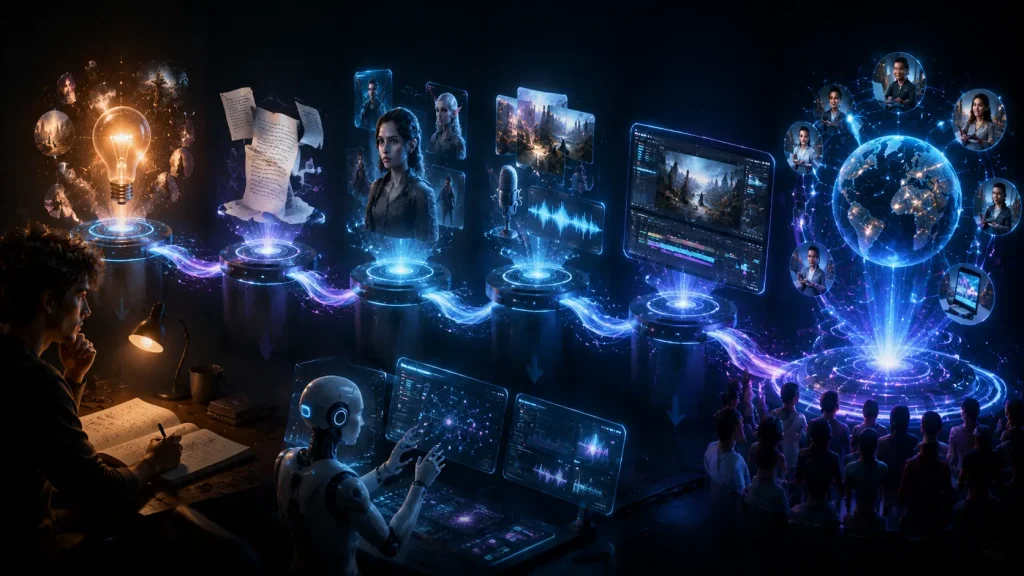
AI storytelling works by combining artificial intelligence tools with human creativity throughout the storytelling process. From the initial idea to publishing the final experience, AI can support creators at different stages of development.
The workflow generally includes the following steps:
Step 1: Idea Generation
Every story begins with an idea. AI storytelling tools can help creators explore and develop new concepts by providing creative suggestions and alternative directions.
AI can assist with:
- Story concepts
- Themes
- Creative angles
- Narrative possibilities
- Content ideas
For example, a writer developing a fictional story can use AI to explore different settings, character ideas, or possible story directions before beginning the writing process.
AI does not replace the creator’s imagination. Instead, it helps creators explore more possibilities and move from an initial idea toward a structured concept.
↓
Step 2: Story Development
Once an idea is created, the next stage involves developing the complete story structure.
AI can support creators with:
Characters
Developing:
- Character identities
- Personality traits
- Background stories
- Character relationships
Plot
Building:
- Story structure
- Events
- Conflicts
- Story progression
Dialogue
Creating:
- Conversations
- Character interactions
- Emotional moments
This helps creators experiment with different storytelling approaches while maintaining their creative control.
↓
Step 3: Content Creation
After developing the story, AI tools can help transform ideas into different content formats.
AI-powered content creation includes:
Text
Creating:
- Articles
- Stories
- Scripts
- Narratives
Images
Generating:
- Character visuals
- Illustrations
- Story scenes
- Creative artwork
Voice
Producing:
- Narration
- AI voice characters
- Audio storytelling experiences
Video
Supporting:
- Animated stories
- Short-form videos
- Visual storytelling content
This allows creators to expand one idea into multiple digital experiences.
↓
Step 4: Editing and Enhancement
AI storytelling does not end after content generation. Editing and refinement are important steps in creating high-quality stories.
AI tools can assist with:
Improving Narratives
Including:
- Better story flow
- Stronger structure
- Improved readability
- Content refinement
Voice Quality Enhancement
Including:
- Natural speech improvements
- Voice adjustments
- Audio refinement
Visual Refinement
Including:
- Improving images
- Adjusting creative styles
- Enhancing visual quality
Creators can use AI as an editing partner while making final decisions based on their creative goals.
↓
Step 5: Publishing and Distribution
The final stage of AI storytelling is sharing the created experience with audiences.
Creators can publish stories through:
- Websites
- Social platforms
- Audio platforms
- Creator communities
- Digital storytelling platforms
Publishing is not only about making content available; it is also about building relationships with audiences.
AI storytelling platforms and communities help creators discover new audiences, receive feedback, and grow their presence.
The complete AI storytelling journey can be summarized as:
Idea Generation → Story Development → Content Creation → Enhancement → Publishing
AI helps creators move through this process faster while allowing human creativity, emotion, and storytelling vision to remain at the center.
How AI Is Transforming Different Types of Storytelling
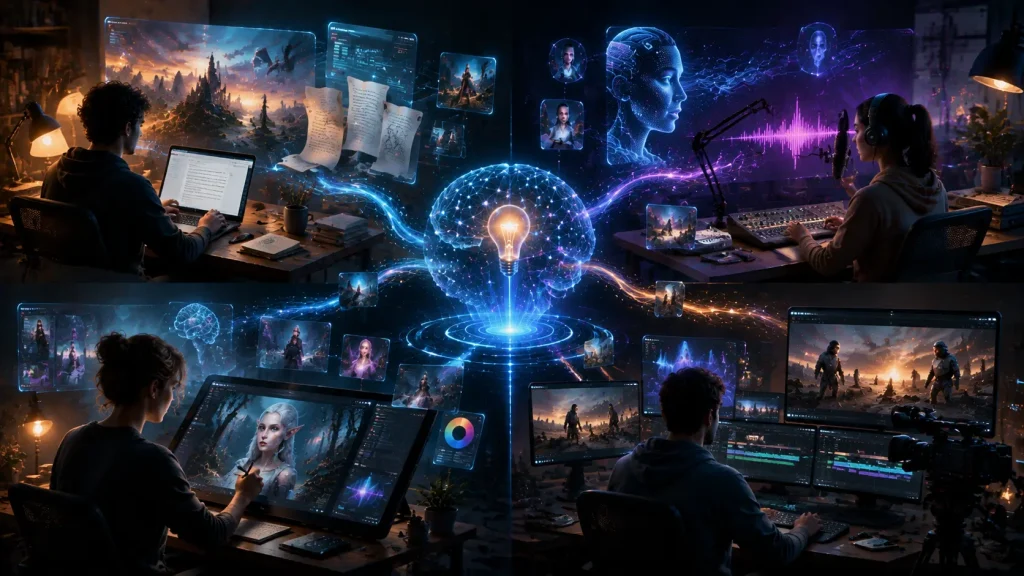
AI storytelling is not limited to one format. As artificial intelligence continues to evolve, creators are using AI tools across multiple storytelling mediums, including written content, audio experiences, visual narratives, and video production.
Traditional storytelling often required separate teams for writing, design, voice production, and editing. AI is changing this process by helping creators explore ideas, produce content faster, and experiment with new storytelling formats.
From AI-generated stories to voice-based experiences, artificial intelligence is expanding how stories are created, shared, and experienced.
AI Writing and Text Storytelling
Written storytelling remains one of the most widely used forms of creative expression. AI writing tools are helping creators develop stories, scripts, and narratives by supporting different stages of the writing process.
Creators can use AI storytelling tools for:
Fiction Writing
AI can support fiction creators by helping develop:
- Story concepts
- Character ideas
- Fictional worlds
- Plot directions
- Narrative structures
Writers can use AI as a creative partner to explore different possibilities while maintaining control over their storytelling vision.
Articles and Digital Content
For digital creators and publishers, AI can assist with:
- Content ideas
- Article structures
- Research organization
- Draft creation
- Content improvement
This helps creators produce informative and engaging content more efficiently.
Scripts and Narratives
AI tools can support script development for:
- Films
- Web series
- Audio dramas
- Short-form content
Creators can experiment with dialogue, character interactions, and different storytelling approaches before final production.
How AI Helps Writers
AI writing assistance can help creators:
- Brainstorm ideas
- Improve story structure
- Generate initial drafts
- Explore alternative narratives
- Refine existing content
However, the emotional depth, cultural context, and creative perspective of the storyteller remain essential parts of meaningful storytelling.
AI Audio Storytelling
Audio storytelling is one of the areas where AI is creating significant opportunities for creators. As audiences increasingly consume content through smartphones, headphones, and voice-based platforms, AI is helping transform written ideas into immersive audio experiences.
AI audio storytelling combines:
- AI-generated voices
- Character narration
- Audio dramas
- Voice-based experiences
- Interactive conversations
Creators can now develop audio content without requiring traditional recording setups for every stage of production.
AI Voices and Character Narration
AI voice technology allows creators to transform scripts into spoken experiences using realistic digital voices.
Creators can develop:
- Story narrators
- Fictional characters
- Virtual personalities
- Voice companions
This enables richer storytelling experiences where characters can communicate through unique voices and emotional expressions.
AI Audio Dramas
Audio dramas rely heavily on strong characters, dialogue, and immersive sound experiences.
AI storytelling tools help creators experiment with:
- Multiple character voices
- Different storytelling styles
- Fictional worlds
- Episodic audio experiences
This creates new opportunities for independent creators to produce character-driven audio stories.
Voice Communities and Interactive Experiences
The future of audio storytelling is moving beyond passive listening. Voice-first platforms are enabling creators and audiences to participate in conversations and communities built around shared interests.
The journey can be understood as:
AI Storytelling → Audio Experiences → Arré Voice
AI helps creators develop stories and voices, while platforms like Arré Voice provide opportunities to share voice-based experiences, connect with audiences, and build communities around storytelling.
AI Visual Storytelling
Visual storytelling has always played an important role in entertainment, marketing, education, and digital media. AI is changing how creators develop visual elements by making image creation and design more accessible.
AI visual storytelling tools can help creators generate:
- AI-generated images
- Character designs
- Illustrations
- Story environments
- Concept artwork
For storytellers, this means ideas can move from imagination to visual representation faster.
Examples include:
- Creating characters for fictional stories
- Designing fantasy worlds
- Developing illustrations for digital narratives
- Building visual concepts for videos and games
AI visual tools allow creators to experiment with different artistic styles and storytelling approaches without requiring advanced design skills for every stage of production.
AI Video Storytelling
Video remains one of the most powerful storytelling formats, and AI is introducing new ways to create and enhance video content.
AI video storytelling tools help creators produce:
- AI-generated videos
- Animated stories
- Social media content
- Digital characters
- Visual narratives
Creators can use AI to support different parts of video production, including:
- Story planning
- Visual development
- Animation
- Editing assistance
- Content adaptation
For social media creators, AI video tools can make it easier to experiment with different formats and produce engaging content consistently.
The combination of AI writing, visuals, voices, and video is creating a new generation of digital storytelling where a single idea can become multiple connected experiences.
Benefits of AI Storytelling for Writers and Creators
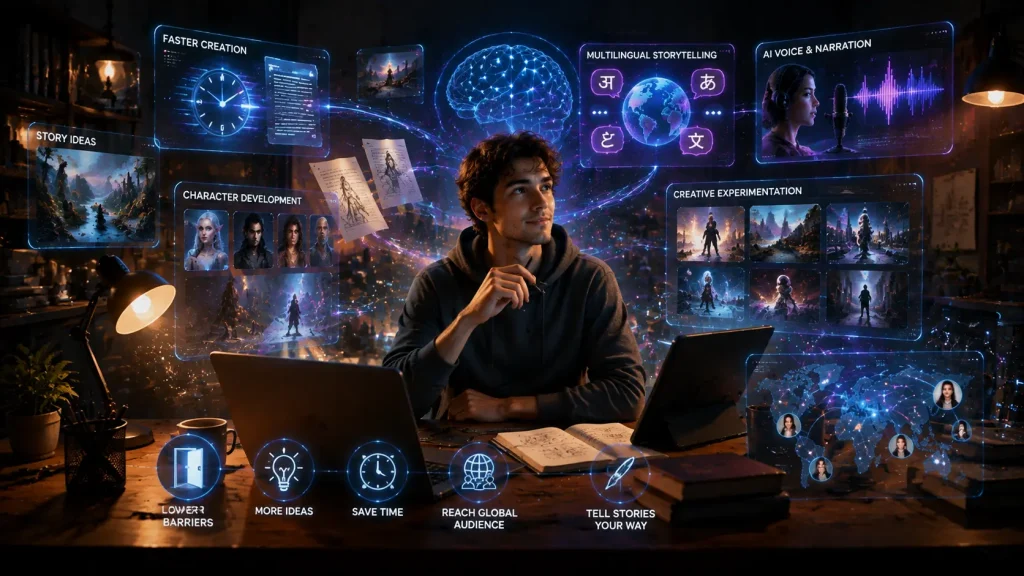
AI storytelling is becoming increasingly valuable for creators because it reduces production challenges while creating new opportunities for experimentation and innovation.
From independent writers to professional content teams, AI tools help creators develop stories faster and explore formats that were previously difficult to produce.
Faster Content Creation
One of the biggest advantages of AI storytelling is improved creative efficiency.
AI tools can help creators move faster through different stages of production:
- Generating ideas
- Creating drafts
- Developing characters
- Producing visuals
- Creating voice content
This allows creators to spend more time improving storytelling quality and connecting with audiences.
Lower Production Barriers
Traditional storytelling often requires multiple resources, including:
- Writers
- Designers
- Voice artists
- Production teams
- Editing support
AI storytelling tools reduce some of these barriers by allowing individual creators and small teams to experiment with complete storytelling experiences.
This makes storytelling more accessible to independent creators who may not have large production budgets.
More Creative Experimentation
AI gives creators the ability to explore more possibilities before finalizing a story.
Creators can experiment with:
- Different characters
- Multiple story directions
- New formats
- Alternative creative styles
This encourages exploration and helps creators discover unique storytelling approaches.
Multilingual Storytelling
AI storytelling is also creating opportunities for content to reach wider audiences through multilingual experiences.
Creators can adapt stories into different languages using AI-powered:
- Translation tools
- Voice generation
- Audio narration
For regions with diverse languages and cultures, this creates opportunities to share local stories with broader audiences.
New Content Formats
AI is enabling storytelling formats that go beyond traditional books, videos, and podcasts.
Emerging formats include:
- AI voice characters
- Interactive stories
- Personalized narratives
- Voice-first communities
- Digital storytelling experiences
These new formats allow audiences to engage with stories in more immersive ways.
AI storytelling is not replacing traditional creativity. Instead, it is expanding the possibilities available to writers and creators by providing new tools to transform ideas into richer digital experiences.
AI Storytelling vs Traditional Storytelling
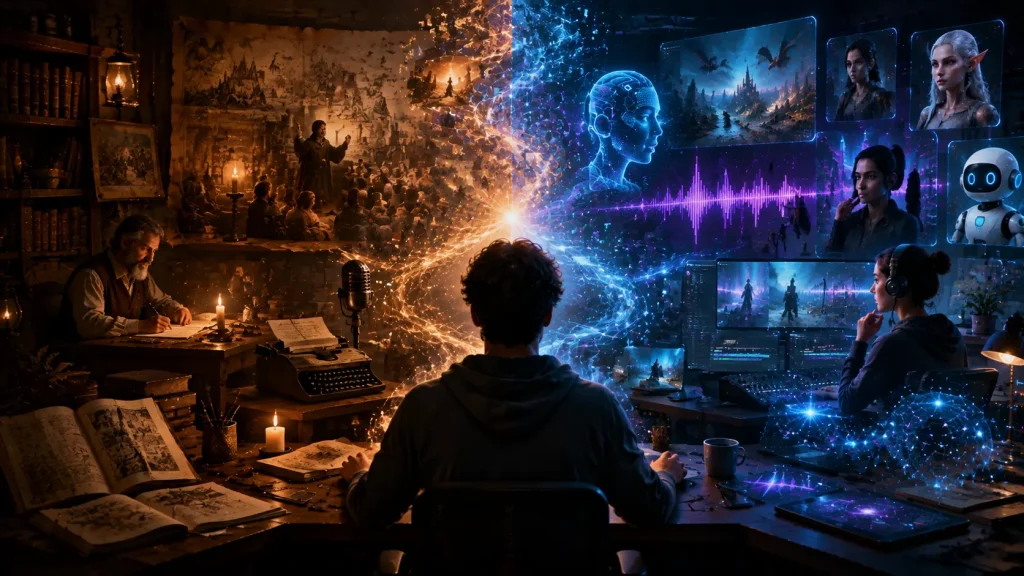
Storytelling has always depended on human imagination, creativity, and the ability to connect with audiences. Traditional storytelling methods have produced some of the most memorable books, films, podcasts, and cultural narratives.
AI-assisted storytelling introduces a new approach by supporting creators with tools that can help during different stages of the creative process. Instead of replacing traditional methods, AI expands the possibilities available to writers, artists, audio creators, and digital storytellers.
The key difference is that traditional storytelling relies mainly on manual processes, while AI-assisted storytelling combines human creativity with artificial intelligence to improve speed, experimentation, and production possibilities.
| Traditional Storytelling | AI-Assisted Storytelling |
| Manual research and brainstorming | AI-supported idea generation |
| Longer production workflows | Faster creation process |
| Limited experimentation due to time and resources | Multiple creative possibilities |
| Higher production requirements | Lower barriers for creators |
| Separate tools and teams for different formats | AI support across writing, visuals, voice, and video |
| Fixed storytelling processes | Flexible and experimental workflows |
Traditional Storytelling
Traditional storytelling has historically required creators to manage every stage of production manually.
For example:
- Writers develop ideas and scripts
- Designers create visual elements
- Voice artists record narration
- Production teams edit and distribute content
This process allows creators to bring human emotion, cultural understanding, and personal experiences into stories. Human creativity remains the foundation of meaningful storytelling.
However, traditional production can also involve challenges such as:
- Longer timelines
- Higher costs
- Limited resources
- Difficulty testing multiple creative ideas
AI-Assisted Storytelling
AI-assisted storytelling supports creators by helping them explore ideas, develop content, and experiment with different formats.
AI tools can assist with:
- Story brainstorming
- Character development
- Script creation
- Visual generation
- Voice production
- Content refinement
For example, a creator developing an audio story can use AI to explore character concepts, generate narration options, and improve the final experience.
AI makes storytelling workflows more flexible, especially for independent creators and smaller teams.
AI Enhances Storytelling But Does Not Replace Human Creativity
The future of storytelling is not about choosing between humans and AI. It is about combining human creativity with intelligent tools.
AI provides:
- Faster production
- Creative assistance
- More experimentation
- Scalable content creation
Humans provide:
- Emotional depth
- Cultural understanding
- Personal experiences
- Original perspectives
The strongest stories will continue to come from human imagination, with AI acting as a creative partner that helps transform ideas into richer digital experiences.
How Creators Are Using AI Storytelling Today
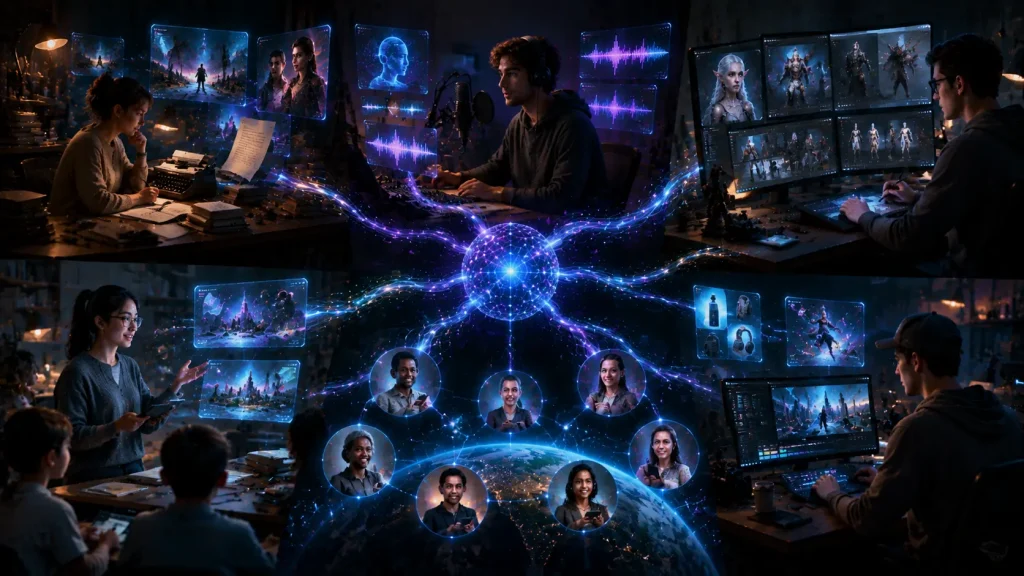
AI storytelling is being adopted across different creative fields. From writers and audio creators to game developers and brands, creators are using AI to develop new forms of digital experiences.
Writers
Writers use AI storytelling tools to support:
- Story development
- Fiction creation
- Character building
- Script writing
AI helps writers explore ideas faster while allowing them to focus on creative direction and storytelling quality.
Examples include:
- Developing fictional worlds
- Creating character backgrounds
- Exploring multiple story possibilities
Audio Creators
Audio creators are using AI storytelling to produce voice-based experiences.
Use cases include:
- Voice stories
- Narration
- Audio dramas
- Character-based content
AI voice technology allows creators to experiment with different voices and storytelling styles while building immersive audio experiences.
Game Creators
Game developers use AI storytelling tools to enhance character experiences.
Applications include:
- Character development
- Game dialogue
- NPC personalities
- Interactive worlds
AI helps developers create richer game environments where characters feel more dynamic and engaging.
Educators
Educators are exploring AI storytelling to create more engaging learning experiences.
Examples include:
- Educational stories
- Interactive lessons
- AI learning assistants
- Narrated content
Story-based learning can help make complex topics easier to understand and more engaging for learners.
Brands
Brands are using AI storytelling to create stronger connections with audiences.
Applications include:
- Marketing storytelling
- Brand characters
- Customer experiences
- Personalized content
AI allows brands to experiment with new ways of communicating while creating more interactive experiences.
AI storytelling is becoming a flexible creative framework that supports different industries and formats. Whether creating fictional worlds, audio experiences, educational content, or brand narratives, AI gives creators new ways to transform ideas into engaging stories.
Can AI Replace Human Storytellers?
The short answer is no. AI storytelling tools are changing how stories are created, but they are not replacing the human creativity and emotional understanding that make stories meaningful.
Storytelling is more than generating words, images, or voices. Great stories are built around human experiences, cultural perspectives, emotions, and personal connections. AI can support the creative process, but the vision and purpose behind a story still come from human creators.
AI works best as a creative partner that helps storytellers explore ideas, improve workflows, and experiment with new formats.
What AI Provides
AI storytelling tools help creators with:
Speed
AI can help reduce the time required for different stages of storytelling, including:
- Generating ideas
- Creating drafts
- Developing characters
- Producing visual and audio elements
This allows creators to move from concept to execution faster.
Assistance
AI acts as a creative assistant by supporting creators with:
- Brainstorming concepts
- Improving story structures
- Exploring different creative directions
- Refining content
Creators remain responsible for the final creative decisions and storytelling approach.
Scale
AI allows creators to produce and adapt content across multiple formats.
For example, one story idea can become:
- Written content
- Audio stories
- Visual experiences
- Video content
- Interactive experiences
This helps creators reach audiences across different platforms.
What Humans Provide
While AI can support production, human storytellers bring elements that technology cannot truly replace.
Emotion
Human creators understand emotions, relationships, and personal experiences. These elements help stories connect deeply with audiences.
Culture
Stories are shaped by:
- Communities
- Traditions
- Languages
- Social experiences
Human creators bring cultural context that gives stories authenticity.
Originality
Creative ideas often come from personal perspectives, imagination, and unique experiences. Human storytellers create original narratives that reflect their individual viewpoints.
Experiences
Personal memories, challenges, and observations influence how humans tell stories. These experiences create the emotional foundation behind meaningful storytelling.
The future of storytelling is not humans versus AI. It is humans using AI to expand their creative possibilities.
Read more – AI Storytelling Tools: Transform Ideas Into Voice Experiences
Frequently Asked Questions
What is AI storytelling?
AI storytelling is the use of artificial intelligence technologies to help creators develop, produce, and distribute stories across different digital formats. AI storytelling tools can support writers, artists, audio creators, and filmmakers by helping generate ideas, create scripts, develop characters, produce visuals, and create voice experiences while keeping human creativity at the center.
How does AI storytelling work?
AI storytelling works by supporting different stages of the creative process. Creators can use AI tools to generate ideas, develop characters, structure plots, create text, produce visuals, generate voices, and refine content. After creation, stories can be published through digital platforms, audio communities, and social channels to reach wider audiences.
Can AI create complete stories?
Yes, AI can help create complete stories by assisting with concepts, characters, scripts, visuals, and audio elements. However, AI-generated stories still require human direction to provide creativity, emotional depth, cultural context, and originality. The strongest results come when creators use AI as a creative partner rather than relying on it as a replacement for human storytelling.
Is AI storytelling replacing writers?
No, AI storytelling is not replacing writers. Instead, it provides writers with tools that help speed up brainstorming, drafting, editing, and experimentation. Human storytellers continue to play an important role in creating meaningful narratives because they bring personal experiences, emotions, cultural understanding, and unique perspectives that AI cannot truly replicate.
What are the best AI storytelling tools?
The best AI storytelling tools depend on what creators want to achieve. AI writing tools like ChatGPT and Claude help with ideas, scripts, and characters. Visual tools support image and video creation, while AI voice platforms help produce audio experiences. Platforms like Arré Voice support voice-first storytelling by helping creators share stories and connect with communities.
Can AI create audio stories?
Yes, AI can help creators produce audio stories through AI voice generation, narration tools, and character voice technology. Creators can develop audio dramas, narrated stories, fictional characters, and voice-based experiences using AI-assisted tools. Combined with voice-first platforms, AI audio storytelling creates new opportunities for creators to share stories with audiences.
How are creators using AI storytelling?
Creators are using AI storytelling across different industries and formats. Writers use AI for story development and fiction creation, audio creators use it for narration and voice experiences, game developers use it for characters and dialogue, educators create learning stories, and brands use AI to develop engaging marketing narratives and personalized content.
What is the future of AI storytelling?
The future of AI storytelling will focus on more interactive, personalized, and voice-driven experiences. AI characters, adaptive stories, voice communities, and new digital formats will allow audiences to engage with content in new ways. AI will continue supporting creators by expanding storytelling possibilities while human creativity remains the foundation of meaningful stories.