What Is the Ganesh Chaturthi Festival?
Ganesh Chaturthi is a Hindu festival dedicated to Lord Ganesha, the elephant-headed deity widely associated with wisdom, prosperity, good fortune, and the removal of obstacles. Also known as Ganapati Chaturthi or Vinayaka Chaturthi, the festival is observed during the Hindu month of Bhadrapada, usually falling in August or September.
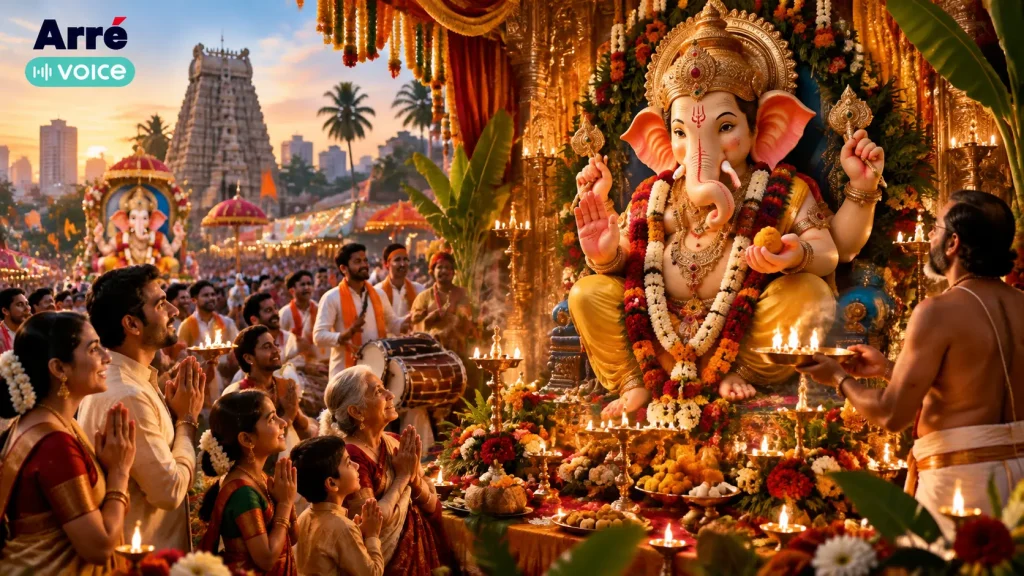
The celebration begins with the installation of a Ganesha idol in homes, temples, and community spaces. Devotees offer prayers, flowers, sweets, and other traditional offerings before concluding the celebration with Ganesh Visarjan, the ceremonial immersion of the idol. While the festival has deep religious significance, it is also an important expression of community, culture, music, art, and storytelling.
Ganesh Chaturthi is a Hindu festival celebrating Lord Ganesha and is observed during the Hindu month of Bhadrapada, usually in August or September. It honours Ganesha as a symbol of wisdom and the removal of obstacles. Celebrations include idol installation, prayers, offerings, community festivities, and Ganesh Visarjan.
Why Ganesh Chaturthi Is One of India’s Most Celebrated Festivals
Ganesh Chaturthi brings together religious devotion, family traditions, artistic expression, and community participation. Families may welcome Ganesha idols into their homes, while neighbourhoods and communities create larger public celebrations featuring decorated pandals, devotional music, cultural programmes, and processions.
The festival is particularly prominent in Maharashtra, where public Ganesh Utsav became an important community tradition, but it is also widely celebrated in Karnataka, Andhra Pradesh, Telangana, Tamil Nadu, Goa, and other parts of India. Each region brings its own customs, foods, forms of worship, and cultural practices to the celebration.
Beyond the religious ceremonies, Ganesh Chaturthi has become a living part of India’s cultural memory. Stories about Ganesha, devotional songs, traditional rituals, artistic decorations, and oral traditions are passed from one generation to another, helping communities preserve and reinterpret their cultural heritage.
Ganesh Chaturthi at a Glance
| Aspect | Details |
| What is Ganesh Chaturthi? | A Hindu festival dedicated to Lord Ganesha |
| Other names | Ganapati Chaturthi, Vinayaka Chaturthi |
| When is it celebrated? | During the Hindu month of Bhadrapada, generally in August or September |
| How long does it last? | Celebrations may range from a single day to several days, with some public celebrations continuing for up to ten days |
| Main rituals | Ganesha idol installation, puja, prayers, offerings, aarti, cultural celebrations, and visarjan |
| How does it conclude? | Traditionally with Ganesh Visarjan, the ceremonial immersion of the idol |
| Where is it widely celebrated? | Across India, with especially prominent celebrations in Maharashtra, Karnataka, Telangana, Andhra Pradesh, Tamil Nadu, Goa, and other regions |
When Is Ganesh Chaturthi Celebrated?
4.1 Ganesh Chaturthi Date and Hindu Calendar
Ganesh Chaturthi is observed on the Shukla Paksha Chaturthi, the fourth day of the waxing phase of the Moon, in the Hindu month of Bhadrapada. In the Gregorian calendar, this generally falls in August or September.
Because the Hindu calendar is lunisolar and follows lunar phases, the Gregorian date of Ganesh Chaturthi changes from year to year. The festival date is therefore determined according to the relevant Hindu calendar and local religious traditions.
The day is particularly associated with the birth or appearance of Lord Ganesha in Hindu tradition, making it an important occasion for Ganesha worship and devotional practices.
4.2 Why the Festival Falls in Bhadrapada
Bhadrapada is an important month in the Hindu religious calendar, and Ganesh Chaturthi is traditionally observed during its Shukla Paksha. The timing connects the festival to a specific lunar period rather than a fixed date in the Gregorian calendar.
The festival’s placement in Bhadrapada has also contributed to its seasonal character. Across different parts of India, communities mark the occasion through worship, decorations, cultural activities, and gatherings that reflect local traditions.
4.3 How the Date of Ganesh Chaturthi Changes Every Year
The date of Ganesh Chaturthi changes because the festival follows the Hindu lunar calendar rather than the fixed Gregorian calendar. The fourth lunar day of the bright fortnight of Bhadrapada determines when the festival begins.
This means that while Ganesh Chaturthi generally occurs around August or September, the exact Gregorian date varies each year. Regional calendars and local traditions may also influence the way the festival date and auspicious timings are observed.
4.4 Ganesh Chaturthi Festival Duration
Ganesh Chaturthi celebrations can vary in length depending on family and regional traditions. Some devotees observe the festival for a single day, while others keep the Ganesha idol for several days.
Large public celebrations may continue for several days and traditionally culminate on Anant Chaturdashi, when many communities conduct Ganesh Visarjan. Ten-day celebrations are particularly associated with large-scale public Ganesh Utsavs.
The duration is therefore not identical for every household or community. It can depend on local customs, family practices, and the chosen day of immersion.
4.5 Ganesh Chaturthi and Anant Chaturdashi
Anant Chaturdashi is the fourteenth day of the bright fortnight of Bhadrapada and is traditionally associated with the conclusion of many Ganesh Chaturthi celebrations.
For communities observing a longer festival, this day is commonly marked by Ganesh Visarjan, the ceremonial immersion of the Ganesha idol. Devotees accompany the idol during processions before bidding farewell and symbolically returning the deity’s physical form to the elements.
Ganesh Chaturthi Rituals and Puja
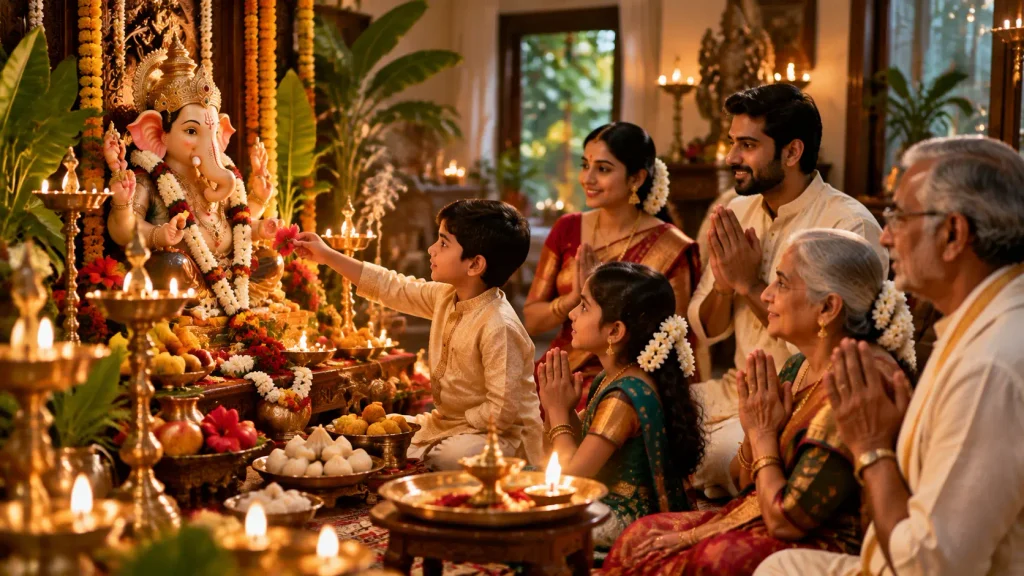
Ganesh Chaturthi rituals vary across regions and families, but the central practice is the worship of Lord Ganesha with devotion, offerings, prayers, and ceremonial observances.
5.1 Bringing the Ganesha Idol Home
For families celebrating Ganesh Chaturthi at home, bringing a Ganesha idol into the household is an important part of the festival.
The idol may be selected according to family traditions, personal preferences, and local customs. Many families now also consider the materials used to make the idol, particularly when choosing more environmentally responsible options.
The arrival of the idol can become a family occasion, with members preparing the space, decorating the area, and getting ready for the installation and worship.
5.2 Ganesh Sthapana
Ganesh Sthapana refers to the ceremonial installation of the Ganesha idol in the designated place of worship.
The prepared space is decorated before the idol is placed and worship begins. Families and communities may follow traditional rituals and seek guidance from religious practitioners for the appropriate procedures and auspicious timings.
The installation marks the formal beginning of worship and turns the decorated space into a centre for prayer and devotional activity during the celebration.
5.3 Ganesh Puja and Traditional Offerings
Ganesh Puja includes prayers and offerings made to Lord Ganesha as expressions of devotion and reverence. The exact customs can differ between regions, traditions, and households.
Common offerings may include flowers, fruits, sweets, durva grass, and other items considered auspicious in Ganesha worship. Devotees may also perform aarti and recite prayers or traditional devotional verses.
Rather than being only a ceremonial practice, the puja provides families and communities with an opportunity to come together in prayer and reflection.
5.4 Modak and Other Foods Associated With Ganesha
Modak is one of the foods most strongly associated with Lord Ganesha and Ganesh Chaturthi. The sweet is traditionally prepared in different forms across India.
Steamed modak made with rice flour and a filling of coconut and jaggery is particularly well known, while fried and other regional variations are also prepared.
Other foods served during Ganesh Chaturthi vary by region and family tradition. Food preparation itself can become part of the celebration, with recipes and cooking practices passed between generations.
5.5 Aarti, Prayers and Devotional Singing
Aarti is an important part of Ganesh worship during the festival. Devotees gather around the Ganesha idol to offer prayers while a ceremonial lamp is moved before the deity.
Devotional songs, bhajans, chants, and traditional prayers may accompany the worship. In community celebrations, these practices can become collective experiences involving families, neighbours, and larger groups of devotees.
Music and devotional singing also contribute to the atmosphere of Ganesh Chaturthi, connecting religious practice with India’s broader traditions of oral and musical expression.
5.6 Daily Worship During the Festival
When the Ganesha idol is kept for multiple days, devotees may perform daily worship throughout the celebration.
Daily practices can include cleaning and decorating the worship area, offering flowers and food, performing aarti, reciting prayers, and gathering with family members or community participants.
The specific routine differs according to local customs and family traditions. The repeated acts of worship also help make Ganesh Chaturthi a period of continued devotional engagement rather than a single-day observance.
How Is Ganesh Chaturthi Celebrated?
Ganesh Chaturthi is celebrated through a combination of religious rituals, family gatherings, community events, artistic expression, music, and cultural activities. The scale of celebration can range from a simple household observance to large public festivals involving entire neighbourhoods.
6.1 Ganesh Chaturthi Celebrations at Home
At home, families generally prepare a dedicated space for the Ganesha idol and decorate it with flowers, lights, traditional designs, and other festive elements.
The celebration may include Ganesh Sthapana, daily puja, aarti, devotional singing, and offerings of sweets and other foods. Family members often participate together, making the festival an opportunity for prayer and shared cultural traditions.
For many households, the celebration is also a way of teaching children about Ganesha, traditional rituals, family customs, and the stories associated with the festival.
6.2 Community Ganesh Chaturthi Celebrations
Community celebrations bring together residents of neighbourhoods, housing societies, villages, and towns.
A community may install a larger Ganesha idol and organize several days of worship and cultural activities. These celebrations can include devotional programmes, music, performances, competitions, social gatherings, and community initiatives.
Public Ganesh Utsavs also create opportunities for people from different backgrounds within a community to participate in a shared cultural celebration.
6.3 Public Ganesh Pandals and Decorations
A Ganesh pandal is a temporary structure or decorated space created for public worship and celebration.
Pandals can range from relatively simple community installations to elaborate artistic displays. Decorations may incorporate flowers, fabric, lighting, traditional motifs, contemporary designs, or themes inspired by Indian culture and social messages.
The creativity involved in designing pandals has become an important visual aspect of public Ganesh Chaturthi celebrations, with communities often investing considerable effort in creating distinctive environments for devotees.
6.4 Music, Aarti and Cultural Performances
Music is closely connected with Ganesh Chaturthi celebrations. Traditional aarti, bhajans, devotional songs, and chants are performed during worship.
Public celebrations may also include cultural programmes such as classical or folk performances, dance, theatre, storytelling, and community events. These activities extend the festival beyond religious worship and create spaces for cultural expression.
In this way, Ganesh Chaturthi combines devotional traditions with the wider artistic and cultural life of the communities celebrating it.
6.5 Processions and Community Participation
Processions are particularly visible during public Ganesh Chaturthi celebrations, especially when the festival concludes with Ganesh Visarjan.
Devotees may accompany the Ganesha idol through decorated streets while singing devotional songs, performing music, and participating in collective celebrations. The scale and style of processions differ considerably between cities, neighbourhoods, and communities.
Community participation is one of the defining features of public Ganesh Utsav, turning the festival into a shared experience rather than an exclusively household observance.
6.6 Ganesh Visarjan: The Immersion Ceremony
Ganesh Visarjan is the ceremonial immersion of the Ganesha idol, traditionally marking the conclusion of the period of worship.
Before the immersion, devotees may perform a final puja and aarti before carrying the idol in a procession to the chosen immersion site. The farewell is both celebratory and emotional, reflecting the idea of respectfully bidding farewell to Ganesha after the period of worship.
Today, many communities also encourage responsible immersion practices, including designated immersion facilities and eco-friendly idols, to reduce environmental impact.
The ceremony brings the festival to a symbolic close while leaving behind the stories, memories, and traditions shared throughout the celebration.
Ganesh Chaturthi Across India
Ganesh Chaturthi is celebrated across India, but its rituals, foods, names, artistic traditions, and public celebrations vary from one region to another. These differences reflect India’s diverse religious and cultural traditions while maintaining the central focus on devotion to Lord Ganesha.
7.1 Ganesh Chaturthi in Maharashtra
Maharashtra is particularly associated with large-scale public Ganesh Chaturthi celebrations. Mumbai, Pune, and many other cities and towns host community Ganesh Utsavs featuring elaborately decorated pandals, devotional programmes, cultural events, and processions.
In Maharashtra, the festival is celebrated both in homes and through prominent public installations. Some community celebrations have become longstanding local traditions, attracting large numbers of devotees.
Ganesh Chaturthi in Maharashtra is also closely connected with the development of the modern public Ganesh Utsav, which helped transform the festival into a major community gathering.
7.2 Ganesh Chaturthi in Karnataka
In Karnataka, Ganesh Chaturthi is widely observed in homes, temples, neighbourhoods, and public spaces. The festival is commonly known as Ganesha Chaturthi or Ganesh Habba in Kannada-speaking communities.
Families may install Ganesha idols at home, perform puja and aarti, prepare traditional foods, and gather with relatives. Public celebrations can include decorated pandals, cultural programmes, devotional music, and processions.
Bengaluru and other parts of Karnataka also reflect the state’s diverse cultural traditions, with celebrations ranging from intimate family observances to large community events.
7.3 Ganesh Chaturthi in Andhra Pradesh and Telangana
Ganesh Chaturthi is celebrated across Andhra Pradesh and Telangana through household worship as well as large public installations.
In Hyderabad, public Ganesh celebrations are particularly visible, with large idols, decorated pandals, devotional activities, and processions. The Khairatabad Ganesh celebration is one of the most prominent examples of the scale that public Ganesh festivals can reach in the region.
Families also observe the festival through idol installation, puja, offerings, devotional songs, and immersion ceremonies according to their local and family traditions.
7.4 Vinayaka Chaturthi in Tamil Nadu
In Tamil Nadu, the festival is commonly known as Vinayaka Chaturthi or Pillaiyar Chaturthi, reflecting regional names for Lord Ganesha.
Homes and temples may be decorated for the occasion, while devotees offer prayers, flowers, fruits, and traditional foods. Kozhukattai, a steamed rice-flour sweet filled traditionally with coconut and jaggery, is strongly associated with Vinayaka worship in Tamil culture.
The festival combines religious observance with family traditions and regional culinary practices, with celebrations varying between households and communities.
7.5 Ganesh Chaturthi in Goa
Ganesh Chaturthi, commonly known as Chavath in Goa, is an important family and cultural festival.
Goan celebrations often have a strong household and community character, with families bringing Ganesha idols home and preparing traditional foods. Homes may be decorated with flowers, natural materials, and festive elements, while family members gather for prayers and meals.
Traditional Goan food and customs form an important part of the celebration, demonstrating how Ganesh Chaturthi adapts to the cultural identity of each region.
7.6 Ganesh Chaturthi in Other Parts of India
Ganesh Chaturthi is also observed in many other states and regions, including parts of Gujarat, Madhya Pradesh, Chhattisgarh, Rajasthan, Odisha, Kerala, and West Bengal.
The scale and form of celebration can differ considerably. Some communities focus primarily on household worship, while others organize public idols, cultural programmes, and processions.
The festival is also celebrated by Indian communities outside the country, where local traditions may combine with the cultural practices of the wider diaspora.
7.7 How Regional Traditions Differ
Regional Ganesh Chaturthi traditions can differ in several ways:
| Aspect | Regional Variation |
| Name | Ganesh Chaturthi, Ganapati Chaturthi, Vinayaka Chaturthi, Chavath and other local names |
| Food | Modak, kozhukattai and other regional preparations |
| Celebration style | Household worship, temple observances, community festivals or large public events |
| Decorations | Traditional floral designs, elaborate pandals, artistic themes and locally inspired decorations |
| Music and performance | Aarti, bhajans, devotional music, folk traditions and cultural programmes |
| Immersion traditions | Timing, procession styles and immersion practices vary by community |
| Local identity | Regional languages, customs, foods and artistic traditions shape the celebration |
These differences show that Ganesh Chaturthi is not a single uniform celebration. Instead, it is a shared festival expressed through many local traditions.
Famous Ganesh Chaturthi Celebrations in India
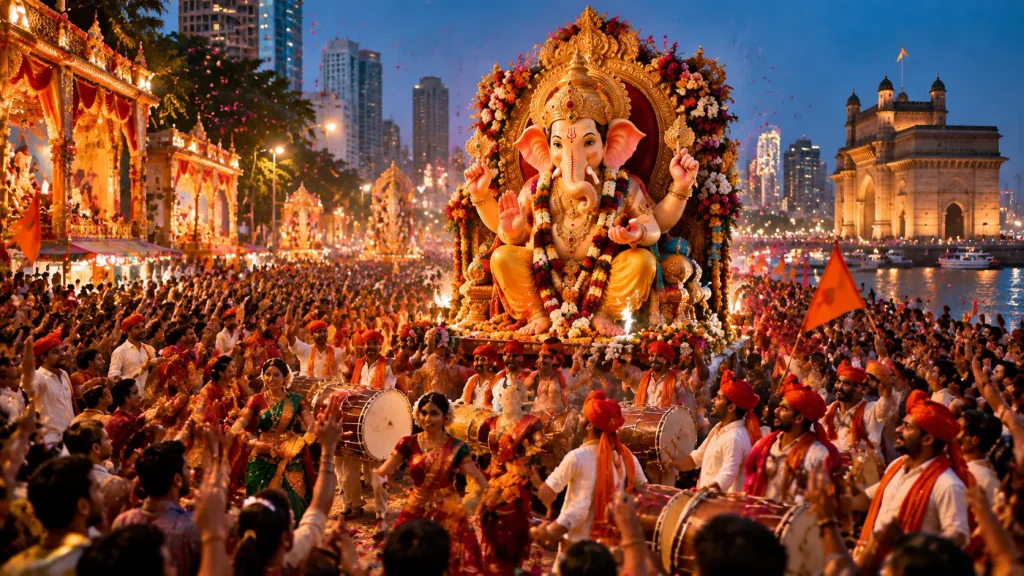
Some cities have developed especially well-known Ganesh Chaturthi traditions because of their history, scale, artistic expression, or strong community participation.
8.1 Mumbai Ganesh Chaturthi
Mumbai is one of the most widely recognized centres of public Ganesh Chaturthi celebrations. Across the city, homes, neighbourhoods, and large community organizations install Ganesha idols during the festival.
Well-known public celebrations attract large crowds and feature elaborate pandals, artistic idol designs, devotional programmes, and cultural activities. The final immersion processions are particularly prominent, with devotees gathering to bid farewell to the idols.
Mumbai’s Ganesh Chaturthi also demonstrates how a religious festival can become deeply connected with a city’s cultural identity and community life.
8.2 Pune Ganesh Utsav
Pune has a strong historical association with the public Ganesh Utsav tradition. The city’s prominent manache Ganpati, or traditionally revered public Ganesha idols, form an important part of its festival culture.
Pune’s celebrations combine religious observance with processions, music, cultural activities, and longstanding community traditions. The city’s Ganesh festival also reflects the historical development of public Ganesh celebrations in Maharashtra.
8.3 Bengaluru Ganesh Celebrations
Bengaluru observes Ganesh Chaturthi through household worship, temples, residential communities, neighbourhood celebrations, and public events.
The city’s diverse population contributes to a variety of celebration styles. Ganesha idols may be installed in community spaces, while families observe puja, prepare traditional foods, and participate in devotional activities.
Public celebrations can also incorporate music, cultural performances, artistic decorations, and immersion ceremonies.
8.4 Hyderabad Ganesh Celebrations
Hyderabad is known for large public Ganesh celebrations, with some of the city’s installations becoming major cultural attractions during the festival.
The Khairatabad Ganesh is particularly well known for its large-scale idol and longstanding public celebration. Across the city, numerous neighbourhoods also organize their own pandals and devotional programmes.
The festival culminates in large immersion processions, making Ganesh Chaturthi one of the most visible public religious celebrations in Hyderabad.
8.5 Community and Neighborhood Ganesh Festivals
Large city celebrations receive significant attention, but neighbourhood Ganesh festivals are equally important to the everyday experience of the festival.
Resident associations, local groups, temples, workplaces, villages, and community organizations may organize smaller celebrations. These events often involve shared worship, cultural programmes, meals, devotional singing, and community activities.
Such celebrations demonstrate that the significance of Ganesh Chaturthi does not depend on the size of the idol or event. At its core, the festival remains a shared expression of devotion, community, and cultural tradition.
Ganesh Chaturthi Traditions and Symbols
Many elements associated with Lord Ganesha carry symbolic meanings within Hindu traditions and devotional practices. Interpretations can differ across religious texts, regional traditions, and communities, so these symbols are best understood within their broader cultural and spiritual context.
9.1 The Meaning Behind the Ganesha Idol
The Ganesha idol serves as the central focus of worship during Ganesh Chaturthi. Devotees welcome the idol into their homes or community spaces and worship it throughout the chosen period of celebration.
The form of Ganesha brings together several distinctive features, including the elephant head, human body, multiple arms, and mouse vehicle. These features have acquired symbolic interpretations across Hindu traditions.
During Ganesh Chaturthi, the idol is not simply a decorative object. It becomes part of a ritual process involving installation, worship, offerings, and eventually immersion.
9.2 Ganesha’s Elephant Head and Its Symbolism
Ganesha’s elephant head is one of his most recognizable characteristics. Elephants are often associated with qualities such as strength, intelligence, wisdom, and discernment.
In traditional interpretations, Ganesha’s elephant head can therefore represent wisdom and the ability to understand what is important. His large ears are also commonly interpreted as a reminder to listen carefully and thoughtfully.
Different traditions may emphasize different meanings, but the elephant form remains central to Ganesha’s identity and symbolism.
9.3 Ganesha’s Four Arms and Their Meaning
Ganesha is frequently depicted with four arms, although artistic representations can vary.
The objects held in his hands and the gestures he makes can carry different symbolic meanings. Common interpretations associate the attributes of Ganesha with ideas such as spiritual knowledge, protection, blessings, discipline, and the ability to overcome obstacles.
The four-armed form also illustrates the distinctive visual language of Hindu religious art, where multiple arms can represent divine abilities and attributes.
9.4 The Mouse as Ganesha’s Vehicle
The mouse, or mushika, is traditionally associated with Ganesha as his vehicle or vahana.
The pairing of the large Ganesha with a very small mouse creates a striking symbolic image. Traditional interpretations connect the mouse with desires or restless tendencies that need to be controlled rather than allowed to dominate.
The image can therefore be understood as representing the ability to master obstacles and impulses through wisdom and discipline.
9.5 Modak and Its Cultural Significance
Modak is closely associated with Lord Ganesha and is one of the most recognizable foods of Ganesh Chaturthi.
The sweet is prepared in several regional forms. Steamed modak made from rice flour with a coconut and jaggery filling is particularly associated with western and southern Indian traditions, while other communities prepare fried or locally adapted versions.
Modak is traditionally offered to Ganesha during worship and is also shared among family members and devotees. Its presence during the festival connects religious devotion with regional food traditions and family practices.
9.6 Durva Grass, Flowers and Other Offerings
Durva grass, commonly identified with a type of sacred grass, is traditionally offered to Lord Ganesha during puja. Flowers, fruits, sweets, leaves, and other offerings may also be used according to local and family customs.
Offerings are an important part of Hindu worship and represent acts of devotion, gratitude, and reverence. The specific items used can vary by region and tradition.
During Ganesh Chaturthi, preparing and presenting these offerings becomes part of the broader ritual experience, bringing together prayer, family participation, and cultural practice.
Ganesh Visarjan and Anant Chaturdashi
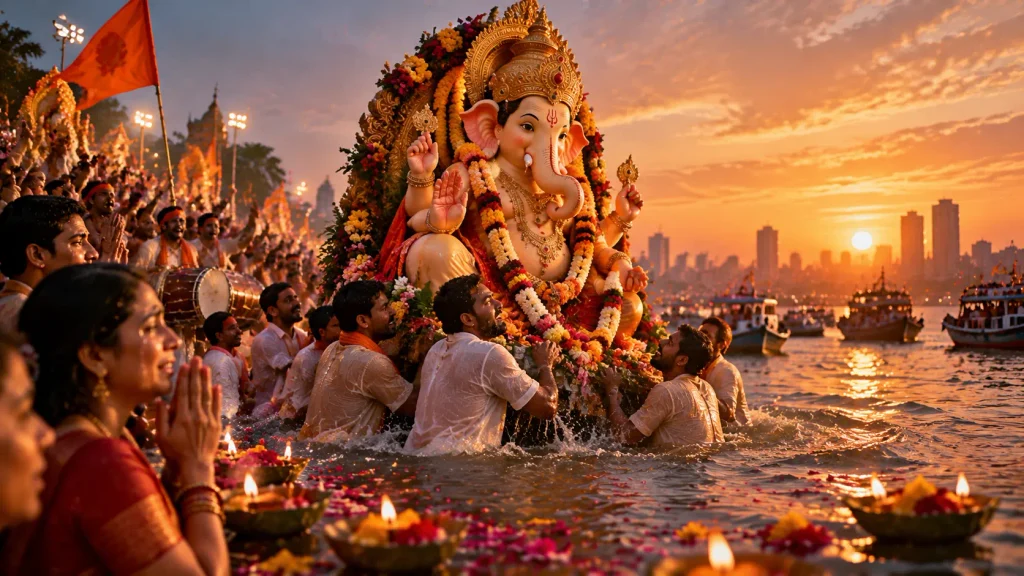
Ganesh Visarjan is the ceremonial immersion of the Ganesha idol that marks the conclusion of a period of worship. For many devotees, it is both a religious ritual and an emotional farewell. The timing of the immersion varies according to family and regional traditions, while longer public celebrations often conclude around Anant Chaturdashi.
10.1 What Is Ganesh Visarjan?
Ganesh Visarjan refers to the ceremonial immersion of a Ganesha idol in water after the period of worship has ended.
Depending on local and family traditions, the immersion may take place after one and a half days, three days, five days, seven days, ten days, or another chosen period. Before the immersion, devotees may perform a final puja and aarti before carrying the idol in a procession.
The ceremony traditionally represents the completion of the festival and the farewell of Lord Ganesha after devotees have welcomed and worshipped him in their homes or communities.
10.2 Why Is the Ganesha Idol Immersed?
The immersion of the idol can be understood within the broader Hindu idea of impermanence and the relationship between physical form and the divine.
The Ganesha idol is welcomed and worshipped in a physical form during the festival. At the conclusion, the idol is returned to water through visarjan. This creates a symbolic cycle of arrival, worship, farewell, and return.
For devotees, the immersion does not represent an end to faith or devotion. Rather, it marks a transition after the period of formal celebration, with the spiritual relationship with Ganesha continuing beyond the physical idol.
10.3 Meaning of Anant Chaturdashi
Anant Chaturdashi is observed on the fourteenth day of the bright fortnight of the Hindu month of Bhadrapada.
The day has significance in Hindu religious traditions and is also widely associated with the conclusion of longer Ganesh Chaturthi celebrations. In many communities, Ganesh Visarjan takes place on Anant Chaturdashi.
The association between the two observances makes Anant Chaturdashi one of the most visible days of the Ganesh festival in places where ten-day public celebrations are customary.
10.4 The Emotional and Spiritual Meaning of Farewell
Ganesh Visarjan is often one of the most emotional moments of Ganesh Chaturthi.
After days of prayers, family gatherings, community celebrations, and devotional activities, devotees accompany the idol for its final journey. Songs, chants, aarti, and expressions of devotion may accompany the procession.
The farewell reflects a recurring theme in Indian spiritual and cultural traditions: welcoming a divine presence, developing a sense of connection, and then accepting its departure while carrying the memory and meaning of the experience forward.
For families, the moment can also become part of a continuing cycle of tradition, with the anticipation of welcoming Ganesha again in a future celebration.
10.5 Traditional and Eco-Friendly Visarjan Practices
Traditional immersion practices have increasingly been accompanied by efforts to reduce environmental impact.
Many communities encourage the use of natural clay idols, designated immersion tanks, artificial ponds, and other controlled facilities. These approaches can help reduce the impact associated with immersing large numbers of idols in natural water bodies.
The exact practices differ by location and local regulations. Devotees can support responsible celebrations by following local immersion guidelines, choosing appropriate idol materials, avoiding unnecessary plastic decorations, and using designated visarjan facilities where available.
Eco-Friendly Ganesh Chaturthi
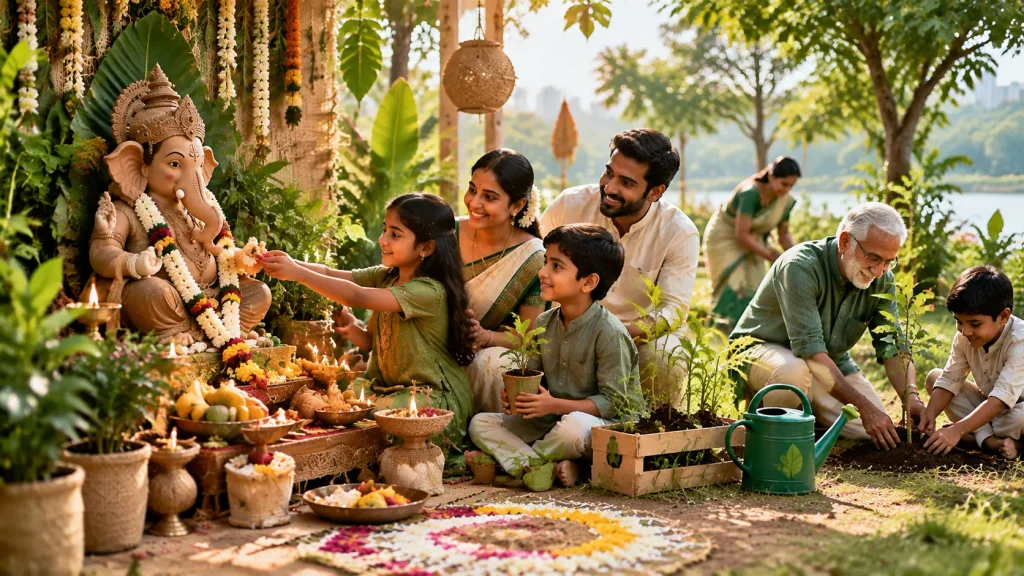
As Ganesh Chaturthi has grown in scale, environmental sustainability has become an increasingly important part of festival discussions. Eco-friendly celebrations seek to preserve the religious and cultural character of the festival while reducing unnecessary environmental impact.
11.1 Why Eco-Friendly Ganesh Chaturthi Matters
Large-scale celebrations can involve substantial use of materials, decorations, packaging, lighting, and water resources. The environmental impact can be reduced when households and communities make thoughtful choices about what they use and how they dispose of it.
An eco-friendly Ganesh Chaturthi does not require abandoning traditional celebration. Instead, it encourages devotees to combine cultural practices with responsible choices that are appropriate for their local environment.
11.2 Clay Ganesha Idols and Natural Materials
Traditional natural clay idols are often promoted as an environmentally preferable alternative to idols made with materials that are difficult to dissolve or may introduce harmful substances into water.
Communities and families can also consider natural or reusable materials for decorations, including flowers, cloth, paper, wood, leaves, and other locally appropriate materials.
The choice of idol material should be considered alongside local guidance and immersion arrangements, since environmental outcomes depend on the complete process rather than on one material alone.
11.3 Reducing Plastic and Harmful Decorations
Reducing single-use plastic is another practical way to make Ganesh Chaturthi celebrations more sustainable.
Families and community organizers can consider reusable decorations, natural materials, recyclable paper products, and cloth-based alternatives. Excessive plastic packaging and disposable decorative items can be avoided where practical.
Lighting and sound can also be planned thoughtfully, particularly in densely populated areas, while following local rules concerning electricity use, noise, public safety, and community events.
11.4 Sustainable Ganesh Visarjan
Sustainable visarjan focuses on ensuring that the immersion ceremony does not unnecessarily damage local water bodies.
Designated artificial ponds and immersion tanks can provide controlled alternatives to natural lakes, rivers, and other water bodies. Communities may also organize collection and responsible handling of flowers, decorative materials, and other festival waste after immersion.
Following local authority guidelines is particularly important because immersion practices and facilities differ between cities and regions.
11.5 How Communities Are Making Celebrations More Sustainable
Communities are increasingly exploring ways to make Ganesh Chaturthi more environmentally responsible without losing its cultural character.
These efforts can include:
- Promoting natural clay Ganesha idols
- Creating designated immersion facilities
- Reducing single-use plastic
- Reusing decorations and festival materials
- Separating recyclable and organic waste
- Encouraging responsible disposal of flowers and other offerings
- Using natural or locally sourced decorative materials
- Following local guidelines for immersion, noise, and public celebrations
Such practices demonstrate how traditional festivals can evolve while retaining their religious and cultural significance.
Ganesh Chaturthi as a Festival of Storytelling and Culture
Ganesh Chaturthi is not only a festival of rituals and public celebration. It is also connected to stories, songs, oral traditions, visual art, food traditions, and community memories.
For generations, stories associated with Ganesha have been shared within families and communities through spoken narratives, devotional songs, religious performances, children’s stories, books, and cultural programmes.
12.1 Stories and Legends Associated With Lord Ganesha
Many stories and legends about Lord Ganesha are part of Hindu religious and cultural traditions.
Stories about Ganesha’s birth, his relationship with Shiva and Parvati, his wisdom, and his encounters with other figures appear in different textual and oral traditions. Popular narratives may vary in their details depending on the source, region, and community.
These stories help explain qualities associated with Ganesha, including wisdom, devotion, intelligence, humility, and the ability to overcome obstacles.
12.2 Ganesha Stories Passed Through Generations
Ganesha stories have traditionally been passed from one generation to another through families, temples, teachers, storytellers, religious texts, and community gatherings.
Children may encounter these stories during festival preparations, family prayers, school activities, cultural programmes, or conversations with elders.
This form of storytelling does more than communicate a religious narrative. It also preserves language, cultural references, values, family memories, and regional interpretations of the festival.
12.3 Devotional Songs, Bhajans and Oral Traditions
Music and oral performance are important parts of Ganesh Chaturthi celebrations.
Devotees may sing aarti, bhajans, chants, and regional devotional songs during worship. These forms of expression allow religious traditions to be experienced through rhythm, repetition, language, and collective participation.
Because songs and prayers are often learned by listening and repetition, they can continue across generations even when the exact written form is not always the primary way they are remembered.
12.4 Storytelling as Part of Indian Festival Culture
Storytelling has long been an important part of Indian cultural life. Festivals provide opportunities for communities to revisit stories, legends, songs, rituals, and shared memories.
During Ganesh Chaturthi, storytelling can take many forms: a grandparent narrating a Ganesha story to a child, a devotional performance in a community gathering, a school presentation, a theatre performance, or a contemporary digital story.
These different formats show how cultural storytelling can adapt to changing audiences while retaining connections to traditional narratives.
12.5 How Audio and Digital Media Are Preserving Festival Stories
Digital media has created new ways to record, share, and discover cultural stories associated with festivals such as Ganesh Chaturthi.
Audio storytelling can preserve narrated Ganesha stories, devotional experiences, personal memories, regional traditions, and conversations about festival culture. Digital platforms can also make such stories accessible to younger audiences and people living away from their ancestral communities.
For a voice-first platform such as Arré Voice, this creates an opportunity for creators to share festival stories through spoken narratives and community-led audio experiences. Instead of preserving culture only as written information or visual content, voice can retain the rhythm, emotion, language, and personal expression that are often central to oral storytelling.
Ganesh Chaturthi in Modern Digital Culture
Ganesh Chaturthi has deep roots in physical spaces such as homes, temples, community pandals and public processions. At the same time, the way people experience and share the festival has expanded through smartphones, social media and digital storytelling.
Today, photographs, short videos, devotional music, festival greetings, personal stories and live updates allow people to participate in Ganesh Chaturthi even when they are away from their hometowns or communities.
Digital culture does not replace traditional celebration. Instead, it creates new ways to document, share and experience traditions across generations and geographical boundaries.
13.1 How Social Media Is Changing Festival Celebrations
Social media has become an important part of how people document and communicate their Ganesh Chaturthi experiences.
Families may share photographs of their Ganesha idol, while communities showcase pandal decorations, cultural programmes, aarti and procession preparations. Creators also use short-form video, photography and audio to tell stories connected with the festival.
Social platforms can make local celebrations visible to people who might otherwise never encounter them. A neighbourhood tradition can become a widely shared cultural moment through photographs, videos or personal accounts.
Social media also encourages participation through:
- Festival greetings and digital messages
- Photos and videos of Ganesha idols
- Pandal and decoration showcases
- Devotional songs and aarti recordings
- Stories about local traditions
- Short videos explaining festival rituals
- Community announcements and event updates
- Personal memories and family celebrations
However, digital sharing works best when it complements the meaning of the festival rather than reducing it to visual content alone. The stories, values and community traditions behind the celebration remain an important part of what makes Ganesh Chaturthi meaningful.
13.2 Digital Greetings, Stories and Festival Content
Digital greetings have become a simple way for people to remain connected during Ganesh Chaturthi.
Messages can range from traditional blessings and devotional greetings to photographs, illustrations, short videos and audio messages. Families living in different cities or countries can exchange greetings without being physically present together.
Festival content has also become more diverse. A single digital post may introduce a Ganesha story, explain the meaning of a ritual, showcase a regional tradition or document a community celebration.
This creates opportunities for cultural knowledge to travel beyond its original setting.
For example, a person unfamiliar with a particular regional Ganesh Chaturthi tradition can discover it through:
- A short audio story
- A narrated cultural explanation
- A video of a traditional celebration
- A creator’s personal festival experience
- A digital collection of devotional stories
- A community’s online festival archive
The result is a broader digital record of how people celebrate and understand the festival.
13.3 Virtual Communities and Online Celebrations
Digital communities can help people participate in Ganesh Chaturthi when distance, work, travel or other circumstances prevent them from attending a physical celebration.
Families and friends may connect through video calls, while community groups can use digital platforms to share schedules, announcements, prayers, cultural programmes and festival updates.
Virtual participation can be especially meaningful for people who have moved away from their hometowns. Digital spaces can provide a connection to familiar traditions, languages, devotional practices and memories.
At the same time, online participation is best understood as an extension of festival culture rather than a complete replacement for physical community life. Ganesh Chaturthi traditionally brings people together through shared spaces, rituals, food, music and participation.
Digital communities add another layer to that experience by making connection possible across distance.
13.4 Preserving Traditional Stories Through Digital Storytelling
One of the most valuable roles of digital culture is the preservation and circulation of stories.
Stories associated with Lord Ganesha have traditionally been passed through families, religious traditions, oral storytelling, devotional literature and cultural performances. Digital media provides additional formats through which these narratives can be recorded and shared.
A traditional story can now become:
- An audio narration
- A podcast episode
- A short-form video
- An illustrated digital story
- A multilingual recording
- A children’s storytelling series
- A community-created cultural archive
Audio is particularly useful for storytelling because it retains the human element of voice, expression, rhythm and emotion.
Digital storytelling can therefore help younger audiences encounter traditional narratives in formats that fit contemporary media habits while keeping the underlying stories connected to their cultural context.
Ganesh Chaturthi Festival: Beyond the Celebration
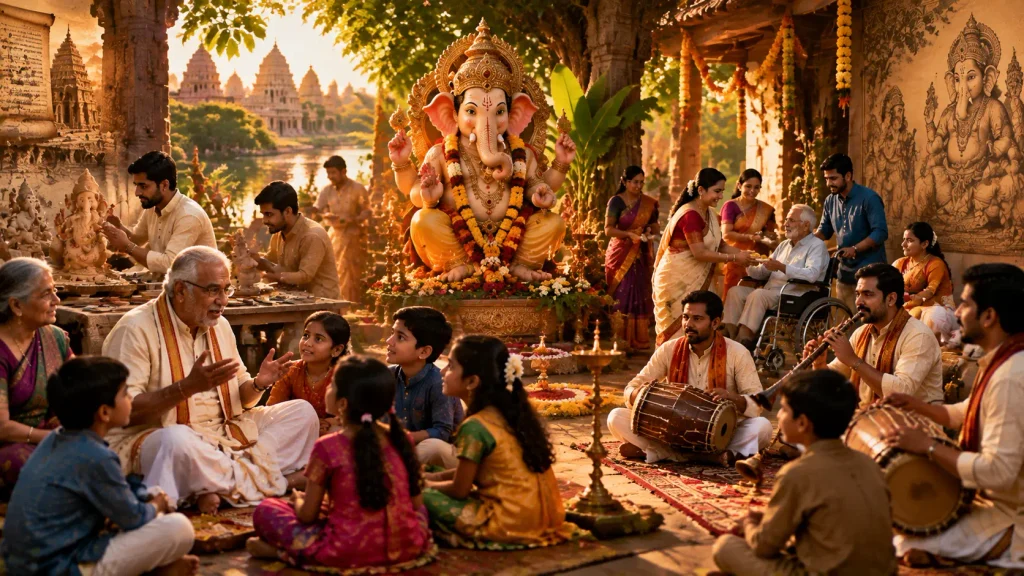
Ganesh Chaturthi is more than a festival observed over a particular number of days. For many families and communities, it is a recurring opportunity to bring people together, express devotion, celebrate creativity and pass cultural knowledge from one generation to another.
Its meaning can be found not only in rituals but also in the relationships and memories created around them.
From preparing the home and welcoming Ganesha to sharing food, singing prayers and participating in visarjan, the festival creates experiences that can become part of family and community memory.
14.1 Family, Community and Togetherness
At the family level, Ganesh Chaturthi can bring relatives together through shared preparation and worship.
Different generations may participate in different ways. Children may help with decorations, younger family members may learn prayers and stories, while elders may pass on customs and explain the meaning behind particular practices.
Community celebrations extend this sense of togetherness beyond the household.
Neighbourhoods and community groups may come together to organize pandals, cultural programmes, devotional activities and processions. These shared activities can create social connections between people who may not interact regularly in everyday life.
This combination of family participation and community involvement is one reason Ganesh Chaturthi continues to have a strong social presence in many parts of India.
14.2 Faith, Creativity and Cultural Expression
Ganesh Chaturthi brings together devotion and creative expression in many forms.
Ganesha idols may be created in different artistic styles, while pandals can incorporate architecture, painting, sculpture, lighting and thematic design. Music, dance, drama and storytelling may also become part of community celebrations.
This creative dimension allows people to express their cultural identity while participating in a shared religious tradition.
The festival therefore exists at the intersection of:
- Faith and devotion
- Art and design
- Music and performance
- Food and family traditions
- Community participation
- Storytelling and oral culture
- Regional identity
- Contemporary creative expression
The specific forms vary considerably across regions and communities, but the connection between celebration and cultural expression remains an important feature of Ganesh Chaturthi.
14.3 Passing Traditions From One Generation to the Next
Traditions survive when they are practiced, explained and remembered.
For many families, Ganesh Chaturthi provides a natural setting for children and younger generations to learn about rituals, stories, prayers, foods and family customs.
A child may learn why a Ganesha idol is brought home, hear a story about Ganesha from a grandparent, participate in aarti or help prepare a traditional offering. These experiences turn cultural knowledge into something lived rather than simply read about.
Each generation may also reinterpret traditions according to its own circumstances. This is why festivals can remain culturally relevant while still retaining connections to their historical and religious roots.
Passing traditions forward does not necessarily mean repeating every practice in exactly the same way. It can also mean preserving the stories, meanings and values that give those practices significance.
14.4 The Role of Storytelling in Keeping Festivals Alive
Storytelling is one of the strongest ways cultural memory is preserved.
Before digital media, stories travelled primarily through spoken narration, family conversations, religious teaching, literature, songs and performances. Today, these traditions can also move through podcasts, audio stories, videos, social platforms and digital archives.
For Ganesh Chaturthi, storytelling can explain not only who Ganesha is but also why particular rituals, symbols, foods and celebrations are associated with the festival.
A story can make a tradition easier to remember because it connects information with people, emotions and experiences.
This is particularly important for younger audiences. When cultural stories are presented through engaging formats while retaining their context and meaning, traditional knowledge can remain accessible without becoming disconnected from contemporary life.
Frequently Asked Questions
What is Ganesh Chaturthi?
Ganesh Chaturthi is a Hindu festival dedicated to Lord Ganesha, the deity traditionally associated with wisdom, prosperity, auspicious beginnings and the removal of obstacles. The festival is observed through prayers, offerings, cultural activities and, in many communities, the installation and eventual immersion of a Ganesha idol.
Why is Ganesh Chaturthi celebrated?
Ganesh Chaturthi is celebrated to honour and worship Lord Ganesha. For devotees, the festival is associated with seeking blessings for wisdom, prosperity, auspicious beginnings and the removal of obstacles. It is also an important occasion for family, community and cultural participation.
What is the meaning of Ganesh Chaturthi?
The term Ganesh Chaturthi refers to the observance of Ganesha on Chaturthi, the fourth lunar day of the Hindu calendar’s relevant fortnight. The festival combines religious devotion with family and community traditions, including puja, offerings, music, storytelling and, in many places, Ganesh Visarjan.
When is Ganesh Chaturthi celebrated?
Ganesh Chaturthi is traditionally observed during the Shukla Paksha Chaturthi of the Hindu month of Bhadrapada, which generally falls in August or September in the Gregorian calendar. The exact date changes each year according to the lunar calendar.
How many days is Ganesh Chaturthi celebrated?
The duration varies by family, community and regional tradition. Some households observe the festival for a shorter period, while public celebrations may continue for several days. The concluding immersion of the Ganesha idol is commonly associated with Anant Chaturdashi, although immersion can take place on different days depending on local practice.
What is the difference between Ganesh Chaturthi and Vinayaka Chaturthi?
Ganesh Chaturthi, Ganapati Chaturthi and Vinayaka Chaturthi are commonly used names for the festival dedicated to Lord Ganesha. Terminology can vary according to region, language and tradition, but they generally refer to the same major observance.
Who started the public Ganesh Chaturthi festival?
The modern public Ganesh Chaturthi movement is strongly associated with Bal Gangadhar Tilak, who helped popularize public Ganesh celebrations in Maharashtra during the late nineteenth century. Public celebrations built on earlier traditions of Ganesha worship and transformed the festival into a major community event.
Why is Ganesh Chaturthi important in India?
Ganesh Chaturthi is important because it combines religious devotion with family traditions, community participation, artistic expression and cultural storytelling. It is particularly prominent in Maharashtra and several other parts of India, while also being celebrated by communities across the country.
What happens during Ganesh Visarjan?
Ganesh Visarjan is the ceremonial immersion of a Ganesha idol in water at the conclusion of a household or community observance. The procession and immersion symbolize a farewell to the deity and are traditionally understood in relation to impermanence, renewal and the cyclical nature of creation and dissolution.
Why is Anant Chaturdashi associated with Ganesh Visarjan?
Anant Chaturdashi occurs on the fourteenth lunar day of the bright fortnight of Bhadrapada. It is traditionally associated with the conclusion of many Ganesh Chaturthi observances and is therefore a major day for Ganesh Visarjan in several regions and communities.
Which states celebrate Ganesh Chaturthi?
Ganesh Chaturthi is celebrated across many parts of India. It has particularly strong public traditions in Maharashtra, Karnataka, Goa, Telangana, Andhra Pradesh and parts of Tamil Nadu, while households and communities in many other states also observe the festival.
What foods are traditionally prepared for Ganesh Chaturthi?
Food traditions vary by region and family. Modak is one of the foods most strongly associated with Lord Ganesha. Other offerings and festive dishes can include different sweets, fruits, steamed preparations and regional foods prepared as part of the household or community celebration.
Why is modak associated with Lord Ganesha?
Modak is traditionally associated with Lord Ganesha and is commonly offered during Ganesh Chaturthi. Its association with Ganesha appears in Hindu religious and cultural traditions, and the sweet has become one of the most recognizable foods connected with the festival.
How can Ganesh Chaturthi be celebrated in an eco-friendly way?
An eco-friendly Ganesh Chaturthi can include choosing clay or other environmentally considerate idols, reducing plastic decorations, avoiding unnecessary single-use materials and following responsible immersion practices. Communities can also reduce waste through reusable decorations, careful waste segregation and environmentally responsible festival planning.
The Meaning and Legacy of Ganesh Chaturthi
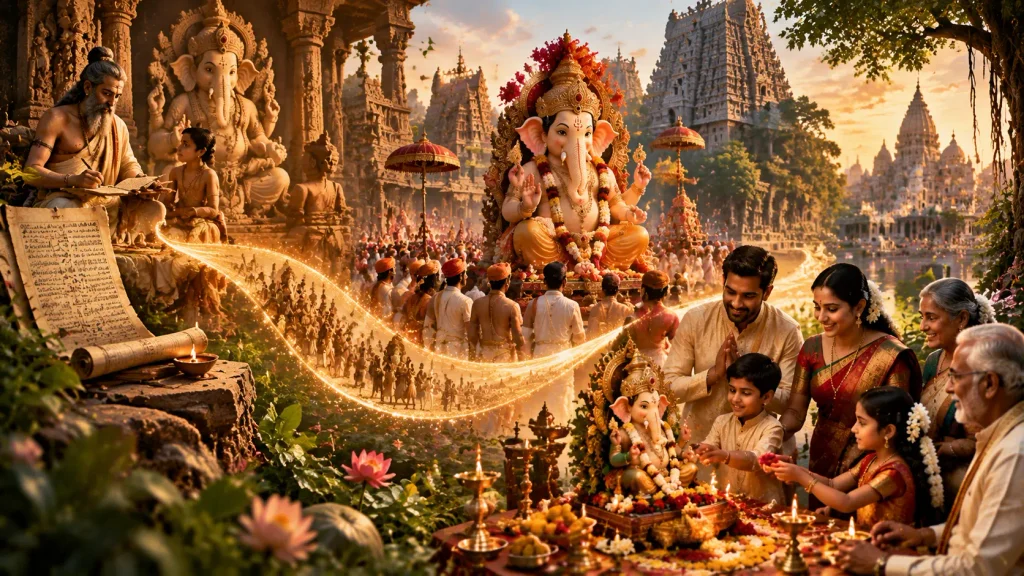
Ganesh Chaturthi continues to be one of India’s most recognizable festivals because it brings together devotion, family, community, art, music, food and storytelling.
Its traditions may look different from one region to another, and modern celebrations continue to evolve. Yet the festival retains a strong connection to the stories and cultural practices through which generations have understood Lord Ganesha.
Ganesh Chaturthi as a Living Indian Tradition
A living tradition is not necessarily one that remains unchanged. It is one that continues to be practiced, remembered and given meaning by successive generations.
Ganesh Chaturthi reflects this idea clearly. Traditional rituals coexist with contemporary decorations, digital communication, new forms of artistic expression and changing community practices.
The festival remains relevant because people continue to participate in it and interpret its traditions within their own families and communities.
From Devotion and Community to Storytelling and Cultural Memory
Ganesh Chaturthi is also a festival of stories.
Stories explain Ganesha’s symbolism, devotional traditions give voice to faith, family practices preserve memories and community celebrations create shared cultural experiences.
These stories are not limited to written texts. They live through conversations, prayers, songs, performances, photographs, videos and increasingly through digital audio.
This makes storytelling an important bridge between the past and the present.
Preserving Ganesh Chaturthi Stories for Future Generations
As media habits change, preserving cultural stories becomes increasingly important.
Recording a grandparent explaining a family tradition, narrating a Ganesha story in a regional language, documenting a community’s annual celebration or sharing a devotional experience through audio can create cultural memories that remain accessible beyond a single festival season.
Digital storytelling can therefore complement traditional forms of cultural transmission. It allows stories to travel across generations, languages and geographical boundaries while retaining the human voices behind them.
Arré Voice and the Future of Festival Storytelling
Platforms such as Arré Voice can provide a modern space for creators and communities to share voice-based stories, cultural narratives, devotional storytelling and personal festival experiences.
Instead of preserving culture only as static text or images, voice-based storytelling can retain elements that make oral traditions powerful: the narrator’s voice, emotion, rhythm, language and personality.
For a festival such as Ganesh Chaturthi, this opens possibilities for creators to share Ganesha stories, regional traditions, family memories, devotional narratives and community experiences in formats that are accessible to today’s audiences.
The future of festival storytelling does not have to choose between tradition and technology. Digital platforms can become another way for people to hear, remember and pass forward the stories that give cultural traditions their meaning.
Ganesh Chaturthi ultimately lives not only in the rituals performed each year, but also in the stories people continue to tell.