What Is Text to Voice AI?
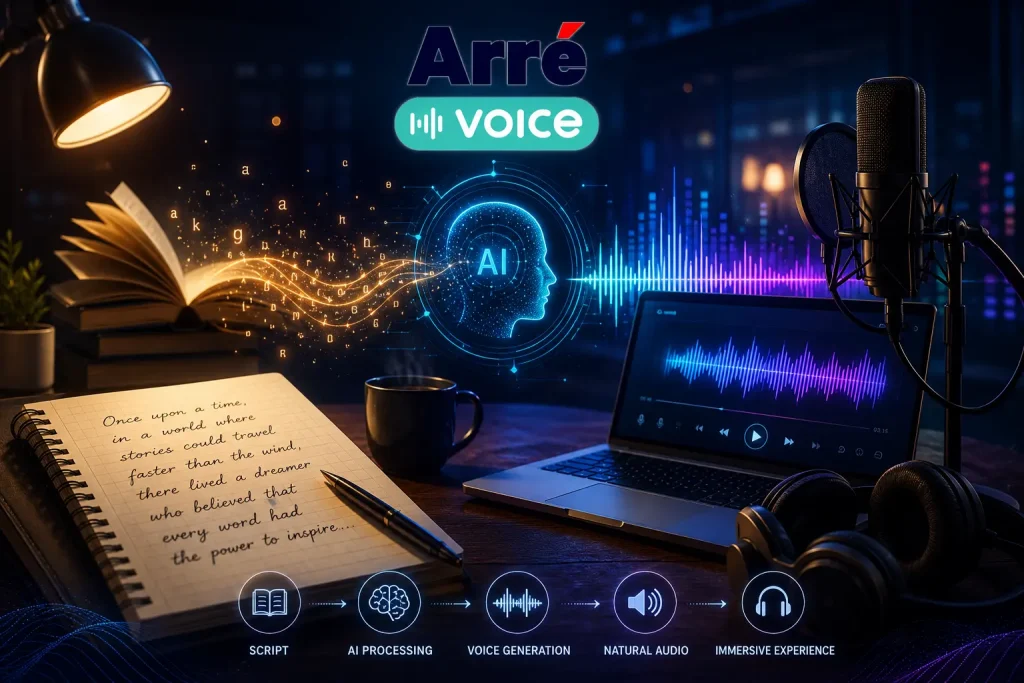
Text to Voice AI is an artificial intelligence technology that converts written content into natural-sounding spoken audio. It allows creators, businesses, educators, and storytellers to transform scripts, articles, stories, and other forms of text into engaging voice experiences without traditional recording setups.
Modern Text to Voice AI systems go beyond simply reading words aloud. They use advanced language processing and AI voice models to understand context, pronunciation, tone, and expression, creating audio that sounds more natural and conversational.
As audiences increasingly consume content through audio formats, Text to Voice AI is becoming an important technology for podcasts, audiobooks, education, accessibility, and digital storytelling. It enables creators to repurpose existing content, experiment with voice-first formats, and reach audiences through new experiences.
For the future of storytelling, AI voice technology represents a shift from text-only content towards more immersive and accessible ways of sharing ideas, stories, and conversations.
Definition of Text to Voice AI Technology
Text to Voice AI refers to the use of artificial intelligence to transform written words into spoken audio.
The technology combines multiple AI capabilities, including:
- Natural language processing (NLP): Helps AI understand written language, meaning, and context.
- Machine learning models: Allow AI systems to learn patterns from large volumes of voice and language data.
- Speech synthesis: Converts analysed text into a generated voice output.
- Voice modelling: Creates different speaking styles, tones, and expressions.
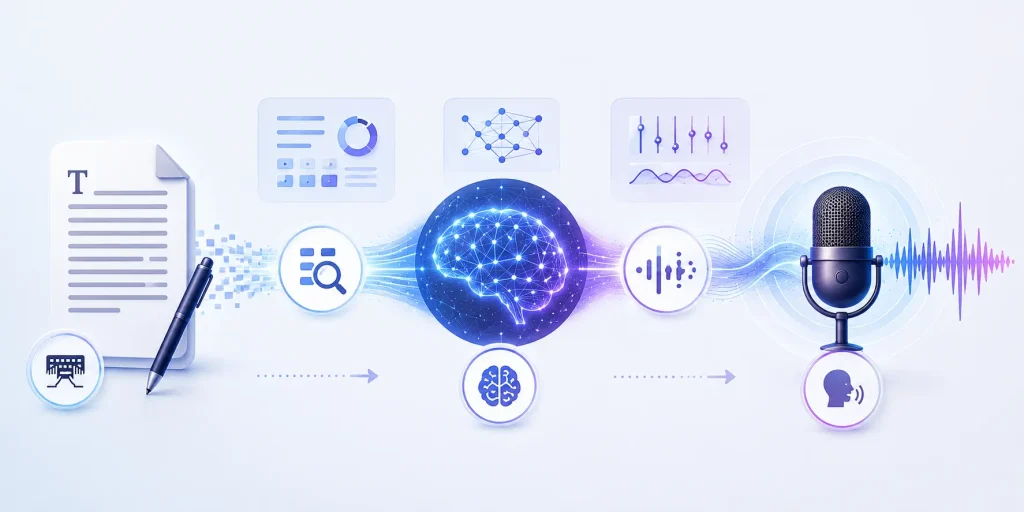
At a basic level, the process can be understood as:
Written text → AI language understanding → Voice generation → Natural audio output
However, modern Text to Voice AI is not limited to word conversion. It analyses how information should be communicated.
For example, a fictional story may require emotional narration, while an educational article may need a clear and structured delivery. AI voice systems use language understanding to adapt the output based on the purpose and audience.
This makes Text to Voice AI useful across multiple industries, including entertainment, publishing, education, marketing, and creator platforms.
How AI Converts Written Text Into Spoken Audio
Text to Voice AI converts written content into audio through a series of AI-driven processes.
The first stage involves text analysis, where artificial intelligence examines the content to understand words, sentence structure, punctuation, and context.
Next, the system processes the language to determine:
- Correct pronunciation
- Natural pauses
- Sentence rhythm
- Word emphasis
- Speaking style
After understanding the text, AI voice models generate speech patterns that match the desired voice characteristics.
The final stage is speech synthesis, where these patterns are converted into an audio file.
Modern AI systems can create voices with:
- Natural pacing
- Realistic pronunciation
- Different tones
- Multiple languages
- Expressive delivery
This allows a written script to become a narrated story, an article to become an audio experience, or educational material to become a voice-based learning resource.
Difference Between Text to Voice AI and Traditional Text-to-Speech
Traditional text-to-speech (TTS) technology has existed for years and was primarily designed to convert written information into understandable speech.
Earlier TTS systems focused on accuracy rather than realism. As a result, generated voices often sounded mechanical, repetitive, and lacking in emotional expression.
Text to Voice AI represents a more advanced evolution of this technology.
| Traditional Text-to-Speech | Text to Voice AI |
| Converts text into basic speech | Creates more natural voice experiences |
| Limited understanding of context | Uses AI to interpret meaning |
| Minimal emotional variation | Supports expressive narration |
| Fixed voice patterns | Offers more customisation |
| Mainly functional applications | Used for storytelling and content creation |
The key difference is that traditional text-to-speech focuses on reading text, while Text to Voice AI focuses on delivering an experience.
This distinction is particularly important for creators, where voice quality, emotion, and storytelling ability influence audience engagement.
Why AI Voice Technology Is Transforming Content Creation
Content creation is becoming increasingly focused on flexibility, speed, and multi-format publishing. Audiences today consume content through videos, podcasts, short-form media, and audio platforms.
AI voice technology helps creators adapt by making audio production faster and more accessible.
With Text to Voice AI, creators can:
- Convert written content into audio formats
- Turn scripts into narrated experiences
- Create multilingual content
- Repurpose existing articles and stories
- Produce voice content without expensive recording setups
For independent creators, this reduces barriers that previously limited audio production. Creating professional-sounding narration no longer always requires a studio, voice actor, or complex editing workflow.
For storytelling platforms, AI voice technology creates new opportunities to combine human creativity with scalable production. A written story can become an immersive audio journey, and a creator’s idea can reach listeners in new ways.
The future of content creation will not be defined by AI replacing human creativity. Instead, AI voice technology will help creators expand their storytelling possibilities and build deeper connections with audiences.
How Does Text to Voice AI Work?
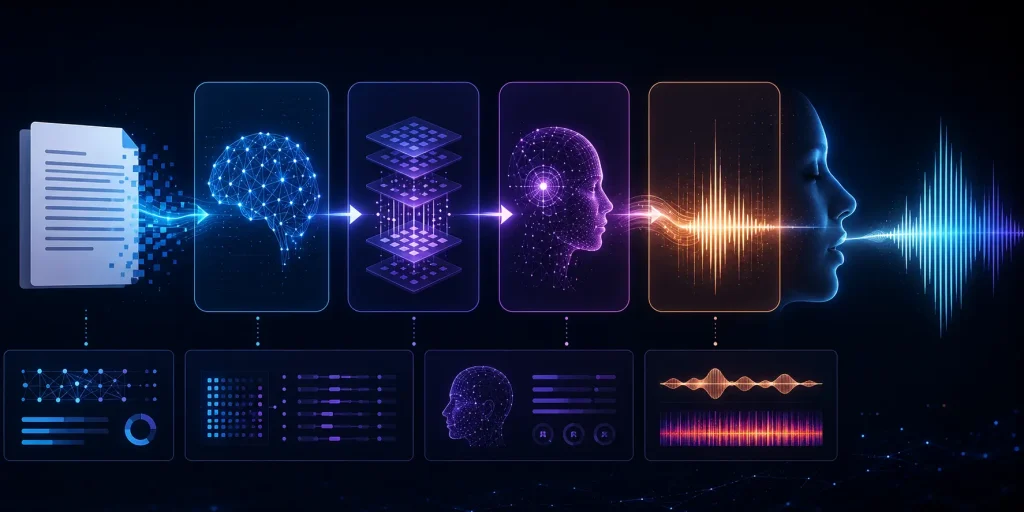
Text to Voice AI works by combining artificial intelligence, natural language processing, and speech generation technologies to transform written language into realistic audio.
Unlike older speech systems that simply converted words into sound, modern AI voice technology understands the meaning, context, and intent behind written content before generating speech.
The process involves analysing text, creating voice patterns, and producing audio that matches human communication styles.
How AI Understands Written Language
Before generating audio, Text to Voice AI first needs to understand the written content.
AI systems analyse:
- Words and phrases
- Sentence structure
- Context
- Language patterns
- Emotional tone
This helps AI determine how the content should be delivered.
For example, a suspenseful story requires a different narration style compared to a business explanation or educational lesson. AI uses language understanding to adjust delivery based on the purpose of the content.
This ability to interpret meaning is what makes modern AI voice systems more natural than traditional speech technologies.
Text Analysis and Language Processing
Natural language processing plays a central role in converting text into realistic speech.
During text analysis, AI evaluates:
Word Recognition and Pronunciation
AI identifies how individual words should be spoken, including names, technical terms, and regional expressions.
Sentence Flow
AI understands punctuation and sentence structure to create natural pauses and rhythm.
Context Understanding
AI determines the intended meaning behind sentences to improve voice delivery.
For example, a question, announcement, or emotional statement may require different speaking patterns even when the words are similar.
This language intelligence helps AI-generated voices sound more conversational and human-like.
AI Voice Modelling and Speech Generation
After understanding the written content, AI creates speech using advanced voice models.
AI voice modelling focuses on characteristics such as:
- Voice style
- Pitch
- Speed
- Tone
- Expression
Different voice models can be designed for different purposes.
A storyteller may need a warm and expressive voice, while an educational creator may prefer a clear and professional narration style.
Once the voice characteristics are determined, speech generation technology converts them into audio output.
This process allows creators to produce consistent narration across different types of content.
How AI Creates Natural Pronunciation, Tone, and Expression
One of the biggest advancements in Text to Voice AI is the ability to create voices that sound more natural and expressive.
Modern AI systems improve realism through:
Context-Based Pronunciation
AI considers surrounding words and meaning to improve accuracy.
Natural Pausing
The system creates pauses and rhythm similar to human speech.
Tone Adjustment
AI can modify delivery based on the purpose and emotion of the content.
Expressive Narration
Advanced AI voices can add emphasis and variation instead of producing flat speech.
These improvements are making AI voice technology increasingly useful for storytelling, entertainment, education, and creator-driven content.
How To Convert Text Into Voice Using AI?
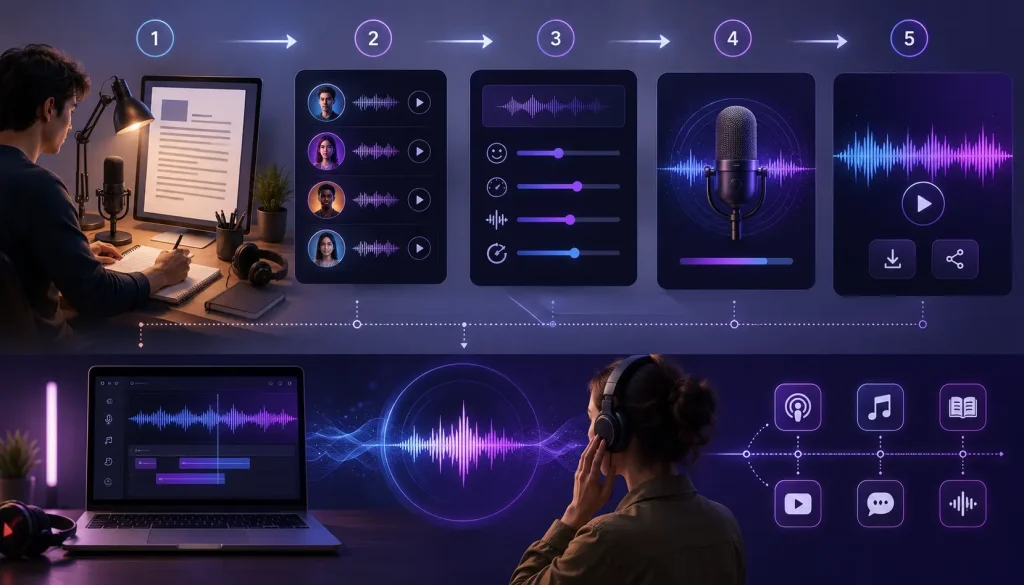
Converting text into voice using AI involves preparing written content, selecting a suitable voice style, adjusting narration settings, generating audio, and refining the final output.
The process allows creators to transform scripts, stories, and articles into engaging audio experiences without traditional recording limitations.
Preparing Scripts for AI Voice Conversion
The quality of AI-generated audio depends on the quality of the original script.
Before conversion, creators should ensure their content is:
- Clear and structured
- Easy to understand when spoken
- Written with natural flow
- Suitable for audio consumption
Written content often needs minor adjustments before becoming audio because listeners cannot see visual elements like headings, images, or formatting.
Shorter sentences, conversational language, and clear transitions help AI create smoother narration.
Selecting an AI Voice Style
Choosing the right AI voice is important because voice influences how audiences experience content.
Creators should consider:
- Audience expectations
- Content category
- Emotional tone
- Storytelling style
Different voice styles work better for different formats.
For example, storytelling content may require an expressive voice, while educational content may benefit from a clearer and more neutral delivery.
Adjusting Tone, Speed, and Pronunciation
Modern Text to Voice AI platforms allow creators to customise narration settings.
Common adjustments include:
- Speaking speed
- Voice tone
- Pronunciation
- Expression level
- Pause timing
These controls help creators create audio that matches their intended audience and purpose.
Small changes in pacing and emphasis can significantly improve the listening experience.
Generating and Editing AI Audio
After selecting the script and voice settings, AI generates the audio output.
Creators can review and refine the result by:
- Correcting pronunciation issues
- Adjusting pacing
- Editing sections
- Improving overall flow
The editing stage ensures the final audio feels polished and engaging.
Publishing Audio Content Across Platforms
Once the audio is ready, creators can publish it across multiple formats and platforms, including:
- Podcasts
- Audio storytelling platforms
- Videos
- Educational resources
- Social media content
The ability to transform written content into multiple formats makes Text to Voice AI valuable for modern creators.
As voice-first content continues to grow, AI-assisted audio creation is helping storytellers reach audiences in more accessible and engaging ways.
Features of Modern Text to Voice AI Technology
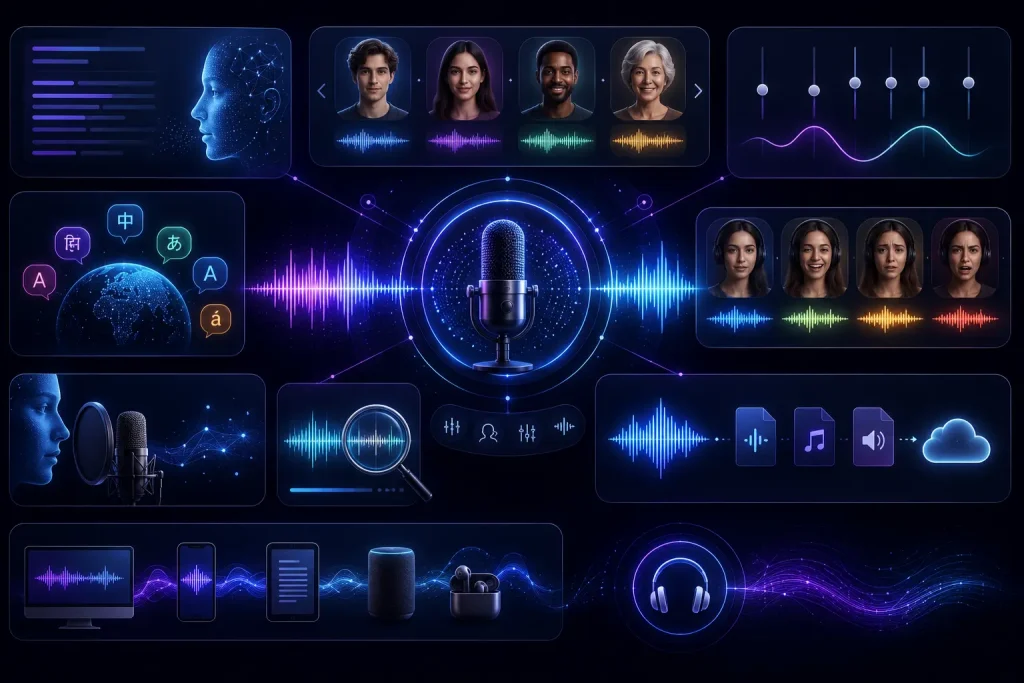
Modern Text to Voice AI technology has evolved significantly beyond basic speech generation. Today’s AI voice systems focus on creating realistic, flexible, and customisable audio experiences that support creators, businesses, educators, and storytellers.
From natural voice generation to multilingual support, these features are making AI-powered audio creation more accessible and scalable.
Natural Sounding AI Voices
One of the biggest advancements in Text to Voice AI is the ability to generate voices that sound closer to human narration.
Modern AI voice systems can replicate natural speech patterns, including:
- Realistic pronunciation
- Natural pauses
- Conversational rhythm
- Voice clarity
- Human-like delivery
This improvement is especially valuable for storytelling, podcasts, audiobooks, and educational content where audience engagement depends on the quality of narration.
Multiple Voice Styles and Personalities
Modern AI voice platforms offer a range of voice options to match different content requirements.
Creators can choose voices based on:
- Tone
- Age group
- Speaking style
- Character personality
- Content format
For example, a fictional audio story may require an expressive storytelling voice, while an educational lesson may benefit from a calm and professional narration style.
This flexibility allows creators to experiment with different formats without needing multiple voice artists.
Language and Accent Support
AI voice technology is helping creators reach wider audiences by supporting multiple languages and accents.
This is particularly valuable for:
- Regional storytelling
- Global content distribution
- Multilingual education
- Localised brand communication
For platforms focused on diverse audiences, multilingual AI narration creates opportunities to preserve cultural stories and make content accessible across different language communities.
Voice Tone and Speed Controls
Modern Text to Voice AI tools provide creators with control over how narration is delivered.
Common adjustments include:
- Speaking speed
- Voice pitch
- Tone variation
- Pause duration
- Emphasis levels
These controls allow creators to match the voice style with the purpose of their content.
A dramatic story may require slower pacing and emotional emphasis, while an instructional video may need faster and clearer narration.
Emotional AI Narration
A major development in AI voice technology is the ability to generate more expressive narration.
Advanced AI systems can adjust delivery based on the emotional context of the content.
Examples include:
- Excited narration for promotional content
- Calm delivery for educational material
- Dramatic expression for storytelling
- Conversational tone for podcasts
This makes AI-generated voices more suitable for creative applications where emotional connection matters.
AI Pronunciation Enhancement
Pronunciation accuracy is essential for creating professional audio experiences.
Modern Text to Voice AI systems use language understanding to improve how words are spoken, including:
- Names
- Technical terms
- Regional expressions
- Complex vocabulary
AI can analyse surrounding context to determine the correct pronunciation and reduce errors in generated audio.
Audio Export and Integration Options
Modern AI voice solutions are designed to fit into existing creator workflows.
Common capabilities include:
- Audio file exports
- Integration with content platforms
- Video creation workflows
- Podcast production tools
- Learning management systems
These features allow creators to move from script creation to audio publishing more efficiently.
Text to Voice AI vs Human Voice Recording
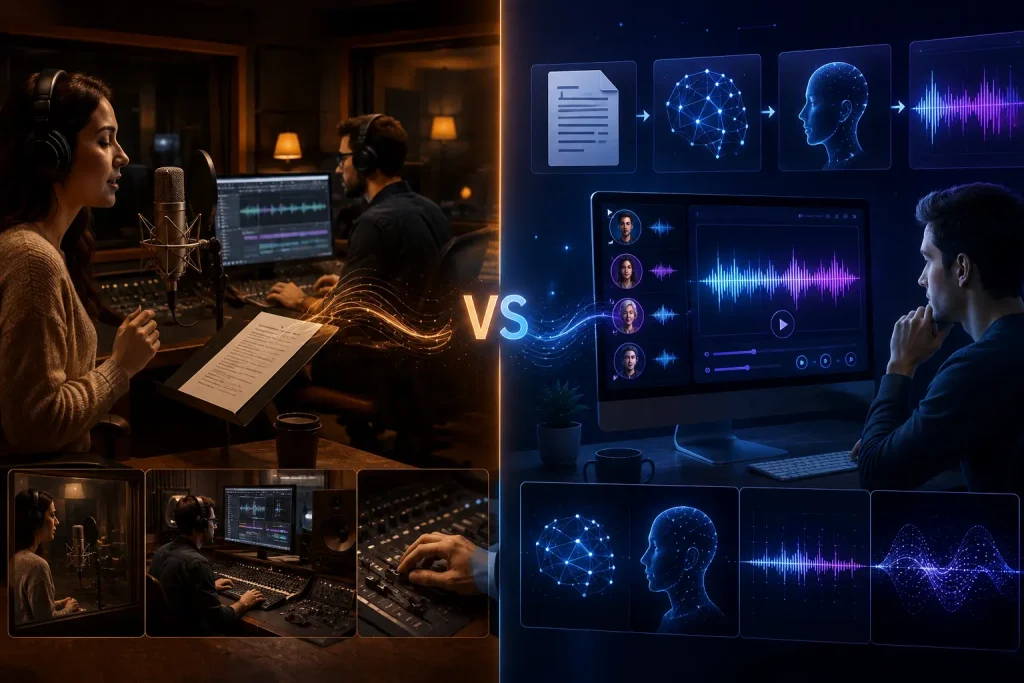
Both Text to Voice AI and human voice recording have important roles in modern content creation. The right choice depends on factors such as content type, budget, production requirements, and the level of emotional expression needed.
While human narration continues to offer authenticity and personal connection, AI voice technology provides speed, scalability, and accessibility.
Traditional Voice Recording Workflow
Traditional voice recording usually involves several production steps:
- Writing and preparing the script
- Hiring a voice artist or narrator
- Setting up recording equipment
- Recording multiple takes
- Editing and mastering audio
This approach provides a high level of human expression, but it can require more time, resources, and production coordination.
For premium storytelling, character performances, and emotionally complex narratives, human voices remain highly valuable.
AI Voice Generation Workflow
Text to Voice AI simplifies the production process by allowing creators to generate narration directly from written content.
The workflow typically involves:
- Preparing a script
- Selecting an AI voice
- Adjusting voice settings
- Generating audio
- Editing and publishing
This makes audio creation faster, especially for creators who need to produce large amounts of content regularly.
Cost and Time Differences
One of the biggest advantages of Text to Voice AI is efficiency.
Traditional voice production may involve:
- Voice talent costs
- Studio expenses
- Recording sessions
- Editing requirements
AI voice generation reduces many of these production barriers, allowing creators to produce audio content with fewer resources.
This makes AI voice technology particularly useful for independent creators, publishers, and organisations producing content at scale.
Scalability Comparison
Human narration can be highly effective, but scaling production often requires additional resources.
Text to Voice AI allows creators to:
- Convert multiple scripts quickly
- Create content in different languages
- Produce consistent narration styles
- Repurpose existing content formats
This scalability makes AI voice technology valuable for content libraries, educational platforms, and storytelling ecosystems.
When Human Narration Works Better
Human voices remain important when content requires:
- Personal connection
- Emotional depth
- Character performance
- Unique storytelling style
For example, a dramatic audio series may benefit from the personality and emotional range of a professional narrator.
Human storytelling carries cultural nuances and personal experiences that technology cannot fully replace.
When AI Voice Technology Is More Effective
AI voice technology works well for:
- Large-scale content production
- Educational resources
- Content repurposing
- Multilingual audio creation
- Rapid experimentation
For creators looking to transform written content into audio efficiently, AI provides a practical solution.
The future of audio creation is likely to involve collaboration between human creativity and AI-assisted production rather than one replacing the other.
Text to Voice AI vs Traditional Text-to-Speech
Text to Voice AI and traditional text-to-speech technology share the same basic goal: converting written text into spoken audio.
However, modern AI voice technology represents a significant evolution in how machines understand and generate speech.
Evolution of Text-to-Speech Technology
Traditional text-to-speech systems were primarily designed for functional purposes, such as accessibility tools and basic voice assistance.
Their focus was on converting text into understandable speech rather than creating realistic narration.
As artificial intelligence advanced, voice systems became capable of understanding language context, improving pronunciation, and generating more natural speech patterns.
How AI Voices Improve Realism
Modern AI voice systems improve realism through:
- Better language understanding
- More natural pacing
- Improved pronunciation
- Emotional variation
- Context-aware delivery
Instead of producing uniform speech, AI voices can adapt their delivery based on the meaning and purpose of the content.
Differences in Quality and Flexibility
The major difference between traditional TTS and Text to Voice AI lies in flexibility.
Traditional TTS typically offers limited customisation, while AI voice systems provide greater control over:
- Voice style
- Tone
- Expression
- Language options
- Content formats
This makes AI voice technology more suitable for creative industries.
Why Creators Prefer AI Voice Solutions
Creators increasingly use AI voice solutions because they offer:
- Faster production
- Lower barriers to entry
- More creative experimentation
- Easier content scaling
For writers, storytellers, and digital creators, Text to Voice AI provides a way to transform ideas into audio experiences while maintaining control over the creative process.
Benefits of Text to Voice AI for Creators
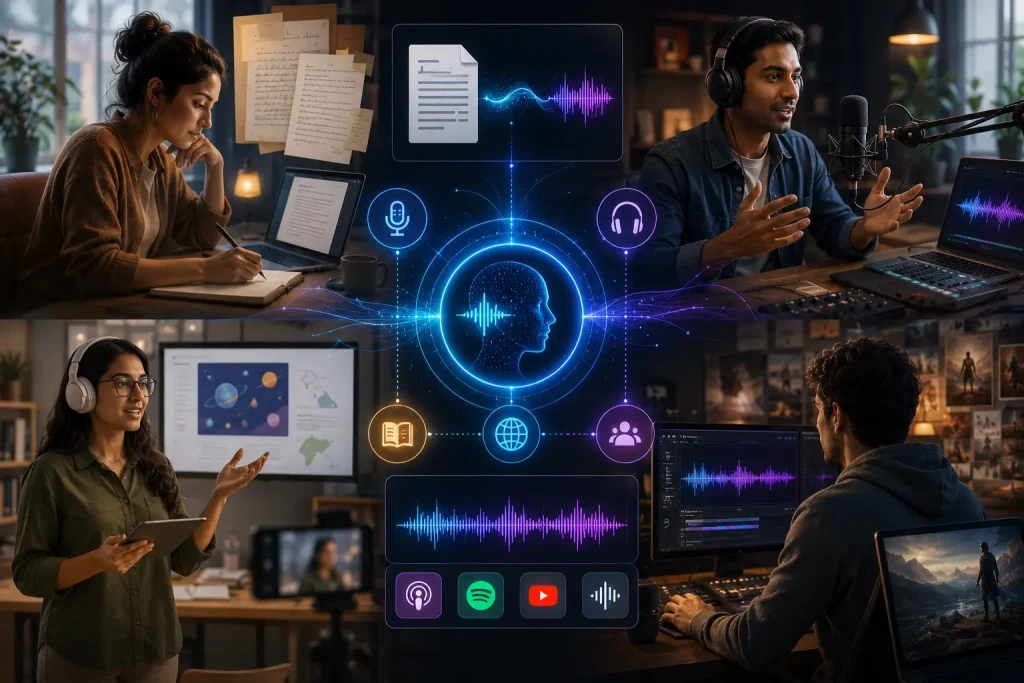
Text to Voice AI is changing how creators develop, publish, and distribute audio content. Traditionally, producing high-quality voice content required recording equipment, professional narration, and significant editing time.
AI voice technology reduces these barriers by helping creators transform written ideas into engaging audio experiences faster and more efficiently.
For writers, storytellers, educators, and digital creators, Text to Voice AI provides new ways to experiment with voice-first content while focusing more on creativity and storytelling.
Turning Written Ideas Into Audio Quickly
One of the biggest advantages of Text to Voice AI is the ability to convert written content into audio within a shorter production cycle.
Creators can transform:
- Articles
- Scripts
- Stories
- Newsletters
- Educational material
into narrated audio experiences without starting a completely new production process.
This allows creators to repurpose existing content and reach audiences who prefer listening rather than reading.
For example, a writer who has already published a story can create an audio version without needing to arrange a separate recording session.
This faster workflow helps creators publish more consistently and explore multiple content formats.
Creating Content Without Recording Equipment
Traditional audio production often requires:
- Professional microphones
- Recording spaces
- Audio editing software
- Voice recording experience
Text to Voice AI removes many of these technical requirements.
Creators can generate narration using only a written script and an AI voice platform.
This makes audio creation more accessible for:
- Independent writers
- Small creators
- Educators
- New storytellers
By reducing production complexity, AI voice technology allows more people to participate in audio storytelling.
Producing Multilingual Audio Experiences
One of the most powerful applications of Text to Voice AI is multilingual content creation.
Creators can adapt content for different audiences by generating audio in multiple languages and accents.
This creates opportunities for:
- Regional storytelling
- Global content distribution
- Language learning resources
- Localised experiences
For diverse markets, including India, multilingual AI voice technology can help creators share stories across different linguistic communities while preserving accessibility.
Scaling Content Production
For creators managing multiple content formats, producing audio manually for every piece of content can be challenging.
Text to Voice AI helps scale production by allowing creators to:
- Convert multiple scripts into audio
- Create consistent narration styles
- Repurpose existing content
- Build larger audio libraries
This is especially useful for publishers, storytelling platforms, and educational organisations that need to produce content regularly.
AI allows creators to increase output while maintaining a consistent workflow.
Improving Accessibility
Voice content makes information available to audiences who may prefer listening over reading.
Text to Voice AI supports accessibility by helping convert written information into audio formats.
This benefits:
- People with visual impairments
- Audiences with different learning preferences
- Users consuming content while multitasking
By making content available in multiple formats, creators can reach wider audiences and create more inclusive experiences.
Building Consistent Voice Experiences
For brands, creators, and platforms, maintaining consistency across audio content is important.
AI voice technology allows creators to develop consistent narration styles across:
- Episodes
- Educational materials
- Brand content
- Digital experiences
This helps establish familiarity and improves the overall audience experience.
For storytelling platforms, consistent voice experiences can support stronger connections between creators, stories, and listeners.
How Writers and Creators Use Text to Voice AI
Text to Voice AI is becoming a valuable tool for writers and creators who want to transform written ideas into immersive audio experiences.
From storytelling and podcasts to education and digital communities, AI voice technology allows creators to explore new formats without completely changing their creative process.
Converting Blogs Into Audio
Many creators already have valuable written content in the form of:
- Blog articles
- Essays
- Newsletters
- Guides
- Thought pieces
Text to Voice AI allows this content to be converted into audio formats.
A written article can become an audio episode that audiences can listen to while travelling, exercising, or completing daily activities.
This helps creators maximise the value of existing content while reaching audiences with different consumption preferences.
Creating AI Narrated Stories
Storytelling is one of the most natural applications of Text to Voice AI.
Creators can transform written fiction, short stories, and narrative content into audio experiences through AI-generated narration.
AI narration can support:
- Fiction stories
- Character-driven narratives
- Folklore
- Interactive storytelling formats
While technology assists with production, the creative direction, storytelling style, and emotional depth continue to come from the creator.
Transforming Scripts Into Podcasts
Podcasts traditionally require recording sessions, hosts, and production workflows.
Text to Voice AI can support podcast creation by helping creators convert prepared scripts into narrated episodes.
This can be useful for:
- Solo creators
- Educational podcasts
- Story-based shows
- Informational content
AI-assisted workflows allow creators to experiment with podcast formats more easily.
Producing Audiobooks
Audiobooks require significant narration time and production effort.
Text to Voice AI can help creators convert written books, short stories, and long-form content into audio formats.
For independent authors, this creates opportunities to make their work available to audiences who prefer listening.
AI narration can also help publishers explore larger catalogues of audio content.
Creating Educational Audio Content
Education is another area where Text to Voice AI can create new possibilities.
Creators and educators can transform learning material into audio resources, including:
- Lessons
- Explanations
- Language learning content
- Training resources
Audio learning allows users to access information more flexibly and supports different learning preferences.
Building Voice-First Experiences
The growth of voice-based content is creating new opportunities beyond traditional formats.
Creators can use Text to Voice AI to develop:
- Audio communities
- Interactive stories
- Voice-based learning experiences
- Digital conversations
As audiences become more comfortable consuming content through voice, creators can explore new ways to build relationships with listeners.
Examples of Content Created With Text to Voice AI
Text to Voice AI can be applied across multiple industries and creative formats. Its flexibility allows creators, businesses, and organisations to transform different types of written content into audio experiences.
Fiction and Storytelling
Storytelling is one of the strongest use cases for AI voice technology.
Creators can develop:
- Short stories
- Audio dramas
- Fiction narratives
- Folklore experiences
- Character-based storytelling
By combining creative writing with AI narration, stories can reach audiences through more immersive formats.
Podcasts and Audio Shows
Text to Voice AI can support podcast production by helping creators generate narrated episodes from scripts.
Applications include:
- Educational podcasts
- News summaries
- Story-based shows
- Explainer content
AI-assisted workflows allow creators to experiment with audio formats more efficiently.
Educational Content
Educators and organisations can use AI voice technology to create:
- Online lessons
- Training modules
- Learning guides
- Audio explanations
Audio formats make educational resources more flexible and accessible.
Marketing Content
Brands can use Text to Voice AI to create:
- Product explainers
- Promotional videos
- Social media content
- Brand stories
AI narration helps businesses produce consistent audio content across multiple channels.
Brand Experiences
Voice can create stronger connections between brands and audiences.
Companies can use AI voice technology for:
- Digital assistants
- Customer experiences
- Interactive content
- Personalised communication
As voice-based interactions continue growing, brands have new opportunities to create memorable experiences.
Accessibility Solutions
Text to Voice AI also plays an important role in improving accessibility.
It can help convert written information into audio for:
- Websites
- Digital documents
- Educational resources
- Public information
By making content available through voice, creators and organisations can reach wider and more diverse audiences.
AI Voice Storytelling: Creating The Next Generation of Digital Narratives

Voice has always been one of humanity’s oldest storytelling mediums. From oral traditions and folk narratives to radio dramas and modern podcasts, stories have always carried emotional power through the human voice.
Text to Voice AI is introducing a new chapter in digital storytelling by helping creators transform written ideas into immersive audio experiences. Instead of limiting stories to screens and pages, AI voice technology allows narratives to become more accessible, interactive, and adaptable.
For creators and storytelling platforms, the opportunity is not just about generating audio faster. It is about exploring new ways for audiences to discover, experience, and connect with stories.
From Written Stories to Immersive Audio Experiences
Traditionally, a story existed primarily through formats such as books, articles, or video content.
Text to Voice AI allows creators to expand these stories into audio experiences.
A written narrative can become:
- An AI-narrated story
- An audio series
- A podcast episode
- An interactive listening experience
This transformation allows audiences to experience content in moments where reading or watching may not be convenient.
Listeners can engage with stories while travelling, exercising, working, or performing everyday activities.
For creators, this creates new opportunities to extend the life of existing content and reach audiences through additional formats.
Combining AI Narration With Human Creativity
AI voice technology does not replace the creative process behind storytelling. Instead, it acts as a tool that helps creators bring ideas to life more efficiently.
Human creativity remains responsible for:
- Story concepts
- Characters
- Cultural context
- Emotional direction
- Creative decisions
AI supports the production process by helping with:
- Narration
- Audio generation
- Content adaptation
- Faster experimentation
The strongest storytelling experiences will come from combining human imagination with AI capabilities.
Creators can focus on developing meaningful stories while technology helps make those stories more scalable and accessible.
Personalised Storytelling Formats
One of the emerging possibilities of AI-powered storytelling is personalisation.
Future audio experiences may adapt based on:
- Listener preferences
- Language choices
- Interests
- Content consumption habits
For example, the same story could potentially be experienced through different narration styles, languages, or formats depending on the listener.
Personalised storytelling can create deeper engagement by making content feel more relevant to individual audiences.
The Role of Voice in Emotional Connection
Voice creates a unique relationship between storytellers and audiences.
Unlike written words alone, voice communicates:
- Emotion
- Personality
- Tone
- Intention
The way a story is narrated can influence how audiences feel and connect with the content.
This emotional aspect makes voice particularly powerful for:
- Fiction
- Personal stories
- Cultural narratives
- Community conversations
AI voice technology is expanding access to audio creation, but the emotional foundation of storytelling continues to come from human experiences and perspectives.
Future of AI-Powered Storytelling
The future of storytelling will likely involve collaboration between creators and intelligent technologies.
AI-powered storytelling may enable:
- More accessible content creation
- New interactive formats
- Multilingual storytelling
- Larger creator communities
- More personalised experiences
For platforms focused on stories and communities, this evolution creates opportunities to build deeper connections between creators and listeners.
Voice storytelling is moving beyond simple narration. It is becoming a new way for people to share experiences, preserve cultures, and build communities.
How Text to Voice AI Is Changing Digital Storytelling
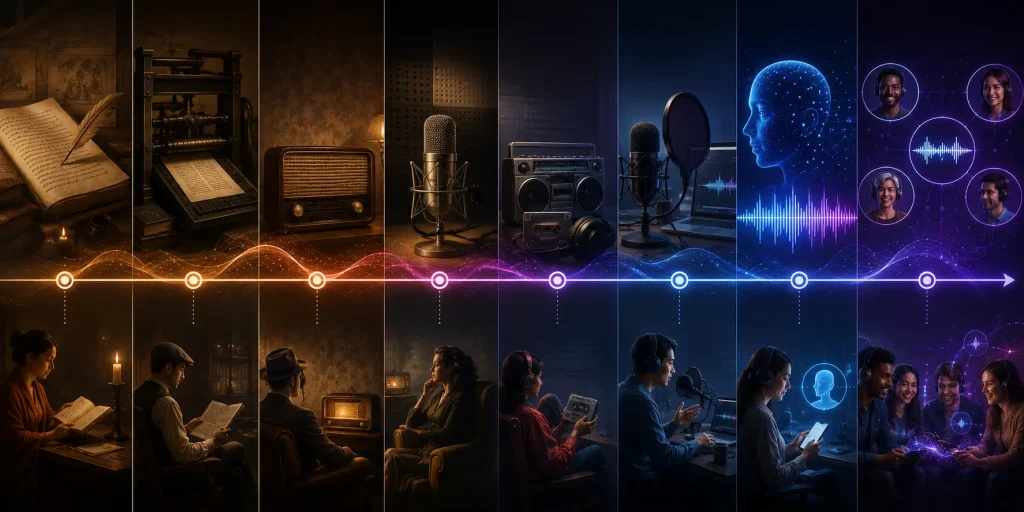
Text to Voice AI is influencing how stories are created, distributed, and experienced. As audiences increasingly consume content through audio formats, voice is becoming an important part of the modern storytelling ecosystem.
The technology is helping creators overcome traditional production barriers while opening opportunities for more diverse voices and narratives.
Growth of Voice-First Content
Audio consumption continues to grow as audiences look for content formats that fit into their daily lives.
Voice-first content allows people to:
- Listen while multitasking
- Consume stories without screens
- Access content more conveniently
This shift is creating opportunities for creators to rethink how stories are delivered.
Text to Voice AI supports this movement by making audio production faster and more accessible.
Making Stories Accessible Across Languages
Language plays an important role in preserving culture and connecting communities.
AI voice technology can help creators adapt stories across different languages and regions.
This creates opportunities for:
- Regional storytelling
- Multilingual content
- Cultural preservation
- Wider audience reach
For diverse markets like India, where storytelling traditions exist across multiple languages, AI-assisted voice technology can help more creators share their narratives with broader audiences.
Supporting Independent Creators
Creating professional audio content traditionally required significant resources.
Independent creators often faced challenges related to:
- Recording equipment
- Production costs
- Voice talent availability
- Editing expertise
Text to Voice AI reduces these barriers by enabling creators to experiment with audio formats more easily.
This allows more writers, storytellers, and niche creators to participate in voice-based content creation.
Expanding Regional Storytelling
Regional stories often carry unique cultural perspectives, traditions, and experiences.
AI voice technology can support regional storytelling by helping creators produce content in different languages and formats.
This can help preserve:
- Folk narratives
- Local histories
- Cultural conversations
- Community experiences
Technology can become a bridge between traditional storytelling and modern digital platforms.
AI-Assisted Creativity and Human Imagination
The role of AI in storytelling is not about replacing human creativity.
Instead, it provides creators with additional tools to explore ideas faster and experiment with new formats.
Human creators continue to provide:
- Original perspectives
- Emotional depth
- Cultural understanding
- Storytelling vision
AI assists by helping transform those ideas into scalable audio experiences.
The future of storytelling will be shaped by collaboration between technology and human imagination.
Choosing The Right Text to Voice AI Solution

With the growth of AI voice technology, creators and businesses have many options for generating audio content. Choosing the right Text to Voice AI solution depends on content goals, audience needs, and production requirements.
The ideal solution should balance voice quality, flexibility, usability, and workflow compatibility.
Voice Quality and Realism
Voice quality is one of the most important factors when selecting an AI voice solution.
Creators should evaluate:
- Natural pronunciation
- Speaking rhythm
- Emotional expression
- Overall realism
For storytelling and entertainment content, realistic narration can significantly influence audience engagement.
Language Capabilities
Language support is important for creators targeting diverse audiences.
Consider:
- Available languages
- Accent options
- Regional pronunciation
- Multilingual capabilities
For global and regional storytelling, language flexibility can determine how effectively content reaches different communities.
Customisation Options
A strong AI voice solution should provide control over narration style.
Important customisation features include:
- Voice selection
- Speed adjustment
- Tone control
- Pronunciation settings
- Expression options
These controls allow creators to match voice output with their content style.
Commercial Usage Rights
Creators and businesses should understand how AI-generated audio can be used.
Important considerations include:
- Content ownership
- Commercial licensing
- Distribution permissions
- Platform usage policies
Clear usage rights help creators confidently publish and monetise their work.
Creator Workflow Compatibility
The best AI voice solution should fit naturally into existing creative workflows.
Consider whether it supports:
- Script management
- Editing processes
- Audio exports
- Content publishing systems
A smooth workflow helps creators focus more on storytelling rather than production challenges.
Platform Integrations
Integration capabilities can make AI voice technology more valuable.
Useful integrations may include:
- Content platforms
- Video tools
- Podcast workflows
- Learning systems
Flexible integrations allow creators to move efficiently from idea creation to audience distribution.
The Future of Text to Voice AI and Voice-Based Content
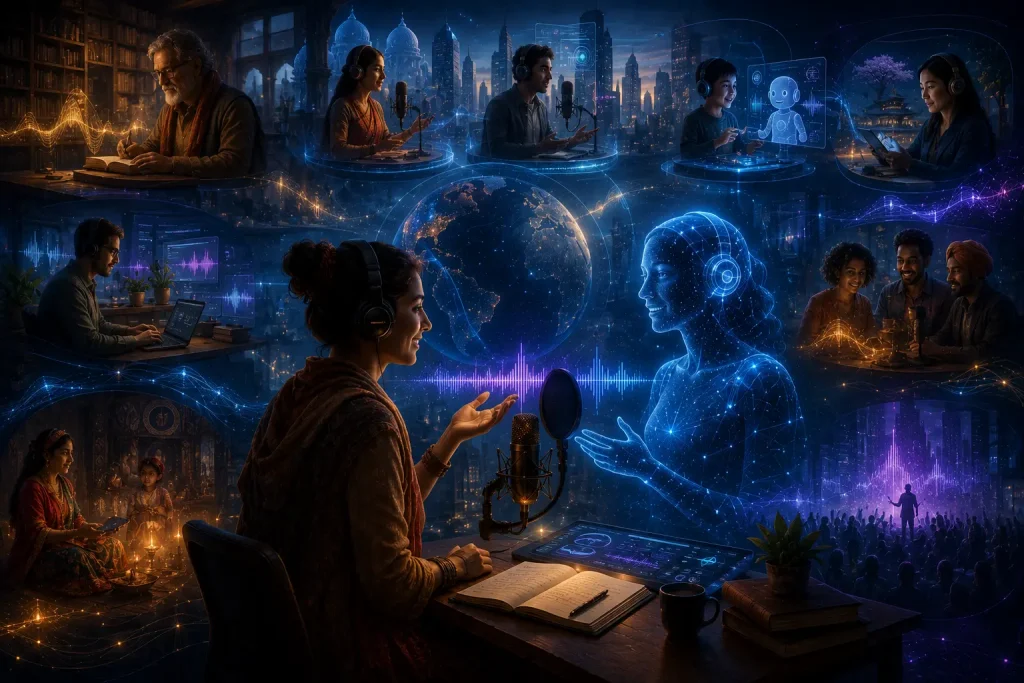
Text to Voice AI is still evolving, and future developments are likely to create even more advanced ways for people to create and experience audio content.
The next generation of voice technology will focus on personalisation, interaction, and deeper connections between creators and audiences.
Personalised AI Voices
Future AI voice systems may become increasingly personalised.
Creators and platforms may use AI voices that adapt based on:
- Audience preferences
- Content type
- Language requirements
- Individual listening habits
Personalised voices could create more meaningful and engaging experiences.
Interactive Audio Experiences
The future of voice content may move beyond passive listening.
Interactive audio experiences could allow audiences to:
- Influence story directions
- Engage with characters
- Participate in conversations
- Explore personalised narratives
This could create new forms of digital storytelling.
AI-Powered Storytelling Communities
As voice creation becomes more accessible, more creators and audiences may participate in storytelling communities.
Platforms could enable:
- Creator collaboration
- Community-driven stories
- Voice-based discussions
- Shared creative experiences
This represents a shift from content consumption towards participation.
Regional Language Growth
AI voice technology can accelerate the growth of regional language content by reducing production challenges.
More creators may be able to produce stories and experiences in languages that previously had limited digital representation.
This could help bring diverse voices and cultural narratives into global digital spaces.
Human Creativity Combined With AI
The future of Text to Voice AI will be defined by collaboration.
AI can improve speed, accessibility, and scalability, but human creativity remains central to meaningful storytelling.
The most impactful experiences will combine:
- Human ideas
- Cultural understanding
- Creative expression
- AI-powered production
Together, these elements can shape a future where more stories are created, shared, and experienced through voice.
What Is Arré Voice?
Arré Voice is a voice-first storytelling platform that enables creators and listeners to discover, create, and engage with audio experiences.
The platform focuses on bringing stories, conversations, and perspectives to audiences through voice-based formats.
Unlike traditional content platforms that focus primarily on text or video, Arré Voice explores the potential of voice as a medium for storytelling, connection, and community building.
As audio consumption continues to grow, voice-first platforms provide new ways for creators to share ideas and audiences to discover meaningful content.
Voice-First Storytelling Communities
Voice has always played an important role in human connection. From oral storytelling traditions to modern podcasts and digital communities, people have used voice to share experiences and build relationships.
Arré Voice builds on this foundation by creating spaces where storytelling and community interaction come together.
Voice-first communities allow people to:
- Discover unique perspectives
- Engage with creators
- Participate in conversations
- Experience stories in a more personal format
As AI-assisted creation tools become more accessible, these communities can enable more creators to participate in the evolving audio ecosystem.
Supporting Creators Through Audio Experiences
AI voice technology is lowering barriers to audio creation, allowing more creators to experiment with voice-based formats.
For creators, this means opportunities to:
- Transform ideas into audio experiences
- Explore new storytelling formats
- Reach audiences through voice
- Build deeper listener relationships
Arré Voice aligns with this shift by supporting a future where creators can use voice as a powerful storytelling medium.
The focus remains on enabling creative expression while technology supports faster and more flexible production.
Connecting Listeners With Original Stories
Audio creates a unique relationship between creators and audiences because listeners experience not only the words but also the emotion, tone, and personality behind them.
Voice-based storytelling allows audiences to:
- Discover original narratives
- Explore different perspectives
- Connect with creators
- Experience stories beyond traditional formats
As audiences increasingly look for authentic and engaging content, voice experiences can create stronger connections between storytellers and listeners.
The Future of AI-Assisted Storytelling on Arré
The future of storytelling will involve collaboration between human creativity and artificial intelligence.
AI can help creators:
- Produce content more efficiently
- Experiment with new formats
- Reach wider audiences
However, the core elements of storytelling—emotion, culture, imagination, and human experience—remain central.
Arré Voice represents this future by exploring how voice, technology, and communities can come together to create the next generation of digital storytelling experiences.
Frequently Asked Questions
What is text to voice AI?
Text to Voice AI is a technology that uses artificial intelligence to convert written content into spoken audio. It analyses text, understands language patterns, and generates realistic voice output that can be used for storytelling, podcasts, education, accessibility, and digital content creation.
How does text to voice AI work?
Text to Voice AI works by analysing written text, understanding context and pronunciation, generating voice patterns, and converting them into spoken audio. Modern AI voice systems use language processing and speech synthesis to create more natural and expressive narration.
Can AI convert scripts into natural audio?
Yes, AI can convert scripts into natural audio by analysing the text and generating voice output with realistic pronunciation, pacing, and tone. Modern Text to Voice AI systems can transform scripts into narration for stories, podcasts, videos, and other audio formats.
Is AI voice generation better than human narration?
AI voice generation and human narration serve different purposes. AI provides speed, scalability, and accessibility, while human narration offers emotional depth, personal expression, and unique performance qualities. Many creators use both approaches depending on their content goals.
Can writers use text to voice AI for storytelling?
Yes, writers can use Text to Voice AI to transform written stories into narrated audio experiences. It can help authors, storytellers, and creators convert fiction, scripts, and creative ideas into formats such as audio stories, podcasts, and digital narratives.
Can text to voice AI create podcast episodes?
Yes, Text to Voice AI can support podcast creation by converting written scripts into narrated audio episodes. It can help creators produce podcast-style content, especially for educational, informational, and storytelling formats.
What is the difference between text-to-speech and AI voice technology?
The main difference is that traditional text-to-speech focuses on converting text into understandable speech, while AI voice technology focuses on creating more realistic, expressive, and context-aware narration using artificial intelligence.
Are AI voices becoming more realistic?
Yes, AI voices are becoming increasingly realistic due to improvements in language models, voice synthesis, and machine learning. Modern AI systems can create more natural pronunciation, emotional variation, and conversational speech patterns.
Can AI voice technology support multiple languages?
Yes, many AI voice systems support multiple languages and accents. This makes the technology useful for multilingual content creation, regional storytelling, education, and reaching diverse audiences.
Can AI voice technology help regional storytelling?
Yes, AI voice technology can support regional storytelling by helping creators produce audio content in different languages and dialects. This can make cultural stories, local narratives, and community voices more accessible to wider audiences.
What is the future of text to voice AI?
The future of Text to Voice AI will likely include more personalised voices, interactive audio experiences, AI-powered storytelling communities, and greater support for regional languages. Human creativity combined with AI technology will shape new ways of creating and experiencing stories.