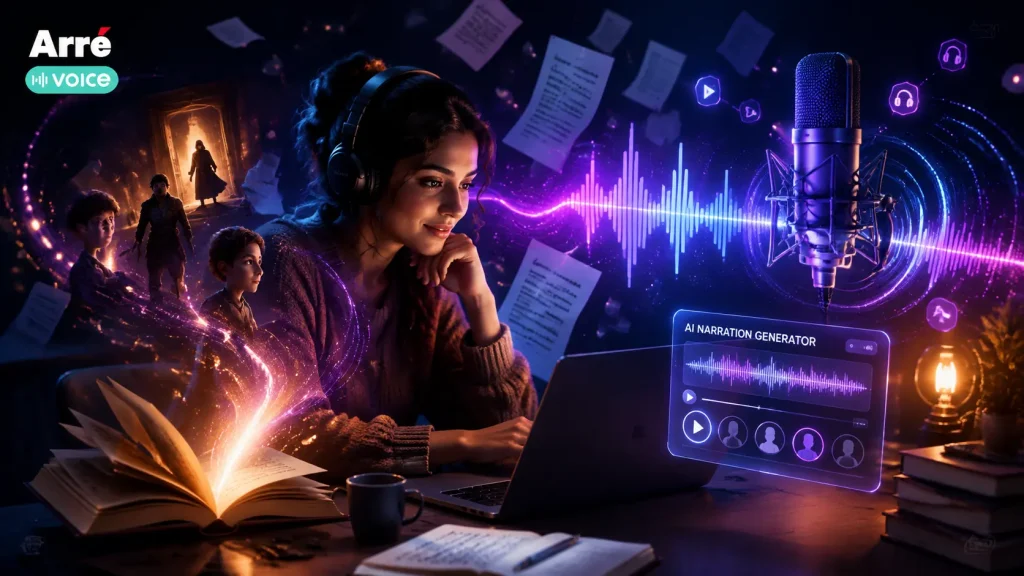
An AI narration generator is a technology that converts written text into realistic human-like voice narration using artificial intelligence. Creators use AI narration generators to produce audio stories, audiobooks, videos, podcasts, and educational content faster without traditional recording equipment or professional voice sessions
How AI Narration Generators Are Transforming Voice Content Creation

The way people consume digital content is evolving rapidly. While written content continues to play an important role, audiences are increasingly choosing audio experiences that fit naturally into their daily routines — whether during commuting, exercising, working, or learning.
This shift has created growing demand for engaging voice-based content such as:
- Audio stories
- Audiobooks
- Podcasts
- Video narrations
- Educational content
- Voice-first experiences
However, creating professional-quality narration traditionally requires significant resources. Many creators need access to:
- Professional voice artists
- Recording equipment
- Studio environments
- Audio editing skills
- Post-production workflows
For independent creators, authors, educators, and content producers, these requirements can make voice production expensive, time-consuming, and difficult to scale.
An AI narration generator is changing how creators approach voice content creation. By using artificial intelligence, these tools can transform written text into realistic voice narration without requiring traditional recording setups.
With AI narration technology, creators can:
- Convert scripts and written content into audio
- Experiment with different voice styles and tones
- Create multilingual voice experiences
- Develop engaging storytelling formats
- Produce content faster and more efficiently
AI narration is not designed to replace human creativity. Instead, it works as a creative assistant that helps writers, storytellers, and creators bring their ideas to life through realistic and immersive voice experiences.
From a simple text script to a complete audio experience, AI narration creates a bridge between written ideas and spoken storytelling.
What Is an AI Narration Generator?
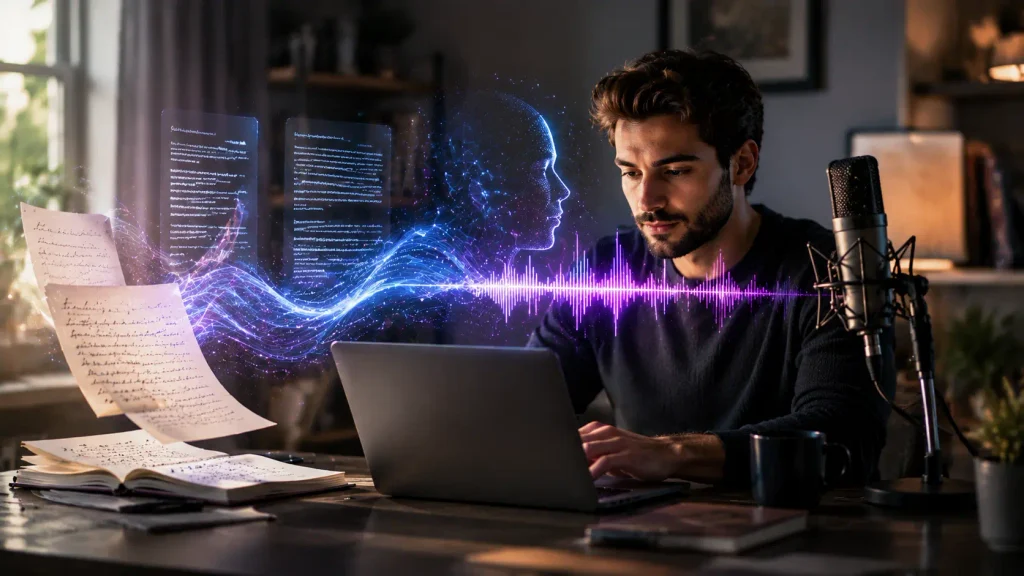
An AI narration generator is a technology-powered tool that converts written text into spoken audio using artificial intelligence and synthetic voice models.
Unlike traditional text-to-speech systems that often produce robotic-sounding voices, modern AI narration generators use advanced machine learning models to create voices with more natural pronunciation, pacing, and emotional expression.
These systems combine multiple technologies, including:
- Text-to-speech (TTS) technology
- Artificial intelligence voice models
- Natural language processing (NLP)
- Speech synthesis algorithms
- Machine learning-based voice generation
An AI narration generator can create voice content for different formats, including:
- Stories and fiction
- Audiobooks
- YouTube videos
- Podcasts
- Online courses
- Marketing videos
- Educational materials
For example, an author can transform a written story into an audio experience, while a video creator can generate professional narration for content without recording every sentence manually.
The process is simple: creators provide written content, select a suitable AI voice, customize narration settings, and generate audio that matches their audience and content style.
By reducing the technical barriers of voice production, AI narration generators allow more creators to experiment with storytelling and publish voice-based content at scale.
How Does an AI Narration Generator Work?
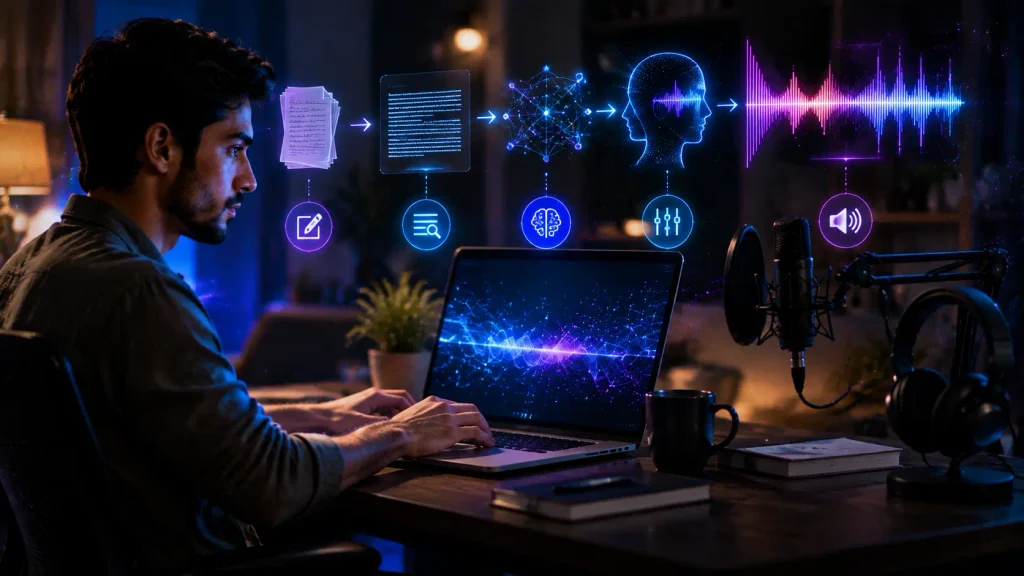
An AI narration generator follows a structured process to transform written text into realistic spoken audio. From script analysis to voice customization, artificial intelligence helps create narration that sounds natural, expressive, and suitable for different content formats.
Step 1: Upload or Write Your Script
The first step is providing the written content that needs to be converted into narration.
Creators can use different types of source material, including:
- Story scripts
- Articles and blog posts
- Books and manuscripts
- Video scripts
- Educational content
- Podcast outlines
The quality of the input text directly influences the quality of the final narration. Clear writing, proper punctuation, and well-structured sentences help AI models understand the intended flow and deliver better results.
For storytelling content, creators can also provide additional context such as:
- Character details
- Emotional tone
- Target audience
- Story atmosphere
This helps generate narration that feels more aligned with the creator’s vision.
Step 2: Choose an AI Voice
After uploading the script, creators can select an AI voice that matches the purpose and style of their content.
Voice selection typically depends on factors such as:
- Tone
- Language
- Accent
- Speaking style
- Audience
- Content category
Different voices work better for different formats:
- A warm and expressive voice for storytelling
- A professional voice for educational content
- A dramatic voice for fiction and audio dramas
- A conversational voice for podcasts
Choosing the right AI narrator helps create a stronger connection between the content and the listener.
Step 3: Generate AI Narration
Once the script and voice are selected, the AI system processes the text and converts it into spoken audio.
During this stage, the AI analyzes and generates:
- Word pronunciation
- Speech patterns
- Natural pauses
- Sentence rhythm
- Voice flow
Advanced AI narration models are designed to create voices that sound more natural by understanding the context and structure of the written content.
Instead of simply reading words aloud, modern AI narration focuses on creating a more human-like listening experience.
Step 4: Customize Voice Expression
Modern AI narration generators provide customization options that allow creators to adjust how the narration sounds.
Creators can modify elements such as:
- Speaking speed
- Voice tone
- Emotional expression
- Voice style
- Delivery style
For example:
- A suspense story may require a slower and dramatic delivery.
- An educational lesson may need a clear and professional tone.
- A children’s story may benefit from a warmer and more expressive voice.
These adjustments help creators produce narration that better matches the mood and purpose of their content.
Step 5: Edit and Publish
After generating the narration, creators can enhance the audio before publishing.
The final production stage may include:
- Adding background music
- Including sound effects
- Adjusting audio levels
- Editing pauses and transitions
- Combining multiple voice segments
Once finalized, the audio content can be distributed across multiple platforms, including:
- Audio storytelling platforms
- Websites
- Social media channels
- Video platforms
- Creator communities
With AI narration workflows, creators can move from an initial idea to a finished voice experience faster, making professional-quality audio production more accessible than ever before.
Benefits of Using an AI Narration Generator
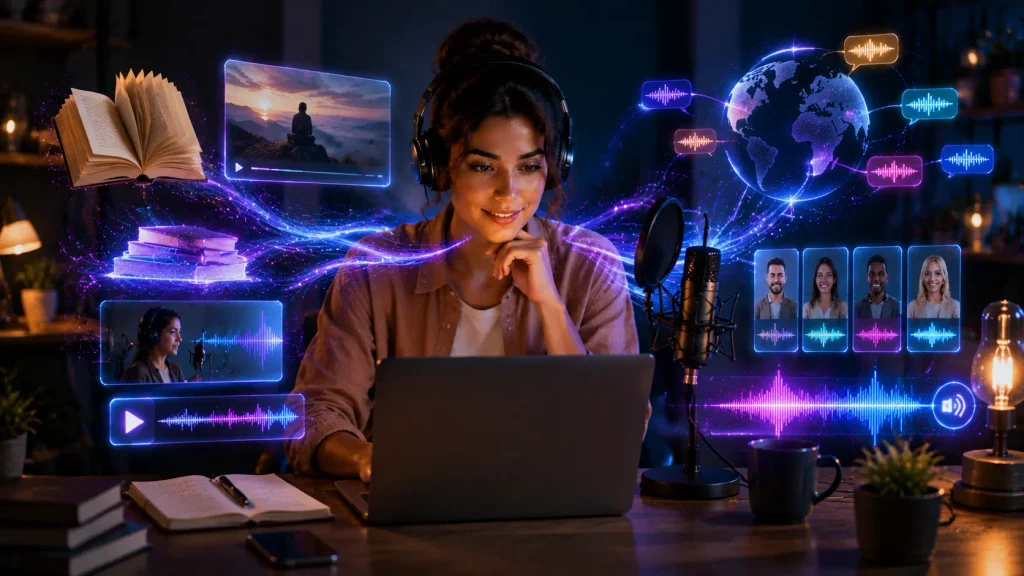
AI narration generators are changing how creators produce voice-based content by making professional-quality narration faster, more accessible, and easier to scale.
From authors creating audiobooks to video creators producing narrated content, AI-powered narration tools help reduce production barriers while giving creators more flexibility over voice styles, languages, and storytelling formats.
Create Human-Like Voice Content Faster
Traditional voice production often involves scheduling recording sessions, managing voice talent, and spending additional time on editing and post-production.
An AI narration generator simplifies this process by converting written content into realistic voice narration within minutes.
Creators can quickly transform:
- Blog posts into audio content
- Scripts into video narration
- Stories into immersive listening experiences
- Educational material into voice lessons
This faster workflow allows creators to focus more on storytelling, creativity, and audience engagement rather than spending excessive time on production tasks.
Lower Production Costs
Professional narration can involve multiple expenses, including:
- Voice actors
- Recording studios
- Audio engineers
- Editing and production teams
For many independent creators, these costs can make voice production difficult to maintain consistently.
AI narration generators provide a more accessible alternative by allowing creators to produce high-quality voice content without requiring expensive recording setups.
This makes AI narration especially useful for:
- Independent authors
- Small content teams
- Educators
- Startup creators
- Social media publishers
By reducing production costs, creators can experiment with more ideas and publish content more frequently.
Create Multiple Voice Versions
One of the biggest advantages of AI narration is the ability to experiment with different voice options.
Creators can generate multiple versions of the same content by adjusting:
- Voice personality
- Speaking style
- Tone
- Character voices
- Narration approach
For example, a storyteller can test different narration styles to find the voice that best matches a fictional world, while a brand can create different voice variations for different audiences.
This flexibility helps creators develop more engaging and personalized listening experiences.
Support Multiple Languages
AI narration generators make multilingual content creation easier by allowing creators to produce voice experiences in different languages.
This helps creators reach audiences across regions without requiring separate recording sessions for every language version.
Multilingual AI narration can support:
- Global storytelling
- Language learning content
- Educational resources
- International video content
- Regional audience engagement
By making voice content more accessible across languages, AI narration helps creators expand their reach and connect with wider communities.
Scale Content Production
Creating more voice content traditionally requires more time, resources, and production capacity.
AI narration allows creators to scale production by generating more content without increasing operational complexity.
Creators can produce:
- More audio stories
- More video narrations
- More educational lessons
- More podcast episodes
- More marketing content
This scalability is especially valuable for creators building content libraries or managing multiple publishing channels.
AI narration does not replace the creative process. Instead, it gives creators the ability to transform more ideas into finished audio experiences.
AI Narration Generator vs Traditional Voice Recording
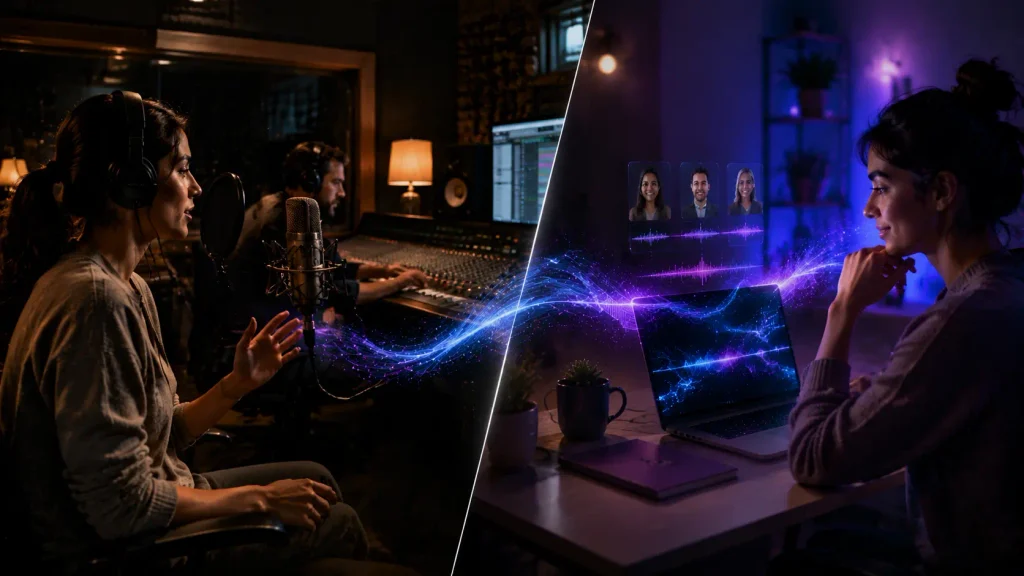
Both AI narration and traditional voice recording have unique advantages. While human narration remains valuable for emotionally complex performances, AI narration provides speed, flexibility, and accessibility for creators who need efficient voice production.
| Traditional Voice Recording | AI Narration Generator |
| Requires professional voice actors | Uses AI-generated voices |
| Requires scheduled recording sessions | Generates narration digitally |
| Higher production and studio costs | Lower production barriers |
| Longer recording and editing timelines | Faster content creation workflow |
| Limited voice availability | Multiple voice styles and options |
| Difficult to update recordings quickly | Easy to regenerate and modify content |
AI narration generators are particularly useful for creators who need scalable voice production, rapid experimentation, or multilingual content creation.
However, human narrators continue to play an important role in projects that require unique emotional interpretation, personal expression, and a distinctive performance style.
The future of voice content will likely combine both approaches — using AI narration for efficiency while preserving human creativity and storytelling expertise.
How to Create a Voice Story Using an AI Narration Generator
Creating a voice story with an AI narration generator allows creators to transform written ideas into immersive audio experiences without complex recording equipment or professional voice production workflows.
From short stories to long-form audio narratives, AI narration tools help creators move from an initial concept to a finished voice experience through a simple creation process.
Step 1: Create or Upload Your Story Script
The first step is preparing the written content that will become the voice story.
Creators can start with:
- Original story ideas
- Fiction scripts
- Blog content
- Book chapters
- Character conversations
- Story outlines
A well-structured script helps AI generate more natural narration. Adding details such as character emotions, scene descriptions, and storytelling style can further improve the final audio experience.
Step 2: Select an AI Voice
After preparing the script, creators can choose an AI voice that matches the mood and purpose of their story.
Voice selection can depend on:
- Story genre
- Audience
- Character type
- Emotional tone
- Narration style
For example:
- A deep, dramatic voice can enhance thriller stories.
- A warm, expressive voice can suit children’s stories.
- A conversational voice can work well for personal storytelling.
The right voice choice helps create stronger emotional engagement with listeners.
Step 3: Adjust Narration Settings
Modern AI narration generators allow creators to customize how the voice delivers the story.
Creators can adjust settings such as:
- Speaking speed
- Voice tone
- Pauses
- Emotional expression
- Delivery style
These adjustments help make the narration feel more natural and aligned with the story’s atmosphere.
A suspenseful story may require slower pacing, while an educational story may benefit from a clearer and more structured delivery.
Step 4: Generate Audio
Once the script and voice settings are finalized, the AI narration generator processes the content and creates the audio version.
The AI system generates:
- Voice pronunciation
- Speech rhythm
- Natural pauses
- Audio flow
Creators can preview the result and make adjustments until the narration matches their creative vision.
Step 5: Add Sound Effects
Great audio storytelling goes beyond narration.
Creators can enhance the listening experience by adding:
- Background music
- Environmental sounds
- Character effects
- Scene transitions
For example, a story set in a forest can include natural sounds, while a dramatic scene can use cinematic background elements to increase emotional impact.
Sound design helps transform simple narration into a more immersive audio experience.
Step 6: Review Quality
Before publishing, creators should review the generated audio carefully.
Important quality checks include:
- Voice pronunciation
- Pacing and timing
- Emotional delivery
- Audio clarity
- Overall storytelling flow
Editing and refinement help ensure that the final audio feels natural and engaging for listeners.
Step 7: Publish and Share
Once the voice story is complete, creators can publish it across different platforms and communities.
Creators can share their audio stories through:
- Audio platforms
- Websites
- Social media
- Creator communities
- Podcast channels
With AI narration, creators can turn written ideas into shareable voice experiences and reach audiences in new ways.
Can AI Narration Replace Human Voice Actors?
AI narration generators are not replacing all human voice actors. Instead, they are providing creators with additional tools that make voice production faster, more affordable, and easier to access.
AI narration helps creators with:
- Faster content production
- Scalable voice generation
- Testing different narration styles
- Creating multiple content versions
- Producing multilingual audio experiences
However, human voice actors continue to offer unique qualities that AI cannot fully replicate.
Human performances provide:
- Emotional interpretation
- Personal connection
- Unique personality
- Creative expression
- Authentic storytelling
A professional voice actor can bring personal experiences, subtle emotions, and performance choices that create a deeper connection with listeners.
The future of narration is not about choosing between humans and AI. Instead, it will combine human creativity with AI-assisted production, allowing creators to produce richer and more engaging voice experiences.
AI can support the storytelling process, while human imagination remains at the heart of every memorable story.
How Arré Voice Fits Into AI Narration
Most AI narration generators focus primarily on converting text into audio. However, creating meaningful voice content requires more than generating a voice — creators also need a way to share their stories, connect with listeners, and build communities.
This is where Arré Voice fits into the AI narration ecosystem.
Arré Voice focuses on helping creators complete the full storytelling journey:
Create → Share → Discover → Connect
Creators can use AI narration technology to develop voice content and use Arré Voice to:
- Share audio stories with audiences
- Reach listeners who enjoy voice-first content
- Build creator communities
- Explore new storytelling formats
- Create meaningful voice-based experiences
AI gives stories a voice.
Arré Voice helps those voices find audiences.
By combining AI-assisted creation with a platform built around discovery and connection, creators can move beyond producing audio and start building lasting relationships through storytelling.
Frequently Asked Questions
What is an AI narration generator?
An AI narration generator is a tool that converts written text into realistic spoken audio using artificial intelligence. It uses advanced voice models and text-to-speech technology to create narration for stories, audiobooks, videos, podcasts, courses, and marketing content. Creators can choose voices, adjust delivery styles, and transform written ideas into engaging audio experiences without traditional recording setups.
How does an AI narration generator work?
An AI narration generator analyzes written text and converts it into speech using artificial intelligence voice models. The system understands pronunciation, sentence structure, pacing, and tone before generating audio. Creators usually upload a script, select a voice, customize settings, and generate narration that can be edited, enhanced with sound effects, and published across different platforms.
Can AI narration sound human?
Yes, modern AI narration can sound highly realistic by using advanced voice models trained to replicate natural speech patterns, pacing, and emotional expression. However, the quality depends on the technology, voice model, and customization options available. Human editing and creative direction can further improve AI-generated narration, making it more engaging for stories, videos, podcasts, and educational content.
What is the best AI narration generator for creators?
The best AI narration generator depends on the creator’s goals, such as storytelling, audiobooks, videos, or educational content. A good tool should provide realistic voices, customization options, multiple languages, and easy content workflows. Creators should evaluate voice quality, commercial usage rights, editing features, and publishing options before selecting an AI narration platform.
Can AI narration generators create audiobooks?
Yes, AI narration generators can help authors and publishers transform written books into audiobook formats. They can convert chapters into spoken audio, provide different narration styles, and speed up production compared to traditional recording. However, creators should review generated audio carefully to ensure correct pronunciation, emotional delivery, and a listening experience that matches the book’s tone.
Can authors use AI narration for their books?
Authors can use AI narration generators to create audiobook versions, character-driven stories, and promotional audio content. AI narration allows independent writers to experiment with voice formats without requiring expensive studio recordings. Authors can combine AI-generated voices with their storytelling skills to create accessible audio experiences while maintaining control over pacing, style, and creative direction.
Is AI narration replacing voice actors?
AI narration is not replacing all voice actors but is becoming an additional tool for content creation. AI helps creators produce narration faster, test different voices, and scale audio production. Human voice actors remain valuable for projects requiring deep emotional performance, unique personality, and artistic interpretation. The future of narration will likely combine human creativity with AI assistance.
Can AI narration generate voices in different languages?
Yes, many AI narration platforms support multiple languages and accents, allowing creators to produce content for global audiences. Multilingual AI narration is useful for storytelling, education, marketing, and video content. However, creators should review translations, pronunciation, and cultural context to ensure the final narration sounds natural and appropriate for each specific audience.
Can I use an AI narration generator for YouTube videos?
Yes, AI narration generators are widely used for YouTube videos, especially for educational content, storytelling channels, documentaries, explainers, and faceless video formats. Creators can convert scripts into professional voiceovers, customize narration styles, and produce content faster. Combining AI narration with strong visuals, editing, and storytelling helps create more engaging viewer experiences.
How can I make AI narration sound more natural?
To make AI narration sound more natural, choose a suitable voice, adjust speaking speed, add pauses, and customize tone and emotion settings. Writing conversational scripts also improves results. Creators should review pronunciation, edit awkward sections, and combine narration with music or sound effects when needed to create a more immersive and human-like audio experience.
Can AI narration be used for storytelling?
Yes, AI narration is increasingly used for storytelling because it helps creators transform written ideas into immersive audio experiences. Writers can use AI voices for fiction, short stories, audio dramas, and character-based narratives. By combining AI narration with creative writing, sound design, and storytelling techniques, creators can produce engaging voice content for modern audiences.