
Why Ramayana Characters Continue to Inspire Generations
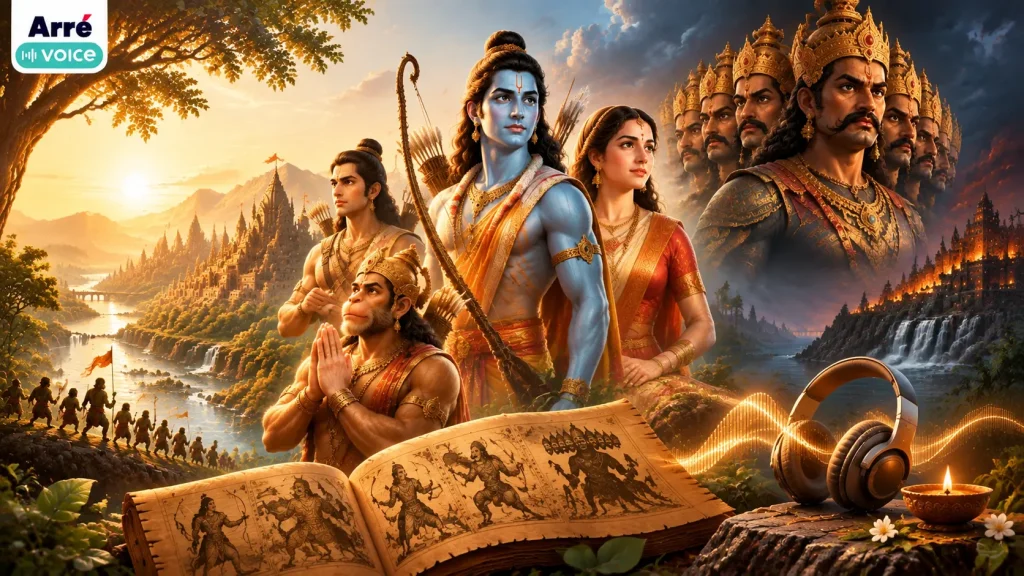
Ramayana characters are the central personalities of the ancient Indian epic Ramayana, representing human values, emotions, choices, and moral dilemmas. Characters like Rama, Sita, Hanuman, and Ravana continue to inspire generations because their journeys explore themes of duty, courage, loyalty, sacrifice, ambition, and the consequences of decisions.
The Ramayana is not remembered only because of its events, but because of the depth of its characters. Each personality represents different aspects of human nature — from righteousness and devotion to conflict, ambition, and inner struggle. These characters transform the epic from a historical and cultural narrative into a timeless exploration of human emotions.
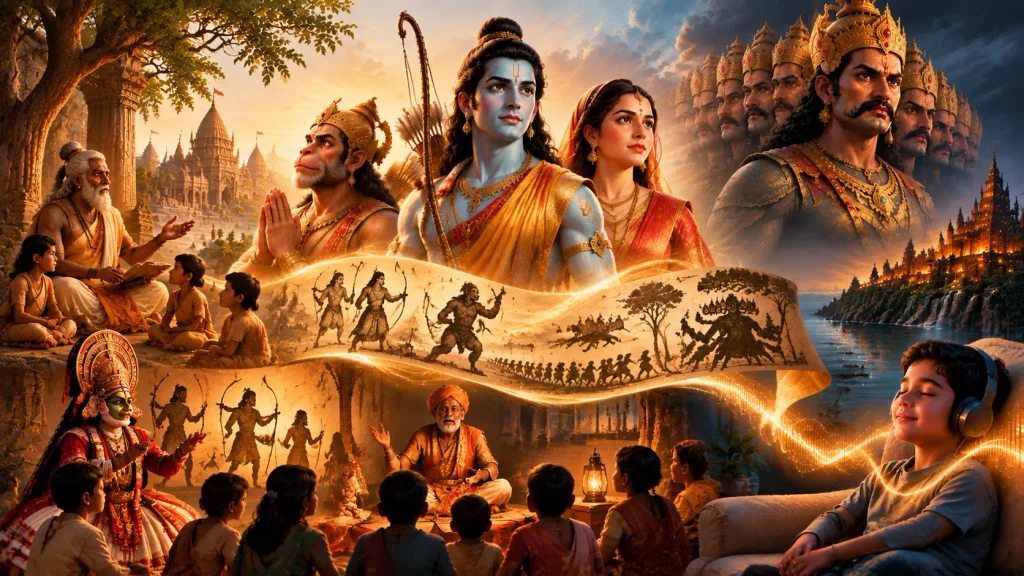
For thousands of years, Ramayana characters have been passed through generations through oral storytelling, traditional performances, scriptures, literature, television adaptations, films, and modern digital formats. Today, these stories continue to evolve through podcasts, audiobooks, and voice-based storytelling experiences that allow audiences to connect with these characters in new ways.
The Importance of Characters in Ramayana Storytelling
Stories become memorable when audiences connect with the people within them. The Ramayana remains one of the most influential storytelling traditions because its characters are not just figures in an epic narrative; they represent emotions, values, conflicts, and choices that continue to exist in human life.
The characters of Ramayana create a bridge between ancient wisdom and modern experiences. Their struggles with responsibility, relationships, power, loyalty, and morality make the epic relatable even today.
1.1 Characters as Symbols of Human Qualities
Ramayana characters represent different dimensions of human nature. Each character carries a unique set of qualities, strengths, weaknesses, and decisions that shape the story.
Rather than presenting characters as simple heroes and villains, the Ramayana explores complex human emotions. The choices made by each character reveal important ideas about responsibility, courage, devotion, leadership, and ambition.
Some of the key qualities represented by Ramayana characters include:
Dharma and Responsibility
Rama represents the importance of dharma, duty, and responsibility. His journey highlights the challenges of making difficult decisions while remaining committed to principles and values.
His character reflects the idea that leadership is not only about power but also about accountability and service.
Courage and Sacrifice
Sita and Hanuman represent different forms of courage. Sita demonstrates emotional strength and resilience while facing difficult circumstances, whereas Hanuman represents fearless action driven by devotion and purpose.
Their journeys show that courage can appear through both patience and action.
Loyalty and Devotion
Hanuman is one of the strongest examples of devotion and loyalty in the Ramayana. His dedication to Rama represents selfless service, humility, and commitment to a greater purpose.
Similarly, Lakshmana’s decision to accompany Rama during exile reflects the strength of family bonds and personal sacrifice.
Wisdom and Leadership
Several Ramayana characters demonstrate different approaches to leadership and knowledge. Rama represents ethical leadership, while Ravana represents intellectual capability combined with the dangers of uncontrolled ambition.
The contrast between these characters creates deeper conversations about how knowledge and power should be used.
Ambition and Ego
Ravana is one of the most complex characters in the Ramayana. While he is known as the antagonist, his character also represents intelligence, scholarship, power, and achievement.
His downfall highlights how ambition and ego can influence decisions when they are not balanced with wisdom and self-control.
Examples of Character Symbolism in Ramayana
| Character | Represents |
| Rama | Dharma, responsibility, leadership, integrity |
| Sita | Strength, resilience, patience, courage |
| Hanuman | Devotion, loyalty, humility, service |
| Lakshmana | Sacrifice, brotherhood, commitment |
| Ravana | Knowledge, ambition, power, ego |
Understanding these symbolic qualities is one of the reasons Ramayana characters continue to inspire storytelling across generations. Their experiences reflect universal human emotions that audiences can connect with regardless of time period or culture.
1.2 Why Ramayana Characters Remain Relevant Today
The relevance of Ramayana characters comes from their emotional depth. Although the epic originated thousands of years ago, the challenges faced by its characters remain familiar to modern audiences.
Questions about duty, relationships, personal choices, leadership, and consequences continue to exist in everyday life.
Rama’s struggle between personal happiness and responsibility reflects challenges faced by leaders and individuals today. Sita’s resilience represents the strength required to overcome adversity. Hanuman’s devotion reflects the importance of dedication and purpose. Ravana’s journey explores how intelligence and success can be affected by pride and uncontrolled desire.
Modern audiences often connect with characters more than events because characters represent emotions that feel universal. A battle, journey, or conflict becomes meaningful because of the feelings, decisions, and relationships behind it.
This character-driven approach is also why Ramayana continues to influence different forms of storytelling — from books and television to films, podcasts, and audio experiences. Through voice and narration, these personalities can gain new emotional dimensions, allowing listeners to experience their journeys in immersive ways.
Main Characters of Ramayana and Their Stories
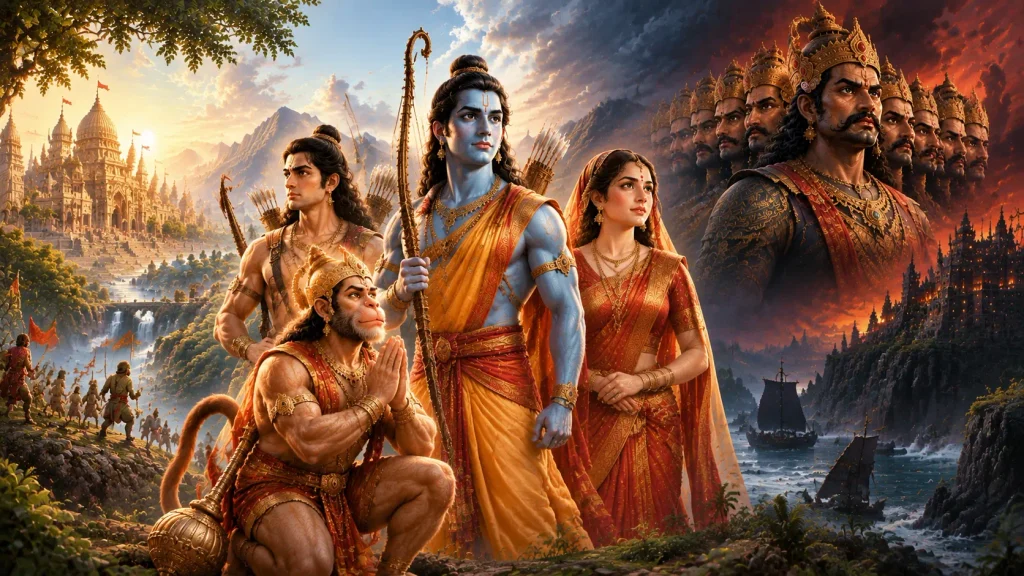
2.1 Rama: The Symbol of Dharma and Responsibility
Rama is the central figure of the Ramayana and is widely regarded as a symbol of dharma, righteousness, and responsible leadership. His journey forms the foundation of the epic, exploring the challenges of following one’s duty even during difficult circumstances.
Born as the prince of Ayodhya, Rama’s life changes when he accepts fourteen years of exile due to a promise made by his father, King Dasharatha. Instead of resisting the decision, Rama chooses to honour his father’s word and accepts the responsibility placed before him.
His journey through exile, his search for Sita, and his battle against Ravana represent themes of justice, courage, and perseverance.
Rama’s Journey From Ayodhya to Exile
Rama’s exile is one of the most significant moments in the Ramayana because it reveals his commitment to duty over personal comfort. Leaving behind his position as heir to the throne, he enters the forest with Sita and Lakshmana.
This decision demonstrates his belief that responsibility is greater than privilege.
Rama as a Leader and Protector
Rama’s leadership is based on fairness, compassion, and accountability. He is not portrayed only as a powerful warrior but also as a leader who considers the responsibilities that come with authority.
His character represents the idea that true leadership requires discipline, empathy, and ethical decision-making.
Meaning of Dharma Through Rama’s Character
Through Rama, the Ramayana explores the complexity of dharma. Following one’s duty is not always easy, and moral choices often involve sacrifice.
His character continues to inspire discussions about leadership, values, and decision-making because these challenges remain relevant in modern society.
Key themes represented by Rama:
- Responsibility
- Integrity
- Leadership
- Decision-making
2.2 Sita: The Symbol of Strength and Resilience
Sita is one of the most significant characters in the Ramayana and represents inner strength, resilience, and emotional courage. Her journey highlights the ability to face challenges with dignity and determination.
Often remembered as Rama’s wife, Sita’s character extends beyond her relationship with him. Her experiences represent independence, patience, strength during adversity, and the ability to maintain inner confidence despite difficult situations.
Sita’s Journey and Challenges
Sita’s life changes dramatically after her abduction by Ravana, leading to one of the most important conflicts in the Ramayana. Her time in Lanka tests her emotional strength and determination.
Despite facing uncertainty, Sita remains firm in her beliefs and demonstrates resilience throughout her journey.
Understanding Sita Beyond Traditional Interpretations
Modern interpretations of Sita often explore her character from different perspectives, focusing on her courage, emotional strength, and individuality.
Her story continues to inspire discussions around identity, resilience, and the experiences of women in storytelling traditions.
Key themes represented by Sita:
- Resilience
- Independence
- Patience
- Inner strength
2.3 Hanuman: The Devoted Warrior of Ramayana
Hanuman is one of the most beloved characters in the Ramayana and represents devotion, courage, loyalty, and selfless service. His character combines extraordinary strength with humility.
His relationship with Rama is considered one of the most powerful examples of dedication in Indian storytelling traditions.
Hanuman’s Relationship With Rama
Hanuman’s devotion to Rama goes beyond loyalty. It represents complete dedication to a purpose and willingness to serve without seeking personal recognition.
Hanuman’s Role in Lanka
Hanuman plays a crucial role during Rama’s search for Sita. His journey to Lanka demonstrates courage, intelligence, and determination.
His actions show that strength becomes meaningful when it is guided by purpose and compassion.
Strength Combined With Humility
Despite possessing immense abilities, Hanuman remains humble. This combination of power and humility is one of the reasons his character continues to inspire generations.
Key themes represented by Hanuman:
- Devotion
- Courage
- Loyalty
- Service
2.4 Lakshmana: The Representation of Loyalty and Sacrifice
Lakshmana represents loyalty, brotherhood, and sacrifice in the Ramayana. His decision to accompany Rama during exile demonstrates his deep commitment and dedication.
Rather than remaining in the comfort of Ayodhya, Lakshmana chooses to share Rama’s hardships and protect him throughout the journey.
Lakshmana’s Relationship With Rama
The bond between Rama and Lakshmana represents one of the strongest examples of brotherhood in storytelling.
Lakshmana’s actions reflect unconditional support and responsibility toward family.
Lakshmana as Protector
During exile, Lakshmana serves as Rama’s companion and protector. His role highlights the importance of commitment and standing beside loved ones during difficult times.
Key themes represented by Lakshmana:
- Brotherhood
- Commitment
- Sacrifice
2.5 Ravana: The Complex Character Behind the Conflict
Ravana is one of the most complex characters in the Ramayana. While he is the primary antagonist of the epic, his character represents a combination of intelligence, power, knowledge, and ambition.
Understanding Ravana only as a villain overlooks the complexity of his personality and the lessons his story provides.
Ravana as a Scholar, King, and Warrior
Ravana is described as a powerful ruler of Lanka and a knowledgeable individual. His intelligence, leadership abilities, and achievements make him a unique character within the epic.
However, his strengths are challenged by his pride, desires, and decisions.
Knowledge and Ambition in Ravana’s Character
Ravana’s story explores the relationship between knowledge and wisdom. The Ramayana presents the idea that intelligence and power must be balanced with humility and ethical choices.
How Ambition and Ego Shaped His Downfall
Ravana’s downfall represents the consequences of uncontrolled ambition and ego. His inability to overcome personal desires ultimately leads to conflict and destruction.
His character remains important because it presents a deeper understanding of human weaknesses and the choices that shape destiny.
Key themes represented by Ravana:
- Intelligence
- Power
- Desire
- Consequences of choices
Supporting Characters of Ramayana and Their Lessons
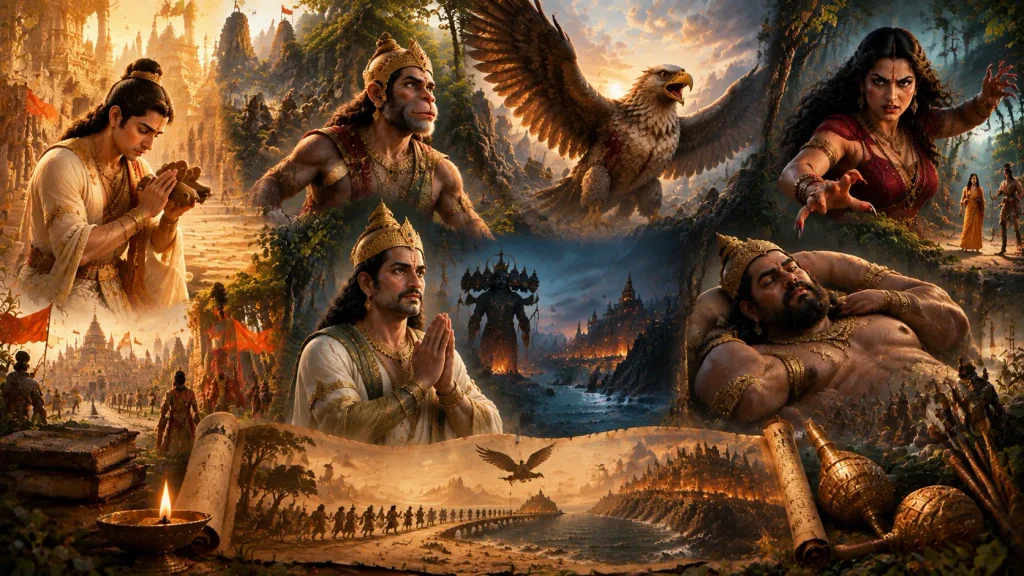
While Rama, Sita, Hanuman, Lakshmana, and Ravana form the central narrative of the Ramayana, the epic’s emotional depth comes from its supporting characters. These individuals represent different human choices, conflicts, and values.
Characters like Bharata, Vibhishana, Kumbhakarna, Sugriva, Jatayu, and Shurpanakha show that the Ramayana is not only a story of good versus evil but also a reflection of complex human emotions, relationships, responsibilities, and moral decisions.
Each supporting character contributes a different perspective on leadership, loyalty, courage, and the consequences of choices.
3.1 Bharata: Choosing Responsibility Over Power
Bharata is one of the most respected characters in the Ramayana because his journey represents selflessness, responsibility, and the true meaning of leadership.
He is the son of King Dasharatha and Queen Kaikeyi and the younger brother of Rama. Although Bharata was entitled to become the king of Ayodhya after Kaikeyi’s demand sent Rama into exile, he rejected the throne because he believed that Rama was the rightful ruler.
His character highlights an important lesson: leadership is not about possessing power but about accepting responsibility.
Bharata’s Relationship With Rama
Bharata and Rama share a relationship built on love, respect, and brotherhood. Unlike conflicts often seen between siblings competing for authority, Bharata considers Rama his guide and elder brother.
When Bharata learns that Rama has been sent into exile because of Kaikeyi’s wishes, he is deeply hurt. He does not celebrate the opportunity to become king; instead, he sees the situation as an injustice against Rama.
His response demonstrates:
- Respect for family values
- Emotional maturity
- Commitment to righteousness
Bharata’s actions show that true relationships are built on trust and values rather than personal gain.
Bharata’s Refusal of the Throne
When Bharata returns to Ayodhya and discovers what has happened, he refuses to accept the crown. He travels to the forest to request Rama’s return and restore him as the rightful king.
However, Rama chooses to honour their father Dasharatha’s promise and continues his exile.
As a symbol of his loyalty, Bharata places Rama’s sandals on the throne and rules Ayodhya as a caretaker until Rama returns.
This moment represents one of the greatest examples of leadership without attachment to power.
Lessons From Bharata’s Character
Bharata’s story teaches important lessons about responsible leadership:
- Power should be treated as a responsibility, not a privilege.
- Personal ambition should not overcome moral values.
- True leaders respect fairness and justice.
- Sacrifice can be a greater expression of strength than authority.
In modern storytelling, Bharata represents the idea that leadership is defined by character, not position.
3.2 Vibhishana: Choosing Truth Over Loyalty
Vibhishana, the younger brother of Ravana, is one of the most complex characters in the Ramayana. His story explores the difficult choice between family loyalty and moral responsibility.
While he belongs to the kingdom of Lanka and is part of Ravana’s family, Vibhishana does not support Ravana’s actions when he believes they violate righteousness.
His character raises an important question:
Should loyalty always come before truth?
The Ramayana presents Vibhishana’s choice as an example of choosing values over personal relationships.
Vibhishana’s Role in Lanka
Vibhishana is portrayed as a wise and thoughtful individual who advises Ravana to follow the path of righteousness.
Unlike Ravana, who is driven by pride and desire, Vibhishana understands the consequences of actions. He repeatedly advises Ravana to return Sita to Rama and avoid conflict.
However, Ravana refuses to listen.
Vibhishana’s role highlights the contrast between:
- Wisdom and arrogance
- Moral responsibility and personal ambition
- Peace and unnecessary conflict
Vibhishana’s Decision to Support Righteousness
When Ravana ignores his advice, Vibhishana leaves Lanka and seeks refuge with Rama.
This decision is controversial because it means leaving his own family and kingdom. However, Vibhishana believes that supporting injustice is worse than standing against someone close to him.
His choice represents:
- Courage to speak against wrongdoing
- Importance of ethical decisions
- Commitment to truth
Conflict Between Family and Values
Vibhishana’s story reflects a universal human conflict. Many people face situations where personal relationships and personal values come into disagreement.
His character teaches that:
- Loyalty should not justify harmful actions.
- Doing what is right may require difficult choices.
- Moral courage often requires sacrifice.
Vibhishana represents the idea that integrity sometimes requires standing alone.
3.3 Kumbhakarna: The Warrior Between Duty and Conflict
Kumbhakarna, the younger brother of Ravana, is one of the most fascinating characters in the Ramayana. Often remembered only as a powerful warrior who slept for long periods, his character represents a deeper conflict between duty, loyalty, and moral awareness.
Unlike a simple villainous character, Kumbhakarna is portrayed as someone who understands the consequences of Ravana’s actions but remains connected to his responsibilities as a brother and warrior.
Kumbhakarna’s Personality
Kumbhakarna is known for his immense physical strength and loyalty. He is one of Lanka’s greatest warriors and plays a significant role during the battle between Rama and Ravana.
However, his character also reflects wisdom and awareness. He recognizes that Ravana’s decision to abduct Sita has created a dangerous situation for Lanka.
Despite understanding this mistake, Kumbhakarna chooses to fight because of his loyalty towards his brother and his duty as a warrior.
His Loyalty Towards Ravana
Kumbhakarna’s relationship with Ravana demonstrates the complexity of loyalty.
He does not blindly support every decision Ravana makes. Instead, he acknowledges Ravana’s mistake but chooses to stand beside him during the conflict.
This creates a powerful character dilemma:
- Should someone support family even when they are wrong?
- Can duty conflict with personal beliefs?
Understanding Kumbhakarna’s Complexity
Kumbhakarna represents the grey areas within human decisions. His story shows that individuals can recognise wrongdoing while still being influenced by duty, relationships, and circumstances.
Lessons from Kumbhakarna include:
- Loyalty requires wisdom.
- Strength must be guided by judgment.
- Difficult choices often involve competing responsibilities.
His character adds emotional complexity to the Ramayana by showing that every individual is shaped by multiple motivations.
3.4 Sugriva: Friendship, Trust, and Leadership
Sugriva plays an important role in the Ramayana as the king of the Vanara kingdom and a key ally of Rama. His journey represents friendship, overcoming insecurity, and learning the responsibilities of leadership.
His alliance with Rama becomes one of the most important partnerships in the epic.
Sugriva and Rama’s Alliance
Sugriva meets Rama during his exile when both characters are facing personal challenges.
Sugriva has lost his kingdom of Kishkindha to his brother Vali and seeks help to regain his rightful position. Rama agrees to support Sugriva, and in return, Sugriva promises to help Rama find Sita.
Their relationship is built on mutual trust and shared purpose.
This alliance demonstrates:
- The power of friendship
- Importance of mutual support
- Strength created through collaboration
Sugriva’s Journey as a Leader
After becoming king, Sugriva must transition from someone seeking help to someone responsible for guiding others.
His journey shows that leadership requires more than gaining authority. It requires:
- Accountability
- Decision-making
- Responsibility towards others
Through his experiences, Sugriva learns the importance of fulfilling promises and supporting those who trust him.
Importance of Friendship in the Epic
Sugriva’s relationship with Rama highlights how meaningful alliances can change the course of events.
The Ramayana shows that friendships based on trust and shared values can help individuals overcome challenges that seem impossible.
Sugriva represents:
- The importance of loyal friendships
- Growth through challenges
- Leadership developed through experience
3.5 Jatayu: Courage Beyond Strength
Jatayu, the elderly vulture king, represents courage, sacrifice, and the willingness to protect others despite limitations.
Although he is not a warrior with great physical power like Hanuman or Rama, his actions make him one of the most memorable characters in the Ramayana.
Jatayu’s Sacrifice
During Sita’s abduction by Ravana, Jatayu attempts to rescue her. Despite his age and Ravana’s immense power, he challenges Ravana to protect Sita.
Jatayu knows that the battle is dangerous, but he chooses to act because he believes protecting righteousness is more important than personal safety.
His sacrifice represents:
- Courage in difficult situations
- Standing against injustice
- Selfless action
His Role in Protecting Sita
Although Jatayu is unable to defeat Ravana, his attempt becomes significant. Before losing his life, he informs Rama about Sita’s abduction and provides important information for the search.
His contribution proves that success is not always measured by victory. Sometimes, courage itself becomes the greatest achievement.
Lesson of Courage Despite Limitations
Jatayu teaches that bravery does not depend only on strength or ability.
His story shows:
- Anyone can make a meaningful difference.
- Age or limitations should not prevent people from doing what is right.
- True courage comes from compassion and responsibility.
Jatayu remains a symbol of sacrifice and moral courage.
3.6 Shurpanakha: The Character Behind the Turning Point
Shurpanakha, the sister of Ravana, is one of the most discussed characters in the Ramayana because her actions become a major turning point in the story.
Her encounter with Rama, Sita, and Lakshmana eventually leads to events that escalate into the conflict between Rama and Ravana.
However, understanding Shurpanakha only as a negative character overlooks the complexity of her role within the narrative.
Role of Shurpanakha in Ramayana
Shurpanakha’s interaction with Rama and Lakshmana during their exile becomes a critical moment in the epic.
Her rejection and the events that follow influence Ravana’s decision to abduct Sita, creating the central conflict of the Ramayana.
Her character represents themes such as:
- Desire and emotion
- Personal choices and consequences
- The impact of individual actions on larger events
Understanding Motivations Behind Conflicts
Shurpanakha’s character provides an opportunity to explore how personal emotions can influence major events.
The Ramayana often presents characters with complex motivations rather than simple categories of good and evil.
Her actions raise questions about:
- How emotions influence decisions
- How personal conflicts become larger struggles
- How perspectives change the interpretation of characters
Character Perspective Beyond Traditional Narratives
Modern interpretations of the Ramayana often examine Shurpanakha from different perspectives, exploring her emotions, identity, and role beyond the traditional portrayal.
This approach helps audiences understand mythology as a living storytelling tradition where characters can be analysed through different cultural and social viewpoints.
Shurpanakha’s role reminds us that even smaller characters can have a significant impact on the direction of a story.
Ramayana Character Relationships Explained
The Ramayana is not only a story about battles, kingdoms, and moral choices. At its core, it is a story about relationships. The bonds between characters reveal some of the most powerful themes of human life: love, loyalty, sacrifice, responsibility, trust, and the consequences of choices.
The relationships in the Ramayana make the characters more relatable because they represent emotions and situations that continue to exist in modern society.
4.1 Rama and Sita: Partnership, Values, and Challenges
The relationship between Rama and Sita is one of the most significant relationships in the Ramayana. Their journey represents love, commitment, shared responsibilities, and the challenges faced during difficult circumstances.
Their relationship is often explored through different interpretations, but at its core, it reflects the connection between two individuals navigating duty, personal challenges, and social responsibilities.
Relationship Dynamics Between Rama and Sita
Rama and Sita’s relationship begins with their marriage in Mithila and continues through some of the most challenging moments of their lives.
Sita chooses to accompany Rama during his exile, leaving behind the comfort of palace life. Her decision represents companionship and commitment, showing that their relationship extends beyond happiness and prosperity.
Their bond reflects:
- Mutual respect
- Emotional connection
- Shared responsibilities
- Commitment during difficult times
Their journey demonstrates that relationships are often tested during moments of uncertainty.
Shared Responsibilities
Rama and Sita represent different forms of responsibility throughout the epic.
Rama’s responsibilities include:
- Following his father’s promise
- Protecting his people
- Upholding his understanding of dharma
Sita’s responsibilities include:
- Standing beside Rama during exile
- Facing challenges with courage
- Maintaining strength during difficult circumstances
Their characters show that responsibility in relationships involves supporting each other while facing external challenges.
Emotional Challenges in Their Journey
The relationship between Rama and Sita experiences several emotional challenges, including exile, separation, and difficult decisions.
Sita’s abduction by Ravana becomes one of the most painful turning points in their journey. Rama’s search for Sita represents determination and commitment, while Sita’s resilience during her captivity reflects emotional strength.
Their story continues to inspire discussions about:
- Love during adversity
- Personal strength
- The balance between individual emotions and social responsibilities
Through their journey, Rama and Sita remain central figures in discussions about relationships, values, and human emotions.
4.2 Rama and Hanuman: The Bond Between Leader and Devotee
The relationship between Rama and Hanuman represents one of the most celebrated bonds in the Ramayana. It reflects trust, loyalty, devotion, and selfless service.
Unlike relationships based on power or personal benefit, Rama and Hanuman’s connection is built on respect and a shared commitment to a greater purpose.
Trust Between Rama and Hanuman
Hanuman’s first meeting with Rama becomes the foundation of a relationship built on understanding and trust.
Rama recognizes Hanuman’s intelligence, courage, and dedication, while Hanuman sees Rama as an ideal leader worthy of complete devotion.
Their relationship demonstrates that true leadership is not based only on authority but also on inspiring trust and respect.
Loyalty and Devotion
Hanuman’s loyalty towards Rama is one of the most powerful examples of devotion in Indian storytelling.
His actions include:
- Helping Rama search for Sita
- Crossing the ocean to reach Lanka
- Delivering Rama’s message to Sita
- Supporting Rama during the battle against Ravana
Hanuman’s devotion is not passive. It is expressed through courage, action, and dedication.
Service as a Form of Strength
Hanuman represents the idea that true strength comes from using abilities to serve others.
His character combines:
- Physical power with humility
- Intelligence with devotion
- Courage with discipline
The relationship between Rama and Hanuman teaches that meaningful connections are built through trust, respect, and selfless contribution.
4.3 Rama and Lakshmana: Brotherhood and Sacrifice
The relationship between Rama and Lakshmana represents one of the strongest examples of sibling loyalty in the Ramayana.
Their bond reflects unconditional support, sacrifice, and the importance of standing beside loved ones during challenging times.
Family Bonds Between Rama and Lakshmana
Lakshmana considers Rama not only his elder brother but also his guide and ideal.
When Rama is sent into exile, Lakshmana chooses to accompany him despite having no obligation to do so.
His decision reflects:
- Deep affection
- Loyalty towards family
- Commitment to shared responsibilities
Their relationship demonstrates how family bonds can become a source of strength during difficult situations.
Commitment Through Exile
During the fourteen years of exile, Lakshmana dedicates himself to protecting and supporting Rama and Sita.
He leaves behind the comfort of palace life and accepts the hardships of forest life.
His commitment represents:
- Sacrifice without expectation
- Responsibility towards loved ones
- Strength through loyalty
Lakshmana’s role shows that support often requires personal sacrifice.
Shared Responsibilities
Although Rama is the central figure of the journey, Lakshmana plays a crucial role by standing beside him throughout the challenges they face.
Their relationship highlights that great journeys are rarely completed alone.
The bond between Rama and Lakshmana teaches:
- The importance of trust between siblings
- Supporting others during hardship
- Sharing responsibilities in difficult circumstances
4.4 Ravana and Vibhishana: Two Different Paths
The relationship between Ravana and Vibhishana presents one of the most important contrasts in the Ramayana.
Although they are brothers from the same family, their choices lead them toward completely different paths.
Their story explores the conflict between family loyalty, personal values, ambition, and morality.
Same Family, Different Choices
Ravana and Vibhishana share the same background, upbringing, and family identity. However, their personalities and decisions are very different.
Ravana is known for:
- Great knowledge
- Powerful leadership
- Ambition
- Pride
Vibhishana is known for:
- Wisdom
- Righteousness
- Ethical thinking
- Seeking peace
Their contrast shows that individuals are shaped not only by circumstances but also by their choices.
Values Versus Ambition
Ravana’s downfall is often connected to his inability to control his ambition and ego.
Despite his intelligence and achievements, his desire for power leads him towards destructive decisions.
Vibhishana, on the other hand, chooses to follow what he believes is right, even when it means opposing his own brother.
Their relationship teaches:
- Knowledge must be guided by wisdom.
- Family loyalty should not support wrongdoing.
- Personal values influence the direction of life.
The contrast between Ravana and Vibhishana makes the Ramayana’s exploration of morality more complex and meaningful.
Ramayana Characters and Their Life Lessons
The characters of the Ramayana continue to inspire audiences because their journeys reflect universal human experiences. Their struggles, decisions, strengths, and weaknesses offer lessons that remain relevant across generations.
From Rama’s commitment to responsibility to Hanuman’s devotion and Ravana’s warnings about unchecked ambition, each character represents important aspects of human behaviour.
5.1 Lessons From Rama
Rama is often remembered as a symbol of dharma, responsibility, and ethical leadership. His journey presents lessons about making difficult decisions while staying committed to personal values.
Responsibility Before Comfort
One of the most important lessons from Rama’s character is choosing responsibility over personal comfort.
When Rama accepts exile to honour his father’s promise, he places duty above his own desires.
This teaches:
- Responsibilities often require sacrifice.
- Strong values guide difficult decisions.
- Personal challenges can be faced with dignity.
Leadership Through Values
Rama’s leadership is not only based on authority but also on fairness, compassion, and responsibility.
His character represents leadership qualities such as:
- Integrity
- Patience
- Respect for others
- Decision-making under pressure
The Ramayana presents leadership as a responsibility towards people rather than a position of power.
Staying Committed to Principles
Throughout the epic, Rama faces situations that test his values.
His commitment to dharma demonstrates the importance of maintaining principles even during difficult circumstances.
The lesson from Rama’s journey is that character is revealed through choices made during challenges.
5.2 Lessons From Sita
Sita represents strength, resilience, and emotional courage. Her journey demonstrates how inner strength can help individuals face difficult circumstances.
Strength During Adversity
Sita experiences some of the most challenging situations in the Ramayana, including separation from Rama and captivity in Lanka.
Despite these difficulties, she maintains courage and dignity.
Her character teaches:
- Strength is not always physical.
- Emotional resilience helps overcome challenges.
- Self-belief provides stability during hardship.
Emotional Resilience
Sita’s journey highlights the importance of remaining strong during uncertain situations.
Her ability to endure challenges represents:
- Patience
- Confidence
- Inner courage
Her story continues to inspire conversations about resilience and personal strength.
Courage Through Challenges
Sita’s character shows that courage can exist in moments of vulnerability.
Her strength comes from her ability to remain firm in her beliefs despite difficult circumstances.
She represents the idea that overcoming challenges requires both emotional and mental strength.
5.3 Lessons From Hanuman
Hanuman is one of the most beloved characters in the Ramayana because he represents devotion, courage, humility, and selfless service.
His character demonstrates that true power comes from using abilities for a meaningful purpose.
Humility With Power
Despite possessing extraordinary strength, Hanuman remains humble.
He does not seek recognition or personal reward. Instead, he uses his abilities to support Rama’s mission.
This teaches:
- Power should be combined with humility.
- True greatness comes from helping others.
- Strength becomes meaningful when used responsibly.
Devotion and Dedication
Hanuman’s devotion towards Rama represents complete dedication to a purpose.
His actions show:
- Commitment
- Discipline
- Faith
- Determination
His journey demonstrates how dedication can overcome seemingly impossible challenges.
Selfless Service
Hanuman’s greatest strength is his willingness to serve without expecting anything in return.
His character teaches that meaningful contributions often come from a desire to help rather than personal recognition.
Hanuman remains a symbol of:
- Courage
- Loyalty
- Service
- Purpose-driven action
5.4 Lessons From Ravana
Ravana is one of the most complex characters in the Ramayana. While often remembered as the antagonist, his character also represents intelligence, knowledge, ambition, and the dangers of uncontrolled desire.
His story provides important lessons about balance between achievement and wisdom.
Importance of Controlling Ambition
Ravana’s intelligence and abilities make him a powerful figure, but his ambition eventually leads to his downfall.
His story teaches:
- Ambition requires discipline.
- Desire without control can create destruction.
- Success must be balanced with responsibility.
Knowledge Without Wisdom
Ravana is known as a scholar with deep knowledge, but knowledge alone does not guarantee good decisions.
His character demonstrates that:
- Intelligence must be guided by ethics.
- Knowledge without humility can become harmful.
- Wisdom is required to use power correctly.
Consequences of Ego
Ravana’s pride prevents him from accepting advice and recognising his mistakes.
His refusal to change his decisions leads to conflict and destruction.
His story reminds audiences that:
- Ego can affect judgment.
- Power without self-awareness can become dangerous.
- True greatness requires humility.
Ravana’s character makes the Ramayana more than a simple battle between good and evil. It becomes a reflection on human strengths, weaknesses, and the consequences of choices.
Ramayana Characters in Indian Storytelling Traditions
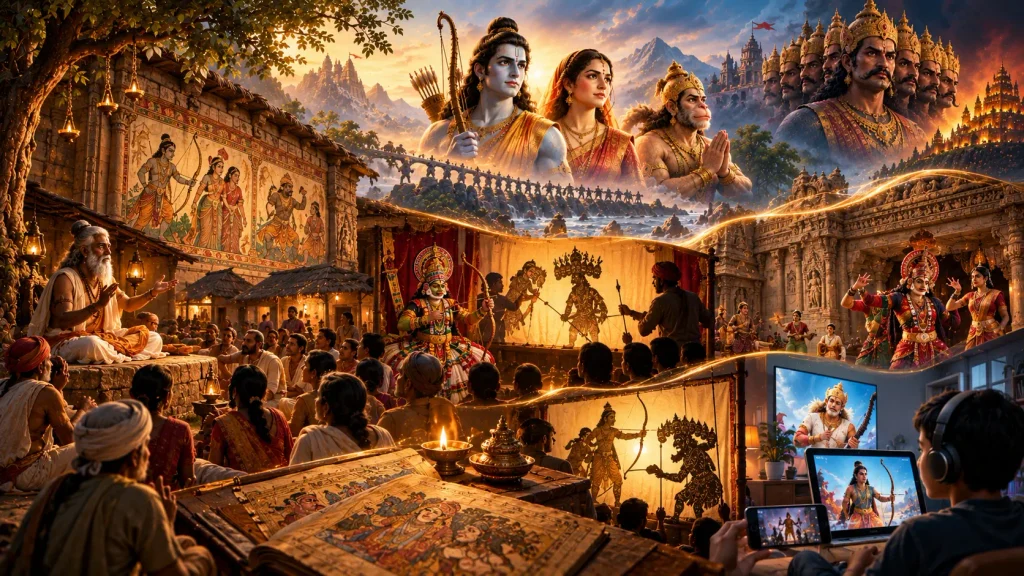
The characters of the Ramayana have survived for thousands of years because they were never limited to a single written text. They continued to evolve through oral traditions, regional performances, folk arts, and cultural interpretations across India.
From village storytellers narrating episodes of Rama’s journey to modern digital platforms recreating these characters through audio and visual experiences, the Ramayana has remained a living storytelling tradition.
The voices, emotions, and performances associated with these characters have helped generations connect with their values, struggles, and human qualities.
Oral Storytelling Traditions and the Preservation of Ramayana Characters
Before books and digital media, the Ramayana was primarily preserved through oral storytelling traditions. Storytellers, spiritual teachers, and performers passed the epic from one generation to another through narration.
These storytelling practices focused not only on events but also on the emotions and personalities of the characters.
For example:
- Rama’s character was presented through themes of duty, leadership, and righteousness.
- Sita’s journey highlighted resilience, patience, and inner strength.
- Hanuman’s stories emphasised devotion, courage, and selfless service.
- Ravana’s character explored intelligence, power, and the consequences of uncontrolled ambition.
Through voice modulation, expressions, and dramatic narration, storytellers transformed these characters from historical or mythological figures into emotionally relatable personalities.
Regional Interpretations of Ramayana Characters
One of the reasons Ramayana characters remain culturally significant is the diversity of regional interpretations across India.
Different regions have adapted the characters according to their own languages, traditions, artistic styles, and cultural perspectives.
Examples include:
- Different versions of Rama’s journey in regional languages
- Local interpretations of Sita’s character and experiences
- Unique portrayals of Hanuman’s devotion and strength
- Folk narratives exploring lesser-known characters and episodes
These variations show that Ramayana characters are not static figures. They continue to gain new meanings based on the communities that preserve and retell their stories.
Folk Performances and Cultural Adaptations
Ramayana characters have been brought to life through various traditional performance forms, including:
- Theatre performances
- Folk dramas
- Puppet shows
- Dance traditions
- Religious storytelling events
Performances such as these use voice, music, costumes, and expressions to create deeper emotional connections with audiences.
A character like Ravana, for example, is often portrayed not only as an antagonist but also as a powerful king, scholar, and complex personality. Such interpretations encourage audiences to explore characters beyond simple definitions of good and evil.
The Role of Voice and Performance in Preserving Characters
Voice has always played an important role in keeping Ramayana characters alive.
A storyteller’s voice can communicate:
- Rama’s calm leadership
- Hanuman’s energy and devotion
- Sita’s emotional strength
- Ravana’s authority and complexity
Through narration and performance, audiences experience the emotions behind the characters rather than simply knowing their actions.
This connection between voice and storytelling continues today through podcasts, audiobooks, and digital audio platforms, where character-driven narratives create immersive experiences for modern listeners.
Know more about
→ Indian Storytelling Traditions
Ramayana Characters in Modern Entertainment and Digital Media
The way audiences experience Ramayana characters has evolved significantly with changes in media and technology.
While traditional storytelling relied on oral narration and performances, modern audiences discover these characters through books, television, films, animation, podcasts, audiobooks, and digital storytelling platforms.
Despite changes in format, the emotional foundation of these characters remains the same. Their conflicts, relationships, and values continue to connect with audiences across generations.
7.1 From Ancient Narration to Modern Adaptations
Ramayana characters have been adapted into multiple forms of entertainment, allowing new audiences to discover their stories.
Modern adaptations include:
- Books and illustrated stories: Making characters accessible through written narratives and visual interpretations.
- Television series: Bringing emotional performances and character relationships into homes across generations.
- Films and animation: Using cinematic techniques to recreate epic worlds and memorable personalities.
- Podcasts and audiobooks: Allowing audiences to experience mythology through narration and voice-based storytelling.
Each adaptation introduces the characters to a different audience while preserving their core themes.
For example:
- Rama continues to represent leadership and responsibility.
- Sita continues to inspire conversations about strength and resilience.
- Hanuman remains a symbol of devotion and courage.
- Ravana continues to create discussions around knowledge, power, and ambition.
7.2 Why Character-Based Storytelling Works
Characters are often the strongest reason audiences connect with stories.
Events may explain what happened, but characters help audiences understand why it matters.
Ramayana characters remain memorable because they represent universal human emotions:
- Love and relationships
- Loyalty and sacrifice
- Conflict and choices
- Strength during challenges
- The consequences of decisions
Character-driven storytelling allows audiences to see parts of their own experiences reflected in fictional or mythological figures.
This is why stories centred around Rama, Sita, Hanuman, and Ravana continue to remain relevant even in modern entertainment formats.
Strong characters create emotional connections that go beyond time, culture, and technology.
Bringing Ramayana Characters to Life Through Audio Storytelling
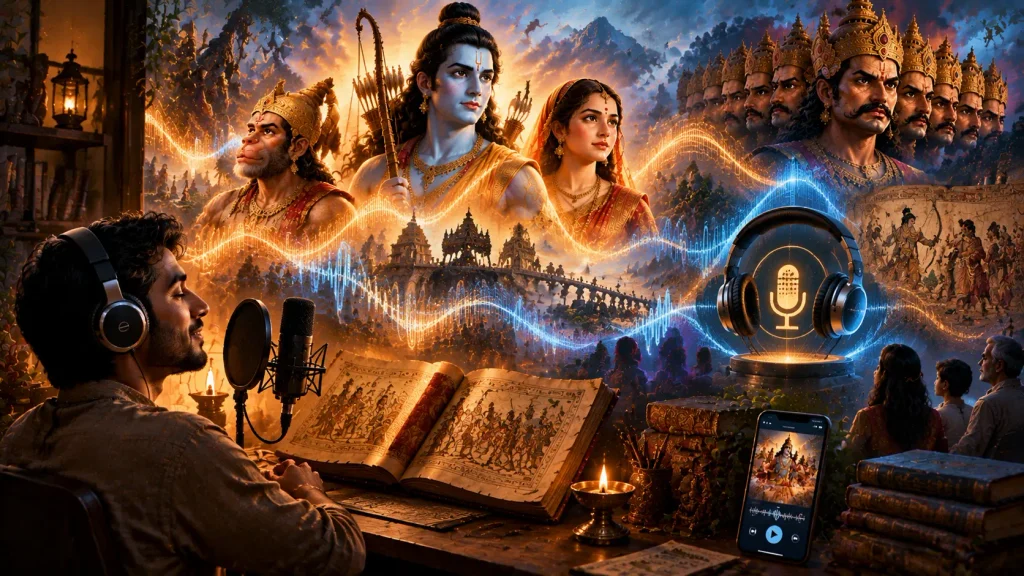
Audio storytelling creates a unique opportunity to experience Ramayana characters through imagination, emotion, and voice.
Unlike visual formats, audio allows listeners to create their own mental images while focusing deeply on narration, dialogue, and emotional expression.
For mythology-based storytelling, voice becomes a powerful tool to communicate the personality and depth of each character.
8.1 Why Voice Makes Mythological Characters More Powerful
Voice adds personality to characters by expressing emotions that written words alone may not fully capture.
A carefully crafted voice can communicate:
- Character identity
- Emotional state
- Personality traits
- Relationships between characters
For example:
Rama’s voice can represent:
- Calmness during difficult decisions
- Leadership and responsibility
- Compassion and balance
Hanuman’s voice can represent:
- Energy and devotion
- Courage during challenges
- Humility despite immense strength
Ravana’s voice can represent:
- Intelligence and authority
- Confidence and power
- The complexity of a character driven by ambition
Through voice, listeners do not just understand characters; they experience their emotions.
8.2 Creating Character-Based Mythological Audio Experiences
Creating immersive audio experiences requires combining storytelling techniques with creative production elements.
Important elements include:
Script Writing
A strong script helps define:
- Character personalities
- Emotional moments
- Dialogue flow
- Story progression
Character Voices
Voice design helps distinguish characters by highlighting:
- Personality
- Background
- Emotional expressions
- Individual identity
Dialogue Creation
Meaningful dialogues help reveal:
- Character motivations
- Internal conflicts
- Relationships between characters
Sound Effects and Atmosphere
Background sounds and audio design create a richer storytelling environment.
Examples:
- Forest environments during exile narratives
- Battle sounds during conflicts
- Emotional music during important moments
Emotional Narration
Narration connects listeners with the deeper meaning behind the story by focusing on:
- Feelings
- Conflicts
- Lessons
- Character journeys
Modern audio platforms and AI-powered voice technologies are creating new possibilities for bringing mythological characters to life through immersive storytelling experiences.
Know more about
→ AI Voice Characters
→ AI Voice Stories
How AI Is Changing Ramayana Character Storytelling
Artificial intelligence is introducing new possibilities for how audiences experience ancient stories and mythological characters.
While traditional storytelling depended on human narrators, performers, and written texts, AI-powered technologies are enabling more interactive, personalised, and immersive storytelling formats.
For characters like Rama, Sita, Hanuman, and Ravana, AI can help creators explore new ways of presenting personalities, emotions, voices, and cultural narratives while preserving the essence of the original stories.
AI does not replace traditional storytelling. Instead, it provides creators with new tools to enhance narration, accessibility, and audience engagement.
9.1 AI Voice Characters
AI voice technology is changing how fictional and mythological characters can be experienced by audiences.
Instead of only reading about a character, listeners can experience stories through unique voices designed to reflect personality, emotions, and storytelling styles.
AI voice characters can help creators develop:
- Character-specific voices
- Emotional narration styles
- Interactive storytelling experiences
- Multilingual character experiences
For example:
A voice representing Rama could focus on qualities such as:
- Calmness
- Wisdom
- Leadership
- Compassion
A voice representing Hanuman could highlight:
- Energy
- Devotion
- Courage
- Determination
A voice representing Ravana could express:
- Intelligence
- Authority
- Complexity
- Inner conflict
By combining storytelling with voice technology, creators can make mythological characters feel more immersive and emotionally engaging.
Character-Based Narration Through AI
Traditional storytelling depends heavily on the narrator’s ability to express different personalities.
AI voice technology allows creators to experiment with:
- Different character tones
- Emotional expressions
- Dialogue-based storytelling
- Dramatic narration styles
This creates opportunities for audiences to experience stories from multiple perspectives while maintaining the uniqueness of each character.
9.2 Interactive Mythology Experiences
AI is also transforming storytelling from a one-way experience into an interactive conversation.
Instead of only listening to a story, audiences can explore characters, events, and themes through voice-based interactions.
Interactive mythology experiences can include:
- Conversational characters
- Personalised storytelling journeys
- Voice-based exploration of narratives
- Character-driven conversations
For example, audiences could explore:
- Questions about Rama’s decisions and leadership
- Stories about Hanuman’s adventures and devotion
- Different perspectives on Ravana’s character and motivations
This approach allows users to engage with mythology in a more personalised way.
Conversational Characters and Story Exploration
AI-powered conversational experiences allow characters to become interactive storytelling companions.
Users can explore:
- Character backgrounds
- Relationships between characters
- Moral lessons from stories
- Cultural interpretations
This creates a deeper connection between audiences and traditional narratives.
Instead of simply consuming stories, users become active participants in discovering them.
Personalised Storytelling Through AI
Every listener may connect with different aspects of the Ramayana.
AI can help personalise storytelling experiences based on:
- Language preference
- Age group
- Interest areas
- Learning goals
For example:
A child may explore stories focused on adventure and values, while another listener may explore philosophical discussions around dharma, leadership, and decision-making.
Know more about
→ Generative Voice AI
9.3 Regional Language Preservation Through AI
One of the biggest opportunities of AI in storytelling is preserving and expanding access to regional narratives.
India has a rich tradition of Ramayana interpretations across multiple languages and cultures.
AI-powered voice and language technologies can support:
- Regional language storytelling
- Voice-based translations
- Preservation of traditional narratives
- Wider accessibility for local stories
Examples include:
- Tamil Ramayana storytelling traditions
- Hindi retellings of the epic
- Regional interpretations from different communities
Each version carries unique cultural perspectives, storytelling styles, and emotional expressions.
Preserving Cultural Heritage Through Digital Storytelling
Many traditional stories have been passed down through generations through oral narration.
AI can help preserve these narratives by supporting:
- Digital archives
- Regional voice preservation
- Multilingual storytelling
- Accessibility for younger audiences
This creates a bridge between ancient storytelling traditions and modern digital experiences.
Through AI, creators can ensure that cultural stories continue to reach new generations while respecting their original values and heritage.
The Future of Ramayana Characters in Digital Storytelling
The future of Ramayana storytelling will continue to evolve as technology changes how audiences discover, experience, and interact with stories.
Ancient characters that have survived through oral traditions, books, theatre, television, and films are now entering new digital formats through audio platforms, AI-powered experiences, and creator-led storytelling communities.
The next generation of storytelling will combine cultural heritage with emerging technologies to create deeper and more personalised experiences.
Growth of Mythology-Based Audio Experiences
Audio storytelling is becoming an important medium for experiencing mythology because it allows audiences to focus on:
- Narration
- Character emotions
- Dialogue
- Imagination
Mythological stories are especially suited for audio because their power has always been connected to voice, performance, and oral traditions.
Future audio experiences may include:
- Immersive character-based stories
- Interactive mythology journeys
- Multi-language audio experiences
- Community-driven storytelling formats
Voice-First Storytelling and Cultural Experiences
As voice technology becomes more common, storytelling will move beyond traditional formats.
Voice-first experiences can make stories:
- More accessible
- More personal
- More interactive
- More engaging
Listeners may experience mythology through conversations, personalised narratives, and character-driven audio journeys.
This represents a new chapter where ancient stories can be experienced through modern technology without losing their emotional and cultural significance.
Creator-Led Cultural Content
The future of storytelling will also be shaped by creators who bring personal perspectives, regional voices, and new interpretations to traditional narratives.
Creators can use digital platforms to:
- Share cultural stories
- Explore forgotten narratives
- Build storytelling communities
- Introduce mythology to new audiences
This shift allows storytelling to become more diverse, participatory, and community-driven.
AI-Powered Storytelling Formats
AI will continue to influence how stories are created, narrated, and experienced.
Future possibilities include:
- AI-assisted storytelling creation
- Interactive character experiences
- Personalised voice narratives
- Multilingual cultural storytelling
These technologies can help preserve timeless stories while allowing creators to experiment with new formats.
Ramayana characters represent the connection between ancient wisdom and modern storytelling technology. They continue to evolve because their emotions, choices, and values remain meaningful across generations.
How Arré Voice Helps Creators Bring Mythological Stories to Life
Modern creators need platforms that allow them to transform ideas, cultural narratives, and personal interpretations into engaging storytelling experiences.
Arré Voice supports a voice-first storytelling ecosystem where creators can explore new ways to share stories through audio.
Creators can use voice-based storytelling to:
- Develop immersive audio experiences
- Create character-driven narratives
- Connect with storytelling communities
- Preserve cultural and personal narratives
By combining human creativity with modern voice technology, creators can bring timeless stories like the Ramayana into new formats for today’s audiences.
The future of storytelling lies in connecting traditional narratives with innovative experiences, allowing every generation to discover stories in new ways.
Discover timeless stories and create immersive voice experiences with Arré Voice.
Frequently Asked Questions
Who are the main characters in Ramayana?
The main characters in the Ramayana include Rama, Sita, Lakshmana, Hanuman, Ravana, Bharata, Vibhishana, Sugriva, and Jatayu. Each character represents different human qualities such as responsibility, devotion, courage, sacrifice, leadership, and the consequences of choices.
Who is the most important character in Ramayana?
Rama is considered the central character of the Ramayana because the epic follows his journey, responsibilities, challenges, and decisions. However, every major character contributes to the deeper themes of the story, including Sita’s resilience, Hanuman’s devotion, and Ravana’s complexity.
What qualities does Lord Rama represent?
Lord Rama represents qualities such as dharma (responsibility and righteousness), leadership, integrity, compassion, patience, and commitment to values. His character is often seen as an example of balancing personal challenges with social responsibilities.
Why is Hanuman an important character in Ramayana?
Hanuman is one of the most beloved characters in the Ramayana because of his devotion, courage, loyalty, and selfless service to Rama. His journey represents the power of dedication, humility, and using strength for a meaningful purpose.
Is Ravana only a villain in Ramayana?
Ravana is often viewed as the antagonist of the Ramayana, but his character is more complex than a simple villain. He is described as a powerful king, scholar, and warrior with great knowledge and abilities. His story also highlights how ego, ambition, and uncontrolled desires can lead to downfall.
What lessons do Ramayana characters teach?
Ramayana characters teach lessons about responsibility, relationships, courage, sacrifice, leadership, humility, and decision-making. Rama represents duty, Sita represents resilience, Hanuman represents devotion, and Ravana represents the importance of balancing knowledge with wisdom.
Who are the female characters in Ramayana?
The important female characters in the Ramayana include Sita, Kaikeyi, Kaushalya, Sumitra, Mandodari, and Shurpanakha. Each character represents different perspectives on strength, relationships, choices, emotions, and social roles within the epic.
How many characters are there in Ramayana?
The Ramayana includes hundreds of characters across its different versions and regional interpretations. While major characters like Rama, Sita, Hanuman, Lakshmana, and Ravana are widely recognised, many supporting characters contribute to the richness of the narrative.
Why are Ramayana characters still popular today?
Ramayana characters remain popular because their emotions, relationships, conflicts, and values continue to connect with modern audiences. Themes such as leadership, family bonds, courage, sacrifice, and personal choices remain relevant across generations and cultures.
Can Ramayana characters be experienced through audio storytelling?
Yes, Ramayana characters can be experienced through audio storytelling formats such as podcasts, audiobooks, and voice-based experiences. Audio allows creators to bring characters to life through narration, dialogue, emotions, and immersive sound design.