What Are Short Audio Stories?
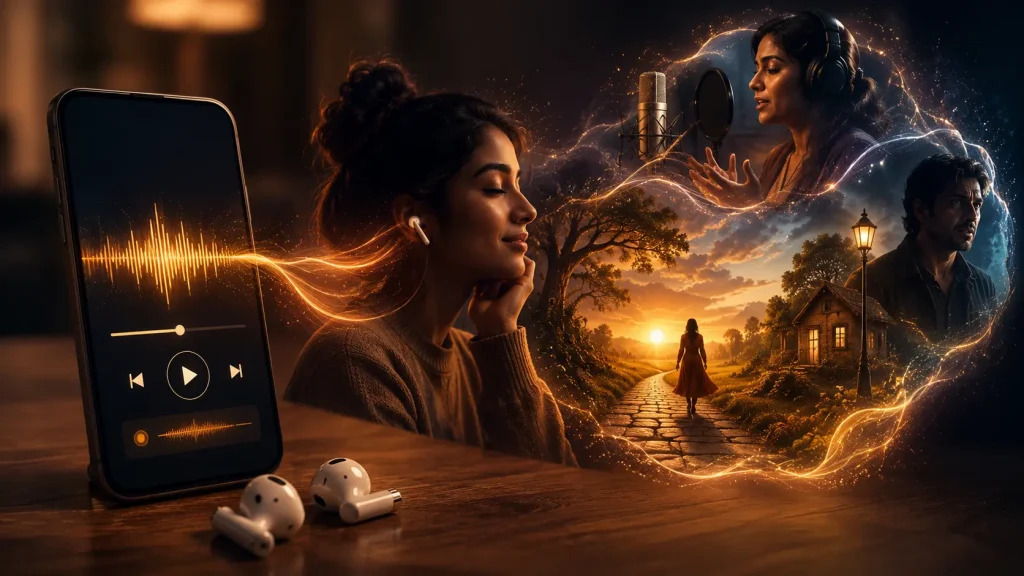
Short audio stories are compact, voice-led narratives designed to deliver a complete storytelling experience in a relatively short listening window. They can include fiction, personal experiences, romance, comedy, horror, folklore, real-life moments, or serialized narratives. Unlike a random audio clip, a short audio story usually has a clear idea, progression, and emotional or narrative payoff that gives the listener a sense of completion.
The format sits between traditional oral storytelling and modern digital audio. Instead of requiring the time commitment of an audiobook or a long podcast episode, short audio stories allow listeners to experience a meaningful narrative while commuting, walking, taking a break, or simply stepping away from a screen.
What Makes an Audio Story “Short”?
There is no universally accepted duration that defines a short audio story. What matters more is how efficiently the story uses time.
A short audio story usually focuses on one central moment, idea, character, conflict, emotion, or experience rather than building a large narrative world over several hours.
Some stories may last only 30 seconds. Others may run for several minutes or even 20 minutes while still feeling short compared with a full podcast episode or audiobook chapter.
The defining qualities are usually:
- A focused narrative idea
- Limited characters or story threads
- Fast entry into the story
- Concise pacing
- A clear emotional or narrative payoff
Short Audio Story vs a Short Audio Clip
A short audio clip is not automatically a short audio story.
An audio clip might contain a joke, quote, opinion, reaction, soundbite, or isolated conversation. A short audio story, however, normally creates some form of narrative movement.
For example, someone saying, “I missed my train this morning,” is simply a statement. If the speaker explains why they missed it, what happened next, and how that unexpected moment changed their day, the audio begins to function as a story.
That difference is important: duration makes the audio short, but narrative structure makes it a story.
How Long Is a Short Audio Story?
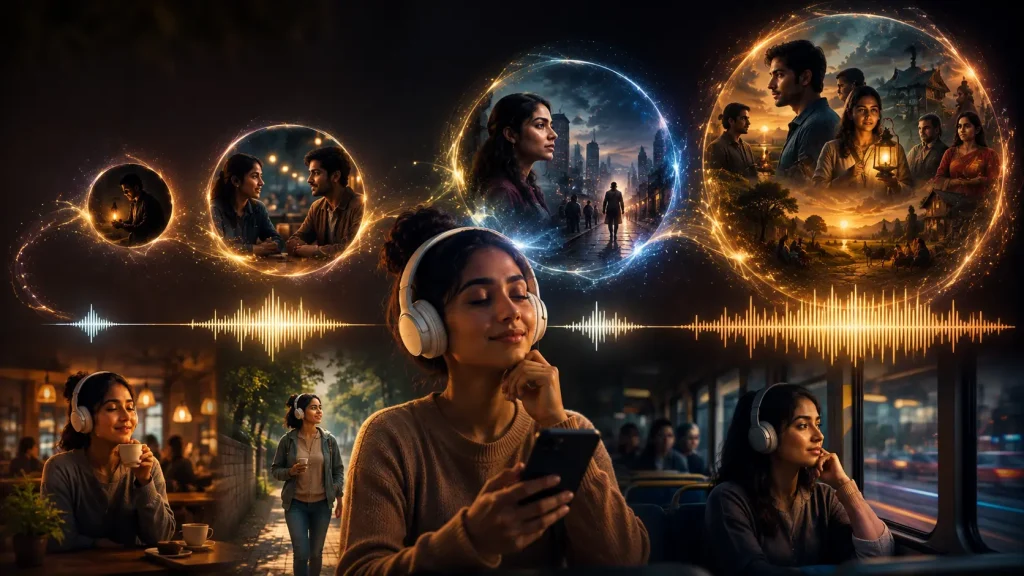
A short audio story can range from less than a minute to roughly 20–25 minutes, depending on the storytelling style, platform, audience, and level of narrative detail.
There is no single industry-standard duration. A 30-second piece of micro-fiction and a 15-minute narrated story can both belong to the broader short-form audio category if they are intentionally designed as compact listening experiences.
30-Second Micro-Stories
At the shortest end of the format are stories that last around 30 seconds.
These stories usually focus on one moment: a surprising encounter, a single memory, an emotional confession, a joke with a payoff, or a very small fictional twist.
Because the listening window is so short, every sentence matters. The opening needs to establish interest almost immediately, and the story often moves directly toward one emotional beat or conclusion.
This format is particularly suited to mobile-first and creator-led audio, where listeners can quickly discover multiple voices and stories.
1–5 Minute Audio Stories
One to five minutes gives a creator more room to establish a character, situation, or mood without demanding much time from the listener.
This range can work well for:
- Micro-fiction
- Personal experiences
- Short horror stories
- Comedy
- Folklore retellings
- Reflective storytelling
It is long enough to build anticipation while remaining easy to fit into a short break or commute.
5–10 Minute Stories
Five to ten minutes allows for more developed storytelling.
A creator can introduce multiple scenes, build suspense, explore a personal experience in greater detail, or create a stronger emotional arc. The format is still relatively compact but begins to feel closer to a traditional short story told through voice.
10–25 Minute Short-Form Narratives
Longer short audio stories may run for 10 to 25 minutes, particularly when they involve detailed narration, multiple characters, atmospheric sound design, or a more complex plot.
At this length, the distinction between a short audio story, a podcast episode, and an audio drama can start to overlap. The difference often depends less on runtime and more on the structure and purpose of the content.
When Does Short Audio Become Long-Form?
There is no precise point at which short-form audio becomes long-form.
Instead, listeners usually experience the difference through commitment. A self-contained eight-minute story feels very different from an hour-long narrative episode that requires sustained attention.
Short audio storytelling is therefore best understood as a design approach rather than a strict time limit: the story is intentionally created to deliver meaningful narrative value within a limited listening window.
Why Short Audio Stories Are Becoming a Distinct Storytelling Format
Short audio stories are increasingly being designed as their own format rather than simply shortened versions of podcasts or audiobooks.
The reason is simple: listening behaviour is changing. People increasingly consume media while travelling, exercising, doing household tasks, waiting between activities, or taking short breaks. Audio can fit into these moments without requiring constant visual attention.
Short-form storytelling adapts naturally to this behaviour.
Designed for Shorter Listening Windows
A good short audio story does not need an hour to establish its point.
The creator can begin directly with a character, situation, question, emotion, or conflict and build the narrative around one clear idea.
This makes short audio particularly useful for listeners who want entertainment but may not have time to begin a long audiobook or commit to a lengthy podcast episode.
Voice Adds Emotion That Text Cannot Fully Reproduce
Voice carries information beyond the words being spoken.
Tone, hesitation, rhythm, accent, silence, laughter, breath, and emphasis can all influence how a listener understands a story.
A written sentence describing nervousness and a voice actually trembling while telling the story can create very different experiences.
This is one reason short audio can feel personal even when the story itself is simple.
Screen-Free Storytelling
Short audio stories can also provide entertainment without requiring continuous screen attention.
Listeners can hear a story while walking, commuting, cooking, resting, or preparing to sleep. The imagination supplies much of the visual world.
That brings digital storytelling closer to the much older tradition of people experiencing stories through spoken voices.
Standalone and Episodic Stories Can Coexist
Short-form audio does not have to follow one publishing model.
Some stories are completely standalone: a listener can hear one piece and leave with a complete experience.
Others can be connected into a series, playlist, recurring character journey, or episodic narrative.
This flexibility makes the format useful both for casual listeners and for creators who want to build an audience around continuing stories.
Types of Short Audio Stories
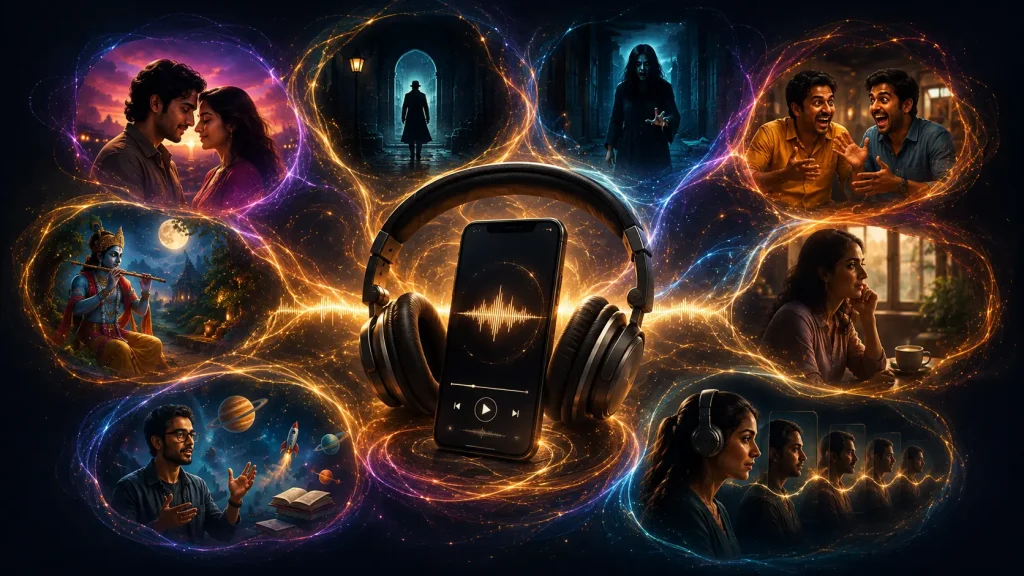
Short audio storytelling is a format rather than a single genre. Almost any narrative style can be adapted into a shorter listening experience.
Micro-Fiction
Micro-fiction compresses an entire fictional idea into a very short narrative.
A creator may build the story around one encounter, twist, decision, or emotional revelation. In audio, narration and vocal performance can give even a few sentences a strong sense of atmosphere.
Personal Stories
Personal stories are based on lived experiences, memories, observations, relationships, or everyday moments.
They can be powerful precisely because they do not always require dramatic events. A conversation with a parent, an unusual commute, a childhood memory, or an embarrassing mistake can become compelling when the storyteller provides context and emotion.
Romance
Short romantic stories often focus on one emotionally meaningful moment rather than an entire relationship.
A first meeting, missed opportunity, breakup, confession, reunion, or memory can provide enough narrative tension for a compact story.
Mystery and Thriller
Mystery and thriller work particularly well in short audio because voice, silence, pacing, and sound can create suspense quickly.
A strange phone call, unexplained sound, missing object, hidden secret, or unexpected encounter can become the centre of the narrative.
Comedy
Comedy can range from fictional scenes to observations, awkward experiences, character performances, and humorous personal stories.
Because jokes and comedic situations often depend on timing and delivery, voice can add a layer that may be difficult to reproduce in written text.
Horror
Audio is naturally suited to horror because the listener has to imagine what cannot be seen.
Whispers, pauses, footsteps, environmental sounds, and changes in vocal tone can create tension without elaborate visuals.
Even a very short horror story can work when it leaves the listener imagining what might happen next.
Folklore and Cultural Stories
Folklore, legends, myths, local tales, and cultural memories have long been shared through oral traditions.
Short-form digital audio gives these forms a new distribution channel. A creator can retell an old story, explain the meaning behind a tradition, or reinterpret folklore for a contemporary audience.
This is especially relevant in a multilingual country such as India, where storytelling traditions differ widely across languages and regions.
Real-Life Stories
Real-life stories can include experiences from work, relationships, travel, family, friendships, challenges, or unusual events.
The value often comes from hearing the story in the storyteller’s own voice, where personality and emotion become part of the narrative itself.
Educational Stories
Not every story is purely entertainment.
History, science, language, culture, and social ideas can also be explained through narrative. Instead of presenting information as a list of facts, the creator can structure it around a person, event, problem, or discovery.
Storytelling can make information easier to follow and remember.
Serialized Audio Stories
A short audio story does not always need to end permanently.
Creators can divide a larger narrative into compact episodes, with each part delivering its own moment while contributing to a wider storyline.
Serialized storytelling combines the accessibility of short-form listening with the anticipation of an ongoing narrative, giving listeners a reason to return for the next part.
Short Audio Stories vs Podcasts vs Audiobooks vs Audio Dramas
Short audio stories sit within the broader audio entertainment landscape, but they are not simply shorter podcasts or miniature audiobooks. The main difference is how the content is structured and experienced.
| Format | Typical Length | Main Structure | Production Style | Best For |
| Short audio stories | Seconds to around 25 minutes | Compact narrative with a clear story movement | Voice-led, from simple narration to light sound design | Quick, story-focused listening |
| Podcasts | Often 20 minutes to an hour or more | Conversation, commentary, interviews, education or episodic storytelling | Usually host-led or conversational | Listeners who want discussion, information or recurring shows |
| Audiobooks | Often several hours | Full-length books or long-form written works narrated aloud | Professional narration, sometimes multiple voices | Deep, sustained listening |
| Audio dramas | Varies widely | Scripted dramatic narrative performed by characters | Multiple actors, sound design, music and cinematic production | Immersive fictional storytelling |
These categories can overlap. A podcast can contain short stories, an audiobook can include a collection of short fiction, and an audio drama can release brief episodes. The distinction comes from the content’s primary format and storytelling intention, not just its duration.
Narrative Structure
Short audio stories generally try to create a recognizable narrative arc quickly. They may introduce a situation, develop it and reach a meaningful ending within a few minutes.
Podcasts are broader. Some tell stories, but many are built around conversations, interviews, commentary or recurring topics rather than a self-contained narrative.
Audiobooks normally preserve the structure of a written book, while audio dramas are closer to theatre or scripted screen entertainment created specifically for listening.
Production Style
Short audio storytelling can be relatively simple. A strong voice and a compelling story may be enough.
Music, ambient sound and effects can enhance the experience, but elaborate production is not mandatory.
Audio dramas usually depend more heavily on performance and sound design. Podcasts often rely on host chemistry or conversation, while audiobooks typically prioritize clear, consistent narration over frequent sound effects.
Episodic vs Standalone Listening
A major strength of short audio stories is that they can work both ways.
A listener might hear one complete personal story in a few minutes, or discover a serialized narrative divided into multiple short episodes.
Podcasts are often episodic by nature. Audiobooks usually require more continuity, while audio dramas may be either standalone or serialized.
Which Format Fits Which Listener?
Choose a short audio story when you want a focused narrative without a large time commitment.
Choose a podcast when you want conversations, opinions, interviews or ongoing discussion.
Choose an audiobook when you want to spend substantial time with a book-length work.
Choose an audio drama when you want an immersive, performed story with multiple characters and richer sound production.
The formats are not competitors in every situation. They satisfy different listening moods and different amounts of available time.
What Makes a Good Short Audio Story?
A short runtime does not make storytelling easier. In many cases, it makes every creative decision more important.
A good short audio story usually gives listeners a reason to continue within the opening moments, develops one focused narrative idea and reaches a satisfying emotional or narrative payoff without unnecessary detours.
Start With a Strong Opening
Short stories have little time for a long introduction.
An effective opening might begin with an unexpected situation, a question, a striking observation, a line of dialogue or a moment already in motion.
Instead of spending a minute explaining the background, the storyteller can place the listener directly inside the experience.
Focus on One Clear Idea or Conflict
Trying to fit several characters, themes and plotlines into a short piece can make the story feel rushed.
A stronger approach is often to build around one central question:
What happened?
What changed?
What does the character want?
What makes this moment worth hearing?
A narrow focus gives the story space to feel complete even when the runtime is brief.
Let the Voice Carry the Story
Narration is not only about pronunciation.
Tone, pace, pauses, emphasis and emotion affect how the listener experiences every sentence. A storyteller who sounds natural and connected to the material can make a simple experience feel compelling.
Short audio also allows individual speaking styles, accents and regional voices to become part of the storytelling identity rather than something that needs to be removed.
Control the Pacing
Good pacing does not necessarily mean speaking quickly.
A suspense story may need silence. A comedy story may depend on a carefully timed pause. An emotional story may need a moment to breathe before the final line.
The goal is to remove material that does not advance the experience while preserving the moments that give the story personality.
Use Sound and Music With Purpose
Music and effects can establish atmosphere quickly, but they should support the story rather than compete with it.
A distant train, rainfall, street ambience or subtle musical cue may establish a setting more efficiently than several lines of explanation.
But not every short audio story needs production effects. Sometimes a clear human voice is the strongest choice.
Deliver an Emotional Payoff
Listeners should feel that something happened.
The payoff might be a laugh, surprise, realization, frightening reveal, emotional connection or new perspective.
It does not need to be dramatic. Even a small personal story can feel satisfying if the ending gives meaning to what came before.
Make the Ending Feel Intentional
Short does not have to mean unfinished.
An effective ending might resolve the central conflict, reveal a twist, return to the opening idea or deliberately leave the listener with a question.
What matters is that the story feels intentionally concluded rather than simply cut off.
When Are Short Audio Stories Most Useful?
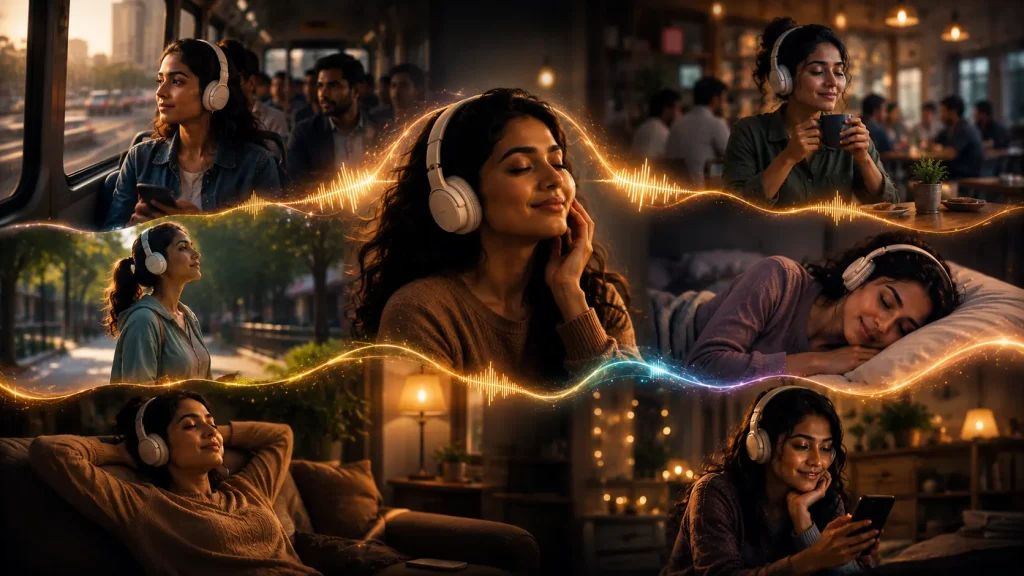
Short audio stories work particularly well in the small windows of time that are often difficult to fill with longer entertainment.
Because they can be experienced without continuously looking at a screen, they can fit naturally into everyday routines.
During Commutes
A short bus, train, metro or cab journey can be enough time to hear one or several stories.
Unlike long-form audio, listeners do not necessarily need to remember where they stopped or return later to finish an episode.
During Short Breaks
A few minutes between meetings, classes or daily tasks can become a listening window.
A complete short story provides a quick change of attention without requiring the commitment of beginning a film, long podcast or audiobook chapter.
While Walking
Walking and audio naturally work together because the listener can remain visually aware of the surroundings while following a narrative.
Stories with strong narration can turn an ordinary walk into a more immersive experience without requiring the listener to hold a screen.
Before Bed
Short audio can also suit listeners who want entertainment before sleeping without continuing to scroll through a phone.
A calm personal story, piece of fiction or folklore can provide a contained listening experience that ends naturally after a few minutes.
For Screen-Free Entertainment
Many digital entertainment formats demand visual attention.
Audio offers a different relationship with media. The listener can close their eyes, move around or complete another simple activity while imagining the people and places being described.
This makes short stories useful when someone wants entertainment without adding more screen time.
For Discovering New Creators
Short-form audio lowers the commitment required to try someone unfamiliar.
A listener may be more willing to spend one or two minutes with a new storyteller than begin an hour-long program from a creator they have never heard before.
If the story connects, the listener can then explore more work from that creator.
For Language Listening
Short stories can also be useful for people listening in a language they are learning or trying to understand better.
Because the pieces are compact, listeners can replay them, focus on pronunciation and hear words used within an actual narrative context.
In multilingual environments, this can also help people discover stories outside the language they use most often.
Short Audio Stories in India
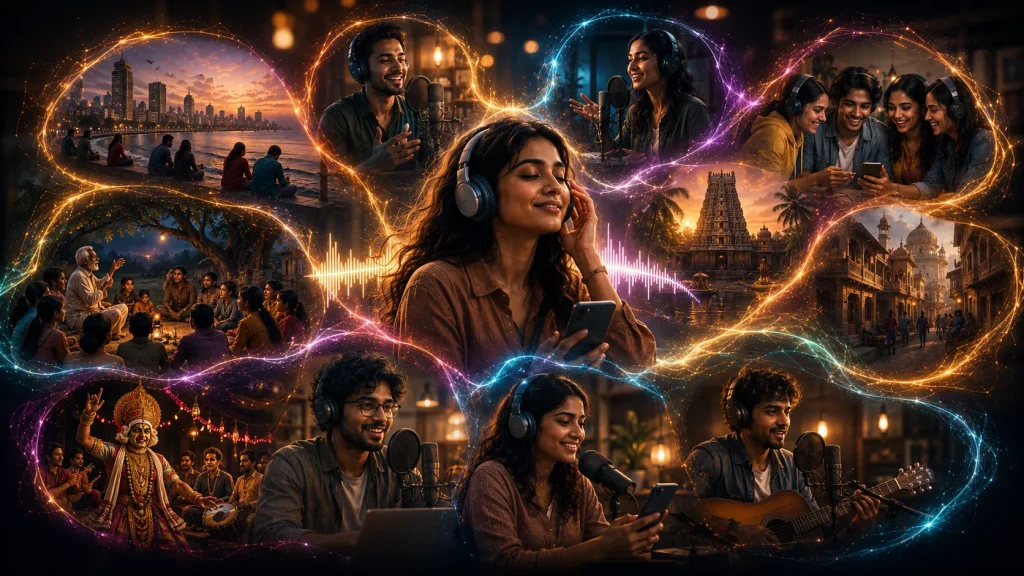
India offers an unusually rich environment for short audio storytelling because storytelling has always existed across many languages, regions and oral traditions.
Digital audio does not replace those traditions. It gives creators new ways to record, reinterpret and distribute them.
A Multilingual Storytelling Environment
There is no single Indian storytelling voice.
Hindi exists alongside Tamil, Telugu, Bengali, Marathi, Malayalam, Kannada, Punjabi, Gujarati and many other languages and dialects, each with its own humour, expressions, cultural references and storytelling traditions.
Audio gives these differences particular importance because listeners do not only hear the meaning of the words. They hear how the story is spoken.
Accent, rhythm, pronunciation and local expressions can become part of the experience.
Hindi and Regional-Language Audio
For digital creators, audio provides an opportunity to create in the language in which a story feels most natural.
A personal experience told in Marathi, a fictional scene in Hindi or a piece of folklore narrated in Tamil can preserve cultural context that may be weakened when everything is translated into one dominant language.
This also creates opportunities for listeners to discover creators based on language, region and storytelling style rather than only broad entertainment categories.
Oral Traditions Meet Digital Audio
Long before smartphones, Indian stories travelled through spoken performance.
Families shared stories across generations. Folk performers carried legends and local histories. Religious, mythological and cultural narratives were repeatedly adapted through oral retelling.
Short digital audio continues part of that behaviour in a new environment.
The storyteller may now be recording into a phone instead of speaking to a physical gathering, but voice still carries personality, memory and interpretation from one person to another.
Micro-Fiction and Creator-Led Storytelling
Digital platforms also allow new forms to emerge alongside traditional storytelling.
Creators can turn everyday observations into 30-second narratives, build fictional characters across several short episodes, record personal memories, reinterpret folklore or experiment with comedy and suspense.
Unlike professionally produced radio or long-form audio, the barrier between storyteller and listener can be much smaller. A creator does not necessarily need a studio or a large production team to begin.
Why Regional Voices Matter
Regional storytelling contributes more than language variety.
It brings local settings, humour, social experiences, idioms, memories and perspectives into the wider digital storytelling ecosystem.
For listeners, this can create something difficult to achieve through generic global content: recognition.
Hearing a familiar phrase, cultural reference, place or style of speaking can make a short story feel immediately personal.
At the same time, digital distribution allows those same stories to travel beyond their original region, helping listeners encounter voices and traditions they may not otherwise discover.
That combination of local identity and digital reach makes India particularly suited to the evolution of short-form audio storytelling.
Where Can You Listen to Short Audio Stories?
Short audio stories can be found across voice-first social platforms, storytelling apps, podcast services and audio libraries. The right platform depends on whether you want professionally produced fiction, independent creator stories, regional-language content, social interaction or very short listening formats.
For short-form listening specifically, it helps to look beyond catalogue size and ask whether the platform makes it easy to discover new stories, creators and genres without committing to long episodes.
What to Look for in a Short-Audio Platform
A useful short-audio platform should make discovery simple.
Look for features such as:
- Recommendations based on interests
- Genre or theme-based discovery
- Multiple language options
- Creator profiles
- Playlists or collections
- Community participation
- Easy movement between related stories
- A listening experience that works well on mobile
For creators, publishing tools matter too. A platform that supports direct recording, simple publishing and audience interaction can make it easier to move from an idea to a finished audio story.
Story, Language and Genre Discovery
Short-form storytelling becomes more useful when listeners can quickly move between different experiences.
Someone may want a Hindi romantic story during one commute, a Tamil cultural story later in the day and a short horror story before bed.
Good discovery systems help users explore by genre, language, creator, theme or listening interest rather than forcing them to search for an exact title every time.
Creator Discovery and Community
Short stories are also an effective way to discover unfamiliar voices.
A listener can sample a creator in less than a minute and then decide whether to explore more of their work.
Platforms with creator profiles, following, comments, collaborative formats or communities can turn that first listen into an ongoing relationship between the storyteller and the audience.
Consider the Listening Experience
Short audio is often consumed while travelling, walking or taking a break, so the listening experience should require as little friction as possible.
Features such as easy playback, continuous discovery, saved collections and convenient mobile listening can become more important than elaborate visual interfaces.
If offline listening is important to you, check the current feature set of the platform or app before choosing it, because download and offline-access options can vary.
Short Audio Stories on Arré Voice
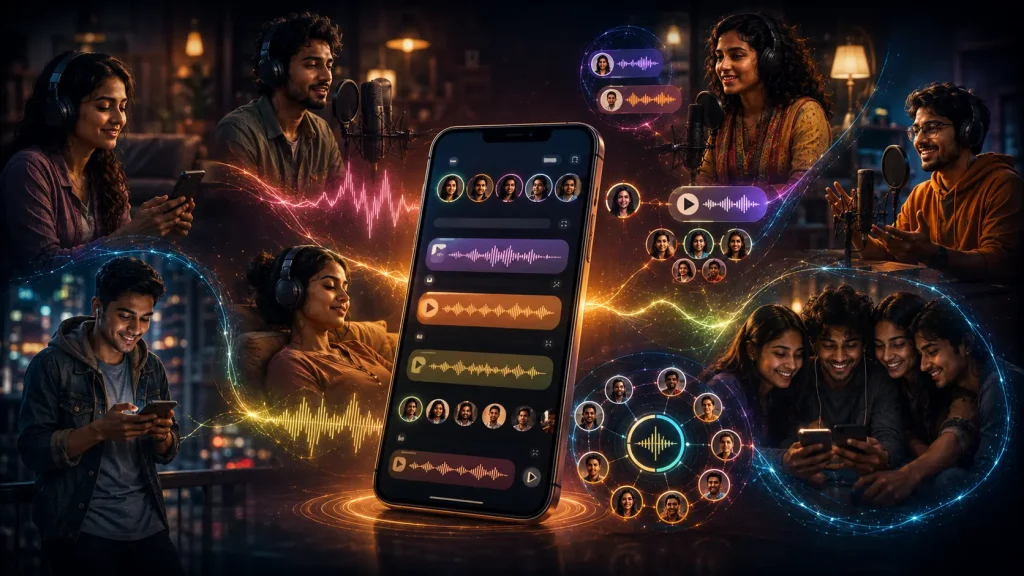
Arré Voice approaches short audio as both a storytelling format and a social experience. Rather than organizing everything around traditional podcast shows, the platform combines short voice creation, discovery, creator profiles, playlists, collaborative conversations and communities.
What Is a Voicepod?
A Voicepod is Arré Voice’s short-form audio format.
Arré describes a Voicepod as a simple 30-second audio clip that can include an optional title and image and can be published for others to hear.
That short duration creates an unusual storytelling constraint.
A creator may have only enough time for:
- One fictional moment
- A personal experience
- A joke or observation
- A short piece of information
- A cultural story fragment
- One episode in a continuing narrative
The format therefore encourages creators to reach the idea quickly rather than building a long introduction.
30-Second Storytelling
Thirty seconds may sound restrictive, but limitations can shape the creative style.
A storyteller has to decide what the listener really needs to hear. There may be room for one hook, one development and one payoff rather than several competing ideas.
Arré’s own description of the format reflects this emphasis on short-form audio, while its current storytelling content also positions Voicepods as suitable for micro-fiction, personal thoughts, jokes and other bite-sized voice content.
Playlists for Connected Stories
Not every story has to remain isolated.
Playlists can group related Voicepods together, allowing listeners to move through stories that share a creator, topic, language or narrative theme. Current public Arré Voice playlist pages are also accessible on the web, creating additional discovery paths beyond an individual audio post.
For serialized storytellers, this can help turn multiple short pieces into a larger listening journey.
Voicepools for Collaborative Conversations and Stories
Voicepools add a participatory layer.
A creator can begin with a prompt and other users can respond with their own short voice contributions. Arré describes public Voicepools as spaces where people can join a prompt with 30-second voice notes, turning one idea into a collection of different perspectives.
That makes the format useful not only for conversations but also for collaborative storytelling.
A prompt could invite people to continue a story, share different endings, contribute memories around one theme or build a story chain. A publicly indexed Arré Voicepool, for example, is specifically titled “A-Z story chain challenge.”
Voiceclubs and Creator Communities
Voiceclubs extend the idea from individual posts to interest-based communities.
Arré currently positions Voiceclubs as spaces where stories and conversations can continue around shared interests, while Voicepools can operate within those communities.
For short-story creators, this matters because discovery does not have to end after one play.
A listener can move from:
Story → Creator → Related stories → Conversation → Community
That journey is one of the differences between social short-form audio and a traditional passive audio library.
Short Audio Stories Worth Listening to on Arré Voice
Because Arré Voice content is creator-led, the catalogue can range from personal stories and fictional series to cultural content, information and community-created narratives.
The following are examples of publicly accessible Voicepods that illustrate different ways creators are using short audio on the platform.
A Parallel Reality of Myself — Introduction Part 1
Creator: Navdeep Kaur
Language: Check the current Voicepod page before publishing
Genre: Mystery / fiction
Listening time: Voicepods are designed as 30-second audio posts.
Why listen: A useful example of how a larger fictional idea can begin as a compact episode and continue across multiple short parts.
Link to voicepod – A Parallel Reality of Myself Introduction
#Wednesday 1
Creator: @amirat._.hasan
Language: Telugu
Genre: Entertainment
Listening time: Voicepod format — approximately 30 seconds
Why listen: A simple example of regional-language creator content built for quick discovery rather than a long-form episode.
Link to voicepod – Wednesday 1
Therijikalam Vangah — Fruits and Its Benefits: Lemon
Creator: c_series_addictz
Language: Tamil
Genre: Health / educational
Listening time: Voicepod format — approximately 30 seconds
Why listen: Shows that short audio does not have to be fictional; information and educational ideas can also be structured as bite-sized voice content.
Link to voicepod – Fruits and Its Benefits: Lemon
Humanity of Jesus — Part 20
Creator: SK_lub
Language: Tamil
Genre: Culture & Heritage
Listening time: Voicepod format — approximately 30 seconds
Why listen: Demonstrates how a creator can use multiple short entries to develop a continuing cultural or thematic series.
Link to voicepod – Humanity of Jesus — Part 20
Editorial note before publishing: These examples were selected from publicly accessible Arré Voice pages. The editorial team should review the live audio before publication and confirm the final language, listening time and suitability of each recommendation. This section will be stronger if Arré replaces or expands these with internally selected Voicepods based on quality, completion, engagement or editorial relevance rather than search visibility alone.
How to Create Your Own Short Audio Story
You do not need a professional studio or a complicated plot to create a short audio story.
The strongest place to begin is with one idea worth hearing.
Pick One Clear Idea
Do not start by trying to fit an entire novel into a minute.
Choose one moment:
- A surprising conversation
- A childhood memory
- A fictional encounter
- A frightening experience
- A joke
- A cultural story
- A small emotional realization
Ask yourself one question:
What should the listener feel or understand when this story ends?
That answer should guide everything you keep or remove.
Hook the Listener Quickly
Short-form audio has very little space for a slow introduction.
Instead of:
“Today I am going to tell you a story that happened to me a few years ago…”
you could begin closer to the moment:
“I knew something was wrong when the phone rang at 2 a.m.”
The second version immediately creates a reason to continue listening.
Build One Narrative Movement
Even a 30-second story needs movement.
A simple structure can be:
Hook → What happened → Why it mattered
For fiction:
Situation → Change or conflict → Payoff
You do not need to explain every detail. Give listeners enough information to understand the moment and let their imagination fill in the rest.
Record Naturally
Short audio often works best when it sounds like a person telling a story rather than reading an essay.
Before recording:
- Read the script aloud
- Remove sentences that sound unnatural
- Slow down where emotion matters
- Leave deliberate pauses
- Pronounce names clearly
- Record somewhere quiet
A natural voice can often create more connection than overly polished narration.
Use Music and Effects Only When They Add Something
Sound can establish a scene quickly.
Rain can suggest weather. Footsteps can create tension. A railway announcement can place the listener at a station without additional explanation.
But effects should not become the story.
If the narration already creates the right emotion, additional music may not be necessary.
Publish, Connect and Continue
Once the story is published, think about what the listener should discover next.
A standalone story might connect to another story from the same creator.
A serialized story might lead to the next episode.
A cultural story might lead to related stories in the same language.
On a voice-first social platform such as Arré Voice, a creator can also connect short audio with playlists, collaborative Voicepools and communities rather than treating every story as an isolated upload.
The most useful publishing journey is therefore not simply:
Record → Upload
It is:
Idea → Story → Publish → Discover → Connect → Create again
What Arré Voice Is Learning About Short-Form Audio
Short-form audio on Arré Voice shows how storytelling can move beyond the conventional podcast model. Voicepods, playlists, Voicepools and Voiceclubs allow individual pieces of audio to become part of a wider network of creators, stories and conversations.
There is also an important limitation to acknowledge: Arré has not provided platform-level data for this article that would support claims such as the most-listened-to genre, highest-performing language or average completion rate. Those findings should only be published when they can be supported by verified first-party data.
What can be observed from the platform is how creators are experimenting with the format.
Languages and Regional Voices
Short-form audio creates room for creators to speak in the languages they naturally use rather than adapting every idea for a single audience.
Publicly available Arré Voice content includes regional-language creation alongside English and Hindi, demonstrating how one voice-first platform can accommodate different linguistic communities.
For Arré, this makes language more than a content filter. A creator’s accent, vocabulary, expressions and speaking style can become part of the identity of the story itself.
Different Stories Fit the Same Short Format
The same short-form structure can support very different kinds of content.
Creators can use compact audio for fiction, personal experiences, humour, cultural storytelling, educational ideas, opinions and continuing series. A short duration does not determine the genre; it determines how efficiently the creator needs to communicate the idea.
That flexibility is important because it allows short audio to develop as a format, rather than becoming associated with only one type of story.
Short Stories Can Become Connected Experiences
A single Voicepod can stand alone, but Arré’s wider structure allows short pieces to connect through playlists, creators, Voicepools and Voiceclubs.
This suggests a different model from traditional long-form audio:
one short story can become an entry point rather than the end of the listening journey.
A listener might discover a Voicepod, explore the creator, move into related stories and eventually participate in a conversation or community around the same interest.
Creator Participation Changes the Format
Short-form audio lowers the amount of production required to experiment with storytelling.
Creators can test an idea without first producing a long episode. A personal observation can become one Voicepod. A larger fictional idea can become several connected parts. A prompt can become a collaborative Voicepool involving multiple voices.
This makes short-form audio particularly suited to experimentation and creator-led storytelling.
What Arré Should Measure Next
As the format develops, first-party platform data can make this section considerably more valuable.
Useful questions include:
- Which story genres generate the strongest completion?
- Which languages are growing fastest?
- Do listeners move from one Voicepod to another from the same creator?
- Which story lengths generate repeat listening?
- How often do standalone Voicepods lead to creator-profile discovery?
- Which stories generate responses or community participation?
- Do serialized stories encourage listeners to return?
- Which themes perform differently across languages?
Publishing aggregated insights from this data in future updates would give Arré something generic articles cannot easily reproduce: first-party knowledge about how people actually create and consume short-form voice content.
The Future of Short Audio Storytelling
The future of short audio storytelling is unlikely to depend on making podcasts progressively shorter. Its larger opportunity lies in building storytelling experiences specifically around voice, mobile behaviour, language, creators and participation.
More Stories Will Begin With Individual Creators
The tools required to publish audio are becoming increasingly accessible.
A creator with a smartphone can record a personal experience, perform micro-fiction, narrate folklore or experiment with a recurring character without needing the production infrastructure traditionally associated with radio or professional audio.
That accessibility can bring more individual voices into digital storytelling.
Multilingual Audio Can Expand Story Discovery
Audio has a particular advantage in multilingual markets because spoken language carries qualities that translation cannot fully preserve.
Pronunciation, accent, rhythm, humour and local expressions contribute to the identity of a story.
In India, this creates room for short-form storytelling across Hindi and regional languages while allowing listeners to encounter voices outside their immediate linguistic or geographic communities.
Audiences Can Become Participants
Traditional audio is usually one-directional: a creator publishes and an audience listens.
Social audio can make that relationship more participatory.
Listeners can respond to prompts, contribute their own perspectives, continue stories, join communities and move from consuming audio to creating it.
That means the future of an audio story may not always be decided entirely by its original creator.
Social Audio Can Make Stories More Connected
Short stories are naturally shareable and discoverable, but community features can give them a longer life.
One story might inspire a response. That response might produce another perspective. Several contributions might develop into an ongoing discussion or collaborative narrative.
In this model, the value is not only in the individual audio file. It is also in the network of people and stories that forms around it.
AI Can Assist Creation Without Replacing the Creator’s Voice
AI will increasingly influence audio creation, from brainstorming and script development to editing, translation, transcription and sound production.
Its most interesting role may be as an assistive tool rather than a replacement for human storytelling.
A creator could use AI to organize an idea, improve a draft, remove background noise or explore translations while keeping the actual narration, perspective and emotional performance human.
As synthetic audio becomes easier to produce, an identifiable human perspective may become even more valuable. The technology can help make a story; the creator still gives people a reason to care about it.
Frequently Asked Questions
What is a short audio story?
A short audio story is a compact narrative told primarily through voice and sound. It usually focuses on one idea, experience, character or conflict and delivers a meaningful narrative or emotional payoff within a relatively short listening window.
How long is a short audio story?
There is no fixed length. Short audio stories can range from around 30 seconds for micro-stories to 20–25 minutes for more developed narratives. The defining characteristic is a focused, intentionally compact storytelling experience rather than a specific runtime.
Are short audio stories the same as podcasts?
No. A short audio story is primarily a narrative format, while podcasts can include interviews, discussions, commentary, education, news and storytelling. A podcast can contain short audio stories, but not every podcast episode is an audio story.
What is the difference between an audio story and an audiobook?
An audio story is a narrative created or presented for listening and can be very short or standalone. An audiobook is typically an audio narration of a published book or longer written work and may require several hours to complete.
Where can I listen to short audio stories?
You can find short audio stories on voice-first social platforms, storytelling apps, podcast platforms and digital audio libraries. Look for platforms that support easy discovery by genre, language and creator. Arré Voice also offers short creator-led audio through Voicepods and connected social formats.
Can I listen to short audio stories for free?
Yes, free short audio stories are available on a variety of websites and apps, although access models differ between platforms. Some services are free, while others may offer subscriptions, paid content or a combination of free and premium listening.
Are there Hindi short audio stories?
Yes. Short audio stories are created in Hindi as well as many other Indian languages. Regional-language audio can include fiction, personal stories, comedy, folklore, cultural storytelling and educational content.
What types of short audio stories are popular?
Common formats include micro-fiction, romance, mystery, thriller, horror, comedy, personal experiences, real-life stories, folklore, cultural stories, educational narratives and serialized fiction. Popularity can vary considerably by platform, audience and language.
Can anyone create a short audio story?
Yes. A short audio story can be created with something as simple as an idea, a quiet recording environment and a smartphone or microphone. Professional sound production can enhance certain stories, but strong storytelling and natural narration are more important than expensive equipment.
How do you make a 30-second audio story?
Start with one idea or moment, open with a line that immediately creates interest, develop one simple narrative movement and finish with a clear payoff. Read the story aloud before recording and remove anything that does not contribute to the central idea.
Are short audio stories good for commuting?
Yes. Their compact length makes short audio stories well suited to commutes because listeners can often complete one or several stories during a journey without committing to a long podcast episode or audiobook chapter.
What is micro-fiction in audio?
Audio micro-fiction is an extremely short fictional story created for listening. It may last from a few seconds to several minutes and usually concentrates on one scene, character, conflict or twist. Voice, pacing, silence and sound can help create atmosphere despite the limited runtime.


[…] additional creative approaches, explore short audio stories and how concise narratives can communicate meaningful […]